A steel plant operating at 54% OEE — not unusual for facilities without a structured maintenance programme — is using just over half its available production capacity. The remaining 46% is consumed by unplanned breakdowns, speed losses, quality defects, and minor stoppages that individually seem insignificant and collectively define the difference between a profitable operation and a facility that perpetually misses production targets. Total Productive Maintenance is the systematic framework that closes this gap — not through a maintenance department initiative, but through a company-wide approach that puts operators at the centre of equipment reliability. Sign in to OxMaint to build your TPM programme with operator AM checklists, CMMS-tracked planned maintenance, and real-time OEE dashboards — or book a demo to see TPM implementation configured for your steel plant's equipment hierarchy.
Implementation Guide · World-Class Manufacturing 2026
Total Productive Maintenance (TPM) Implementation in Steel Plants: The 8-Pillar Approach
From 5S foundation and autonomous maintenance through focused improvement and quality maintenance — the structured TPM roadmap that takes a steel plant from reactive firefighting to world-class OEE.
OEE Benchmarks — Where Is Your Plant?
OEE = Availability × Performance × Quality
The Foundation
5S — The Prerequisite for Every TPM Pillar
TPM cannot be built on a disorganised workplace. 5S is not a housekeeping programme — it is the operational discipline that makes abnormal conditions visible. In a steel plant, a dirty rolling mill gearbox looks the same as a gearbox leaking gear oil until the floor is clean. Abnormality detection is impossible without a baseline of cleanliness and organisation. Sign in to OxMaint to create 5S audit checklists per area with photographic evidence tracking.
Seiri — Sort
Remove everything not needed for current production. Tag unneeded items. Eliminates clutter that hides defects and creates hazards.
Seiton — Set in Order
A place for everything, everything in its place. Tools at point of use. Spare parts clearly labelled. Lost time searching for tools drops to zero.
Seiso — Shine
Clean the equipment and workspace — and keep it that way. Cleaning reveals leaks, cracks, and wear that would otherwise be invisible until breakdown.
Seiketsu — Standardise
Document the standard for cleanliness and organisation. Create visual standards. The first three S's only sustain if standards are defined.
Shitsuke — Sustain
Build 5S into daily habit through audit schedules, management engagement, and CMMS-tracked 5S inspection completion. Without Shitsuke, all four prior S's decay within weeks.
The 8 Pillars
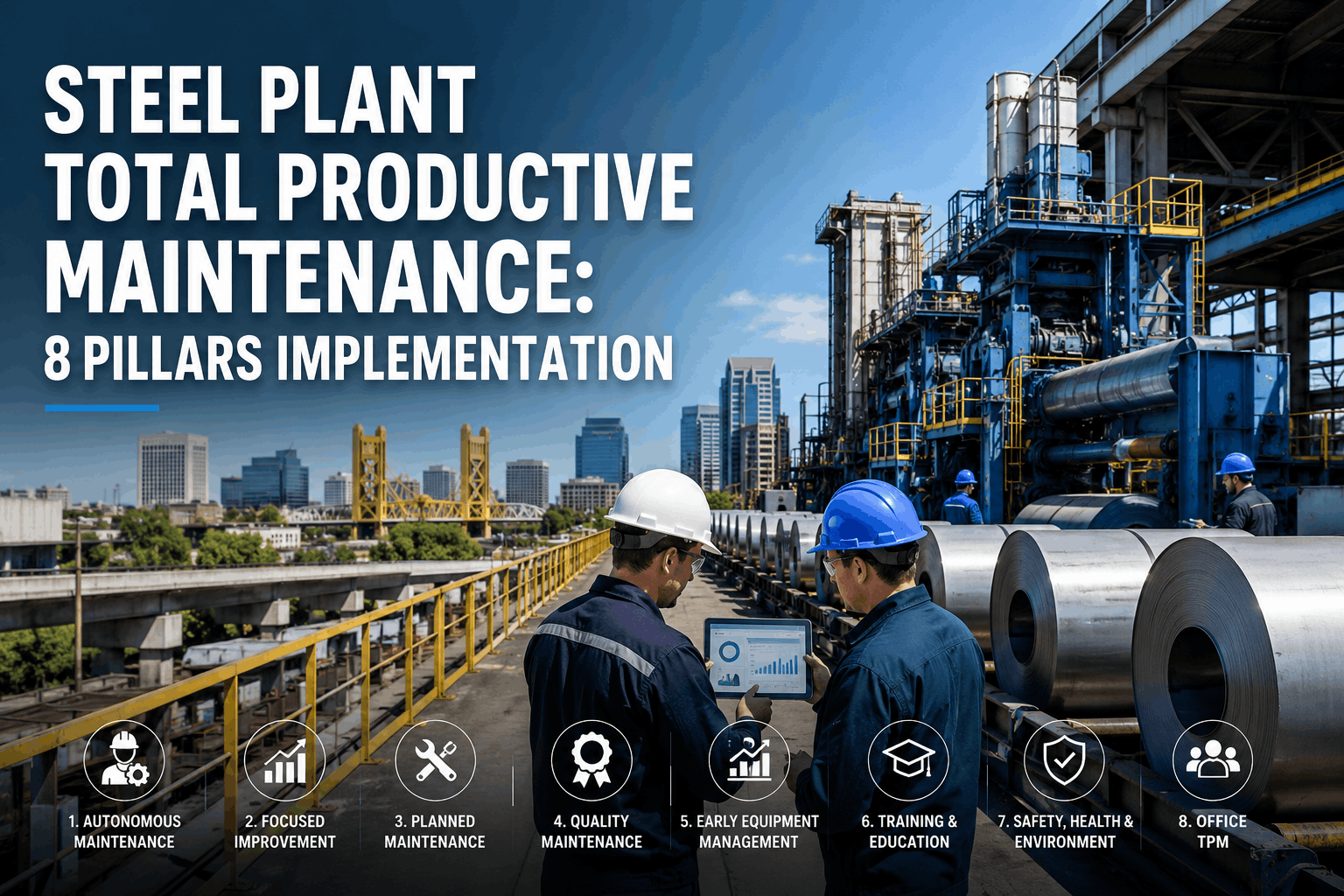
The 8 Pillars of TPM — Steel Plant Context
The eight pillars are interdependent — Autonomous Maintenance requires Training to work; Planned Maintenance enables Quality Maintenance; Focused Improvement feeds data back into all other pillars. Implement them in sequence, starting with Pillars 1 and 3, before expanding to the remaining six. Book a demo to see OxMaint's TPM module configured for steel plant equipment hierarchies.
01
Autonomous Maintenance (Jishu Hozen)
Operators take ownership of their equipment — cleaning, lubricating, inspecting, and tightening as daily routines. In a steel plant, AM empowers blast furnace operators, rolling mill attendants, and continuous caster operators to detect abnormal conditions — oil seeps, loose fasteners, unusual vibration — before they become breakdowns. CMMS-tracked AM checklists with mobile completion drive compliance from 40–60% on paper to 85–95%.
Sign in to create AM checklists per equipment.
OEE Impact: Availability
02
Focused Improvement (Kobetsu Kaizen)
Cross-functional teams systematically eliminate the largest OEE losses using structured problem-solving tools — 5 Whys, Ishikawa diagrams, Pareto analysis. In steel, recurring issues like coke oven door seal failures, blast furnace tuyere deterioration, or rolling mill roll chatter are analysed to root cause rather than repetitively repaired. Each Kaizen event documents the before-state, root cause, countermeasure, and measured improvement.
OEE Impact: All three components
03
Planned Maintenance
Maintenance department-led PM programme scheduled around production windows — converting breakdown maintenance into proactive interventions. In steel, planned maintenance covers blast furnace refractory inspection cycles, hot rolling mill bearing replacements, continuous caster mould oscillation mechanism overhauls, and electrical switchgear thermographic inspections. CMMS automates scheduling, generates work orders before due dates, and tracks completion rates. Target: PM completion >85%.
Sign in to configure planned maintenance schedules.OEE Impact: Availability
04
Quality Maintenance (Hinshitsu Hozen)
Links equipment condition directly to product quality. In steel, surface defects in hot-rolled coil are traced to roll surface condition; thickness variation to AGC system calibration; inclusion defects to ladle refractory wear. Quality Maintenance establishes equipment condition standards that prevent defect generation — rather than detecting defects after production. Maintenance and quality teams share data, cross-referring process quality outcomes to equipment maintenance records.
OEE Impact: Quality
05
Early Equipment Management
Maintenance knowledge from the current equipment fleet is incorporated into the design and commissioning of new equipment — reducing startup time, minimising early-life failures, and building in maintainability from the outset. Steel plant capital projects — new continuous casters, reheat furnace replacements, cold mill upgrades — benefit from maintenance input on lubrication access, sensor placement, and spare parts standardisation before the first weld is made.
OEE Impact: Long-term Availability
06
Training and Education
Autonomous Maintenance only works when operators know what normal equipment condition looks like and can identify abnormal conditions that require maintenance intervention. A structured training programme builds operator competency in cleaning, inspection, and lubrication standards — and builds maintenance technician competency in the advanced diagnostics that AM cannot cover. Training records tracked per person and per competency level in the CMMS.
Book a demo to see training record management in OxMaint.OEE Impact: Enabler for all pillars
07
Safety, Health and Environment (SHE)
TPM creates more opportunities for equipment interaction — which increases the importance of safety protocols. In a steel plant, work on blast furnaces, hot metal transfer equipment, and oxygen systems requires rigorous LOTO procedures, PTW management, and gas detection verification on every maintenance event. The SHE pillar ensures that TPM's increased equipment engagement is matched by zero-compromise safety execution. CMMS captures LOTO records per work order.
OEE Impact: Zero accident = Zero unplanned downtime
08
TPM in Administration
TPM principles applied to administrative functions — production scheduling, spare parts procurement, maintenance planning, and information flow — that support the shop floor. Delays in spare parts procurement create maintenance windows that cannot be executed. Inaccurate production schedules create PM windows that are immediately overridden. Administrative TPM removes these upstream barriers to shop-floor TPM effectiveness.
OEE Impact: Performance (schedule attainment)
Implementation Roadmap
TPM Rollout Sequence — Steel Plant Phase Plan
Launching all eight pillars simultaneously dilutes focus and produces no measurable result in any pillar. The proven sequence starts with the two foundation pillars — Autonomous Maintenance and Planned Maintenance — on a single pilot line before expanding. Sign in to OxMaint to track pilot line TPM metrics from day one.
01
Weeks 1–4
Baseline and Pilot Selection
Select pilot line — typically the plant's highest-loss asset or clearest bottleneck. Measure OEE for four weeks before any TPM activity. This baseline is the proof of value at 90 days. Implement 5S on the pilot line. Begin operator AM training on cleaning, inspection, and lubrication standards for the pilot equipment.
02
Weeks 5–12
Autonomous Maintenance Steps 1–3
Restore pilot equipment to basic condition. Eliminate contamination sources and hard-to-clean areas. Operators begin daily AM checklists — cleaning, lubricating, inspecting — tracked in OxMaint with mandatory completion sign-off. Any abnormality found triggers a maintenance work order automatically. Measure AM compliance rate (target: >85% from week 6).
Sign in to build AM checklists per equipment.
03
Weeks 8–16
Planned Maintenance Programme Launch
Configure CMMS-scheduled PM work orders for pilot line equipment — using OEM recommendations and MTBF data from recent breakdown history as the initial interval baseline. Maintenance technicians freed from reactive breakdown work by AM's early defect detection shift to executing planned PM. Measure PM completion rate. Launch first Kaizen on the highest-frequency breakdown mode identified in baseline data.
Book a demo to see PM scheduling in OxMaint.
04
Months 4–6
OEE Review and Expansion Decision
Compare OEE at month 4 against the pre-TPM baseline. A functional pilot with Pillars 1 and 3 running well should show measurable Availability improvement. The business case for expansion to additional lines is built from this comparison. Begin Pillars 4 (Training) and 7 (SHE) concurrently with pilot line continuation. Plan second line TPM start. Operators at AM Step 3 begin developing visual standards.
"
The most common failure mode in steel plant TPM implementation is not the wrong methodology — it is the wrong sequence. I have seen large integrated steel plants launch all eight pillars simultaneously across the entire facility, produce an impressive training programme, generate mountains of audit paperwork, and show no measurable OEE change twelve months later. The problem is not that the operators or maintenance teams are unwilling. The problem is that without a concentrated pilot, nobody ever sees what good looks like. When you focus everything on one line — a specific rolling mill or caster — and you can walk the plant floor and show people: this is what 5S looks like, this is an operator who knows their machine better than the maintenance technician did six months ago, this is the breakdown rate before and after — the programme becomes self-sustaining. The pilot is the proof. Without the proof, TPM is a training exercise. With the proof, it becomes a culture. In my experience, a focused 90-day pilot with OEE tracked daily in a CMMS produces the visual evidence that turns sceptical operators into programme advocates more effectively than any training session.
OxMaint TPM Support
How OxMaint Powers Your TPM Programme
Pillar 1
Operator AM Checklists
Digital AM checklists per equipment with mandatory sign-off, photo evidence, and automatic work order generation on any abnormality found. Mobile completion drives compliance from paper's 40–60% to digital's 85–95%. Supervisor sees real-time completion status across all equipment.
Sign in to build AM checklists.
Pillar 3
Planned Maintenance Scheduling
PM work orders auto-generated per equipment before due dates. Interval types: calendar, runtime hours, production cycles. PM completion rate tracked as the primary Planned Maintenance KPI. Overdue alerts before intervals lapse.
Book a demo to see PM configuration.
OEE
Real-Time OEE Tracking
OEE calculated from work order and production data — Availability from breakdown and downtime records, Performance from production rate tracking, Quality from defect counts. Dashboard shows current OEE vs. baseline vs. world-class target. The metric that proves TPM is working.
Sign in to activate OEE tracking.
Pillar 2
Kaizen and CAPA Tracking
Focused improvement events tracked as structured work items with problem statement, root cause analysis, countermeasure, owner, and measured outcome. Recurring breakdown patterns surface in MTBF trend data — feeding the Kaizen prioritisation list automatically.
Book a demo to see Kaizen tracking.
Pillar 7
Safety and LOTO Documentation
LOTO records captured per maintenance work order — procedure executed, energy sources isolated, verification method, and technician attribution. PTW management integrated with work order lifecycle. Zero paper LOTO binders. Every record retrievable per equipment and per date.
Sign in to activate LOTO documentation.
Dashboard
TPM Maturity Dashboard
AM completion rate, PM compliance, OEE by line, breakdown frequency, MTBF trend, and active Kaizen count — all visible on one dashboard per plant and per equipment hierarchy. Management sees TPM maturity progression without manual report assembly.
Book a demo to see the TPM dashboard.
World-Class OEE Starts with a 90-Day Pilot. OxMaint Tracks Every Metric from Day One.
AM checklists, planned maintenance scheduling, OEE tracking, Kaizen records, and LOTO documentation — the full TPM operating system for your steel plant, deployed in days. Free trial, no implementation fees.
Common Questions
Steel Plant Teams Ask These About TPM
What OEE should a steel plant target when implementing TPM?
World-class OEE is 85% for discrete manufacturers — in continuous process steel operations, achieving 85% overall OEE is an ambitious but achievable target with a mature TPM programme. Most steel plants without TPM operate at 40–65% OEE. A well-structured 90-day pilot focused on the highest-loss asset typically produces 5–15 OEE percentage point improvement on the pilot line within the first two quarters. The absolute target matters less than the trending direction — OEE must be measured before TPM starts to make the improvement visible.
Sign in to activate OEE tracking in OxMaint from day one of your TPM pilot.
Which TPM pillar should a steel plant implement first?
Autonomous Maintenance (Pillar 1) and Planned Maintenance (Pillar 3) should always be launched first — in that sequence. AM without Planned Maintenance produces a list of abnormalities that operators can detect but maintenance cannot promptly address, creating frustration. Planned Maintenance without AM means the maintenance team is still doing basic cleaning and inspection rather than the advanced PM work they should be doing. Training and Education (Pillar 6) must run concurrently because AM cannot function without operator competency. The remaining five pillars follow in phases as the pilot matures.
Book a demo to see OxMaint's TPM pillar deployment configuration.
How does a CMMS support TPM in a steel plant?
A CMMS is the operational backbone of TPM. It converts AM checklists from paper (40–60% compliance) to digital mobile completion (85–95% compliance) with supervisor visibility. It schedules and tracks Planned Maintenance work orders automatically. It calculates OEE from work order and production data. It captures Kaizen improvement records. It tracks LOTO documentation per maintenance event for the SHE pillar. Without CMMS, TPM metrics are manually compiled and typically 2–4 weeks out of date by the time they reach management review. With CMMS, TPM performance is visible in real time.
Sign in to see OxMaint's TPM module configured for steel plant equipment hierarchies.