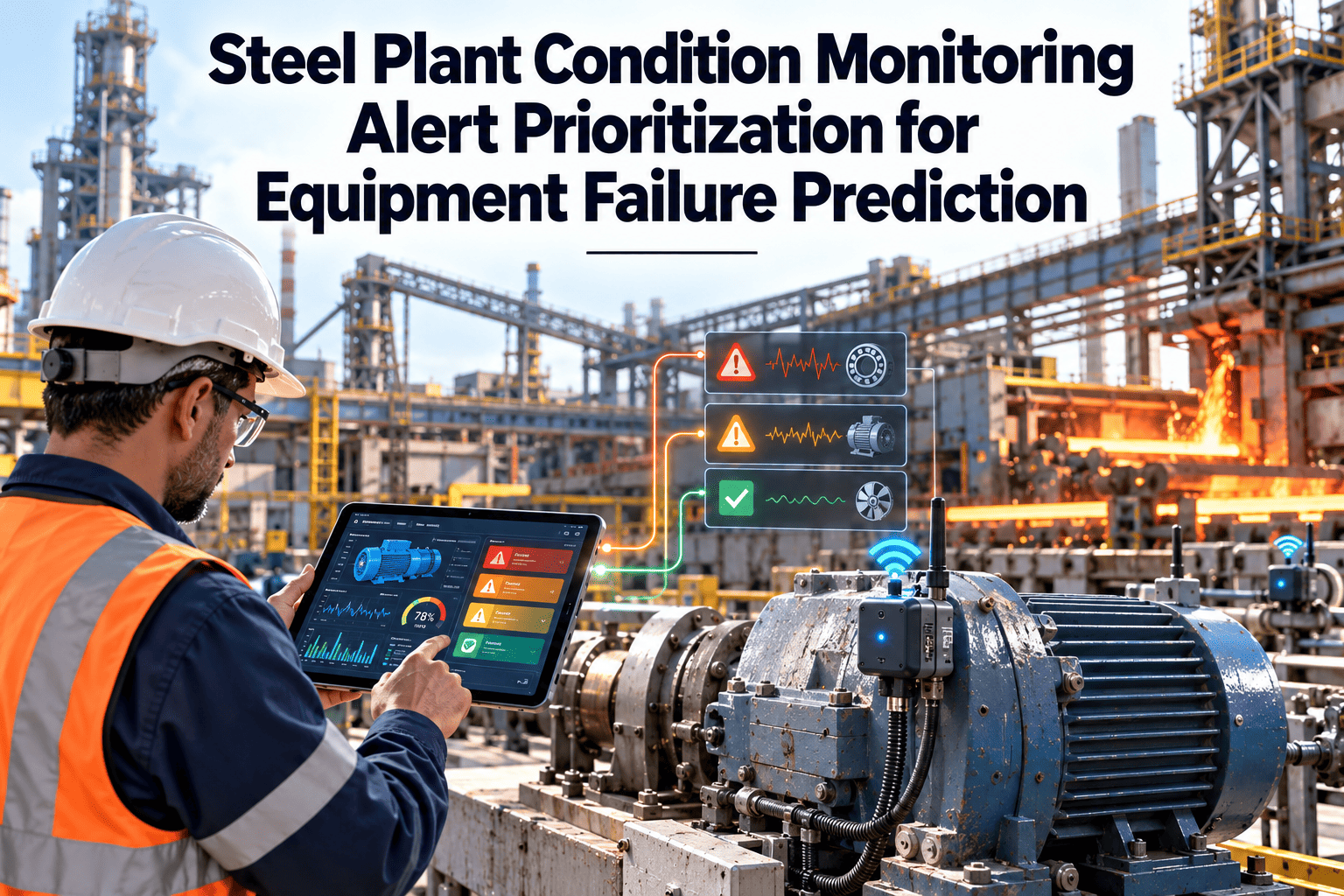
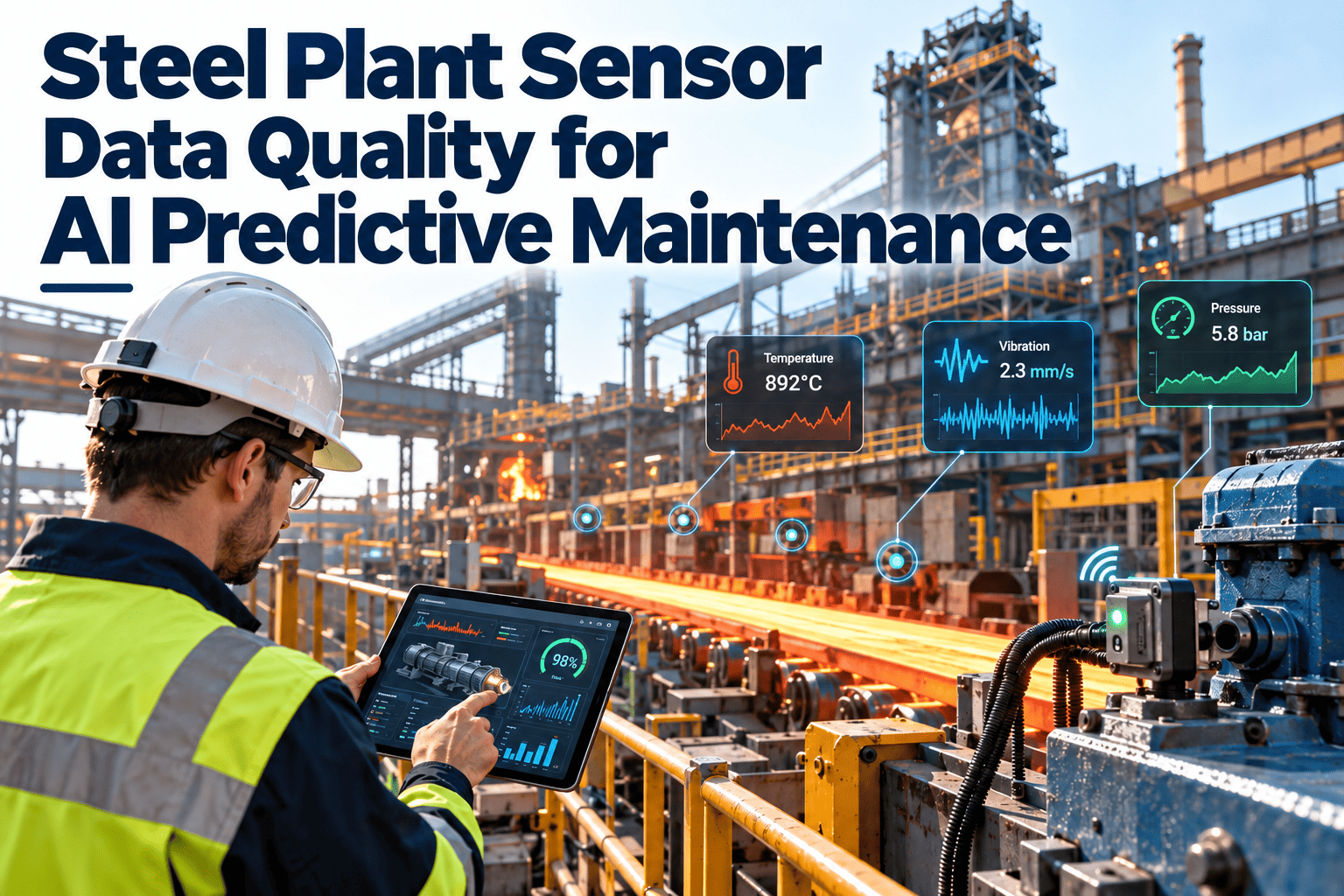
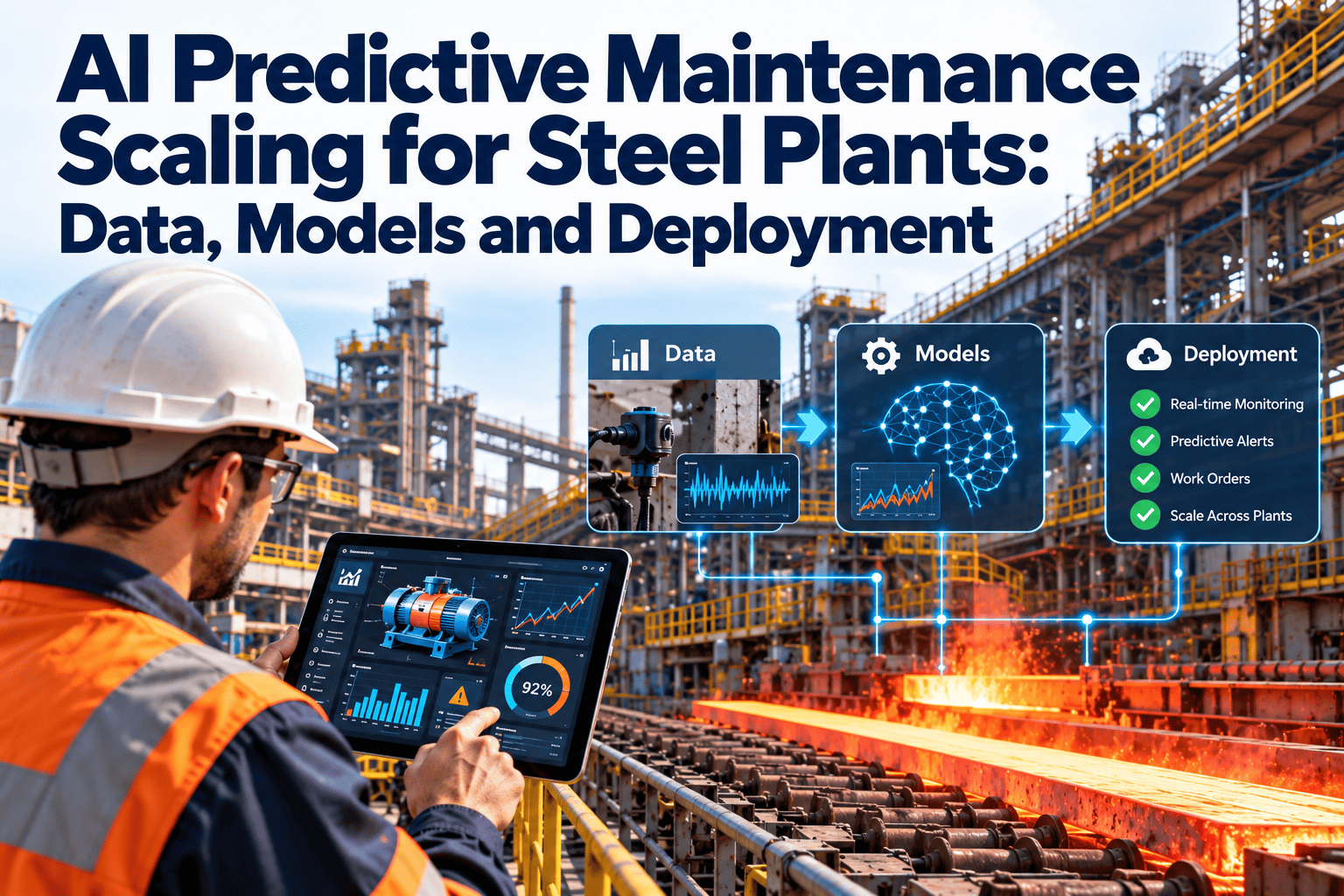
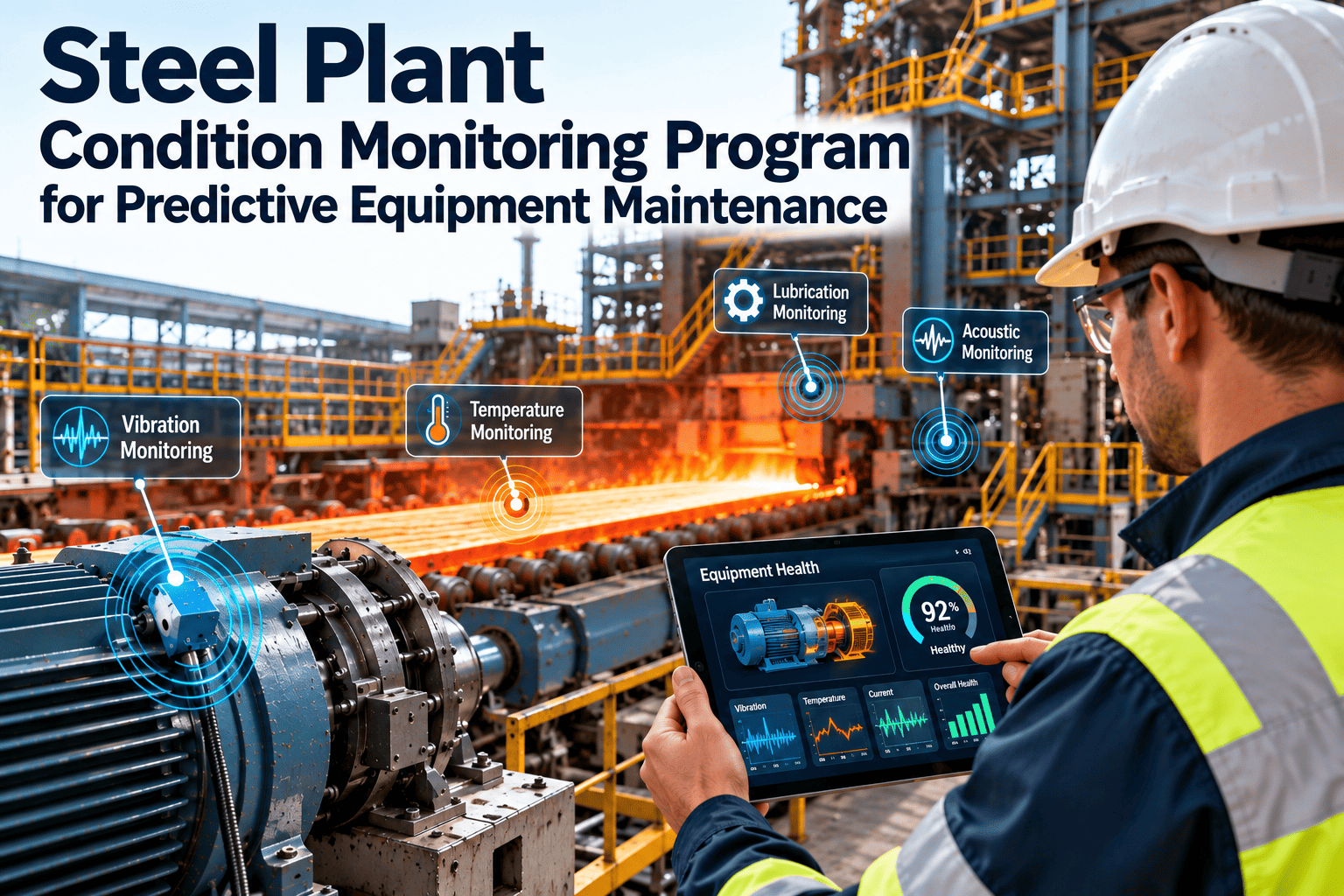
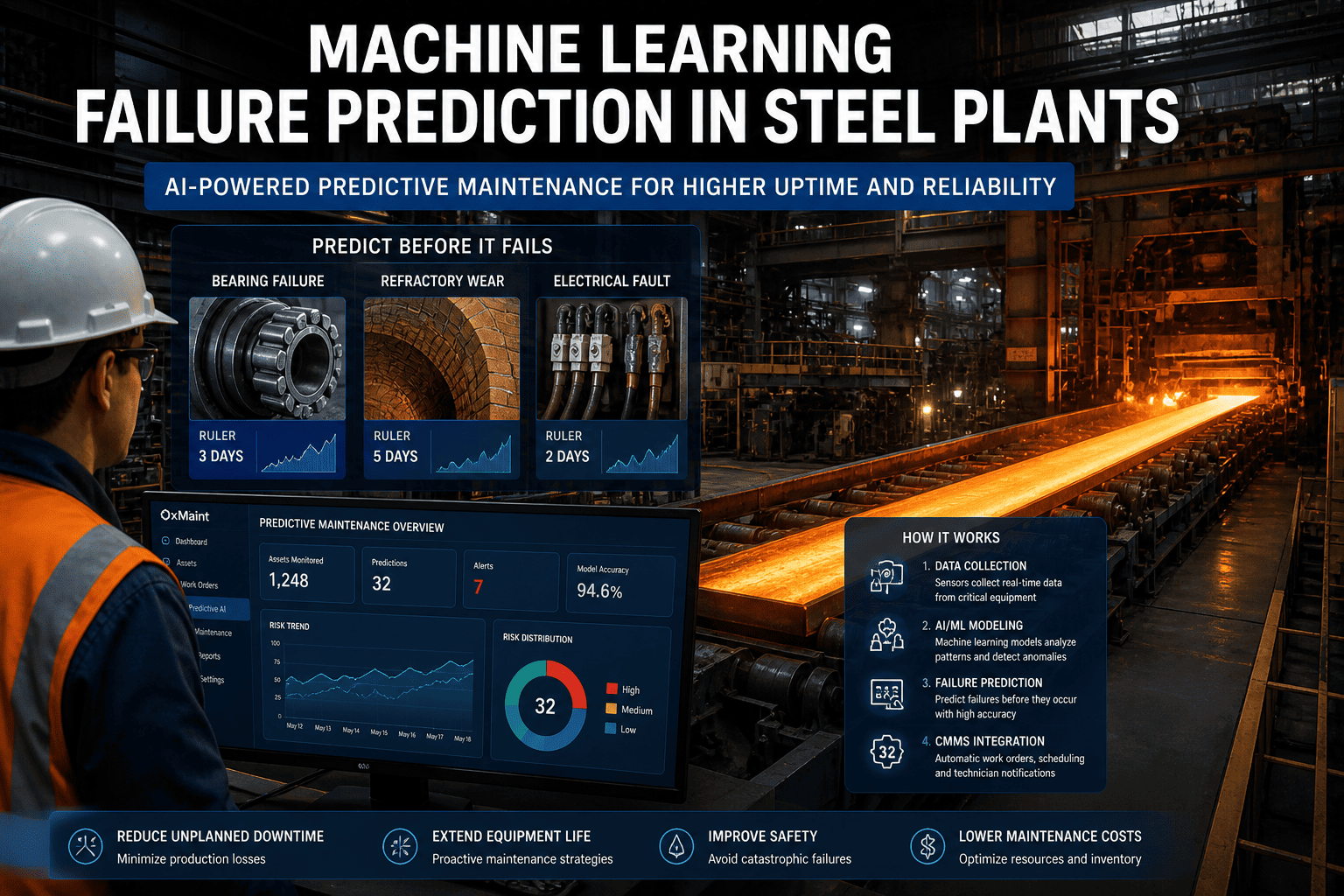
The steel industry spent $4.2 billion on unplanned downtime in 2024 — roughly 5-8% of total operating costs across integrated and EAF mills worldwide. That number is shrinking, but only at plants where predictive maintenance has moved from pilot project to production-grade system. ArcelorMittal, POSCO, and Tata Steel are running hundreds of AI algorithms simultaneously across blast furnaces, rolling mills, and continuous casters. Plants still operating on calendar-based PM intervals are not just inefficient — they are structurally disadvantaged against competitors whose maintenance cost per tonne is falling while theirs holds flat. This guide provides the 12-month implementation roadmap that steel plants use to deploy AI predictive maintenance from first sensor to full-plant coverage. Sign up for OxMaint to start building your predictive foundation today.
AI-Powered Predictive Maintenance for Steel Plants: Implementation Roadmap & ROI Guide
12-month phased roadmap covering sensor deployment, ML model training, CMMS integration, and documented $14-24M annual value creation for integrated steel operations.
Why Calendar-Based PM Fails in Steel
Calendar-based preventive maintenance either intervenes too early — wasting money on unnecessary repairs — or too late, after a failure has already begun. In a steel plant running 24/7 with assets operating at extreme temperatures, neither outcome is acceptable. AI predictive maintenance replaces time-based schedules with condition-based intelligence that detects degradation patterns 3-8 weeks before functional failure.
Over-Maintenance
Bearings replaced at 6-month intervals when data shows 80% still had 40%+ remaining life. Wasted parts, wasted labour, unnecessary production interruptions.
Under-Maintenance
Gearbox failure on a hot strip mill 3 weeks before scheduled PM because degradation accelerated under heavier-than-planned production loads. $500K+ emergency repair.
False Confidence
PM compliance at 95% but unplanned downtime still high — because calendar schedules do not correlate with actual equipment condition under variable operating loads.
accuracy in predicting equipment failures has been achieved by LSTM (Long Short-Term Memory) neural networks applied to manufacturing equipment — compared to 60-70% accuracy from conventional condition monitoring. Multi-sensor fusion models combining vibration, thermal, and acoustic data achieve false-positive rates below 8% versus 35-40% for single-sensor systems.
12-Month Implementation Roadmap
The proven path starts with your existing data infrastructure, targets the highest-impact assets first, and scales as ML models mature. Most steel plants complete the foundation phase within 3 months and see measurable ROI before the end of month 6. Sign up for OxMaint to start building your digital foundation this week.
Digital Foundation
Clean asset data, consistent failure codes, complete work order records in CMMS. Deploy wireless vibration and temperature sensors on 10-20 critical assets. Connect sensor alerts to CMMS for auto work order generation. Establish baseline metrics for downtime, MTBF, and maintenance cost per tonne.
Model Training & Validation
ML algorithms learn normal baselines for each asset under all operating conditions. Multi-sensor fusion activated — vibration + thermal + acoustic for 4-6x diagnostic precision. Edge AI deployed on plant floor for sub-10ms response times. First predictive detections validated against actual outcomes.
Scale & Integrate
Expand sensor coverage to 50-100 assets across all production areas. Integrate SCADA alarm feeds, Level 2 systems, and LIMS data. Activate digital twin models for refractory wear projection and caster segment prediction. Prescriptive recommendations with risk scoring begin auto-generating.
Optimize & Compound
Advanced analytics: remaining useful life estimation, sensor fusion ML models, spare parts demand forecasting. Maintenance scheduling optimized against production commitments. Carbon intensity scoring for maintenance deferrals. Capital planning intelligence with AI-backed condition data for board-level budget requests.
Where AI Delivers Maximum Impact in Steel
Not all assets deliver equal predictive value. Target sensor deployment where unplanned failure costs are highest, access is most restricted, and degradation signatures are detectable weeks in advance. Book a demo to map high-impact deployment zones for your plant.
Stave cooler temperature arrays detect refractory wear. Cooling water flow analysis flags channel blockage. Tuyere failure predicted 3-6 weeks ahead via infrared shell mapping. Converting $4.8M emergency repairs into $340K planned interventions.
Mold thermocouple pattern recognition identifies breakout precursors 30-90 seconds before occurrence. Segment roller vibration monitoring prevents strand quality defects. Ladle refractory wear rate tracked per heat with automated reline scheduling.
Work roll bearing failure predicted weeks before seizure via vibration trending (BPFO, BPFI, BSF). Hydraulic AGC system degradation detected through servo valve response time analysis. Reheat furnace refractory monitored via skid pipe cooling flow.
Vessel shell temperature mapping tracks refractory degradation per heat. Electrode arm hydraulics monitored for seal wear and cylinder drift. Transformer cooling and busbar connection integrity assessed through thermal trending.
Documented Results from Steel Plant Deployments
These are not theoretical projections — they are measured outcomes from integrated and EAF steel operations running AI predictive platforms in 2025-2026.
| Metric | Before AI | After AI (12 Months) | Impact |
|---|---|---|---|
| Unplanned Downtime | 15+ hrs/week | 2-3 hrs/week | 85% Reduction |
| Maintenance Cost per Tonne | Baseline | 18-25% lower | $14-24M Annual Value |
| Equipment Lifespan | Standard replacement cycles | 20-40% extension | CapEx Deferral |
| Failure Prediction Accuracy | N/A (reactive) | 80-97% | 30-90 Day Advance Warning |
| False Positive Rate | 35-40% (single sensor) | Below 8% (multi-sensor) | 4-6x Precision Gain |
| Safety Incidents | Industry average | Reduced by robotic coverage | Zero-Access Inspections |
Why OxMaint for Steel Predictive Maintenance
OxMaint is built to be the operational layer that connects every data source — IIoT sensors, SCADA alarm feeds, digital twin outputs, and robotic inspection data — into a single maintenance workflow engine. Sign up free and have AI active on your critical assets within the first week.
Multi-Sensor Fusion AI
Correlates vibration, temperature, pressure, current draw, and acoustic data across assets. Detects subtle multi-parameter signatures that precede failure — catching problems while they are $5K repairs instead of $500K emergencies.
Auto Work Order Generation
When AI detects a developing failure, it auto-generates a complete work order — diagnosed failure mode, recommended procedure, required parts, and optimal timing relative to production schedule. No dashboard alert that gets ignored.
Digital Twin Integration
Receives condition data from physics-based equipment models — blast furnace refractory projections, caster segment simulations, mill roll wear models. Twin predictions become CMMS work orders automatically.
Edge AI Deployment
ML models run on edge hardware installed in the plant — processing vibration and thermal data in under 10ms without a cloud round trip. Continuous prediction even during network outages in furnace and mill areas.
The steel plants that are winning on maintenance are not the ones with the most sensors — they are the ones that have connected their sensor data to their maintenance workflows. Data without action is just cost.
-- Head of Asset Management, Integrated Steel Producer, Western Europe
Your Competitors Are Already Moving
ArcelorMittal, Tata Steel, and POSCO have been running AI maintenance programs at scale for two years. The window to catch up without major capital disadvantage is 2026 — and it starts with connecting your existing SCADA and IIoT data to automated CMMS work orders.