Total Productive Maintenance (TPM) is often described as a cultural shift toward zero defect manufacturing, but poorly-executed TPM programs become bureaucratic busywork — operators spend hours on equipment cleaning checklists with no impact on asset reliability, small group activities generate suggestions that never get implemented, and the organization gradually abandons the program as people revert to reactive firefighting patterns. The difference between successful TPM programs (achieving 35-45% reduction in unplanned downtime and 12-18 point OEE improvement) and failed programs (consuming resources with minimal results) is structural clarity: the eight pillars of TPM provide the framework for sustainable improvement, but only when each pillar has dedicated leadership, clear accountability, and integrated metrics showing whether the pillar's activities are producing measurable reliability results. Sign Up Free to implement all eight TPM pillars with integrated tracking that connects each pillar's activities to measurable reliability and OEE outcomes.
The Eight Pillars of Total Productive Maintenance: A Framework for Sustainable Reliability Culture
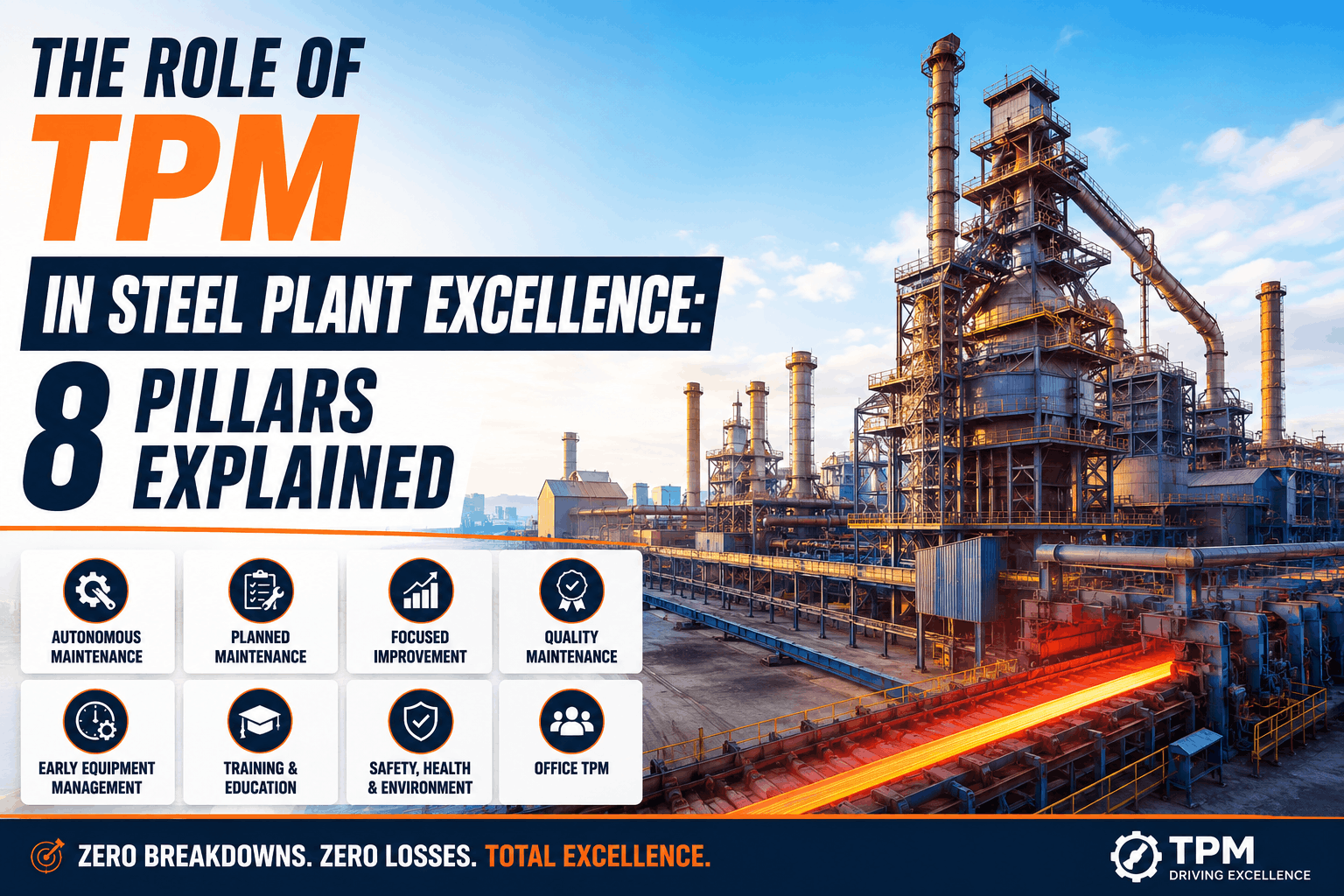
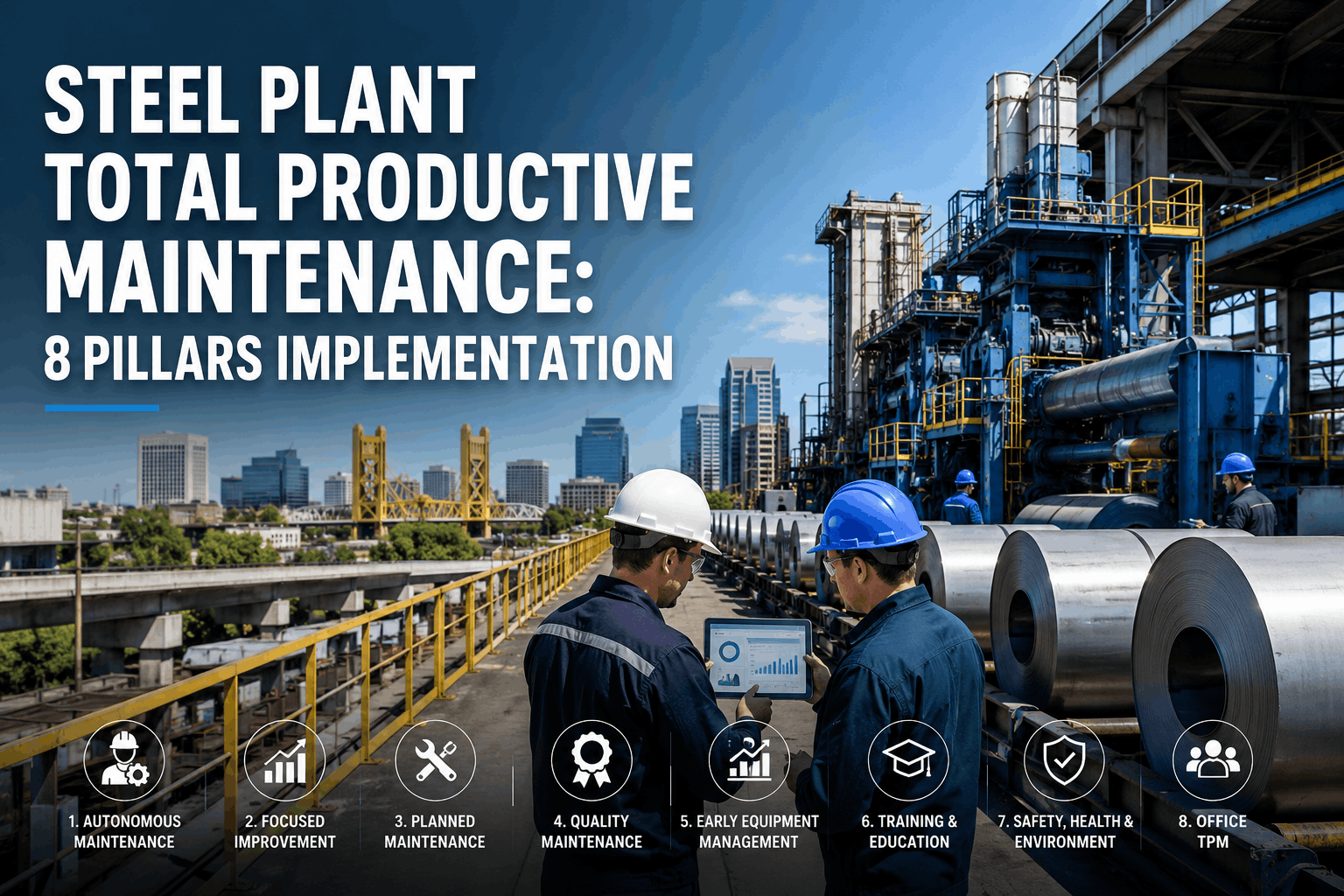
Total Productive Maintenance programs implementing all eight pillars — autonomous maintenance, targeted improvement, planned maintenance, quality maintenance, early equipment management, training, safety and environment, and office TPM — deliver 35-45% reduction in unplanned downtime and accelerate OEE improvement by 40-60% compared to partial TPM implementations.
Why TPM Programs Fail: The Implementation Mistakes That Cause Programs to Stall After Initial Enthusiasm
TPM programs typically launch with strong energy: 5S organizing of equipment areas, creation of small group activity teams, assignment of equipment ownership to operators, operator equipment cleaning and basic inspection checklists. For the first 3-4 months, energy is high, visible improvements in equipment appearance are obvious, and organization leadership is excited about the cultural shift. But without structural alignment across all eight TPM pillars, the program stalls: operators tire of cleaning checklists that seem divorced from actual reliability improvements, small group teams generate suggestions that maintenance ignores because they're already overwhelmed with reactive work, planned maintenance doesn't improve because the activities are still scheduled on calendar intervals rather than condition-based targeting. By month 6-9, the program quietly fades — the equipment still looks clean and organized, but unplanned downtime hasn't actually improved, operators have returned to reactive firefighting mentality, and leadership shifts focus to the next improvement initiative. The root cause of failure is always the same: isolated implementation of individual pillars without strategic integration. Autonomous maintenance (Pillar 1) cannot succeed without planned maintenance (Pillar 3) backing it up and early equipment management (Pillar 5) preventing new equipment from developing bad failure patterns. Small group activities (Pillar 2) cannot generate value-creating suggestions without support from leadership to implement ideas. Training (Pillar 6) must be tied to specific role expectations, not generic maintenance skills. Safety (Pillar 7) and office TPM (Pillar 8) must be genuinely integrated, not added as afterthoughts. Steel mills that succeed with TPM Book a Demo see how all eight pillars integrate into a coherent program with dedicated pillar leadership, cross-pillar coordination, and integrated success metrics.
The Eight Pillars of TPM: Individual Pillar Definition, Objectives, and Success Metrics
Operators take ownership of routine equipment cleaning, basic inspection, fluid checks, and minor adjustments — preventing deterioration from neglect. Success metric: 90%+ operator compliance with AM checklist, early detection of 25-35% of equipment deterioration issues before they require maintenance intervention.
Small group problem-solving teams identify chronic failures and implement targeted improvements — typically achieving $30-80K annual savings per improvement team. Success metric: 80%+ of team-generated suggestions implemented within 6 months, average improvement delivering measurable reliability or cost benefit within 30 days of implementation.
Systematic preventive maintenance scheduled based on equipment condition and failure risk (not calendar intervals) — targeting maintenance toward high-failure equipment. Success metric: 90%+ PM compliance rate, MTBF improvement of 15-25% on target assets, planned work representing 75%+ of total maintenance labor.
Eliminate root causes of quality defects by maintaining process conditions, equipment geometry, and environmental factors within specification — preventing out-of-spec production. Success metric: 99.2%+ quality compliance rate, 85%+ of quality defects traced to controllable maintenance factors, defect recurrence rate below 5%.
Eliminate initial failures on new or modified equipment by incorporating reliability and maintainability requirements into design and commissioning — preventing chronic failure patterns before equipment reaches full operation. Success metric: 40-50% reduction in early-life failure rates vs legacy equipment, MTBF achievement within 3-6 months of commissioning vs 12+ months historical patterns.
Develop operator and technician capability through structured training in equipment operation, basic maintenance, problem-solving, and safety — enabling effective TPM participation across the organization. Success metric: 100% of relevant personnel certified in core skill areas, training effectiveness measured by improvement in autonomous maintenance compliance and small group activity outcomes.
Integrate safety into all TPM activities — ensuring that autonomous maintenance, planned work, and improvements enhance safety and do not create new hazards. Success metric: Zero safety incidents related to TPM activities, all equipment modifications include safety impact assessment, operators trained in safe equipment handling and emergency procedures.
Apply TPM principles to administrative functions — eliminating information delays, improving maintenance planning quality, and reducing planning-execution disconnect. Success metric: 95%+ data accuracy in maintenance systems, maintenance schedule compliance improving by 20-25%, planning meeting effectiveness improving measured by decision execution rate.
TPM Implementation Performance Benchmarks: Expected Improvements Across All Eight Pillars
| Performance Metric | Pre-TPM Baseline | 12-Month TPM Target | 24-Month TPM Target | Financial Impact (2M ton facility) |
|---|---|---|---|---|
| Unplanned Downtime | 15-18% | 9-11% | 6-8% | $8-12M annual reduction |
| MTBF (Critical Equipment) | 1,200-1,500 hrs | 1,800-2,200 hrs | 2,400-3,000 hrs | 25-40% extended campaign |
| Planned Maintenance Compliance | 65-72% | 85-90% | 92-97% | $2-4M improved reliability |
| Quality Compliance Rate | 97.2-98% | 98.8-99.2% | 99.2-99.6% | $1.2-1.8M grade value |
| Operator Equipment Knowledge (Self-Assessment) | 25-35% | 65-75% | 85-95% | Early detection + safety |
| Safety Incident Rate (per 200K hours) | 3.2-4.1 | 1.1-1.8 | 0.3-0.8 | $400K-800K incident cost reduction |
Five Critical Success Factors for TPM Program Sustainability: Beyond the Eight Pillars
Each of the eight pillars must have a dedicated pillar champion (Maintenance Manager for Pillar 3, Operator Supervisor for Pillar 1, Safety Manager for Pillar 7, etc.) responsible for execution, outcome tracking, and continuous improvement of that pillar. Monthly cross-pillar coordination meetings ensure that Pillar 2 improvements include Pillar 3 planned maintenance alignment, Pillar 4 quality activities connect to Pillar 1 operator activities, and Pillar 8 administrative improvements support all operational pillars. Without this structural clarity and coordination, pillar activities operate in isolation and fail to create compound reliability improvement. The coordination structure also clarifies decision authority and prevents leadership paralysis when conflicting priorities emerge. Sign Up Free to track progress against all eight TPM pillars with dedicated metrics for each pillar and cross-pillar coordination dashboards.
TPM programs fail when activities are tracked (hours of autonomous maintenance completed, number of kaizen suggestions submitted) but outcomes are not visible — operators don't see that their cleaning efforts correlated with reduced failures, small group teams don't know whether their improvements actually worked, maintenance leadership can't demonstrate that TPM investment is producing reliability improvement. Real-time tracking that connects Pillar 1 autonomous maintenance compliance to MTBF improvement on specific equipment, that shows Pillar 2 improvement outcomes in terms of cost savings and failure prevention, that demonstrates Pillar 3 planned maintenance impact on availability — transforms TPM from activity-counting exercise into outcome-focused program. The psychological impact is enormous: when operators see that consistent autonomous maintenance correlates with zero failures on a piece of equipment over 6 months, they internalize the connection between their actions and results, and program adoption accelerates dramatically.
TPM programs fail when maintenance owns the program and operates try to support it — the model is backward. TPM succeeds when operators own their equipment and view maintenance as a supporting function. This mindset shift requires: (1) giving operators genuinely meaningful equipment decisions (not just checklist completion), (2) asking operators for input on equipment improvement rather than telling them what to do, (3) respecting operator expertise in equipment characteristics and failure patterns, (4) empowering operators to stop equipment operation when they detect abnormal conditions rather than requiring supervisor approval. When operators transition from executing maintenance instructions to owning equipment performance, program sustainability increases dramatically. The operator ownership model also accelerates early failure detection — an operator who owns their equipment notices subtle changes in noise, vibration, or performance days or weeks before an external condition-monitoring system would flag the issue. Book a Demo to see how TPM programs with operator-owned equipment governance sustain improvement momentum.
Pillar 2 (focused improvement/kaizen) fails when small group teams submit suggestions and nothing happens — leadership, citing resource constraints or capital limitations, silently shelves 60-70% of ideas. Teams demoralize, meeting attendance drops, suggestion quality deteriorates. Success requires that 85%+ of submitted ideas are evaluated for feasibility within 30 days, 60%+ are implemented within 60 days with clear timeline, and 25%+ are implemented within 30 days (quick wins). Improvements don't always require capital — many of the highest-impact ideas are operational or procedural changes that cost almost nothing to implement. A team suggesting that a bearing be re-lubricated every 200 operating hours instead of 250 hours (based on observed failure pattern) requires zero capital and zero engineering but delivers 15-25% MTBF improvement on that bearing class. Success requires that management actively facilitates implementation of ideas and reports back to the team showing outcome, not just thanking them for participation.
The most common TPM failure mode is launching all eight pillars simultaneously without integration framework — Pillar 1 operators clean equipment with no connection to whether Pillar 3 planned maintenance is actually happening, Pillar 2 small groups generate ideas that Pillar 3 never implements, Pillar 4 quality work isn't connected to Pillar 1 operator early-detection activities, Pillar 6 training teaches generic skills not reinforcing the other seven pillars. Successful implementations prioritize integration across pillars: Pillar 1 checklists are designed to identify early warning signs that Pillar 3 planned maintenance needs to address, Pillar 2 teams explicitly generate improvement suggestions aligned with Pillar 3 equipment targeting, Pillar 4 quality maintenance feeds back insights to Pillar 1 operators on what adjustments prevent quality defects, Pillar 6 training is customized to each equipment class and tied to specific Pillar 1 and Pillar 3 activities. This integration creates compound improvement velocity: each pillar's activities reinforce the others, creating a coherent improvement system rather than eight parallel programs.
TPM Program Launch Roadmap: 24-Month Implementation Timeline for All Eight Pillars
Total Productive Maintenance: Frequently Asked Questions
How much time should operators spend on autonomous maintenance activities weekly?
Typical target is 10-15% of operator shift time (4-6 hours per week per operator) on autonomous maintenance cleaning, inspection, and adjustment activities — with the remaining shift time focused on production operation and immediate problem response.
What size should small group kaizen teams be for Pillar 2?
Optimal team size is 5-8 people representing the equipment area (operators, technicians, production supervisors) — large enough to capture diverse perspectives, small enough to make decisions quickly and maintain engagement throughout the project lifecycle.
How frequently should operators be trained on equipment-specific knowledge?
Initial intensive training (4-6 weeks) followed by quarterly refresher training and on-demand training triggered by equipment changes — ensuring operators maintain competency as equipment evolves and knowledge deepens through experience.
Can TPM be implemented on aging equipment or only on new mills?
TPM delivers 25-35% more reliability improvement on older equipment than new equipment because the failure patterns are well-understood and operator knowledge can be leveraged more effectively — implementation difficulty is similar, benefit is higher.
What is the typical cost of TPM program implementation?
Full eight-pillar TPM program typically requires $200K-500K in internal and external consulting, training development, and metrics system setup — with payback typically achieved in 4-8 months through reliability and productivity improvements.
How can plants prevent TPM program fatigue and sustain momentum beyond year 2?
Sustained momentum requires continuous pillar leadership, real-time outcome tracking showing TPM impact on reliability, regular celebration of improvement successes, and integration of TPM into permanent organizational structure (not temporary program).
Should TPM be implemented plant-wide immediately or piloted on specific equipment?
Pilot approach is typically more successful — implement full eight-pillar TPM on 3-5 equipment classes (blast furnace, caster, rolling mill, key auxiliary equipment) for 6-12 months, demonstrate results, then expand to remaining equipment classes.
How do you integrate TPM with existing condition monitoring and predictive maintenance systems?
TPM Pillar 1 (autonomous maintenance) feeds operator early-detection observations to condition monitoring systems, while Pillar 3 (planned maintenance) uses condition data to trigger maintenance — creating a two-level detection system (operator + technology) rather than either/or approach.
Launch Your Eight-Pillar TPM Program Today
OxMaint provides the integrated metrics platform and pillar coordination framework that steel plants need to implement all eight TPM pillars as a coherent system — connecting operator activities, maintenance interventions, improvement ideas, quality work, and administrative functions into measurable reliability improvement.