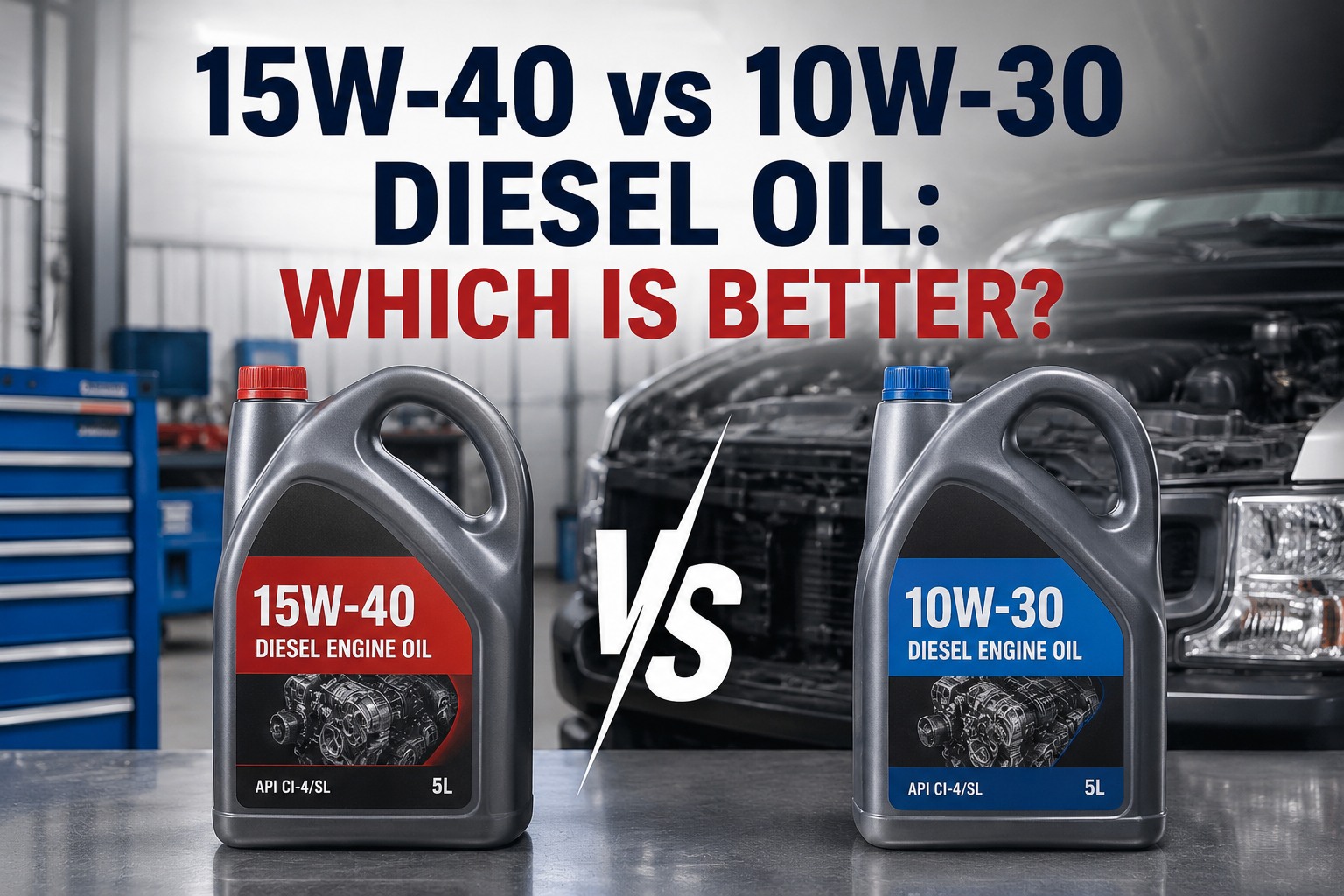
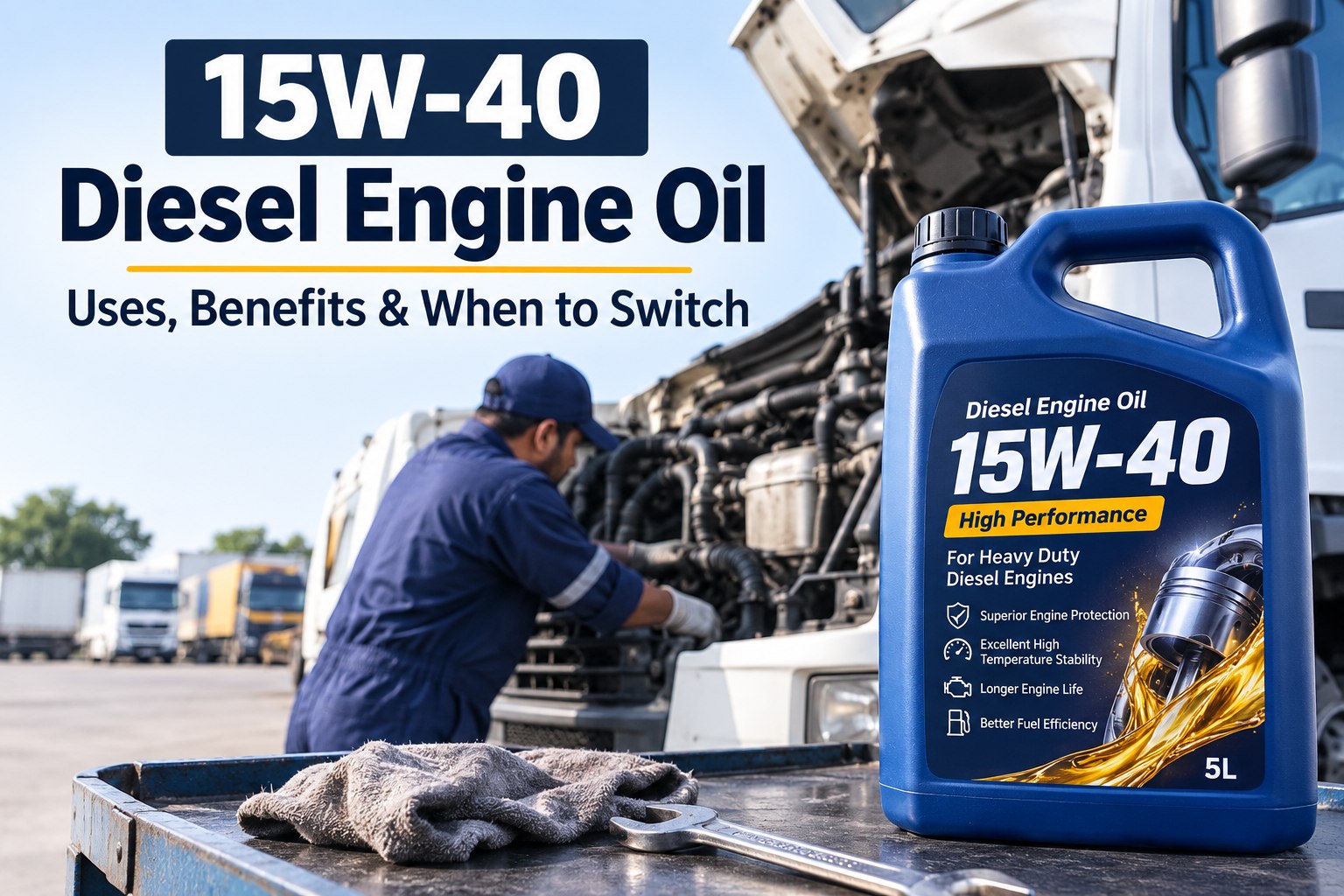
Ask any fleet manager, diesel mechanic, or heavy-equipment operator which engine oil is better — 15W-40 or 10W-30 — and you will get one of the most passionately debated answers in the entire diesel maintenance world. 15W-40 has been the default heavy-duty diesel oil for four decades, coating every fleet garage in America with the muscle memory that "if it runs diesel, it takes 15W-40." 10W-30 arrived aggressively in the mid-2010s with the API CK-4 and FA-4 grade launches, backed by every major OEM's fuel-economy push, and now virtually every new-generation Cummins, Detroit Diesel, PACCAR, and Volvo engine specifies 10W-30 from the factory. Both oils are excellent. Neither is wrong. But they are engineered for different operational envelopes, and the wrong choice for your specific engine, climate, and duty cycle costs real money in fuel consumption, wear rate, and cold-start reliability. This 2026 guide walks through what the viscosity grades actually mean, the direct head-to-head comparison across the metrics that matter, the temperature performance envelope where each oil wins, the application decision framework mature fleets use, and the API grade backward-compatibility rules that determine whether you can switch. OxMaint tracks oil sampling, drain intervals, and lubrication history per vehicle in the fleet — turning oil choice from tribal knowledge into operational data. Book a free demo to see fleet oil analysis tracking inside OxMaint.
15W-40
15W
Cold cranking viscosity · flows down to approximately -20°C
40
Kinematic viscosity at 100°C · thicker film at operating temperature
10W-30
10W
Cold cranking viscosity · flows down to approximately -25°C
30
Kinematic viscosity at 100°C · thinner film · lower parasitic drag
Lower W number = better cold flow · lower second number = thinner at operating temperature · both oils are multi-grade formulations engineered for full-temperature-range operation
2-3%
typical fuel economy advantage of 10W-30 over 15W-40 in over-the-road heavy-duty applications
-25°C
cold-start capability of 10W-30 vs approximately -20°C for 15W-40 · matters for cold-climate fleets
CK-4
the shared API service category · both 15W-40 CK-4 and 10W-30 CK-4 are backward compatible with older CJ-4 engines
Head-to-Head Comparison — Every Metric That Matters
The right oil for your operation depends on which metrics you are optimizing for. A refrigerated over-the-road fleet running new Cummins X15 engines through Minnesota winters optimizes for cold flow and fuel economy — pointing to 10W-30. A vocational fleet running older Detroit Series 60 engines hauling aggregate in Arizona summers optimizes for high-temperature film strength — pointing to 15W-40. The direct comparison below reflects how these oils actually behave across the metrics fleet managers evaluate. OxMaint stores this comparison against the specific engine model so oil selection becomes an evidence-based decision per vehicle. Start a free trial to configure oil-per-engine mapping inside OxMaint.
15W-40 vs 10W-30 · Direct Comparison Across Seven Metrics
Cold Start Capability
Down to -20°C
Down to -25°C · advantage
Fuel Economy
Baseline
2-3% improvement · advantage
High-Temp Film Strength
Thicker film · advantage in hot / high-load
Thinner film · designed for tighter tolerances
Wear Protection · Older Engines
Better for pre-2017 engines · advantage
Adequate if API grade matches
Wear Protection · Modern Engines
Adequate
OEM-specified for 2017+ engines · advantage
DPF / SCR Compatibility
CK-4 compatible
CK-4 or FA-4 compatible · check spec
Cost Per Gallon
Similar
Similar · sometimes slight premium
Every row above lives against the specific engine model in a mature fleet CMMS · oil selection becomes evidence-based rather than default-by-habit
Temperature Performance — Where Each Oil Actually Wins
The single clearest way to understand why fleets choose one oil over the other is to look at how each oil actually behaves across the operational temperature range. Both oils are multi-grade formulations, but their viscosity profiles diverge at both ends of the spectrum — 10W-30 wins at cold start and mid-range operating temperature, while 15W-40 maintains thicker film strength at extreme high temperatures. The performance envelope below reflects the standard SAE J300 behavior for both grades. Book a demo to see temperature-mapped oil recommendations inside OxMaint.
Viscosity Behavior Across Operating Temperature Range
15W-40 Behavior
Too thick · poor flow
Marginal · slow flow
Adequate flow
Good flow
Thick film · good wear protection
Excellent film · advantage
10W-30 Behavior
Marginal · better than 15W-40
Good flow · advantage
Excellent flow · advantage
Excellent flow · low drag
Adequate film · tight-tolerance design
Adequate film · check OEM spec
10W-30 wins at the cold-and-mid range · 15W-40 wins at the high-temp high-load extreme · the right choice depends on where your operational envelope sits
The Application Decision Framework — When to Pick Which
The direct answer to "which oil should I use" comes down to matching the oil to your specific engine, climate, and duty cycle. The framework below reflects how mature fleet operations actually make the decision — with clear indicators pointing to each grade based on the operational envelope. OxMaint stores the oil selection per engine model, per climate zone, and per duty cycle so the decision is captured once and applied consistently across the fleet. Start a free trial to standardize oil selection across your fleet inside OxMaint.
Application Decision Framework · Match Oil to Operating Envelope
Engine model year is pre-2017 or older EPA emissions generation
Operating in hot climates (Southwest US · Middle East · Australia interior)
Vocational duty cycle with high-load operation (aggregate haul · logging · construction)
Mixed fleet with older engines requiring backward-compatible service oil
OEM manual specifies 15W-40 or equivalent CJ-4 / CK-4 SAE 15W-40
Very high mileage engines with worn tolerances needing thicker film
Engine model year is 2017+ or new-generation EPA / GHG-compliant
Operating in cold climates (Northern Plains · Canada · Northern Europe)
Over-the-road linehaul optimizing for fuel economy at scale
OEM manual specifies 10W-30 or requires FA-4 grade
Newer Cummins X15 · Detroit DD15 Gen 5 · PACCAR MX-13 · Volvo D13 factory fill
Fleet fuel-economy program with measurable ROI on 2-3% MPG improvement
Always verify against the OEM service manual for the specific engine · mixed fleets often maintain both oils in inventory with per-vehicle assignment tracked in OxMaint
Every Engine · Every Oil Change · Every Sample — One Platform
OxMaint tracks oil selection per vehicle, drain interval per engine, oil analysis samples with wear-metal trend, and lubrication history across the fleet · replacing paper oil tags and spreadsheet drain records.
API Service Categories — Backward Compatibility Rules
The API service category on the oil label — CK-4 or FA-4 — determines what engines the oil is safe to use in. This matters most for mixed fleets running engines from multiple generations, because putting the wrong-grade oil into an older engine can void warranty coverage and reduce protection below what the engine requires. The framework below reflects the current API heavy-duty diesel oil service categories and their backward-compatibility rules.
API Heavy-Duty Diesel Oil Service Categories
CJ-4
Introduced 2006
Legacy grade for pre-2017 emissions-compliant engines · phase-out active but still available
Older equipment · not backward compatible with FA-4
CK-4
Introduced 2016
Current mainstream grade · available in both 15W-40 and 10W-30 · backward compatible with CJ-4
Safe substitute for CJ-4 in older engines · use for mixed fleets
FA-4
Introduced 2016
Low-HTHS viscosity grade · 10W-30 only · designed for fuel economy in new engines
Not backward compatible · verify OEM approval before use
CK-4 is the safest choice for mixed fleets · FA-4 delivers fuel economy but requires OEM verification · OxMaint captures API grade per vehicle to prevent cross-contamination
Fleet Manager Perspective · Oil Choice as Operational Data
Fleets that treat oil selection as a tribal-knowledge decision leave real money on the table. We ran a 340-truck mixed-generation fleet through a systematic oil review two years ago. The trucks running pre-2017 Detroit Series 60 engines and older Cummins ISX15 stayed on 15W-40 CK-4 — that decision was straightforward. The 2019+ Cummins X15 and Detroit DD15 Gen 5 engines moved to 10W-30 CK-4, then eventually to FA-4 where OEM approval allowed it. Twelve months into the transition, the 10W-30 vehicles showed a measured 2.4% fuel economy improvement across a comparable route mix. On a 340-truck fleet averaging 120,000 miles per year at 6.5 MPG on diesel around four dollars a gallon, that 2.4% improvement was roughly $650,000 of annual fuel savings. What made the decision possible was tracking oil grade per vehicle, oil analysis samples per drain, and cost-per-mile data in one system. Once we moved to OxMaint, every oil change captured the specific product, the specific drain interval, the specific analysis result, and the wear-metal trend against the specific engine. The old paper oil tag system could never have supported this. That is the difference between fleet-level oil discipline and running on habit. Both 15W-40 and 10W-30 are excellent oils. The question is which one your specific engine wants, and whether you are tracking the answer as data.
Per-Vehicle Oil Assignment
OxMaint stores approved oil grade per engine · prevents cross-contamination · standardizes fleet lubrication policy.
Every Sample Trended
Oil analysis results captured per drain · wear-metal trend visible per engine · drain interval optimized from real data.
Cost-Per-Mile Visible
Lubrication cost tracked against the specific vehicle · ROI on oil upgrade programs measurable at fleet level.
Turn Fleet Oil Choice into Operational Data
If your fleet still tracks oil changes on paper tags stuck to windshields, sample results in a folder in the shop office, and lubrication cost by fuel-card statement rather than by vehicle, you are running one of the largest single operating expenses in your fleet without operational visibility. See what OxMaint — a CMMS built for fleet lubrication tracking — looks like against your fleet.
Frequently Asked Questions
Can I use 15W-40 instead of 10W-30 (or vice versa)?
In most cases, yes — as long as the API service category matches. CK-4 15W-40 and CK-4 10W-30 are both backward compatible with older CJ-4 engines. FA-4 10W-30 is NOT backward compatible with older engines and should only be used where OEM specifies it. Always check the OEM service manual before switching, especially for engines under warranty. Some newer OEMs void warranty coverage if 15W-40 is used where 10W-30 is specified.
Which diesel oil is better for cold weather?
10W-30 wins clearly in cold weather. It flows at temperatures down to approximately -25°C, versus about -20°C for 15W-40. This translates into faster oil circulation at cold start, reduced dry-start wear on bearings, and better cranking performance in extreme cold. Fleets operating in the Northern Plains, Canada, or Northern Europe typically standardize on 10W-30 for this reason.
Which diesel oil is better for fuel economy?
10W-30 typically delivers a 2-3% fuel economy advantage over 15W-40 in over-the-road heavy-duty applications, because its thinner viscosity at operating temperature creates less parasitic drag on rotating engine components. FA-4-grade 10W-30 extends this advantage further with even lower HTHS viscosity. On a 340-truck fleet at 120,000 miles per year, this can translate to hundreds of thousands of dollars in annual fuel savings.
Which oil is better for older diesel engines?
15W-40 remains the safer choice for pre-2017 heavy-duty diesel engines. Older engines were designed with wider bearing tolerances that benefit from the thicker oil film that 15W-40 provides at operating temperature. Very high-mileage engines with worn tolerances also benefit from 15W-40's thicker film. CK-4 15W-40 is the current standard grade for this application.
What is the difference between CK-4 and FA-4?
Both CK-4 and FA-4 were introduced in 2016 by the American Petroleum Institute. CK-4 is available in both 15W-40 and 10W-30 viscosities and is backward compatible with older CJ-4 engines. FA-4 is 10W-30 only, has lower high-temperature-high-shear (HTHS) viscosity, delivers additional fuel economy benefit, and is NOT backward compatible — it should only be used in engines where the OEM specifically approves FA-4. Mixed fleets typically standardize on CK-4 to avoid the compatibility issue.
How does a fleet CMMS help with oil selection?
A modern fleet CMMS like OxMaint stores the approved oil grade per engine model, tracks every oil change against the specific vehicle with product identification and drain interval, captures oil analysis results per drain with wear-metal trend data, and calculates lubrication cost-per-mile against the specific vehicle. This turns oil selection from a tribal-knowledge decision into evidence-based operational data — critical for mixed fleets managing both 15W-40 and 10W-30 across multiple engine generations.