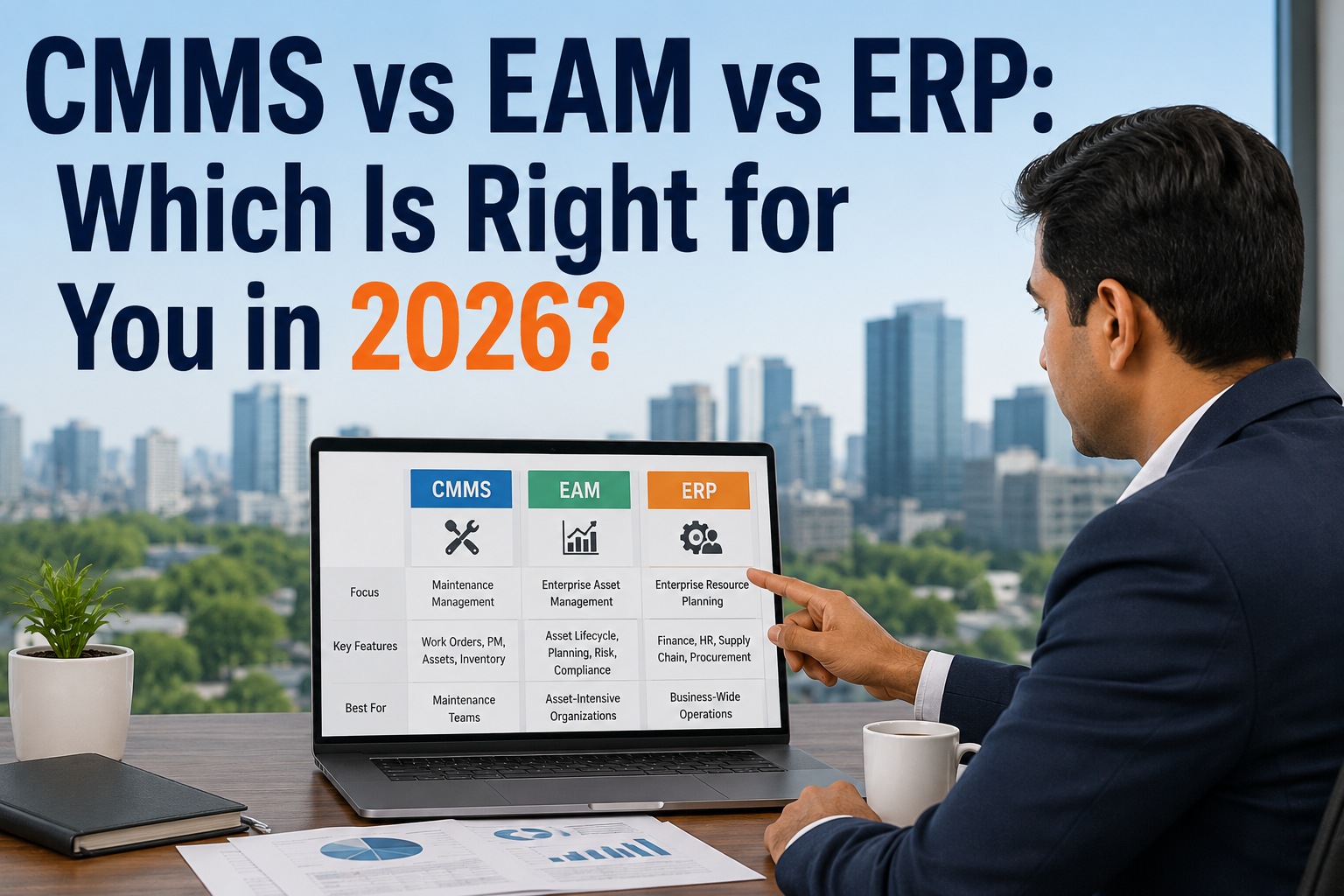
Choosing between CMMS vs EAM vs ERP is one of the most consequential platform decisions maintenance and reliability leaders make — picking the wrong system can cost over $100,000 in wasted licenses and implementation time across a five-year cycle. A Computerized Maintenance Management System (CMMS) focuses on work orders and preventive maintenance, Enterprise Asset Management (EAM) broadens that scope to full lifecycle asset performance, and an ERP's maintenance module bolts onto broader financial and supply chain operations. This 2026 comparison breaks down features, total cost, scalability, and integration architecture so you can confidently select the right maintenance software. Explore OxMaint's AI-powered platform with a Start Free Trial to see how it bridges the gap.
CMMS vs EAM vs ERP Platform Decision
The Wrong Maintenance Software Choice Costs $120K+ Over 5 Years
Before you lock into a rigid ERP maintenance module or an overstuffed EAM suite, map your exact operational reality. Compare CMMS, EAM, and ERP architectures side-by-side to prevent overbuying and eliminate costly downtime.
Traditional ERP / Spreadsheet Approach
- Reactive maintenance driving 40%+ unplanned downtime
- Rigid ERP modules requiring 12–18 months to implement
- Siloed asset data disconnected from actual floor conditions
- High license costs for features maintenance teams never use
OxMaint CMMS + EAM Approach
- Predictive maintenance slashing downtime by 30–50%
- Rapid deployment in weeks, not quarters
- Unified asset lifecycle tracking and real-time analytics
- Lean, AI-driven licensing that scales with your facility
CMMS EAM Difference
CMMS vs EAM vs ERP: Core Scope and Capabilities
Understanding the CMMS EAM difference means looking at asset lifecycle depth, financial integration, and maintenance execution focus — three dimensions where these platforms diverge sharply.
| Capability | CMMS | EAM | ERP Maintenance Module |
|---|---|---|---|
| Work Order Management | Core strength, highly configurable | Included, but secondary to lifecycle | Basic, often clunky |
| Preventive Maintenance (PM) | Advanced scheduling and triggers | Advanced, condition-based | Standard calendar-based |
| Asset Lifecycle Management | Execution-focused | Full cradle-to-grave tracking | Tied to fixed accounting assets |
| Spare Parts Inventory | Deep maintenance-specific control | Deep, with procurement triggers | Driven by broader supply chain |
| Financial / HR Integration | Requires API connectors | Native or built-in middleware | Fully native |
| Implementation Timeline | 2–8 weeks | 3–9 months | 12–18+ months |
| Typical Annual Cost (per user) | $40 – $120 | $150 – $500+ | $1,000+ (bundled) |
Maintenance Software Choice
CMMS vs EAM: Which Platform Fits Your Operation?
The maintenance system comparison often comes down to asset complexity, regulatory compliance requirements, and total operational footprint.
Best for Focused Maintenance Execution
Ideal for plants with 50–5,000 assets where the primary goal is eliminating reactive maintenance, automating PM schedules, and tracking work orders. A modern CMMS like OxMaint deploys in weeks, requires minimal IT support, and delivers ROI in under 90 days.
Best for Complex Asset Lifecycles
Necessary for multi-site enterprises managing capital planning, depreciation, and strict ISO 55000 compliance. EAM adds financial weight and implementation time, making it overkill for single-facility teams that just need robust maintenance execution and predictive analytics.
ERP vs CMMS
Why ERP Maintenance Modules Frustrate Reliability Teams
Over 60% of maintenance teams forced into an ERP maintenance module report low adoption rates due to clunky interfaces and slow workflows. The mismatch between financial software design and frontline maintenance reality creates friction that costs hours every week.
"A 180-asset manufacturing plant spending $42K/yr on an ERP maintenance add-on replaced it with OxMaint. Within 4 months, they cut average work order completion time by 35% and recovered 12 maintenance hours per week — saving $28,000 annually in labor and lost production."
— Worked Scenario: Mid-Sized Manufacturing Plant
CMMS Comparison 2026
How OxMaint Bridges the CMMS vs EAM Gap
You shouldn't have to choose between rapid CMMS deployment and deep EAM asset tracking. OxMaint's AI-powered platform delivers the work-order speed of a CMMS with the lifecycle analytics of an EAM — without the ERP bloat.
AI-Driven Work Orders
Automate work order generation, prioritize critical assets, and auto-assign technicians based on skill set and availability. Eliminate paper workflows and cut unplanned downtime by 30–50%.
Predictive Maintenance Analytics
Move beyond calendar-based PMs. OxMaint analyzes vibration, temperature, and runtime data to predict failures before they happen, extending asset life by up to 20%.
Full Asset Lifecycle Tracking
Gain EAM-level visibility into cradle-to-grave asset performance, maintenance history, and depreciation — ensuring ISO 55000 and FMCSA compliance readiness for any audit.
Smart Spare Parts Inventory
Auto-replenish critical spares based on usage trends and predictive alerts. Reduce inventory carrying costs by 15–25% while eliminating stockouts on essential parts.
Stop Guessing. Start Maintaining.
See OxMaint on your assets. Book a 30-min demo and discover how the right platform eliminates downtime and cuts maintenance costs.
Maintenance System Selection Guide
5-Step Framework for Your CMMS vs EAM vs ERP Decision
Use this evaluation framework to ground your maintenance software comparison in hard operational data rather than vendor hype.
Audit Your Asset Baseline
Count active assets, criticality tiers, and current PM coverage. If you manage under 5,000 assets at a single site, a robust CMMS usually wins. Multi-site complexity over 10,000 assets demands EAM.
Calculate Total Cost of Ownership (TCO)
Factor in licenses, implementation, IT overhead, and downtime risk. ERP modules often hide 200%+ in consulting fees. OxMaint delivers transparent per-user pricing with zero hidden implementation costs.
Evaluate Integration Architecture
Your maintenance system must connect to IoT sensors, SCADA, and financial software. Ensure the platform offers open REST APIs. Native AI integrations, like OxMaint's, dramatically speed up time-to-value.
Map Compliance Requirements
If you need ISO 55000 certification or FMCSA compliance, verify audit trails and documentation depth. A dedicated CMMS/EAM handles this far better than retro-fitted ERP modules.
Run a 14-Day Pilot
Stop evaluating brochures. Load real asset data into the system, assign live work orders, and test mobile adoption. You will know within two weeks if the UX fits your frontline technicians.
Frequently Asked Questions
CMMS vs EAM vs ERP: Your Top Questions Answered
What is the main difference between CMMS and EAM?
The main difference is scope: a CMMS focuses tightly on maintenance execution (work orders, scheduling, preventive maintenance), while EAM expands to manage the entire asset lifecycle, including capital planning, depreciation, and multi-site financial integration. OxMaint combines the rapid deployment of a CMMS with EAM-level lifecycle tracking.
Can an ERP system replace a CMMS for maintenance teams?
While an ERP includes a maintenance module, it rarely replaces a dedicated CMMS effectively because ERPs are built for finance and supply chains, not frontline technicians. Most reliability teams using ERP for maintenance report slow workflows and low adoption, leading them to bolt on a specialized CMMS anyway. You can see how OxMaint integrates seamlessly with existing ERPs by requesting a Book a Demo.
How much does a CMMS or EAM cost in 2026?
In 2026, a CMMS typically costs $40 to $120 per user per month, while EAM platforms range from $150 to $500+ per user due to their complexity. ERP maintenance modules are often bundled but carry hidden implementation costs exceeding $100K. OxMaint offers transparent, cost-effective pricing that scales with your operation.
How long does it take to implement maintenance software?
A modern CMMS like OxMaint can be fully implemented in 2 to 8 weeks, whereas traditional EAM platforms take 3 to 9 months, and ERP modules can take over a year. The timeline depends on data migration, asset hierarchy setup, and integration requirements, but cloud-based AI platforms deploy significantly faster.
When should a company upgrade from CMMS to EAM?
A company should consider upgrading to a full EAM when managing 10,000+ assets across multiple geographic locations, requiring deep capital expenditure tracking, or needing strict ISO 55000 compliance frameworks. However, platforms like OxMaint blur this line by offering EAM-grade lifecycle analytics within a lightweight CMMS interface.
Make the Right Choice
Ready to Modernize Your Maintenance Strategy?
Join the reliability leaders using OxMaint to predict failures, streamline work orders, and maximize asset uptime. Start your free trial today or book a personalized demo to see the platform in action.
Free 14-day trial · No credit card


.png)


