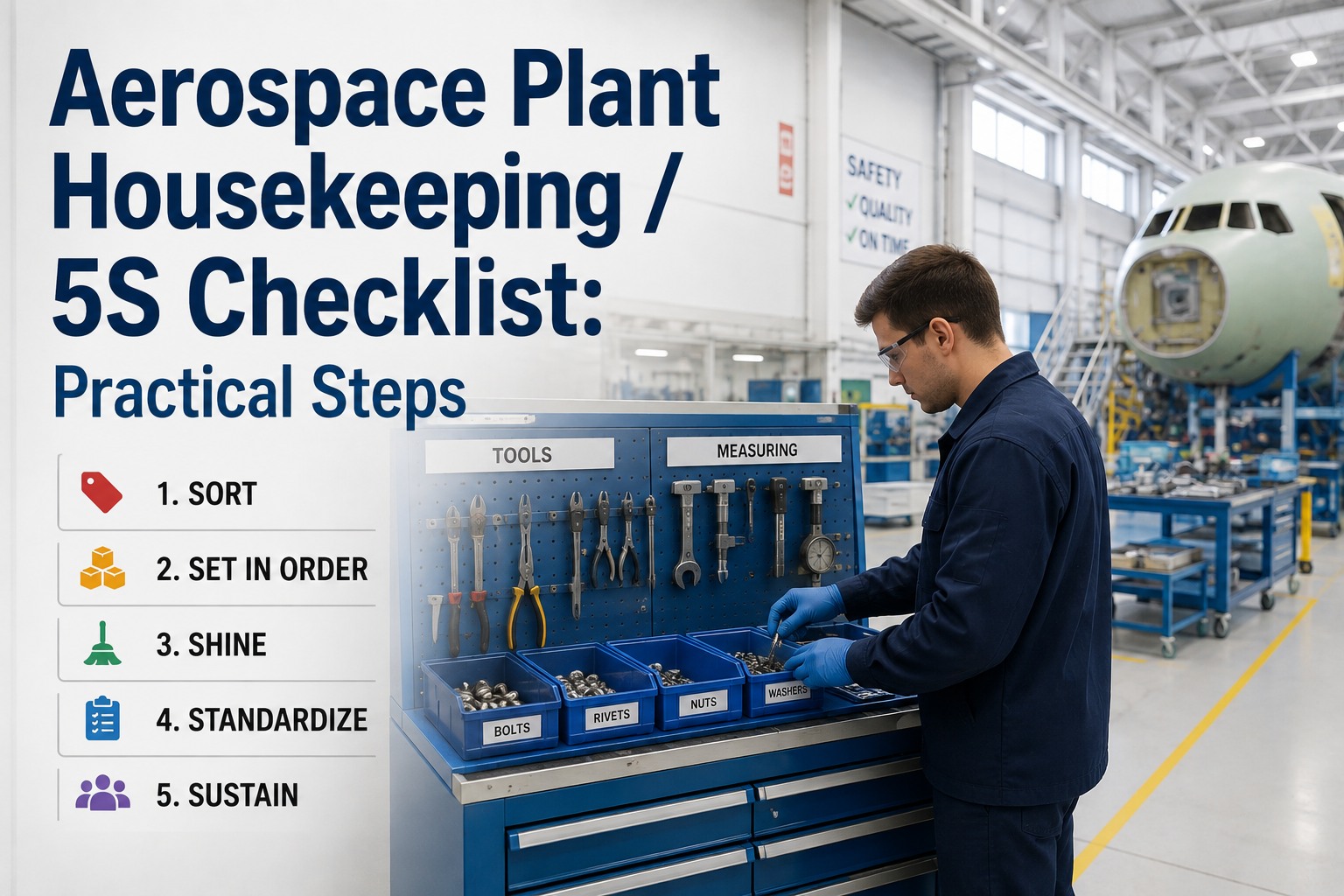
An aerospace plant housekeeping / 5S checklist is the fastest way to catch small issues before they become shutdown-level failures — and the biggest reason inspections fail is inconsistency across technicians, shifts, and sites. This guide gives you an audit-ready aerospace plant housekeeping / 5S checklist you can deploy today, with the exact inspection points, pass/fail criteria, and escalation rules your team can defend to any AS9100, AS9145 APQP, or ITAR auditor. It covers aerospace CNC inspection, clean assembly zones, composite handling, machining audit trails, and lean 5S compliance in one repeatable procedure. OxMaint's maintenance management software turns this checklist into a scheduled work order on every technician's phone — capturing photos, readings, and e-signatures against each item, escalating any fail automatically, and storing a complete inspection history against the asset. Start Free Trial and standardize how every inspection gets done.
The real cost of inconsistent housekeeping & 5S in aerospace manufacturing
In aerospace, a housekeeping miss is not a messy floor — it is a Foreign Object Debris (FOD) event, a contaminated composite layup, a failed AS9100 audit, or a grounded work order. Plants that run 5S on paper see the same three failures repeat across shifts and sites.
A 180-asset aerospace machining plant spending $42K/yr on reactive cleanup and audit prep typically recovers that entire budget in the first year by standardizing 5S into scheduled, traceable digital inspections. The difference is not effort — it is consistency. OxMaint makes the checklist identical for every technician, every shift, every site.
Aerospace plant housekeeping / 5S checklist: the 5 pillars with pass/fail criteria
Each pillar below is written as an inspection point your team can defend. Use it as a printable aerospace plant housekeeping / 5S checklist, or deploy it in OxMaint so every item is captured with a photo, a reading, and an e-signature.
- Remove all tools, fixtures & materials not needed for the current job from the work zone
- Red-tag any item without a defined home or current work order
- Clear FOD bins, chip trays & coolant areas of foreign objects
- Pass: zero untagged items in zone · Fail: any red-tag unresolved >24h
- Shadow boards complete — every tool has a labeled, outlined home
- Calibrated instruments stored in designated, protected locations
- Composite materials & adhesives within shelf-life and stored per spec
- Pass: 100% tools in home · Fail: any calibrated tool out of place
- CNC machines wiped down; coolant, oil & chip buildup removed
- Clean assembly zones at required cleanliness level (no dust, fibers, residue)
- Inspect while cleaning — leaks, cracks, loose fasteners, abnormal wear logged
- Pass: no visible contamination · Fail: any leak or defect found
- Zone checklists posted & current version; responsibilities assigned by shift
- Cleaning & inspection frequencies defined per asset criticality
- Photo standards show what "good" looks like for each zone
- Pass: checklist version current · Fail: missing or outdated standard
- Weekly layered audits by team leads; monthly by plant management
- 5S score trended per zone; corrective actions closed on time
- New technicians trained & signed off before independent inspection
- Pass: audit score ≥90% · Fail: repeat finding in same zone
- E-stops, guards & interlocks present, accessible & functional
- Aisles, exits & eyewash stations clear and marked
- LOTO points identified; PPE available & in spec at each station
- Pass: all safety devices verified · Fail: any device blocked or inoperative
Aerospace CNC, composite & clean assembly inspection checklist
Aerospace plants run mixed environments — a machining audit has different limits than a composite layup room or a clean assembly cell. This scannable table gives the inspection points, typical limits, and escalation trigger for each zone.
| Zone | Key inspection points | Typical limit / criteria | Escalate if |
|---|---|---|---|
| Aerospace CNC machining | Coolant concentration & pH, chip removal, way-lube level, spindle vibration, tool wear offsets | Coolant 7–10% / pH 8.5–9.2; vibration within OEM baseline | Any reading out of band or visible leak |
| Composite layup / cure | Material shelf-life & freezer log, cleanroom garments, humidity & temp, tool surface condition | Temp 18–24°C, RH <60%, materials within out-time | Expired material or environmental excursion |
| Clean assembly | FOD control, ESD mats & wrist straps, torque tool calibration, particle count | ISO 14644 class per program; torque tools in cal | FOD found or calibration overdue |
| ITAR / controlled areas | Access log, badge control, covered work-in-process, segregated scrap & documentation | 100% access logged; no uncovered controlled parts | Any unlogged entry or exposed controlled item |
| General plant / aisles | Floor marking, rack condition, spill kits, lighting, fire extinguisher access | Aisles clear; extinguishers inspected monthly | Blocked egress or damaged racking |
Turn this aerospace plant housekeeping / 5S checklist into a repeatable, audit-ready system
Paper checklists fail because they depend on memory and goodwill. OxMaint's AI-powered CMMS + EAM platform delivers the checklist as a scheduled work order, captures proof against each item, and escalates any fail automatically — so no reading, defect, or corrective action falls through the cracks.
How to roll out an aerospace 5S program in 30 days
Most plants overthink the launch. A focused 30-day rollout gets you from paper to a sustained, digital 5S program without stopping production.