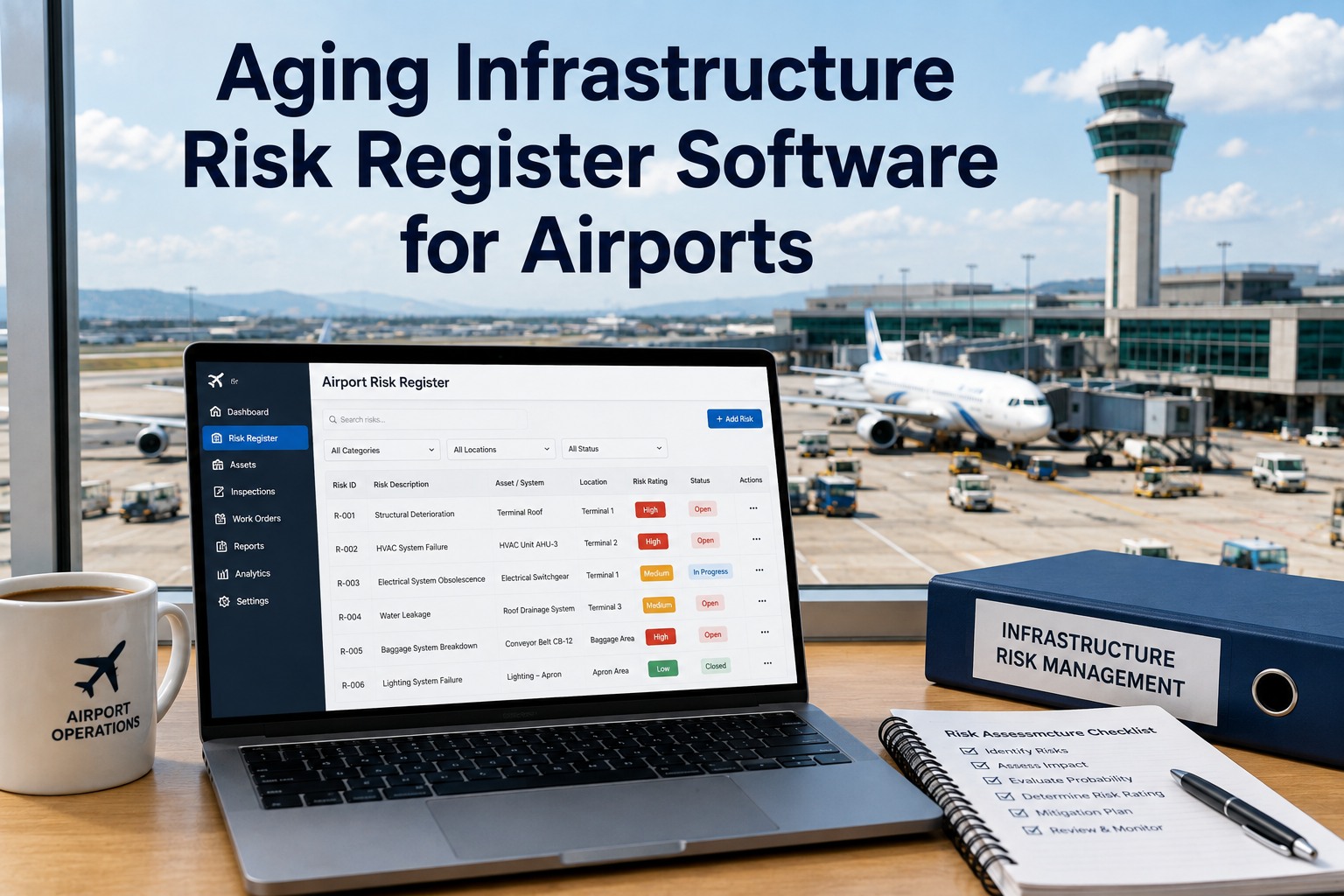
Airport aging infrastructure risk register software is where extended asset lives stop being a whispered engineering concern and become a data-backed capital case the board can actually approve. This guide covers the 4-tier airport asset criticality model, the 5×5 risk register matrix boards understand, the regulatory anchor points (14 CFR Part 139, ACRP, FAA Order 5190.6C), and the report structure capital committees fund. Start free on OxMaint to build your airport risk register, or book a demo.
Aging Infrastructure Risk Register Software · For Airports That Report to Boards
14 CFR Part 139 · ACRP-aligned · capital-committee ready.
Part 139
14 CFR airport operating certification — every safety and security asset must stay in serviceable condition, always
400+
ACRP practical resources for airport practitioners — managed by TRB National Academies, FAA-sponsored
PCI
Pavement Condition Index — the FAA-recognized runway/taxiway condition scoring foundation for AIP eligibility
5190.6C
FAA Airport Compliance Manual — the Feb 2026 order anchoring compliance obligations that the register maps against
The 4-Tier Airport Asset Criticality Model
Not every aging asset carries the same risk. A worn taxiway light and a corroded fuel-farm valve both need attention, but only one grounds the airport. The four-tier model below is the field-standard segmentation aligned to 14 CFR Part 139 that lets a capital committee focus on where the risk actually lives.
Tier 1
Airside — Safety-Critical
Example assetsRunway & taxiway pavement · airfield lighting · ARFF vehicles · fuel farm · fuel hydrant system · NAVAIDs
Regulatory anchor14 CFR Part 139 · FAA AC 150/5300 series · Grant Assurances
Failure consequenceRunway closure · certificate action · accident / incident risk
Tier 2
Terminal — Operational
Example assetsJet bridges · baggage handling system · terminal HVAC · escalators & elevators · CCTV · access control · fire suppression
Regulatory anchorNFPA 25 & 72 · TSA screening requirements · ADA · local fire code
Failure consequenceFlight delays · passenger service impact · SLA penalties · reputational cost
Tier 3
Landside — Service
Example assetsParking garages · access roads · curbside canopies · shuttle infrastructure · landside lighting
Regulatory anchorLocal building & life-safety codes · ADA · state DOT for access roads
Failure consequenceCustomer experience degradation · revenue loss · localized closure
Tier 4
Ancillary — Support
Example assetsAdmin buildings · maintenance shops · storage · non-passenger utility infrastructure
Regulatory anchorStandard building code · workplace safety
Failure consequenceInternal productivity impact · minor cost exposure
The 5×5 Risk Register Matrix — With Real Airport Assets Plotted
The 5×5 likelihood × consequence matrix is the single visual that translates asset condition data into a language capital committees fund. Below is the standard grid with example airport assets plotted at typical positions when the aging-infrastructure conversation begins — every red-zone asset needs a defensible action plan attached before the next board cycle.
Consequence →
Rare
Unlikely
Possible
Likely
Almost Certain
Catastrophic
ARFF fleet
Runway pavement
Fuel farm
Major
Airfield lighting
Jet bridges
Terminal HVAC
Baggage system
Moderate
NAVAIDs
Elevators
Escalators
Access control
Minor
Landside lighting
Curbside canopies
Parking garages
Negligible
Admin HVAC
Maint shops
Likelihood →
Low — monitor
Medium — planned renewal
High — capital case now
Critical — board action
Asset Life-Cycle · Design Life · Current Age · Remaining Useful Life
The RUL bar below is the second visual boards fund from. Each row shows a typical airport asset category, the design life the industry references, and the point at which the capital-renewal case moves from "planning" to "urgent." The renewal decision window is not at end-of-life — it's roughly at 70–85% of design life, where lead time still supports a defensible plan.
Runway Pavement
Design life: 20 yr
PCI-driven renewal · overlay vs reconstruction decision opens ~ year 15
Airfield Lighting (LED conversion)
Design life: 15 yr
Failed-lamp rate + circuit resistance trend · retrofit case builds year 10–12
Jet Bridges (Passenger Boarding)
Design life: 25 yr
Structural + drive-system inspection · major refurb vs replace decision year 18–20
Terminal HVAC (Chillers & AHUs)
Design life: 20 yr
Efficiency degradation + refrigerant regulation · high-efficiency retrofit case
Baggage Handling System
Design life: 20 yr
Reliability + throughput ceiling · full system replacement is a multi-year project
ARFF Vehicles
Design life: 15 yr
Part 139 index compliance · AIP eligibility for replacement
Build Your Airport Risk Register on OxMaint — Free Forever
Sign up on OxMaint's free forever plan and load the 4-tier asset criticality model, the 5×5 risk matrix, and per-asset RUL tracking. Board-ready reports export straight from the platform. No card, no time limit.
Regulatory & Standards Framework the Register Maps Against
An airport risk register earns its authority by mapping every risk line to a specific regulatory or standards anchor. The six anchors below are the ones every capital committee and FAA inspector recognizes on sight.
Anchor 01
14 CFR Part 139
Airport operating certification for scheduled & unscheduled aircraft >30 seats and air carrier ops >9 seats. Safety and security assets must stay in serviceable condition.
Anchor 02
FAA AC 150 Series
Advisory Circulars covering pavement design, airfield lighting, marking, drainage, ARFF. Reference standard for every airside asset spec and renewal case.
Anchor 03
FAA Order 5190.6C
Airport Compliance Manual (Feb 2026). Grant assurance obligations — the airport commitments made in exchange for AIP funding, still binding decades later.
Anchor 04
ACRP Reports
400+ practical resources from TRB National Academies. Report 138 covers preventive maintenance program design and prioritization for airports specifically.
Anchor 05
NFPA 25 & 72
Fire suppression system inspection, testing, maintenance (NFPA 25) and fire alarm signaling (NFPA 72). Documented test intervals for every terminal asset in these systems.
Anchor 06
AIP Funding Framework
Airport Improvement Program entitlement + discretionary funding for runways, taxiways, signage, lighting, markings. Register data supports competitive AIP applications.
The Board-Ready Risk Report · 5 Sections a Capital Committee Actually Reads
A risk register that lives only in the CMMS never funds anything. The five-section report structure below is what gets extracted from the register and put in front of the capital committee — condensed, defensible, action-oriented.
Section 01
Executive Risk Summary
One page. Count of Tier 1 assets in high/critical risk zone. YoY movement. Number of assets past 85% of design life. The board reads this and nothing else.
Section 02
5×5 Risk Matrix With Plot
The heat map with every asset plotted. Committee members find the red squares in 15 seconds. The universal visual that translates asset condition into fundable decisions.
Section 03
Prioritized Capital Renewal List
Ranked list of the top 20 renewal candidates. Risk score · estimated capital · AIP eligibility flag · consequence-of-do-nothing sentence for each line.
Section 04
Regulatory Compliance Position
Part 139 obligations, grant assurances, NFPA test-interval status. Aging assets that are still compliant today but on trajectory to lose compliance within 3 years.
Section 05
3-Year Capital Roadmap
Renewal sequencing across the next 3 fiscal cycles. AIP application windows aligned. The plan the committee actually approves, defers, or adjusts.
How OxMaint Runs the Full Airport Risk Register Program
Asset inventory, condition scoring, tier assignment, RUL tracking, and board-ready reporting all run on one CMMS — designed for airport asset management teams reporting into capital committees and prepared for the FAA inspection that can arrive any time of year.
Inventory
Full Asset Register With Age Data
Every airside, terminal, landside, and ancillary asset — install date, design life, current age, and Part 139 flag captured against a single hierarchy.
Score
Condition + Consequence Scoring
Standardized condition scoring (PCI for pavement, condition indices for equipment) plus consequence scoring by tier. Feeds directly into the 5×5 matrix position.
Estimate
Remaining Useful Life Tracking
RUL calculated from install date, condition trend, and failure history. Renewal window flags at 70–85% of design life for capital planning lead time.
Prioritize
Ranked Capital Renewal List
Top-20 renewal candidates ranked by risk score, with AIP eligibility flag and do-nothing consequence per line. The list capital committees fund from.
Comply
Part 139 & NFPA Position Tracking
Test intervals, inspection cadence, grant assurance obligations tracked against every applicable asset — no-gap documentation for FAA inspection.
Report
Board-Ready Extract
5-section capital committee report generated from live register — executive summary, matrix, prioritized list, compliance position, 3-year roadmap.
Give the Board the Airport Risk Data They Actually Fund From
Free forever plan — no card, no time limit. Load the 4-tier model, plot assets on the 5×5 matrix, track RUL against design life, and export the 5-section board report straight from the platform. Or book 30 minutes and we'll walk your airport's aging-asset portfolio end-to-end.
Frequently Asked Questions
What is an airport aging infrastructure risk register?
A live database of every airport asset that could fail meaningfully as it ages — pavement, lighting, ARFF vehicles, jet bridges, terminal HVAC, baggage systems, fuel farms, escalators — scored on likelihood of failure and consequence if it happens, and mapped to the regulatory anchors (14 CFR Part 139, ACRP guidance, NFPA 25/72, AIP obligations) that govern each. The register's job is to turn asset condition data into a language the capital committee funds from: prioritized renewal candidates, defensible risk scores, and a 3-year roadmap that survives budget scrutiny.
How does the 4-tier asset criticality model work?
Tier 1 is airside safety-critical — runway and taxiway pavement, airfield lighting, ARFF vehicles, fuel farm, NAVAIDs — anchored to 14 CFR Part 139 and grant assurances, where failure means runway closure or certificate action. Tier 2 is terminal operational — jet bridges, baggage handling, HVAC, escalators, fire suppression — anchored to NFPA 25/72 and TSA, where failure means flight delays and SLA impact. Tier 3 is landside service — parking, access roads, curbside — where failure hits customer experience and revenue. Tier 4 is ancillary — admin buildings, shops, storage — where failure hits internal productivity. Segmentation lets the capital committee focus on where the airport-grounding risk actually lives.
Why is 70–85% of design life the renewal decision window, not end-of-life?
Because a defensible capital case requires lead time. A runway overlay is a multi-year planning and execution cycle; a baggage system replacement is a 2–3 year project; a jet bridge major refurb needs engineering, procurement, and shutdown coordination. Starting the renewal case at end-of-life means running the asset past its design life while the project executes — which is exactly what turns a routine renewal into an emergency capital request that the board sees as a planning failure. The 70–85% trigger point preserves lead time and keeps the renewal in the planned-capital track rather than the emergency track.
What role does ACRP play in the register?
The Airport Cooperative Research Program has published 400+ practical resources specifically for airport operators, managed by the Transportation Research Board of the National Academies and sponsored by the FAA. ACRP Report 138 (Preventive Maintenance at General Aviation Airports) is the go-to reference for PM program design and prioritization — guiding principles, safety and economic priority weighting, resource planning, implementation. The register cites ACRP guidance as one of the recognized methodological anchors alongside Part 139 and FAA Advisory Circulars, which strengthens the case with capital committees and FAA reviewers alike.
Book a demo to see the register-to-ACRP mapping.
Can register data support an AIP grant application?
Yes — and this is where the register earns real dollars. The FAA Airport Improvement Program funds airport infrastructure projects like runways, taxiways, signage, lighting, and markings, with entitlement funding based on passenger volume plus discretionary funding for larger needs. Competitive AIP applications benefit from documented asset condition data, quantified risk scores, and a coherent capital roadmap that shows the requested project sits inside a broader planning discipline rather than in isolation. Register outputs — PCI scores for pavement, condition trends for lighting, ARFF Part 139 index compliance status — all feed directly into the AIP business case.
Sign up free to start building the data foundation.