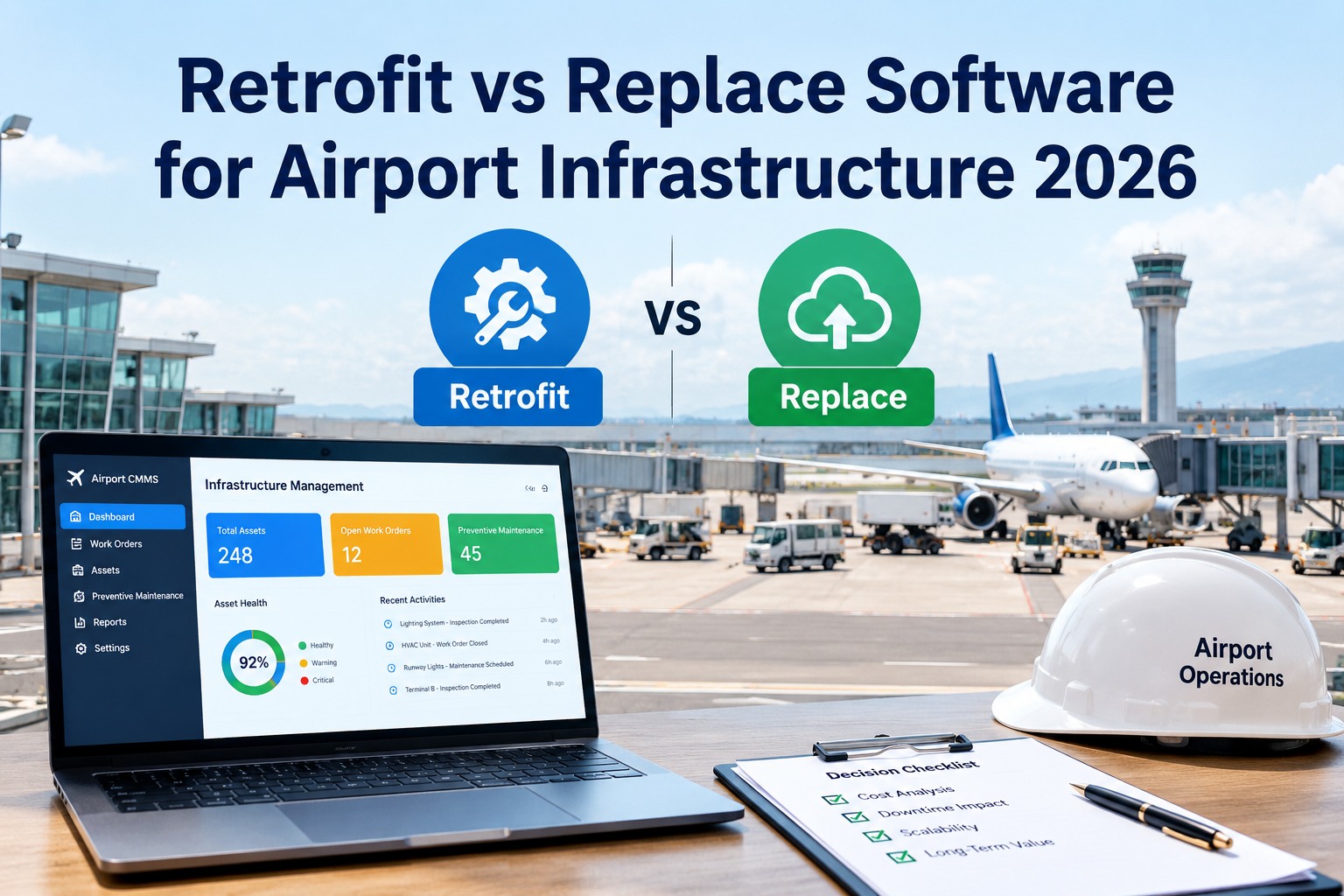
Aging airport infrastructure is the quiet risk on every executive's balance sheet: runways, HVAC plants, baggage systems and power distribution built decades ago, most with no capital renewal plan behind them and a "fix it when it breaks" posture that holds until an unmonitored asset fails catastrophically and takes operations down with it. Retrofit vs replace software turns that risk into a defensible capital plan — the system that decides, per asset, whether to extend life or fund replacement, and gives the board the operational data to approve it. This guide covers the 2026 decision framework and how OxMaint's maintenance management software carries it. Start free or book a demo.
Aviation · Capital Planning · Retrofit vs Replace · CMMS 2026
Retrofit vs Replace Software for Airport Infrastructure 2026
The decision framework hub airports use to defend infrastructure spend — condition, remaining useful life, and lifecycle cost per asset, turned into a capital plan the board and funding partners will approve.
80%
of an asset's lifetime cost is operation & renewal, not purchase
30–40%
annual maintenance vs replacement value — the replace threshold
10,000+
maintainable assets at a typical large international airport
15–30 yr
life extension a documented reconstruction can add
The Real Problem Isn't the Decision — It's the Data Behind It
Airports replacing assets on manufacturer age schedules do two expensive things at once: they scrap equipment with years of life left, and they miss the assets degrading faster than the schedule predicts. Condition-based decisions need condition data — which most airports don't systematically collect. The result is a capital committee funding the loudest project request in the room instead of the highest-consequence one. Sign up free and OxMaint tracks every asset with age, condition, failure history and remaining-useful-life estimates, so the decision rests on evidence, not intuition.
Age-Schedule Replacement
Replacing on manufacturer-recommended age wastes budget on assets with significant remaining life — and misses the ones degrading faster than the schedule.
No Condition Baseline
Without systematic condition data, there's no way to prove an asset can be safely extended — or that it can't. The decision defaults to guesswork.
Split Budget Stories
When repair spend lives apart from replacement timing, the maintenance budget and the CapEx request tell two different stories about the same asset.
Invisible Off-Book Assets
A surprising number of airports have critical equipment nobody tracks. It works until it fails — and a capital renewal plan makes the invisible fundable.
Start Here: The Condition Assessment
Every infrastructure decision should begin with a condition assessment — a formal inspection that paints a clear picture of what you actually have. It's the step that changes plans: officials at one California airport were set to replace a primary runway until a condition assessment and budget review pointed to a different, cheaper path. The first instinct to replace is often not the only alternative. Book a demo to see condition scoring configured for your asset categories — pavement on FAA PCI, HVAC on ASHRAE, structure on engineering criteria.
Condition Score 1–10 · built from four inputs
Inspection Findings
What the formal assessment actually recorded on the asset.
Age vs Design Life
Where the asset sits against its engineered lifespan.
Maintenance Cost Trend
Whether repair spend is stable or climbing.
Failure History
Frequency and severity of unplanned events.
Scores update after each inspection or IoT data cycle — so the committee sees not just today's grade but whether the asset is holding stable or sliding toward a renewal threshold.
The Decision Framework: Four Paths, Not Two
"Retrofit vs replace" is really a spectrum. A condition assessment usually reveals that between "leave it" and "rip it out" sit two middle paths that save money and disruption. Matching the asset to the right path is the whole discipline — and the pavement example makes it concrete. Sign up free and OxMaint records the chosen path and its justification per asset, so every decision is documented.
Lowest cost
Maintain / Repair
Arrest deterioration where it's appeared without extending underlying life. Right when condition is stable and cost trend is flat.
Pavement: crack-seal & spot-patch — an operating expense
Life-extending
Retrofit / Rehabilitate
Targeted upgrade that documents real life extension — often the smartest move on a structurally sound asset with an aging component.
Pavement: mill-and-overlay — +10–15 yrs, capitalized
Deep renewal
Reconstruct
Rebuild the full structure with higher capacity where the base itself is failing. A capital improvement with the longest life gain.
Pavement: full reconstruction — +15–30 yrs, capital
End of life
Replace
Fund new when maintenance economics cross the line — annual cost above 30–40% of replacement value, or parts and service impact force the timing.
Any asset: continued repair now costs more than renewal
The Board Doesn't Fund the Best Argument. It Funds the Best Evidence.
Oxmaint converts operational history into a ranked project list, multi-year spending forecast and lifecycle cost comparison across retrofit and replacement options — the structured documentation a capital decision needs to hold up in bond presentations and budget review.
The Numbers That Decide It
A defensible retrofit-vs-replace call rests on a handful of figures — and the point is that all of them come from tracked operational history, not age estimates or intuition. These are the inputs a committee should be arguing from. Book a demo to see them aggregated across your portfolio into a capital roadmap.
Remaining Useful Life
Estimated life left against rising repair frequency — the crossover point where continued maintenance stops paying.
Maintenance-to-Replacement Ratio
Annual maintenance cost as a percentage of replacement value. Past 30–40% is the common signal to replace.
Total Cost of Ownership
Purchase is only 15–20% of lifetime cost; the other 80% is operation, maintenance and renewal. TCO reframes the whole call.
Service Impact Score
Unplanned work frequency, downtime and passenger impact — turning "this feels urgent" into a ranked, evidence-based input.
Condition Trend
Not just the current grade but the direction — holding stable or deteriorating toward a renewal trigger date.
Documented Life Extension
Whether a retrofit's added years are engineering-documented — the line that also decides capitalize vs expense under GASB.
Age-Threshold Guesswork vs. Retrofit-vs-Replace in OxMaint
The gap between a capital plan that gets approved and one that gets questioned is whether every number traces to operational data. Here's what changes when the decision lives in a CMMS built for airport asset management. Start free and put your first asset class on a defensible footing this week.
What OxMaint Gives Engineering & Capital Planning
OxMaint scales to the full complexity of airport asset management — airfield to terminal systems — giving engineering the visibility to prevent failures and finance the defensible data to fund renewal. Here's the concrete mapping. Book a demo to see it on your portfolio.
Asset Register with RUL
Every asset tracked with age, condition, failure history and remaining-useful-life estimate — the foundation every retrofit-vs-replace call rests on.
Condition Scoring, Per Category
1–10 scores on criteria customized per asset class — pavement on FAA PCI, HVAC on ASHRAE, structure on engineering rules — refreshed each cycle.
Lifecycle Cost Comparison
Repair spend, replacement timing and service value in one asset cost picture, comparing retrofit and replacement economics side by side.
Risk & Service-Impact Ranking
Unplanned work, downtime and corrective cost aggregated into a service-impact score that ranks projects by consequence, not volume.
Rolling CapEx Forecast
Renewal trigger dates and cost estimates rolled into a multi-year spending forecast finance can take into bond and budget cycles.
PM Scheduling & Failure Prevention
Preventive scheduling that extends the safe useful life of aging assets — buying the deferral that makes a renewal plan affordable.
Use this framework plus OxMaint to build a defensible capital renewal plan, extend the useful life of aging assets safely, and give the board and funding partners the data they need to approve the right investments. Try OxMaint free or book a demo to see it on your airport.
"
We were carrying a capital plan the board kept sending back — every line was "this is old, we should replace it," with no numbers behind the timing. We stood up OxMaint across the airfield and terminal estate, scored every asset, and let repair-cost trends and remaining-life estimates drive the ranking instead of age. Two projects we'd slated for full replacement came back as retrofits with documented life extension — saving eight figures and months of disruption — and the ones that genuinely needed replacing finally had the cost history to justify the spend. The last capital submission went through on the first pass. For the first time the plan defended itself.
Director of Engineering & Capital Planning · Large International Airport
Frequently Asked Questions
When should an airport retrofit instead of replace?
When a condition assessment shows the asset is structurally sound with an aging component, and a documented retrofit extends useful life at lower cost and disruption than replacement. Replace when annual maintenance passes 30–40% of replacement value.
Why not just replace assets on their age schedule?
Age schedules waste budget on assets with years of life left and miss the ones degrading faster than expected. Condition-based decisions need real condition data — which is exactly what most airports don't systematically collect.
How does this produce a plan the board will approve?
By replacing narrative justification with ranked project lists, multi-year CapEx forecasts and lifecycle cost comparisons built from operational data — documentation that holds up in capital review and bond presentations.
Does the retrofit-vs-replace call affect accounting treatment?
Yes. Work with documented engineering life-extension is typically capitalized; the same work without documented life-extension is often expensed as restoration — so the condition and life-extension record matters for GASB treatment too.
Can OxMaint generate CapEx forecasts finance can use in bond presentations?
Yes. OxMaint aggregates renewal trigger dates, replacement cost estimates and retrofit options across the portfolio into the multi-year forecast capital committees and finance leadership need.
Sign up free to start.
Turn Aging Infrastructure Into a Capital Plan That Defends Itself.
OxMaint tracks every asset with age, condition, failure history and remaining useful life, and produces the ranked project lists, lifecycle cost comparisons and bond-ready CapEx forecasts that get renewal approved — so retrofit-vs-replace is a documented decision, not a guess. Start free — no credit card, unlimited users, forever. Or book a demo.