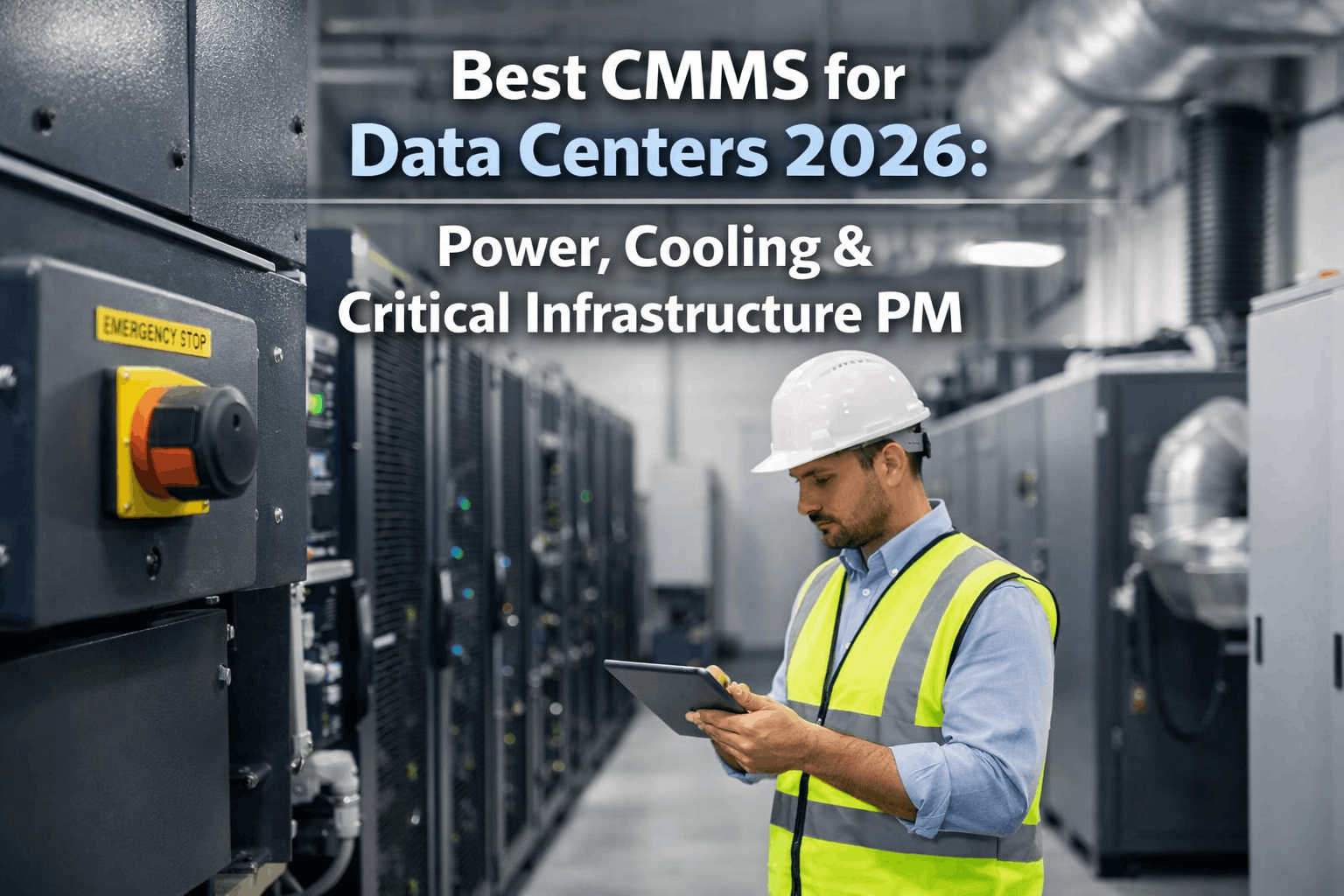
Best CMMS for Data Centers 2026: Power, Cooling & Critical Infrastructure PM
At 2:17 AM on a Tuesday, a Tier III colocation facility lost cooling in its primary server hall. A CRAH unit's variable frequency drive had been throwing intermittent fault codes for three weeks, but with no centralized maintenance system, the alerts were buried in a technician's email inbox. By the time the hot aisle reached 42°C, thermal shutdowns cascaded across 280 racks—taking down SaaS platforms, financial transaction engines, and a regional hospital's EHR system. The root cause was not a catastrophic equipment failure; it was a $200 VFD bearing that should have been replaced during a routine quarterly PM. This scenario repeats across data centers globally, where the complexity of interdependent power and cooling systems overwhelms spreadsheet-based maintenance programs. Schedule a demo to see how Oxmaint prevents cascading failures before they start.
Critical Infrastructure 2026
Best CMMS for Data Centers: Power, Cooling & Critical PM
Achieve 99.999% uptime with automated preventive maintenance for UPS systems, CRAC/CRAH units, PDUs, generators, fire suppression, and environmental monitoring.
average loss from unplanned outages (Uptime Institute)
$9,000/minAvg. cost of Tier III downtime
99.999%Uptime achievable with CMMS PM
70%Failures preventable with PM
70%Outages caused by human error or missed PM
5.26 minMax annual downtime at 99.999%
AutoPM scheduling across all critical systems
24/7Environmental threshold monitoring
Why Reactive Maintenance Destroys Uptime
In a data center environment, a "fix it when it breaks" approach is not just inefficient—it is an existential threat to the business. Every piece of critical infrastructure exists as part of an interdependent chain: the generator feeds the UPS, the UPS feeds the PDU, the PDU feeds the servers, and the cooling system protects them all. When one link fails without warning, the cascade can take down an entire facility in minutes. Modern data center operations require a proactive maintenance strategy that anticipates failures based on runtime hours, thermal cycling data, and manufacturer service intervals. Start Free Trial.
The Hidden Costs of Missed Preventive Maintenance
01
Cascade Failures
$2.5M
Average cost of a single unplanned outage including SLA penalties, lost revenue, and emergency repair labor.
02
UPS Battery Failure
#1
Leading cause of data center downtime. Batteries degrade silently—without PM testing, failure is the first symptom.
03
Cooling Drift
5°C
Temperature deviation that triggers thermal throttling. Uncalibrated CRAH units drift without quarterly PM checks.
04
Generator No-Start
15%
of standby generators fail to start on demand due to skipped monthly load bank tests and fuel quality checks.
05
Compliance Gaps
Audit
SOC 2, ISO 27001, and Uptime Institute audits require documented PM histories—spreadsheets fail scrutiny.
The Automated PM Lifecycle for Critical Infrastructure
A purpose-built CMMS transforms data center maintenance from a spreadsheet nightmare into an automated, auditable process. By integrating PM schedules with equipment runtime counters, environmental thresholds, and SLA obligations, facility managers ensure that every UPS battery test, CRAH filter change, and generator exercise happens on time—without a single task falling through the cracks.
Proactive Critical Infrastructure PM Workflow
Automated for 99.999% uptime
1
Continuous Monitoring & Alerting
BMS IntegrationEPMS Feeds
CMMS ingests real-time data from BMS, EPMS, and environmental sensors. Runtime counters, thermal readings, and power quality metrics trigger auto-alerts when thresholds approach PM service intervals.
2
Automated PM Work Order Generation
Runtime TriggersCalendar Schedules
Work orders auto-generate based on manufacturer intervals, runtime hours, or calendar cycles. Each task includes step-by-step procedures, safety lockout/tagout requirements, and required parts lists.
3
Technician Execution & MOPs
Mobile AppMOP Checklists
Technicians receive tasks on mobile devices with Method of Procedure checklists. Battery impedance readings, refrigerant levels, and torque values are captured digitally with photo evidence for audit trails.
4
Vendor & Contractor Coordination
Vendor PortalSLA Tracking
Specialized PM tasks (generator load bank, UPS capacitor replacement, fire suppression recertification) are dispatched to certified vendors with SLA response time tracking and completion verification.
5
Compliance Reporting & Trend Analysis
DashboardAudit Logs
Completed PM records feed compliance dashboards. SOC 2, ISO 27001, and Uptime Institute audit packages generate automatically. Trend data predicts equipment end-of-life and capital planning needs.
See Automated Data Center PM in Action
Watch how Oxmaint helps facility managers automate PM schedules across UPS, cooling, power distribution, and fire suppression systems—with full audit trail compliance.
Connected Systems: The Data Center Maintenance Ecosystem
Effective data center maintenance does not happen in isolation. It requires seamless integration between the CMMS, Building Management System, Electrical Power Monitoring, and environmental controls. Connecting these systems ensures that every alarm, every threshold breach, and every runtime milestone triggers the correct maintenance response—automatically.
Integrated Data Center Maintenance Stack
Oxmaint CMMS
Central Hub
PM scheduling, work orders, asset lifecycle, spare parts inventory, vendor management, compliance reporting
BMS / DCIM
Environment Source
Temperature, humidity, airflow, rack power density, hot aisle/cold aisle monitoring, capacity planning
EPMS
Power Source
UPS load, PDU branch circuits, generator status, ATS transfer logs, power quality harmonics
Seamless data flow ensures every environmental alarm, power anomaly, and runtime milestone triggers the correct PM response automatically.
Uptime KPIs & Performance Metrics
The success of a data center PM program is measured by uptime availability, Mean Time Between Failures (MTBF), and compliance audit pass rates. Tracking these metrics allows facility managers to make data-driven decisions about equipment refresh cycles, staffing levels, and capital investment priorities—proving ROI to executive leadership and customers alike.
Critical Infrastructure Performance KPIs
Optimizing for five-nines uptime
Facility Uptime
99.99%
Target: 99.999%
Total facility availability (power + cooling)
PM Compliance
97%
Target: 100%
PM tasks completed on schedule per SLA
MTBF (Cooling)
18 mo
Target: >24 months
Mean time between CRAC/CRAH failures
Audit Readiness
100%
Target: 100%
SOC 2 / ISO 27001 documentation complete
Before & After: The PM Transformation
Implementing a structured CMMS-driven PM program for data center critical infrastructure yields immediate and measurable results. From eliminating unplanned outages to passing compliance audits with zero findings, the operational shift is dramatic and quantifiable.
Spreadsheet Tracking vs. CMMS-Automated PM
Unplanned Outages
Quarterly
→
Near Zero
PM Compliance Rate
68%
→
99%
Audit Preparation
6 Weeks
→
1-Click
Equipment Lifespan
7 Years
→
12+ Years
Emergency Repair Cost
$280K/yr
→
$45K/yr
Spare Parts Stocking
Guesswork
→
Data-Driven
SLA Penalty Exposure
High
→
Minimal
Eliminate Unplanned Downtime Today
Join leading data center operators using Oxmaint to automate critical infrastructure PM. Ensure five-nines uptime, pass every audit, and extend equipment lifecycles.
A standardized PM matrix ensures that no component in the power chain, cooling loop, or life safety system is overlooked. From daily environmental checks to annual generator overhauls, defining these tasks with documented procedures prevents the small oversights that cause catastrophic failures.
We operated three data centers on spreadsheets for years and convinced ourselves it was working. Then we failed a SOC 2 audit because we couldn't prove our UPS batteries had been tested on schedule. The auditor didn't care that we 'probably did it'—they needed timestamped, photo-documented evidence. Implementing Oxmaint gave us that audit trail overnight. But the real transformation was operational: our PM compliance went from 68% to 99%, our MTBF on cooling units doubled, and we haven't had a single unplanned power event in 14 months. The CMMS didn't just fix our compliance problem—it eliminated the failures that created compliance problems in the first place.
— VP of Data Center Operations, Multi-Site Colocation Provider
99%
PM compliance rate
2x
Cooling MTBF increase
Zero
Unplanned power events
1-Click
Audit report generation
Data center operators who achieve five-nines uptime understand that reliability is not luck—it is the product of disciplined, documented preventive maintenance executed consistently across every critical system. Schedule a demo to build your critical infrastructure PM program.
Protect Your Uptime SLA
Oxmaint empowers data center teams to automate PM across power, cooling, fire suppression, and environmental systems. Achieve five-nines uptime, pass every audit, and extend critical equipment lifecycles.
Can Oxmaint manage PM for different equipment types from multiple OEMs?
Yes. Oxmaint is OEM-agnostic and manages assets from any manufacturer—Liebert, Schneider Electric, Eaton, Caterpillar, Cummins, Trane, and others—within a single unified platform. You can create custom asset categories, PM templates, and procedure checklists specific to each equipment model's manufacturer-recommended service intervals, ensuring that every UPS, CRAH unit, generator, and PDU receives the exact maintenance it requires.
How does Oxmaint handle the difference between calendar-based and runtime-based PM?
Oxmaint supports both trigger types simultaneously. Calendar-based PMs (e.g., quarterly CRAH filter changes) generate work orders on fixed schedules. Runtime-based PMs (e.g., UPS fan replacement at 40,000 hours) trigger automatically when integrated meter readings from your BMS or EPMS reach configured thresholds. This dual approach ensures that equipment running under heavy load gets serviced more frequently, while lightly loaded systems are not over-maintained.
Can the system generate audit-ready compliance reports for SOC 2 and ISO 27001?
Absolutely. Every completed PM task in Oxmaint is timestamped, digitally signed by the technician, and can include photo evidence, meter readings, and procedure checklist completion records. The system generates audit packages on demand that document the full maintenance history of every critical asset—exactly the evidence SOC 2, ISO 27001, and Uptime Institute auditors require. This eliminates the weeks of manual report compilation that spreadsheet-based systems demand.
Can we coordinate PM tasks with planned maintenance windows and change control?
Yes. Oxmaint allows you to define maintenance windows and link PM work orders to change management workflows. Tasks requiring system switchover (e.g., transferring load to bypass before UPS maintenance) can be flagged to require management approval and scheduled exclusively within approved change windows. This ensures that PM activities never conflict with customer SLAs or create unprotected operating periods.
Does Oxmaint manage spare parts inventory for critical spares?
Yes. Oxmaint includes a full inventory management module that tracks critical spare parts—UPS batteries, CRAH filters, generator belts, fuses, contactors, and more. The system monitors stock levels against minimum thresholds and auto-generates purchase requisitions when inventory falls below configured reorder points. This ensures that when a PM task requires a part, it is already on the shelf—eliminating the delays and premium costs of emergency procurement.