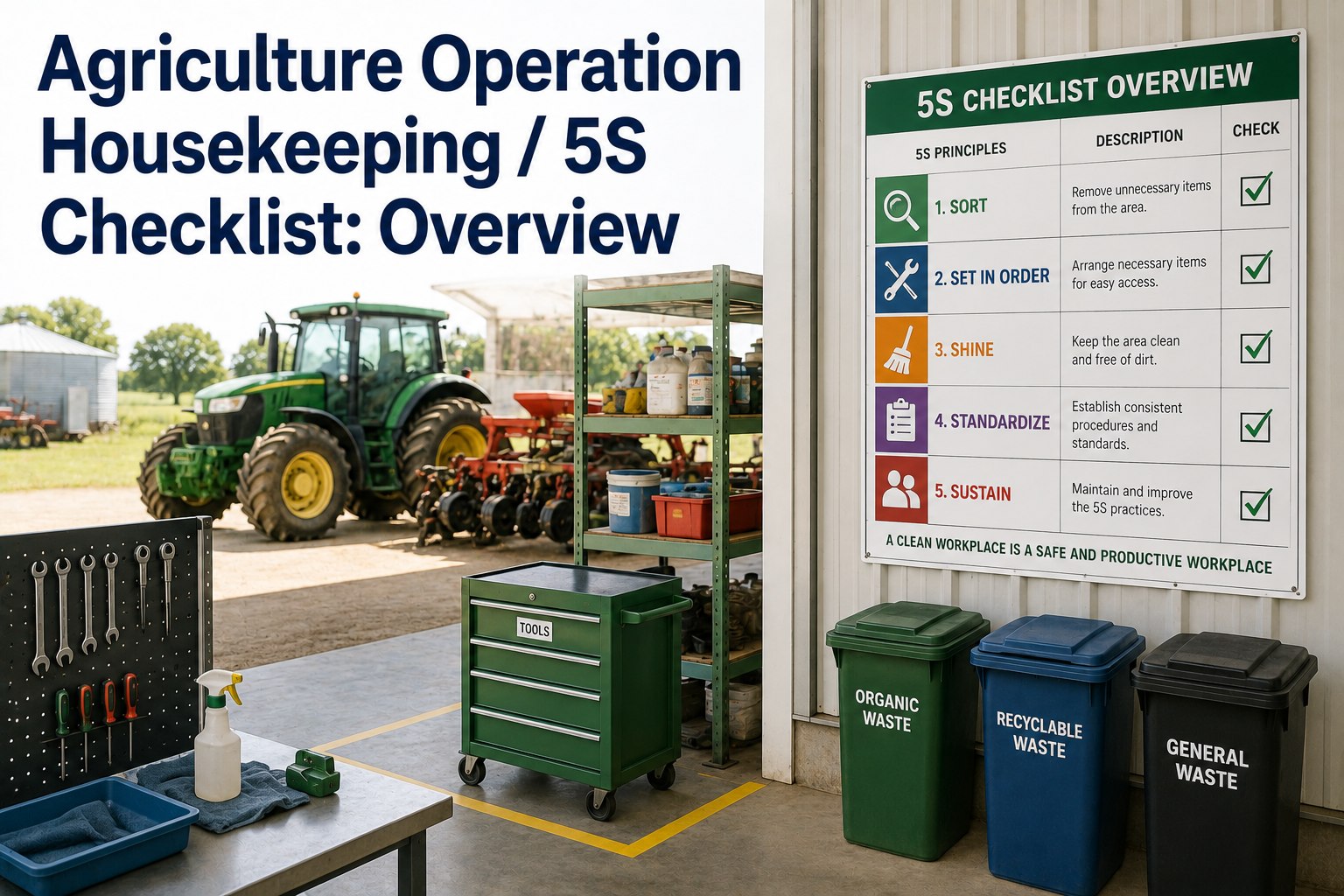
An agriculture operation housekeeping / 5S checklist is a structured, lean-aligned inspection tool that keeps farm workspaces, equipment yards, chemical storage areas and worker facilities clean, organized and audit-ready — and it's the single biggest variable in whether your operation passes a GAP certification audit or an OSHA inspection. Farms that run disciplined 5S programs (Sort, Set in Order, Shine, Standardize, Sustain) report fewer contamination incidents, faster equipment turnaround and dramatically smoother audits. Yet most operations still track housekeeping on paper clipboards that get lost, skipped or pencil-whipped — leaving EHS managers scrambling the week before an auditor arrives. This guide gives you a complete, pass/fail agriculture operation housekeeping / 5S checklist procedure aligned to OSHA 1928 agricultural standards, EPA pesticide-handling rules and GAP/GFSI food-safety schemes, plus the corrective-action workflow auditors expect to see. You can also Start Free Trial of OxMaint to digitize every check with photo evidence, e-signatures and an audit trail that builds itself.
Pass Your Next GAP or OSHA Audit Without the Week-Before Scramble
A complete 5S checklist procedure for farm operations — chemical storage, equipment yards, worker facilities and harvest zones — with clear pass/fail criteria, mandatory documentation points and digital capture that turns every inspection into audit-ready evidence.
What Poor Farm Housekeeping Actually Costs You
Agriculture consistently ranks among the most hazardous US industries — the CDC reports roughly 100 agricultural workers suffer a lost-work-time injury every single day, and poor housekeeping is a leading contributing factor in slips, chemical exposures and equipment incidents.
Beyond injuries, failed GAP certification audits can cost a grower-shipper its retail contracts — a single major non-conformance on chemical storage or sanitation can suspend certification for 90+ days. A documented, consistently executed agriculture operation housekeeping / 5S checklist is the cheapest insurance your operation can buy.
Agriculture Operation Housekeeping / 5S Checklist Template: 5 Zones, 40+ Checkpoints
This agriculture operation housekeeping / 5S checklist example is organized by zone — the same structure GAP auditors and OSHA compliance officers walk. Each item needs a pass/fail rating, a photo for any fail, and an assigned corrective action with a due date.
Chemical & Pesticide Storage
- All pesticides in original, labeled containers; no unmarked secondary jugs
- Storage locked, ventilated, with signage per EPA Worker Protection Standard
- SDS binder current and accessible within 30 seconds of the door
- Spill kit stocked: absorbent, PPE, disposal bags — inspection tag dated
- No chemicals stored near food, feed, seed or PPE (cross-contamination check)
- Inventory log reconciled within the last 30 days; expired product segregated
- Eyewash station flushed and tested weekly; test log posted
- Floor free of leaks, residues and crystallized spills (Shine step)
Equipment Yard & Shop
- Tractors, implements and row crop machinery parked in marked bays (Set in Order)
- Guards and shields in place on PTO shafts, augers and belts
- Tools shadow-boarded; nothing stored on floors, steps or cab floors
- Walkways and exits clear of hoses, cords, pallets and debris — 36-inch minimum
- Fluid leaks tagged and a work order raised within 24 hours
- Fire extinguishers charged, tagged and mounted; monthly check initialed
- Waste oil, filters and scrap tires in labeled containment, removed on schedule
- LOTO stations stocked; locks and tags accounted for
Worker Facilities & Welfare
- Field sanitation: toilets and handwashing within 1/4 mile of crews (OSHA 1928.110)
- Potable drinking water with single-use cups; dispensers sanitized daily
- Break areas clean, shaded and free of pesticide drift exposure
- First-aid kits stocked and sealed; expiration dates checked monthly
- Decontamination supplies (soap, water, towels) at mixing/loading sites
- Posted emergency contacts, field maps and muster points current
Harvest, Packing & Food-Safety Zones
- Food-contact surfaces cleaned and sanitized on a documented schedule (GAP)
- Harvest containers food-grade, intact and stored off the ground
- No glass, brittle plastic or personal items in packing areas
- Pest-control devices mapped, numbered and checked on schedule
- Condensate, standing water and product waste removed same-shift
- Traceability lot boards updated; foreign-material log reviewed weekly
Fuel, Water & Infrastructure
- Fuel tanks on secondary containment (110% capacity); no stained soil
- Hoses, nozzles and meters inspected; drip trays emptied
- Wellheads and irrigation stations protected from chemical backflow
- Manure/lagoon areas bermed, fenced and signed
- Electrical panels closed, labeled, with 36-inch clearance maintained
- Roads and culverts clear; dust-control measures active on haul routes
Documentation Points Auditors Demand
- Inspector name, date/time, zone and shift recorded on every checklist
- Photo attached to every FAIL item — before and after correction
- Corrective action assigned to a named owner with a due date
- Closure verified by a second person (e-signature)
- Repeat failures flagged for root-cause review at the monthly EHS meeting
- Records retained 3+ years and retrievable within minutes
How to Score Your 5S Audit: Pass/Fail Criteria and Inspection Frequency
A checklist without scoring is just a walk-through. Leading farm operations score each zone monthly and hold every zone above 90% — anything below triggers a documented corrective-action plan within 48 hours.
| Zone | Frequency | Pass Threshold | Critical Fail Items (auto-fail zone) | Corrective SLA |
|---|---|---|---|---|
| Chemical & Pesticide Storage | Weekly | 95% | Unlocked storage, unlabeled container, missing SDS | 24 hours |
| Equipment Yard & Shop | Weekly | 90% | Missing PTO guard, blocked exit, dead extinguisher | 48 hours |
| Worker Facilities | Daily (in season) | 95% | No potable water, no handwashing within 1/4 mile | Same shift |
| Harvest & Packing Zones | Daily (pre-op) | 100% on food-contact items | Unsanitized food-contact surface, glass in zone | Before production starts |
| Fuel, Water & Infrastructure | Monthly | 90% | Fuel outside containment, backflow risk at wellhead | 72 hours |
Worked example: a 2,400-acre row crop operation running this agriculture operation housekeeping / 5S checklist SOP found 11 fails in its first month — 4 of them auto-fail items in chemical storage that would have triggered a GAP major non-conformance. Closing them took 6 labor-hours. The alternative was a suspended certificate and a lost retail contract worth roughly $180K per season.
Lean 5S Compliance: What Each Step Looks Like in an Agriculture Operation
5S isn't abstract lean theory — on a farm it maps directly to physical zones and daily habits. Here's how each step translates, and the benchmark mature programs hit.
Sort (Seiri)
Red-tag everything in the shop and chemical shed that hasn't been used in 12 months — obsolete parts, mystery jugs, broken tools. Most operations remove 20–30% of stored items in the first pass, instantly cutting clutter and contamination risk.
Set in Order (Seiton)
Shadow boards for tools, marked parking bays for implements, labeled shelves for every chemical class. Target: any worker can find any item in under 30 seconds — and can see in one glance when something is missing.
Shine (Seiso)
Cleaning is inspection. A wiped-down engine reveals a weeping hydraulic line; a swept chemical-store floor reveals a slow container leak. Schedule 15 minutes of zone cleaning at the end of every shift — it doubles as your early-warning system.
Standardize (Seiketsu)
Turn the first three steps into a written agriculture operation housekeeping / 5S checklist procedure with named owners, photos of "what good looks like" and fixed frequencies. If the standard lives in one person's head, it dies when they leave.
Sustain (Shitsuke)
Monthly scored audits, trend charts at the EHS meeting, and recognition for zones holding 95%+. This is where paper programs collapse — and where digital checklists with automatic reminders and escalation keep lean 5S compliance alive past week three.
Digitize Your Agriculture Operation Housekeeping / 5S Checklist with OxMaint
Paper checklists fail audits because they can't prove follow-through. OxMaint turns every inspection into a closed-loop, timestamped, photo-backed record — so your EHS team walks into any GAP or OSHA audit with evidence, not excuses.
Digital Checklists with Mandatory Fields
Deploy this exact 5S template to any phone or tablet. Inspectors can't submit without photos on fail items, pass/fail on every line and an e-signature — eliminating pencil-whipping and skipped zones entirely.
Automatic Corrective-Action Work Orders
Every failed item auto-generates a work order with an owner, due date and escalation path. Operations using closed-loop tracking cut repeat findings by 40–60% within two audit cycles.
Asset-Linked Audit Trail
Inspections tie directly to the sprayer, tank or packing line they cover. Pull three years of records for any asset in under 60 seconds — the exact retrieval speed GAP and OSHA auditors ask for.
Compliance Analytics & Score Trends
Dashboards show zone scores, overdue corrective actions and repeat-fail hotspots across every site. Spot a drifting zone weeks before it becomes a non-conformance — and prove continuous improvement to certifiers.
See OxMaint Running This Exact 5S Checklist on Your Operation
Book a 30-minute demo and we'll load this agriculture operation housekeeping / 5S checklist into a live OxMaint workspace — zones, scoring, photo capture and corrective actions included.
Agriculture Operation Housekeeping / 5S Checklist: FAQs
What should an agriculture operation housekeeping / 5S checklist include?
At minimum it should cover five zones: chemical/pesticide storage, equipment yard and shop, worker welfare facilities, harvest and packing areas, and fuel/water infrastructure. Each line item needs a clear pass/fail definition, a photo requirement for failures, and a named corrective-action owner. Align items to OSHA 1928, the EPA Worker Protection Standard and your GAP/GFSI scheme's sanitation clauses.
How often should farm housekeeping and 5S inspections be performed?
High-risk zones need the highest cadence: worker sanitation and food-contact areas daily during season, chemical storage and the equipment yard weekly, and infrastructure monthly. A full scored 5S audit across all zones should run at least monthly, with results trended and reviewed at your EHS meeting.
Does OSHA require housekeeping checklists on farms?
OSHA doesn't mandate a specific checklist form, but multiple agricultural standards — field sanitation (1928.110), temporary labor camps, guarding of farm field equipment (1928.57) and the general duty clause — effectively require documented housekeeping and inspection. A written, consistently executed checklist is your primary evidence of good-faith compliance during an inspection.
How does a 5S checklist help with GAP certification audits?
GAP and GFSI auditors score sanitation, chemical storage, pest control and worker hygiene — exactly what a zone-based 5S checklist documents. Digital records with timestamps, photos and closed corrective actions demonstrate the "verify" and "correct" steps certifiers require. You can Start Free Trial of OxMaint and have audit-ready records from your very first inspection.
What's the best way to move from paper checklists to digital?
Start with your highest-risk zone — usually chemical storage — and digitize that single checklist first, then roll out zone by zone over 2–4 weeks. Choose a CMMS with offline mobile capture (connectivity is patchy in the field), mandatory photo fields and automatic corrective-action work orders. Most teams are fully paperless within a month, and a Book a Demo session can map your existing paper form into OxMaint in one call.
Make Every Shift Audit-Ready — Starting Today
Digitize your agriculture operation housekeeping / 5S checklist, close every corrective action with photo proof, and walk into your next GAP or OSHA audit with records that build themselves.
Free 14-day trial · No credit card · Set up your first checklist in under 10 minutes