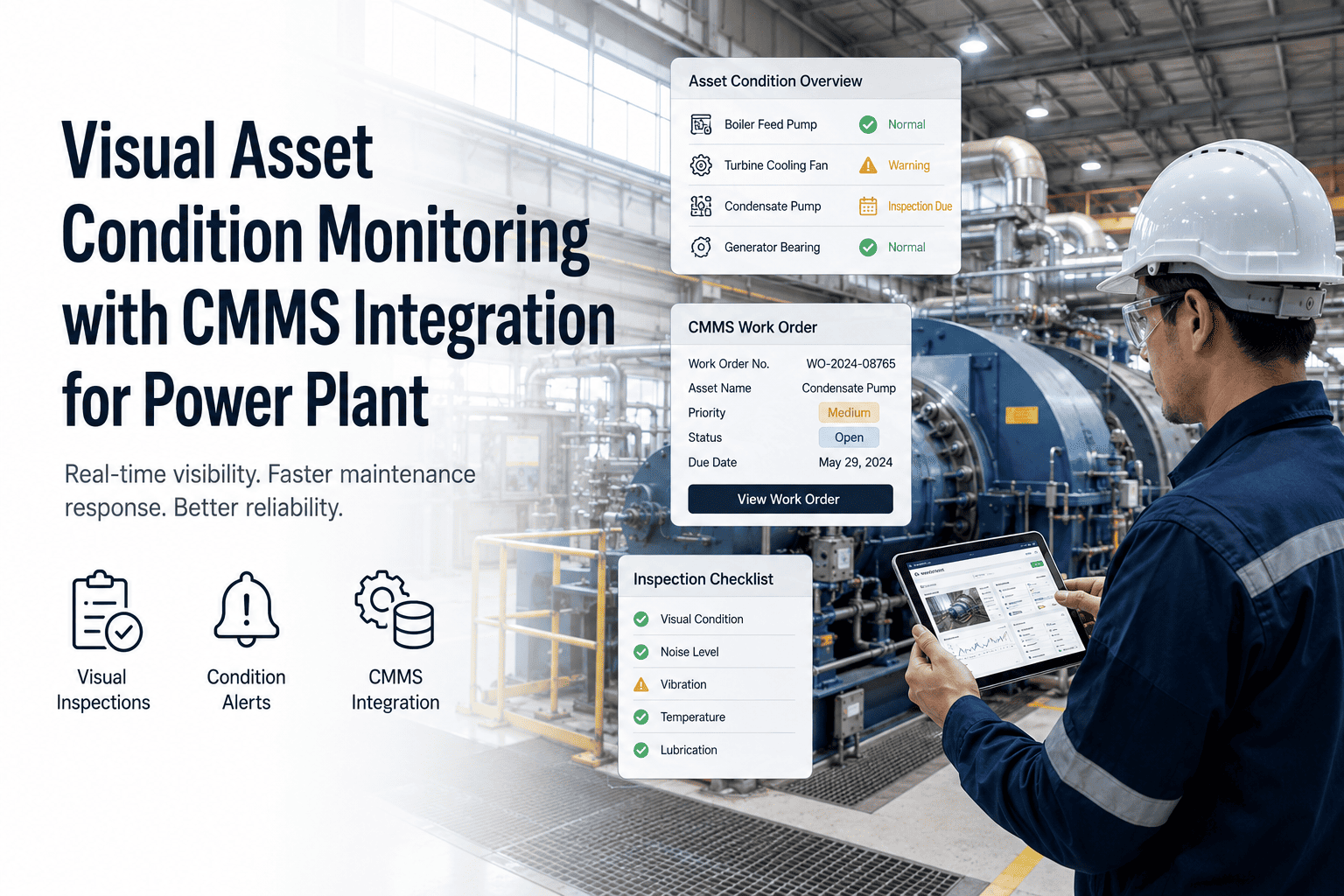
A rotary kiln is the heart of a cement plant — a 70-metre rotating steel cylinder operating at 1,450°C, processing 3,000 tonnes of clinker per day, running continuously for 200 to 300 days before a planned shutdown. When a kiln refractory brick fails unexpectedly, the shutdown is not hours — it is days of emergency brick replacement, kiln shell inspection, and controlled cooling and reheating procedures. The production loss runs at $50,000 to $120,000 per day depending on plant capacity and market conditions. The grinding mills, raw material conveyors, vertical roller mills, and cement silos that surround that kiln are equally consequential — a single clinker conveyor failure can stop clinker flow to three mills simultaneously. Cement plants have always known that maintenance quality determines production economics. The change that AI-driven maintenance introduces is the ability to know which specific asset is trending toward failure three weeks before it fails, rather than discovering it has failed when the production alarm sounds at 2am. Sign up for Oxmaint to activate AI-driven maintenance at your cement plant today.
The Maintenance Challenges Unique to Cement Plants — and What Oxmaint Does About Each
Cement plants face a specific combination of maintenance challenges driven by extreme operating conditions, high energy intensity, 24/7 production requirements, and aging infrastructure. Each challenge below maps directly to an Oxmaint capability — not a general platform feature, but a specific operational workflow that addresses the challenge. Sign up for Oxmaint to deploy these solutions at your plant.
Unplanned kiln shutdowns, mill stoppages, and conveyor failures halt production entirely. A single kiln stop costs $50,000–$120,000 per day in lost clinker production, and emergency refractory repairs extend shutdowns further.
AI-driven predictive maintenance powered by IoT sensors detects kiln shell temperature anomalies, tyre and roller wear, and mill vibration signatures 14–42 days before failure — generating scheduled work orders with parts pre-staged. Book a demo to see kiln monitoring configured.
Energy represents 40% of cement production costs. Poorly maintained equipment — kilns running with degraded combustion, mills with worn liners, compressors with fouled coolers — consumes 10–30% more energy than specification without any visible operational change.
AI-driven energy optimisation analyses consumption patterns per asset, flags equipment showing efficiency degradation from IoT energy meter data, and generates the specific PM work orders — combustion tuning, liner inspection, cooler cleaning — that recover the lost efficiency. Each work order is linked to its energy improvement. Sign up to activate.
Clinker quality — free lime content, burnability, mineralogy — is directly affected by kiln operating condition. Equipment drifting out of specification produces off-spec clinker that must be reprocessed or blended, increasing both energy use and production cost.
Real-time monitoring of kiln parameters — inlet temperature, exit gas oxygen, shell temperature profile, clinker bed depth — links equipment condition to quality output. Condition-based maintenance keeps kiln operating within specification, reducing off-spec clinker by 15–20% and improving cement strength consistency. Book a demo.
Kiln refractory bricks, mill liners, crusher wear parts, and conveyor components have long procurement lead times. Stockouts at point of failure trigger 4–6 week delivery waits that extend unplanned shutdowns far beyond the actual repair time.
AI-based inventory management forecasts demand from failure predictions, sets optimised reorder points per part per asset, and auto-generates purchase orders before stockouts occur. When AI predicts a mill liner reaching end-of-life in 30 days, the parts order generates automatically — eliminating the procurement extension to shutdown duration. Sign up to activate.
Cement plants present severe safety hazards — kiln hot work, crusher confined space entry, elevated conveyor structures, and dust explosion risk in silos. Manual safety inspection programmes produce incomplete records that fail regulatory audit.
Real-time hazard detection alerts and integrated permit-to-work management enforce safety compliance at the work order level. Digital inspection records — timestamped, GPS-tagged, photo-evidenced — produce audit-ready documentation for OSHA, ISO 45001, and dust explosion risk assessments on demand. Book a demo for safety compliance.
Cement production accounts for approximately 8% of global CO₂ emissions. Kiln combustion optimisation, clinker-to-cement ratio management, and alternative fuel substitution all reduce emissions — but only when equipment condition is maintained at design specification.
Real-time emissions tracking links equipment condition to environmental performance. Combustion tuning PM work orders are tied directly to NOx and CO₂ reduction targets. Automated sustainability reporting generates regulatory submission documents from Oxmaint work order records — eliminating manual compilation. Sign up for emissions tracking.
Many cement plants operate kilns, mills, and crushers that are 25–40 years old. Reactive maintenance on aging equipment accelerates degradation — each emergency repair that fails to address root cause shortens the remaining service life of the asset.
Digital twin technology and predictive analytics monitor aging infrastructure health continuously — identifying degradation trends before they compound into irreversible damage. Condition-based maintenance on aging assets extends service life by 25% on average and provides the quantified condition data needed for defend-vs-replace capital decisions. Book a demo.
Cement plants face mandatory environmental permit conditions, dust emission reporting, kiln operating licence requirements, and occupational health standards. Manual monitoring and paper-based reporting create compliance gaps that surface only during regulatory inspection.
Automated monitoring and reporting streams inspection records, safety permit logs, emissions readings, and maintenance audit trails directly from work order completion — producing compliance documentation without manual effort. Audit-ready reports for any regulatory period are generated in minutes, not days. Sign up for compliance automation.
How Oxmaint Monitors the Four Most Consequential Assets in a Cement Plant
Real-time AI monitoring delivers its highest value on cement plant assets where the failure cost is largest and the failure mode is detectable weeks in advance. The four assets below account for the majority of unplanned production loss across the cement industry. Sign up for Oxmaint to activate monitoring on all four.
Rotary Kiln — The Asset That Cannot Stop
The rotary kiln is the production constraint for the entire cement plant — everything upstream feeds it and everything downstream depends on it. Kiln availability directly equals plant output. The primary failure modes detectable by real-time monitoring are kiln shell hot spots (from refractory brick failure), tyre and roller ovality degradation, pinion and girth gear wear, and inlet/outlet seal deterioration.
Oxmaint's kiln monitoring integrates thermal imaging for shell hot spot detection, vibration analysis for drive train components, and process parameter trending for combustion efficiency. The AI model alerts the maintenance team when shell temperature at any monitored zone exceeds the baseline trend by a configurable threshold — providing 7–21 days of advance warning for refractory issues that would otherwise be discovered at emergency shutdown. Book a demo to see kiln shell monitoring configured.
- Shell thermal imaging: hot spot detection at 5°C above zone baseline
- Tyre and roller: ovality measurement from vibration signature analysis
- Drive train: girth gear and pinion mesh frequency trending
- Process parameters: inlet O₂, exit temperature, shell radiation trending
Cement and Raw Mill — High-Energy, High-Wear Grinding
Ball mills, vertical roller mills, and roller presses operate under continuous high load with wear-intensive grinding media, liners, and roller surfaces. The failure consequence for a mill is lower than a kiln shutdown but far more frequent — mill bearing failures, liner wear-through, and separator failures are the most common sources of unplanned downtime in cement plants after kiln events.
Oxmaint monitors mill bearing vibration at each bearing position, separator drive temperature and current, mill inlet and outlet differential pressure (indicating liner wear and fill level), and grinding media acoustic signature. When mill liner wear reaches the point where specific gravity and ball-to-liner impact acoustic signatures shift from established baselines, Oxmaint alerts the maintenance team — enabling liner change scheduling during planned production windows rather than reactive replacement at sudden throughput loss. Sign up to activate mill monitoring.
- Bearing vibration: all positions monitored with bearing defect frequency analysis
- Liner wear: acoustic and differential pressure trending for wear progression
- Separator: thermal and current monitoring on drive and classifier bearings
- Process: feed rate vs power consumption efficiency trending
Five Oxmaint Capabilities That Deliver the Most Value in Cement Operations
Oxmaint is purpose-built for heavy industrial maintenance — mobile-first for technicians in dusty, high-noise plant environments, AI-powered for reliability engineers tracking degradation trends, and integrated for plant managers who need live KPI visibility. Book a demo to see all five configured for your cement plant.
Every monitored asset — kiln drive, mill bearing, crusher, fan, conveyor drive — receives a health score (0–100) updated continuously from vibration, thermal, process parameter, and acoustic sensor data. When a score drops below the configured Caution threshold, the maintenance supervisor receives a mobile alert. When it drops to Alarm, a predictive work order generates automatically with the fault classification, recommended action, and parts requirement list. The maintenance team acts on condition data, not calendar dates.
Cement plant annual shutdown planning is traditionally driven by calendar intervals and accumulated operating hours. Oxmaint's AI monitoring changes this by providing a condition-based scope assessment — showing which assets have condition data indicating maintenance is genuinely needed at the upcoming shutdown, and which are still within healthy operating range. This prevents scope creep from calendar-based over-maintenance and prevents scope gaps where a deteriorating asset is missed because it is not yet on the fixed interval schedule. Sign up to configure shutdown scope support.
Cement plant maintenance technicians work in some of the most challenging environments in industry — kiln hot work areas, mill interior confined spaces, crusher galleries with dust concentrations that require full PPE. Oxmaint's mobile work order system is designed for this reality: rugged device compatible, offline capable in areas without WiFi coverage, voice-command enabled for hands-free updates, and photo capture for condition documentation at the point of work. Every work order closes with a complete digital record without the technician visiting an office to fill out paper. Book a demo to see mobile work orders.
Kiln refractory bricks have 6–8 week OEM delivery lead times. Vertical roller mill tyre segments have 10–12 week lead times. When an AI failure prediction provides 30–42 days of advance warning, standard procurement windows are tight but achievable. When the failure occurs with no warning, the procurement lead time becomes the dominant component of shutdown duration. Oxmaint's inventory system auto-generates purchase orders when AI predictions indicate an asset approaching maintenance — converting every potential emergency procurement into a planned standard order.
Cement plant energy consumption is monitored per asset in real time against learned baseline values. Equipment consuming above baseline — a raw mill drive drawing 8% excess power due to worn grinding media, a kiln fan running with increased resistance from a degraded impeller — generates a maintenance alert in Oxmaint alongside the energy deviation data. The PM work order for the corrective action is linked to the energy saving it recovers. Over a 12-month period, this creates a documented record of energy improvements from maintenance actions — supporting both cost reduction and sustainability reporting. Sign up for energy monitoring.
AI Maintenance at Your Cement Plant — Operational in 60 Days
Oxmaint's implementation team has configured AI maintenance programmes for heavy industrial cement operations. Sensor deployment, CMMS configuration, and AI baseline training complete within 60 days of project start — with the first predictive alerts typically appearing within 90 days of sensor installation.
Cement Plant AI Maintenance — Documented Performance Outcomes
The following metrics are drawn from documented AI maintenance deployments across cement, mining, and heavy industrial operations — the sectors with the most comparable asset types and operating conditions to cement production.
| Performance Metric | Reactive / Calendar PM | AI Predictive (Oxmaint) | Improvement |
|---|---|---|---|
| Unplanned kiln stoppages/year | 4–8 events average | 0–2 events (planned only) | ↓ 75–100% |
| Maintenance cost vs reactive | Baseline (100%) | 60–75% of baseline | ↓ 25–40% |
| Emergency parts procurement | Frequent — 1.8–2.5x standard price | Eliminated — standard orders only | 100% premium eliminated |
| Kiln liner/refractory life | Standard OEM estimate | +20–30% extension | ↑ 25% average |
| Energy waste from poor condition | 10–30% above design spec | Within 3–5% of design spec | ↓ 5–8% energy cost |
| Shutdown scope accuracy | ±30–40% vs planned scope | ±10–15% vs planned scope | 3x better scope control |
| Maintenance record completeness | 60–70% paper records complete | 100% digital — auto-completed | Full audit readiness |
Swipe to view full table
The 35% operating cost reduction documented across manufacturing sectors applies directly to cement operations — and the composition in cement is particularly favourable. Energy savings are larger (40% of cost base vs 15–20% in lighter manufacturing), and emergency procurement savings are larger (longer lead times mean bigger premium). The five levers — predictive maintenance, inventory optimisation, energy recovery, labour productivity, and quality improvement — compound over 18–24 months to deliver the full reduction from a reactive baseline. Sign up for Oxmaint to begin capturing these savings at your cement plant.
What Cement Plant Teams Say After AI Maintenance Deployment
We had been running our kiln No. 2 tyre and riding ring on a 6-month visual inspection cycle. The Oxmaint vibration monitoring flagged an ovality signature developing at the mid-kiln tyre position — health score dropped from 82 to 64 over three weeks. We investigated at the next planned inspection window and found the riding ring had developed a 12mm ovality from a hot spot that had developed under the tyre. We corrected it during a 4-day planned stop. If we had run it to the next 6-month inspection, we would have been looking at a full tyre replacement and a minimum 18-day emergency stop. The AI detection saved us approximately $900,000 in avoided replacement cost and lost production.
AI Maintenance for Cement Plants — Common Questions
The highest return comes from assets where the combination of failure consequence and failure predictability is greatest. In cement plants, this means the rotary kiln drive train and shell thermal monitoring deliver the highest absolute value — kiln downtime cost is simply enormous relative to sensor investment. Raw mill and cement mill bearings and liners come next, followed by clinker cooler fans, raw material crushers, and bucket elevators. The typical deployment sequence for a greenfield Oxmaint installation in a cement plant is: kiln shell thermal and drive in weeks 1–4, mill bearing vibration in weeks 5–8, auxiliary equipment in weeks 9–16. Book a demo to discuss the deployment sequence for your specific asset portfolio.
Yes. Oxmaint integrates with all major cement plant automation platforms via OPC-UA (supported by ABB, Siemens, Honeywell, and Rockwell Automation systems), REST API, MQTT for IoT edge devices, and direct database connections for process historians including Osisoft PI and Aspentech. For plants where the DCS already stores kiln operating parameters — exit gas temperature, shell radiation, drive power — Oxmaint can begin AI scoring on this historical data immediately without waiting for new IoT sensor installation. New sensors are added incrementally to the assets where existing instrumentation is insufficient for the required monitoring resolution. Sign up for Oxmaint to discuss your DCS integration path.
The IoT sensors used for cement plant AI monitoring are industrial-grade devices rated for the conditions they are installed in. Vibration accelerometers mounted on kiln drive bearing housings and mill trunnion bearings are IP67-rated for dust and moisture ingress, rated to 85°C ambient, and are designed for the continuous vibration environments of heavy rotating equipment. Thermal sensors monitoring kiln shell temperatures use non-contact infrared measurement that requires no physical contact with the rotating shell. All sensors transmit wirelessly to edge devices located in less hostile environments — the electronics are not co-located with the harsh measurement point. Edge devices are ATEX-rated for dust explosion risk areas where required. Book a demo to discuss sensor selection for your specific plant conditions.
The implementation timeline for a cement plant Oxmaint deployment follows this sequence: weeks 1–2 cover DCS integration configuration and CMMS asset register setup; weeks 3–6 cover IoT sensor installation on the priority assets (typically kiln and primary mill); weeks 7–12 cover AI baseline learning on the installed sensors; weeks 13–16 typically see the first anomaly alerts as the AI model develops sufficient baseline data to flag meaningful deviations. For assets already connected to a process historian, AI scoring on existing data begins in week 2 — providing immediate insights while the new IoT sensor baseline accumulates. Most cement plants report their first high-confidence predictive alert within 60–90 days of sensor installation. Sign up for Oxmaint to begin the implementation conversation.
The Kiln That Runs Without Surprise Is the Plant That Leads on Cost. Oxmaint Makes That Possible.
Every cement plant's competitive position ultimately comes down to kiln and mill availability and energy efficiency — the two variables most directly controlled by maintenance quality. Oxmaint gives your maintenance team the AI health scoring, real-time alerts, automated work orders, parts inventory management, and compliance documentation that make planned maintenance the norm and unplanned shutdowns the exception.