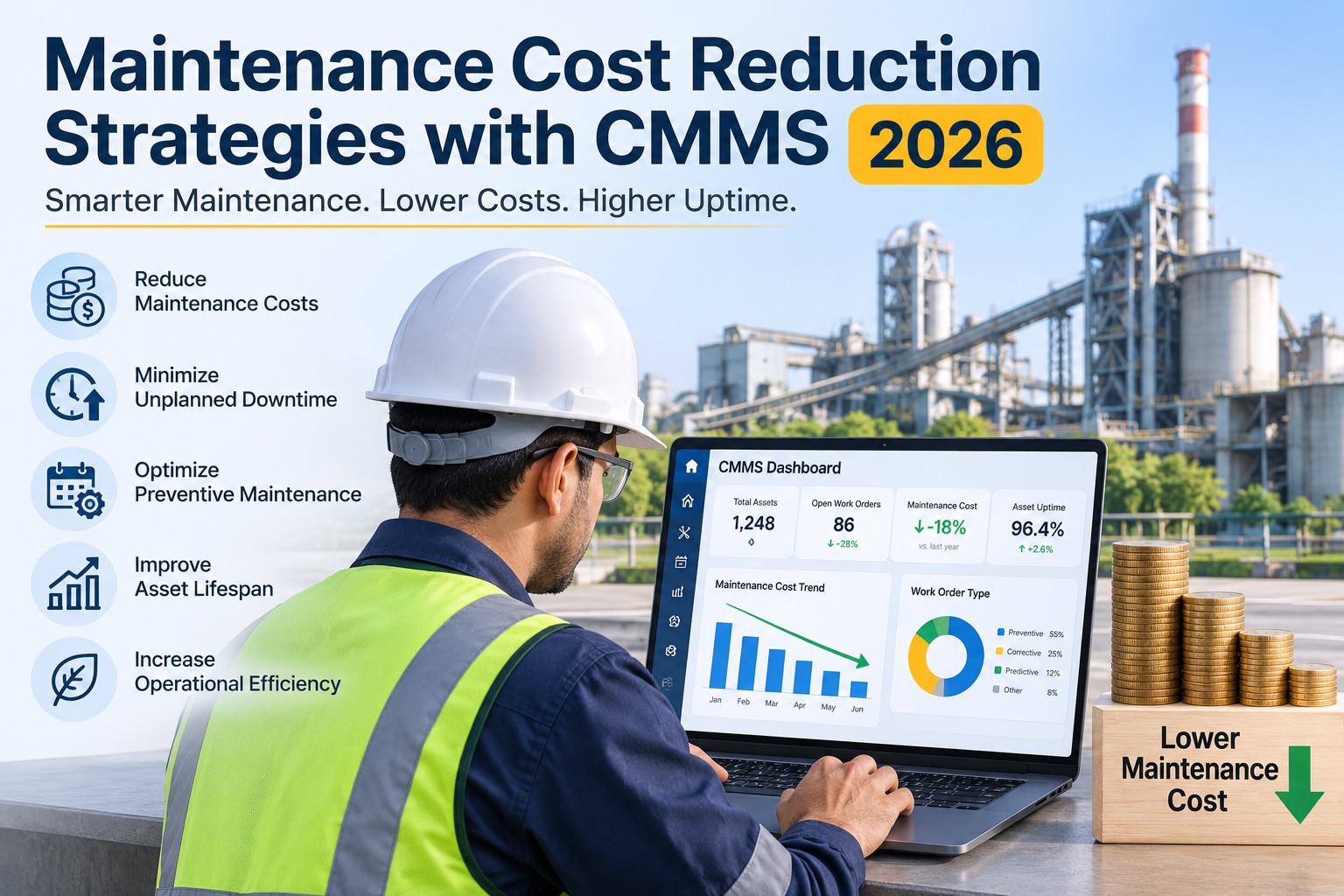
Every maintenance director has sat across from a CFO who looked at the maintenance budget request and asked one question: "What do I get for this?" Without CMMS data behind that answer, the conversation ends in a cut. With it, you can show exactly which assets are consuming disproportionate spend, what the cost per downtime hour is at each site, how much the preventive maintenance program saved versus the reactive baseline, and what capital renewal is required in years 2, 3, and 4 to prevent the emergency repair costs that will dwarf the requested budget. Maintenance budgeting without CMMS data is guesswork defended by relationships. Maintenance budgeting with CMMS data is evidence defended by numbers — and numbers win budget conversations. Facilities using OxMaint's budget versus actual reporting and CapEx justification analytics report 2.4x faster budget approval, 34% more accurate maintenance cost forecasts, and capital requests that get approved on first submission rather than after three rounds of justification. Want to see your maintenance data structured into a CFO-ready budget defense? start a free trial or book a demo and see your cost data formatted for leadership presentation.
The budget request shows how much maintenance costs. It does not show what happens to downtime, failure rates, or asset life when that budget is cut. Without outcome data linked to spend, cutting maintenance looks like an obvious saving.
Budget vs. actual reporting linked to PM compliance rate, unplanned failure frequency, and downtime hours. Show the CFO that the $120,000 PM program prevented $840,000 in reactive repair costs last year. That is the ROI argument that wins.
"The chiller is 15 years old" is not a capital justification. Without maintenance cost history, condition scores, and failure frequency data per asset, every replacement request looks like a preference rather than a financial necessity.
OxMaint shows cumulative maintenance spend on each asset versus its current replacement value — the repair-vs-replace ratio that makes CapEx approval straightforward. When a chiller has consumed 68% of its replacement value in maintenance costs, the case is self-evident.
Maintenance headcount requests are rejected when leadership cannot see utilization data. "We need two more technicians" fails when the CFO suspects existing capacity is being misallocated to reactive work that better planning would eliminate.
Technician wrench time tracking, work order completion rates, and reactive vs. planned ratios show exactly how labor is allocated — and what additional capacity would enable. Data-backed headcount requests succeed where narrative-based ones fail.
A department that consistently spends 30% over or under budget gets its next request discounted by default. High variance signals that the team does not understand its own cost drivers — which destroys credibility in budget negotiations.
Real-time cost tracking against budgeted values per asset and system reduces maintenance budget variance from the industry average of ±28% to within ±5%. A department with tight variance history earns budget trust — which translates to requests that move through approval without challenge.
Contractor invoices processed through accounts payable rarely make it back into maintenance cost reports with asset-level attribution. The result is maintenance spend reports that undercount actual cost by 20-35% — making budgets appear adequate when they are already over-spent.
OxMaint links contractor work orders to specific assets, capturing labor cost, parts cost, and contractor invoices in the same record. Total maintenance cost per asset is accurate — including all external spend — enabling honest budget baseline construction.
Annual budget requests presented without a 3-5 year maintenance cost trajectory force leadership to evaluate each request in isolation. Without context showing that this year's investment prevents a larger expense in year 3, single-year analysis always favors the cut.
OxMaint's rolling 5-10 year CapEx forecasting models show cumulative maintenance cost trajectories and replacement timelines across the entire asset portfolio. Leaders see the full cost picture — not just this year's maintenance line item.
Side-by-side comparison of planned maintenance spend against actual spend for each asset, system, site, and portfolio level. Updated in real time as work orders close and parts are issued. Shows variance in dollars and percentage — with color-coded alerts for assets trending over budget.
For each major asset: current replacement value, cumulative maintenance spend (lifetime), repair-to-replacement ratio, asset condition score, and projected failure cost if not replaced. Ranks the entire asset portfolio by replacement urgency — giving leadership a clear, defensible prioritization framework for capital allocation.
Calculates the financial return on PM investment by comparing PM program cost against avoided failure cost. Uses actual failure data from before and after PM program implementation. Expresses the return as a ratio — typically 3:1 to 7:1 for well-designed PM programs — in language that CFOs and boards understand.
Projects capital renewal requirements for the entire asset portfolio across a 5-10 year horizon. Driven by asset age, condition scores, maintenance cost trends, and replacement value. Shows leadership the total capital exposure they are managing — not just this year's immediate needs — enabling strategic planning rather than reactive funding.
| Budget Dimension | Reactive Budget Management | CMMS-Driven Budget Planning (OxMaint) |
|---|---|---|
| Budget Construction Method | Last year's spend plus inflation estimate — no asset-level data | Built from actual per-asset cost history, PM schedules, and failure trends |
| Budget Variance | ±28% average — reactive failures make cost unpredictable | ±5% average — planned maintenance creates predictable cost baseline |
| CapEx Justification | Asset age and anecdotal failure history | Repair-to-replacement ratio, condition score, and failure cost projection |
| Mid-Year Reforecast | Manual — requires spreadsheet consolidation over several days | Real-time — budget vs. actual visible at any point without manual effort |
| Contractor Cost Tracking | Processed through AP — no link to assets or maintenance records | Linked to specific work orders and assets — included in total maintenance cost per asset |
| PM Investment Defense | Narrative — "preventive maintenance is good practice" | Financial — "PM program cost $120K, avoided failures valued at $840K = 7:1 ROI" |
| Multi-Year Planning | Annual only — no forward visibility beyond current budget year | 5-10 year rolling CapEx model updated continuously from asset condition data |
| Leadership Credibility | Low — high variance history, anecdotal justifications, rejected requests | High — consistent variance, data-backed requests, first-submission approval rate |
Export the previous 12-month maintenance cost summary from OxMaint — broken down by labor, parts, and contractor costs for each asset and system. This is your actual cost baseline, not an estimate. It includes every work order closed in the period and every part issued against those work orders.
OxMaint's PM schedule shows every planned maintenance task for the coming year — with estimated labor hours, parts requirements, and vendor costs already attached. Sum the PM schedule cost by system and site. This is your planned maintenance spend — the predictable, controllable portion of your maintenance budget.
Use OxMaint's MTBF data to estimate expected reactive failure events per asset class in the budget year. Multiply expected failure frequency by average repair cost per failure type. Add a contingency percentage — typically 15-25% of planned maintenance budget for operations with PM compliance above 80%, higher for reactive-dominant operations.
For each asset where cumulative maintenance spend has exceeded 40-60% of current replacement value, generate a CapEx justification showing the repair history, the replacement value, the projected failure cost if the asset is not replaced, and the recommended replacement timeline. OxMaint produces this report per asset on demand.
Lead the budget presentation with the PM ROI calculation — what the PM program cost last year versus what it prevented. Follow with the 5-year CapEx forecast showing the total capital exposure across the portfolio. Close with the budget vs. actual variance trend — demonstrating that this team manages maintenance spend to within ±5%. This sequence answers every CFO question before it is asked.
This five-step process replaces weeks of manual data gathering with hours of CMMS report generation. The underlying data is already in OxMaint from your team's daily work order activity — it just needs to be formatted for a financial audience. Book a demo to see the complete budget reporting workflow configured for your operation, or start a free trial and begin generating real cost data from your first work orders.