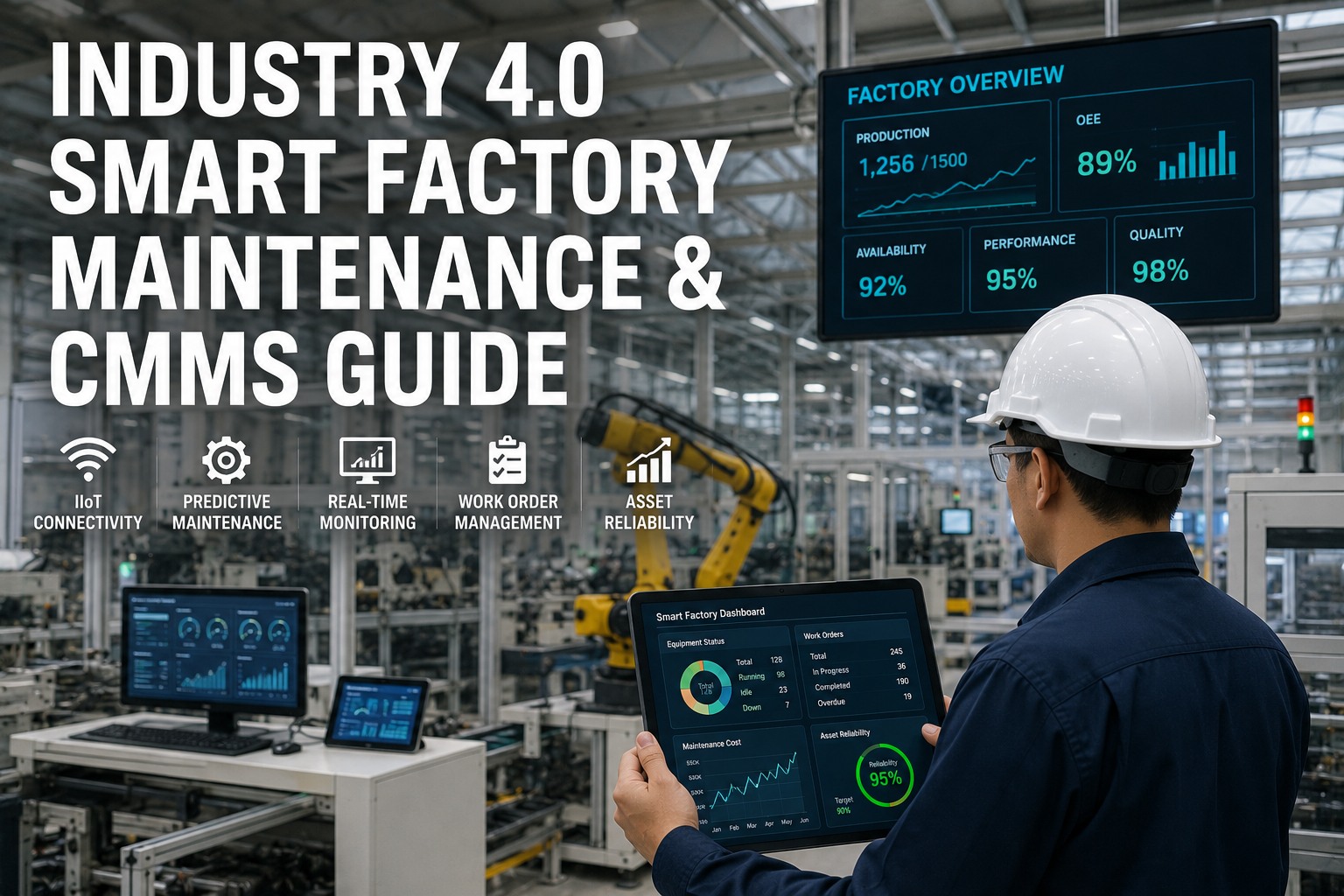
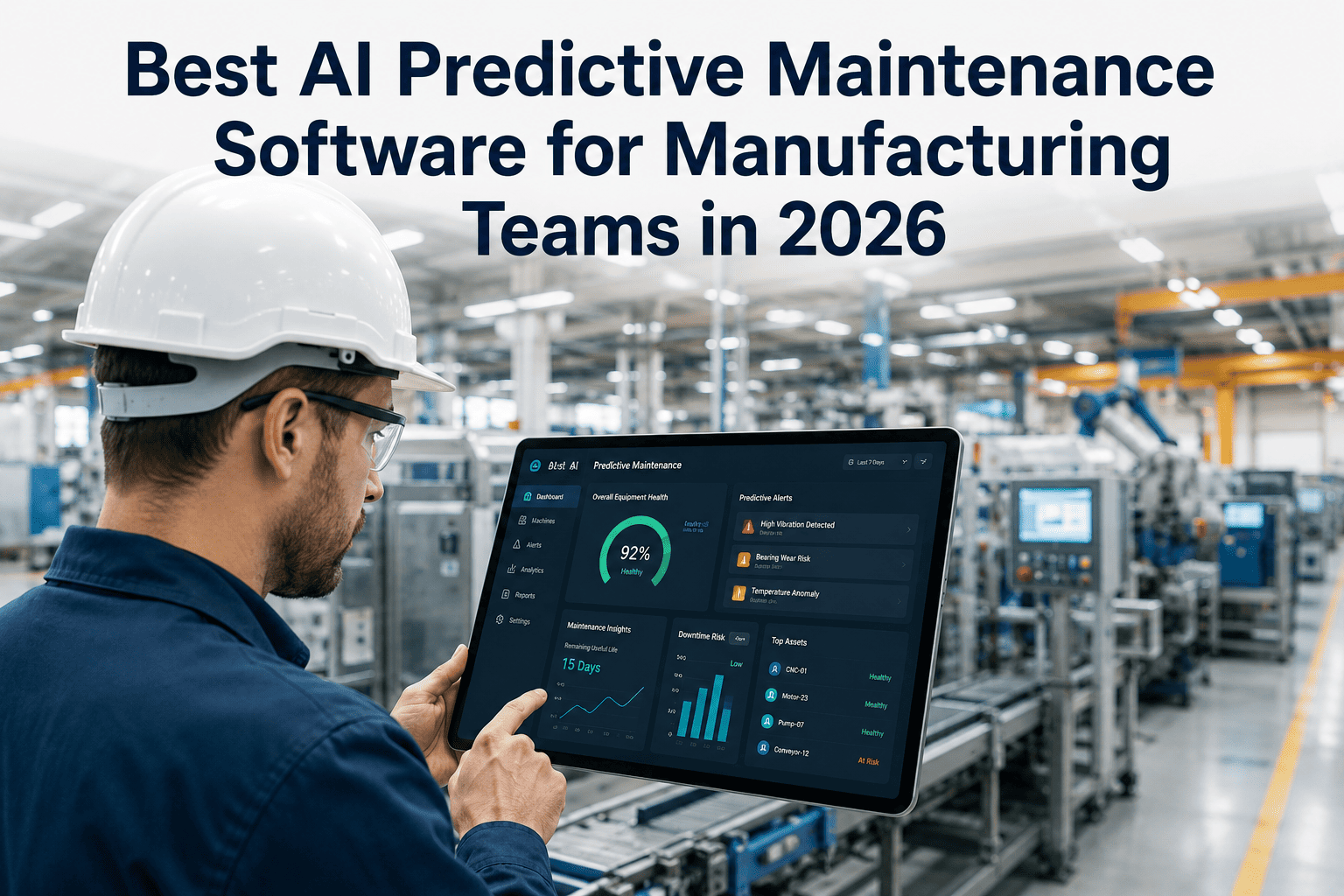
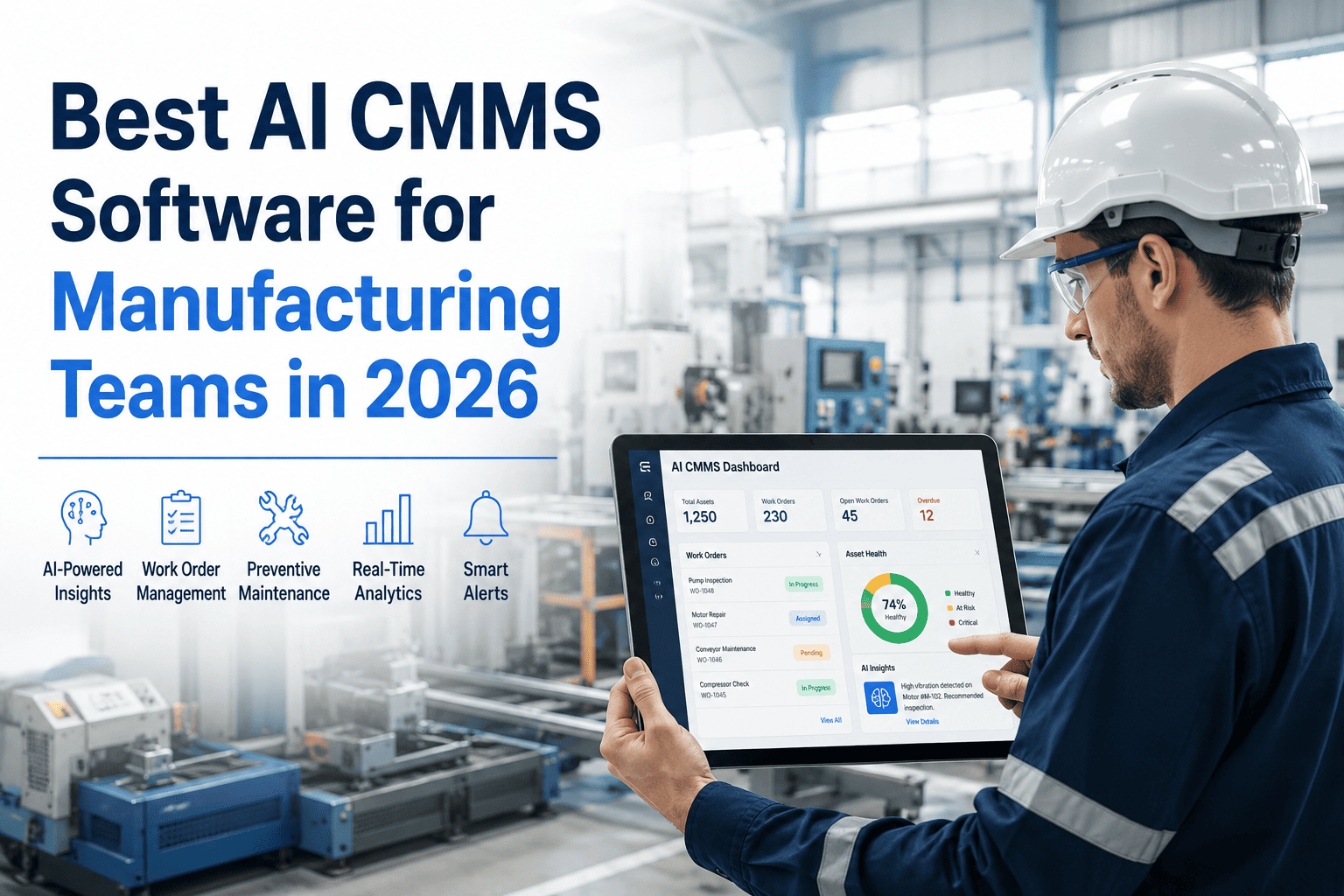
Manufacturing plants run on uptime. Every unplanned equipment failure on the plant floor costs an average of $260,000 per hour in lost production, emergency labor, and scrapped materials — and the difference between plants that hold their OEE above 80% and those hovering at 55% is almost always the quality of their maintenance management system. A CMMS built for manufacturing is not a work order ticketing system with a factory skin — it is a platform that understands production schedules, integrates with PLCs and SCADA, tracks OEE at the line level, and connects every maintenance action to the specific asset and production impact it affects. In 2026, the manufacturing CMMS market offers more choices than ever — and more noise to cut through. This guide ranks the top 10 manufacturing CMMS platforms on the criteria that plant maintenance managers and operations directors actually use to make decisions: OEE tracking capability, plant floor usability, asset hierarchy depth, IoT integration, and the absence of implementation timelines measured in years. Start a free trial of OxMaint or book a demo to see how it performs against your specific manufacturing environment.
Best CMMS for Manufacturing: Top 10 for 2026
The definitive ranking of manufacturing CMMS platforms for plant managers, maintenance directors, and operations teams — evaluated on OEE integration, plant floor usability, asset hierarchy depth, IoT connectivity, and real-world implementation experience.
How We Ranked These Platforms
Every platform in this list was evaluated against six criteria weighted for manufacturing operations specifically. A CMMS that excels for facilities management but lacks production-based maintenance triggers and OEE integration is not a manufacturing CMMS — it is a facilities CMMS being sold to manufacturers.
Does the platform track OEE at the line and machine level? Can maintenance actions be connected directly to production availability, performance, and quality metrics?
Can technicians use it on the plant floor — on mobile, offline if needed, with gloves on? Is the work order interface designed for maintenance technicians or software administrators?
Does it support full manufacturing asset hierarchy — plant, line, machine, component — with production-based PM triggers (cycles, units, hours) alongside calendar triggers?
Can it receive real-time sensor data from plant floor equipment, trigger condition-based work orders from SCADA alerts, and connect to existing IIoT infrastructure without heavy IT projects?
How long from contract signature to first PM work orders generating? Manufacturing teams cannot afford 12-month implementations — platforms that get plants live in weeks score significantly higher.
Per-user vs unlimited pricing, implementation fees, training costs, and the hidden cost of the ongoing platform administration burden that enterprise CMMS systems impose on maintenance teams.
Top 10 Manufacturing CMMS Platforms — 2026 Rankings
These rankings reflect platform capability as of Q2 2026 across manufacturing environments ranging from single-site production plants to multi-facility industrial portfolios.
OxMaint leads the 2026 manufacturing CMMS rankings for one primary reason: it is the only platform that combines a fully built-in OEE dashboard at the individual line level with production-based maintenance triggers (units, cycles, operating hours) and a mobile-first interface designed specifically for plant floor technicians. Most CMMS platforms track work orders and call it maintenance management — OxMaint connects every PM completion, every equipment inspection, and every corrective repair to the production asset it affects and the OEE impact it generates. The asset hierarchy (Portfolio to Plant to Line to Machine to Component) maps directly to how manufacturing organizations actually structure their operations, not how a generic facilities CMMS was adapted to fit. SCADA and IoT integration through API, MQTT, and Modbus TCP enables condition-based work order triggers from real-time equipment data without heavy IT infrastructure projects. No per-user pricing — unlimited users means every technician, supervisor, and plant manager has full access without software cost becoming a barrier to adoption. Implementation typically gets plants generating PM work orders within the first week.
IBM Maximo remains the benchmark for enterprise-scale manufacturing asset management — particularly in heavy industry, utilities, and defense manufacturing where regulatory documentation requirements and deep ERP integration justify the implementation investment. Maximo's asset hierarchy and PM scheduling capabilities are comprehensive, and its long track record means integrations with SAP, Oracle, and legacy SCADA systems are well-documented. The significant limitation is implementation complexity and cost — Maximo implementations typically run 12-24 months and $500,000-$2M+ depending on customization scope, making it inaccessible for mid-size manufacturers and impractical for organizations needing rapid deployment.
Fiix's acquisition by Rockwell Automation positions it uniquely for manufacturers already invested in the Allen-Bradley and FactoryTalk ecosystems. The plant floor integration capabilities are strong, and the mobile interface is genuinely usable by technicians. OEE tracking is available but requires configuration rather than being built-in out of the box. Mid-size manufacturers in discrete and process manufacturing report strong PM compliance improvements after Fiix deployment — with implementation timelines of 4-8 weeks for standard configurations.
UpKeep has built strong adoption in light manufacturing and food production environments where mobile usability and rapid deployment are prioritized over deep manufacturing-specific functionality. The technician-facing mobile app is among the most intuitive in the market — driving high adoption rates in teams transitioning from paper-based systems. OEE tracking and production-based PM triggers are limited compared to manufacturing-specific platforms, making UpKeep better suited to manufacturers with straightforward maintenance requirements than complex multi-line production environments.
Limble consistently earns strong reviews from mid-size manufacturing plants for its balance of capability and implementation simplicity. PM scheduling, work order management, and basic asset tracking are solid. The platform lacks native OEE tracking and production-based maintenance triggers, positioning it best for manufacturers whose maintenance needs are primarily calendar-based rather than production-cycle-based. Strong reporting capabilities and competitive pricing make it a credible option for plants that do not require deep manufacturing analytics integration.
Platforms 6-10: Complete Market View
Solid PM and work order management with good process industry templates. Lacks native OEE but integrates with process historian systems. Better suited to chemical and food manufacturing than discrete production lines.
Capable enterprise asset management with strong inventory and procurement integration. Implementation complexity and cost position it for larger manufacturers — mid-size plants often find the overhead disproportionate to their operational needs.
Fluke's acquisition brings strong condition monitoring sensor integration to eMaint's CMMS platform — particularly for vibration and thermal monitoring applications. OEE tracking requires additional configuration and the platform can feel complex for teams coming from paper-based systems.
MaintainX has built strong adoption among frontline maintenance technicians with a consumer-grade mobile interface. Manufacturing-specific functionality — OEE, production-based triggers, line-level analytics — is limited, positioning it better for light industrial and facilities than complex manufacturing environments.
Feature Comparison: Top 5 Manufacturing CMMS Platforms
This feature matrix compares the capabilities that matter most for manufacturing plant maintenance operations — not the features that look good in a demo but rarely get used on the plant floor.
| Capability | OxMaint | IBM Maximo | Fiix | UpKeep | Limble |
|---|---|---|---|---|---|
| Built-in OEE Dashboard | Yes — line level | Add-on module | Configuration required | No | No |
| Production-Based PM Triggers | Yes — units, cycles, hours | Yes | Limited | No | No |
| IoT / SCADA Integration | API, MQTT, Modbus | Extensive | Rockwell native | Limited API | API only |
| Mobile Plant Floor App | Offline-capable | Functional | Strong | Excellent | Good |
| Implementation Timeline | Days to weeks | 12-24 months | 4-8 weeks | 1-2 weeks | 2-4 weeks |
| User Pricing Model | Unlimited users | Per user | Per user | Per user | Per user |
How to Choose: Matching CMMS to Your Manufacturing Context
The right manufacturing CMMS depends on your plant type, team size, existing technology infrastructure, and how urgently you need to reduce downtime. Use this decision framework to align your requirements to the platforms that deliver the best fit — rather than the most feature-rich platform that your team will never fully adopt.
Assembly lines, machining centers, stamping and fabrication — discrete manufacturing needs production-based PM triggers, line-level OEE tracking, and machine-component asset hierarchies. OxMaint and Fiix both handle discrete manufacturing configurations without heavy customization.
Continuous process environments need condition-based maintenance triggers from process historian data, regulatory compliance documentation, and maintenance scheduling that accounts for continuous production windows rather than shift-based discrete manufacturing cycles.
Food manufacturing adds GMP compliance, digital inspection records with photo documentation, and FSMA/HACCP maintenance documentation requirements. OxMaint's audit-ready work order documentation and digital inspection capability meets food manufacturing compliance requirements without custom development.
Multi-facility manufacturers need portfolio-level dashboards that compare OEE, PM compliance, and maintenance cost across plants — with drill-down to individual lines and machines. OxMaint's multi-site architecture delivers this without the enterprise implementation cost of Maximo.
Frequently Asked Questions
What is the difference between a manufacturing CMMS and a general facilities CMMS?
How does OEE integration in a CMMS actually work?
How long does CMMS implementation take in a manufacturing environment?
Can OxMaint replace our existing MES or connect to it?
The Right Manufacturing CMMS Pays Back in the First Quarter
OxMaint is built for manufacturing plants that need to reduce unplanned downtime, improve OEE, and give their maintenance teams the mobile-first tools to execute PM programs without fighting the software. No 12-month implementation. No per-user pricing that penalizes team growth. No dashboards that require a data analyst to interpret. Just a manufacturing CMMS that plant floor teams actually use — and that connects maintenance actions directly to production performance from day one.