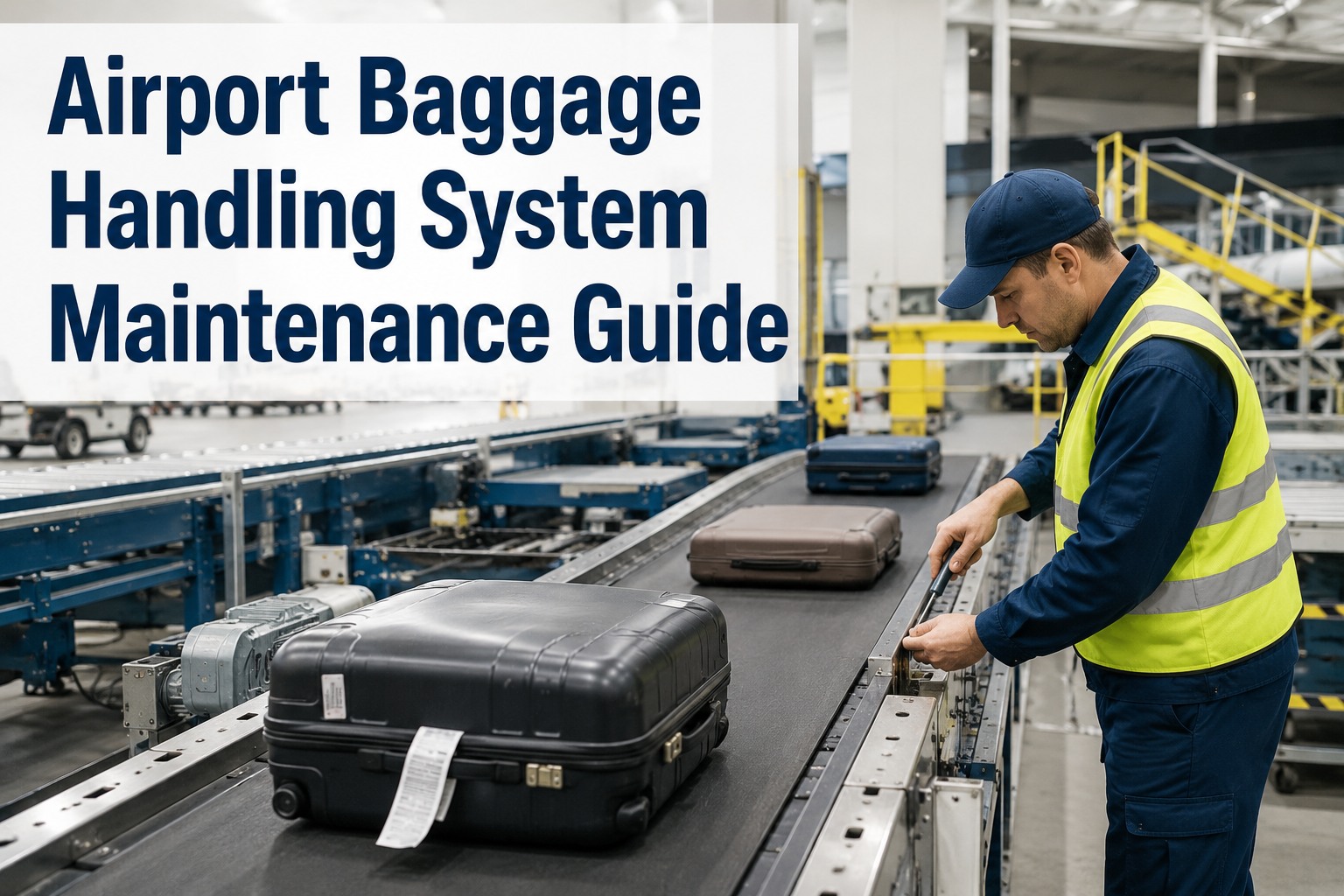
Airport baggage handling system maintenance is the throughput-critical discipline that keeps conveyors, explosive detection system (EDS) scanners, and sortation diverters moving bags from check-in to aircraft hold without cascading delays. A single conveyor jam or sorter mis-divert on a peak departure bank can ripple into missed connections, passenger claims, and slot penalties — which is why leading airports treat BHS maintenance not as a cost center but as a flight-safety-adjacent reliability program. Modern baggage handling maintenance programs combine preventive maintenance libraries, condition-based monitoring, and CMMS-driven work-order discipline to sustain 99%+ system availability. OxMaint brings all of these capabilities into one AI-powered CMMS platform — or you can Start Free Trial to see the BHS PM library on your own assets today.
Can your baggage handling system survive the next peak departure bank without an unplanned outage?
Every minute of BHS downtime at a Tier-1 airport can delay 12+ flights and cost upwards of $5,000 in recovery, rebook, and slot-penalty exposure. OxMaint gives maintenance teams the preventive, predictive, and work-order structure to keep conveyors, EDS scanners, and sortation diverters running at the throughput your operation demands.
Why baggage handling maintenance is throughput-critical infrastructure
A mid-sized airport processing 25,000 bags per day typically operates 1,200+ conveyor segments, 40–60 sortation diverters, and 8–15 EDS inline scanners. When any critical node fails, the entire bag flow is throttled — and the cost compounds every minute.
A 2024 study of 30 international airports found that facilities using a structured CMMS for airport conveyor maintenance experienced 42% fewer unplanned BHS stoppages compared with spreadsheet-driven or reactive programs. The difference wasn't headcount — it was task discipline, asset hierarchy clarity, and the ability to see failure patterns before they became incidents. For a 180-asset baggage handling system, the annual avoided cost of moving from reactive to CMMS-driven preventive maintenance routinely exceeds $480,000.
Airport conveyor maintenance checklist: PM tasks that prevent 80% of failures
The highest-ROI BHS maintenance tasks are not complex — they are simply performed on schedule, documented, and trended. Below is the core PM library OxMaint deploys for baggage handling system maintenance, organized by criticality tier.
- Inspect belt tracking and tension on all driven rollers
- Check for frayed edges, missing cleats, and belt misalignment
- Verify photo-eye sensors and proximity switches respond cleanly
- Inspect drive motor temperature and listen for abnormal bearing noise
- Clear debris from transfer points and underside guards
- Confirm emergency-stop circuits test functional at all zones
- Verify diverter pneumatic pressure and stroke timing
- Inspect pusher arms, sorter belts, and lane-guide wear strips
- Test barcode scanner read-rate logs — flag zones below 98%
- Lubricate sorter chain and verify tension per OEM spec
- Check sorter drive gearbox oil level and seal condition
- Audit bag-jam sensors and clear optical paths
- Calibrate inline EDS scanner per TSA / ECAC regulatory schedule
- Inspect conveyor bed-through EDS belt for wear and tracking
- Verify PLC communication health across all BHS sub-networks
- Test failover PLC and redundant power supplies
- Review historian alarms — identify repeating fault codes
- Audit UPS battery health and automatic transfer switch
How much does BHS downtime cost — and what's the payback of a CMMS?
For a mid-sized airport processing 25,000 bags/day across a 180-asset BHS network, the financial math is stark. Below is a worked example based on real OxMaint airport deployments.
| Metric | Reactive (Spreadsheet) | OxMaint CMMS | Annual Impact |
|---|---|---|---|
| Unplanned BHS downtime hours | 180 hrs/year | 54 hrs/year | -70% |
| Mean time to repair (MTTR) | 92 min | 28 min | -70% |
| PM compliance rate | 61% | 96% | +35 pts |
| Spare-parts stockout events | 22/year | 4/year | -82% |
| Annual downtime cost | $1,185,000 | $355,500 | -$829,500 |
The typical OxMaint BHS deployment pays for itself in under 90 days. One regional hub processing 18,000 bags/day reduced unplanned BHS stoppages by 63% within the first six months — translating to $612,000 in avoided recovery and delay costs annually, while cutting overtime spend by 22% through better work-order scheduling.
How OxMaint keeps baggage handling systems running at airport throughput
OxMaint is an AI-powered CMMS and EAM platform built for the asset density, regulatory pressure, and 24/7 operating reality of airport BHS environments. Here is how four core capabilities map directly to baggage handling reliability.
BHS-Specific PM Library
Pre-built preventive maintenance templates for conveyors, belt scanners, sortation diverters, EDS units, and PLC control panels — deployable on day one. Ensures Tier 1–3 PM tasks fire on schedule, not when someone remembers.
Predictive Maintenance with AI
OxMaint's AI engine analyzes vibration, temperature, motor-current, and PLC alarm trends to predict bearing failures, belt degradation, and sorter drive issues weeks before they cause a bag jam or system halt.
Spare-Parts Inventory for BHS
Critical spares — belts, bearings, photo-eyes, diverters, pneumatic valves — tracked with min/max levels and auto-reorder. OxMaint links each part to its parent asset so technicians find the right part in seconds, not 20 minutes.
Maintenance Analytics & KPIs
Real-time dashboards for BHS availability, MTBF, MTTR, PM compliance, and asset health scores. Identify your worst-performing conveyor zones and sorter lanes, then prioritize capital and labor where it moves the needle.
Airport sortation maintenance: a 6-month reliability turnaround
A regional airport with 42 sortation diverters and 180 conveyor segments was averaging 15 unplanned BHS stoppages per month — costing an estimated $78,000/month in delay recovery and passenger rebooking. Here's how a structured OxMaint deployment changed the trajectory in 180 days.
Asset hierarchy & baseline
All 222 BHS assets imported into OxMaint with parent-child relationships. Each conveyor segment, scanner, and diverter mapped to its PLC zone and operational criticality tier. Baseline MTBF captured: 14 hours.
PM library deployment
BHS-specific PM templates assigned — daily, weekly, monthly tiers. Work orders auto-generated and dispatched to technicians' mobile devices. PM compliance jumped from 58% to 89% within four weeks.
Predictive analytics activation
Vibration and motor-current sensors on 12 critical sorter drives connected to OxMaint AI. Within three weeks, the system flagged two bearing degradation trends — both replaced during overnight downtime windows before failure.
Results
Unplanned BHS stoppages dropped from 15/month to 4/month. MTBF improved from 14 to 52 hours. MTTR fell from 85 minutes to 31 minutes. Estimated annualized savings: $612,000. The airport's BHS availability hit 99.6% during peak departure banks.
See OxMaint on your baggage handling assets — book a 30-min demo
Walk through a live BHS asset hierarchy, PM library, and predictive dashboard configured for your airport. We'll show you exactly where the downtime is hiding and how to close the gap.
Airport baggage handling system maintenance — frequently asked questions
What is baggage handling system maintenance and why is it critical?
Baggage handling system (BHS) maintenance is the structured program of preventive, predictive, and corrective work performed on conveyors, sortation diverters, EDS scanners, and control systems to sustain operational availability. It is critical because a single BHS failure during a peak departure bank can delay 12+ flights, trigger passenger rebooking costs, and incur slot penalties exceeding $5,000 per hour at Tier-1 airports.
How often should airport conveyor maintenance be performed?
Daily visual inspections of belt tracking, photo-eyes, and e-stop circuits form the baseline. Weekly tasks cover diverter pneumatics, sorter chain lubrication, and scanner read-rate audits. Monthly work includes EDS calibration, PLC communication health checks, and UPS battery testing. A CMMS like OxMaint automates the full schedule so no task slips — you can Start Free Trial to deploy the complete BHS PM library on day one.
How does a CMMS improve BHS reliability?
A CMMS improves baggage handling reliability by enforcing PM schedule compliance, capturing complete asset hierarchies, trending failure data, and linking spare parts to parent equipment. Airports using OxMaint typically see PM compliance rise above 95%, unplanned downtime drop 50–70%, and MTTR fall by 60% or more because technicians arrive at the right asset with the right part and the right procedure.
What are the most common BHS failure modes?
The most frequent BHS failures are belt misalignment and fraying, bearing seizures on driven rollers, photo-eye sensor contamination, diverter pneumatic valve wear, sorter chain stretch, and EDS scanner calibration drift. Roughly 70% of these failures are preventable with scheduled PM tasks — which is why CMMS-driven preventive maintenance has such a strong payback profile for airport operations.
How long does it take to implement OxMaint for an airport BHS?
Most airport BHS teams are live on OxMaint within 2–4 weeks. Asset hierarchies can be imported from existing spreadsheets or CMMS exports, the BHS PM library is pre-built and ready to assign, and technician mobile adoption typically exceeds 90% within the first month.
Stop reacting to BHS failures. Start preventing them.
Deploy OxMaint's AI-powered CMMS across your baggage handling system and join the airports cutting unplanned downtime by 50–70% within six months. Your next peak departure bank doesn't have to be a gamble.
Free 14-day trial · No credit card