How an Airport Reduced GSE Downtime by 38% with Digital Maintenance Management
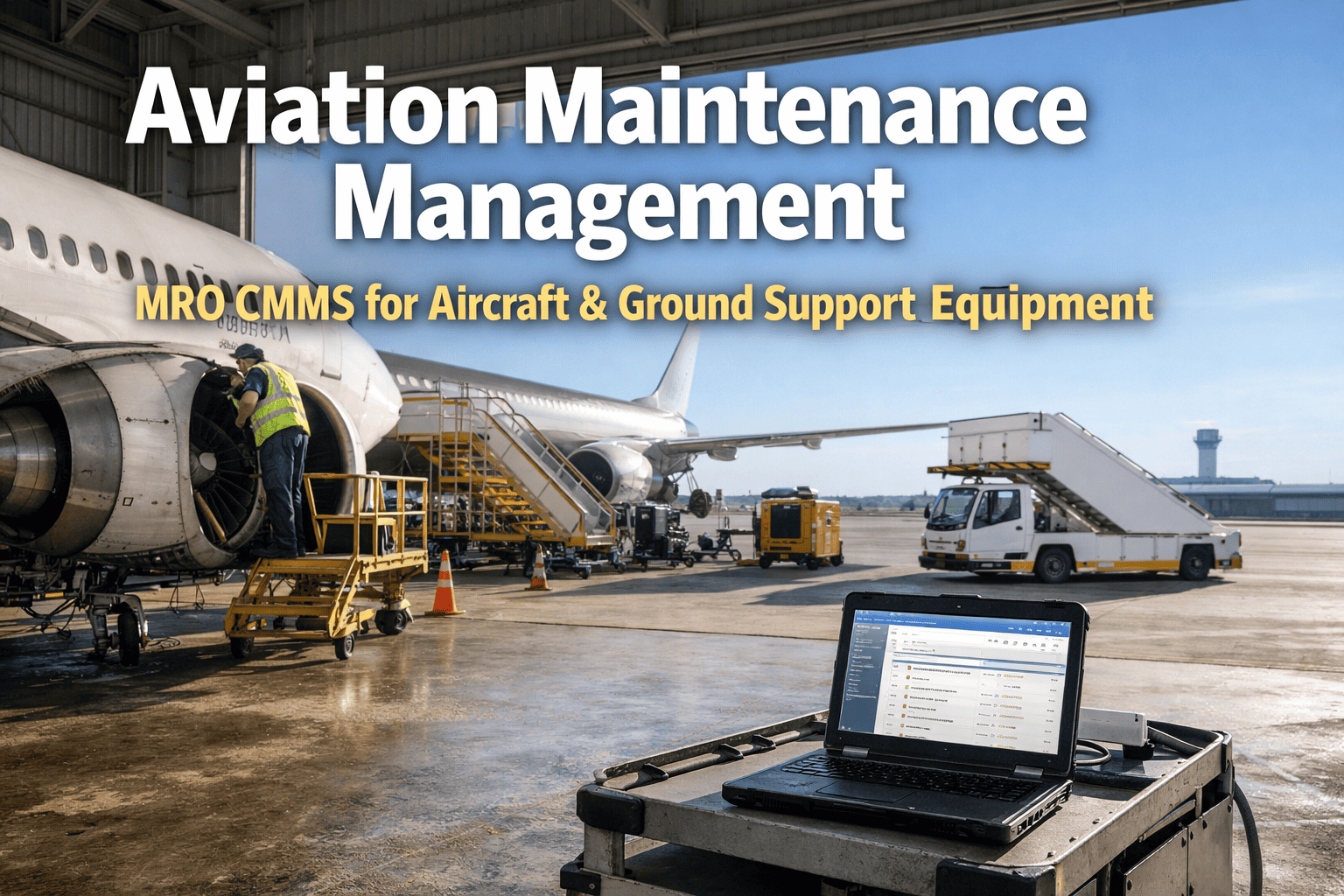
A regional airport handling 4.2 million passengers annually was losing $820,000 every year to unscheduled GSE failures — pushback tractors stranded at gates, belt loaders pulled mid-turnaround, and GPU units failing during boarding. The maintenance team had 140 GSE assets spread across three terminals, paper-based service logs, and no visibility into which units were overdue for PM. Within 11 months of implementing OxMaint across their full fleet, the airport reduced GSE downtime by 38%, lifted fleet availability from 79% to 94%, and recovered the entire implementation cost within the first operating season. This is the full account of what changed, why it worked, and what every ground handler can replicate.
AVIATION · CASE STUDY · GSE · CMMS · FLEET MANAGEMENT · ROI
38% less GSE downtime. 94% fleet availability. $820K saved annually.
How one regional airport transformed ground operations with OxMaint digital maintenance management.
recovered annually — the combined value of eliminated airline delay penalties, reduced emergency repair costs, and recovered productive technician hours. The airport's maintenance budget stayed flat. What changed was how it was spent: from reactive breakdown response to structured PM that stopped the failure before it reached the ramp.
Before OxMaint, the airport's maintenance team was running entirely on reactive response. When a pushback tractor failed at a gate, a technician was dispatched. The hydraulic failure that could have been caught at the quarterly fluid check went unnoticed because the quarterly check wasn't being done — or wasn't being recorded. The absence of a digital PM platform meant there was no visibility into which of the 140 assets were overdue, no automatic PM triggers, and no way to prove compliance to airline customers or airport authority auditors.
No PM Visibility
No system to show which of 140 assets were overdue. Technicians responded to failures — not to schedules.
62 overdue PMs discovered at go-live
Paper Records
Service records stored in binders. No history retrieval, no trend data, no compliance package for airline audits.
4 airline audit findings in 18 months
Reactive Breakdowns
23 in-service GSE failures in the prior 12 months — each generating airline delay penalties and emergency parts costs.
$820K in reactive failure costs annually
No Utilisation Tracking
Engine hours tracked manually, often weeks behind. PM intervals based on calendar months — not actual usage.
31% of assets PM'd too early or too late
Before vs After — The Numbers Side by Side
Eleven months after go-live, the airport ran a full fleet performance review. Every metric moved in the same direction. The comparison below shows the baseline 12-month period against the first full 12 months of OxMaint-managed maintenance. These results are replicable for any GSE fleet of 50 assets or more with structured PM configuration.
What They Configured — The Five OxMaint Modules That Drove Results
The improvement didn't come from one change. It came from five interconnected modules working together — each closing a gap that had been haemorrhaging money quietly before OxMaint made it visible. All five are active from your first fleet configuration in OxMaint.
01
Utilisation-Based PM Triggers
Engine hours connected via OBD to OxMaint. Oil changes and hydraulic services triggered at exact hour thresholds — not calendar guesses.
Result: PM compliance 41% → 96%
02
AI Predictive Fault Detection
AI analytics flagged developing hydraulic faults via pressure trend analysis — 3 pushback tractors intercepted before ramp failure in the first season.
Result: 3 failures prevented in season 1
03
AI Camera Vision Inspections
Camera-based tyre and brake visual checks during dispatch — defects flagged before each shift without stopping the unit or deploying additional staff.
Result: 14 tyre defects caught pre-shift
04
Digital Daily Inspection Logs
Operators completed pre-shift checklists on mobile. Defects auto-raised work orders. Paper binders eliminated. Audit evidence generated automatically.
Result: 0 audit findings post go-live
05
SAP Parts Integration
OxMaint PM forecasts triggered SAP purchase orders for oil filters, brake pads, and hydraulic seals — parts on the shelf before the PM was due, not ordered reactively.
Result: Parts wait delays eliminated
The Implementation Timeline — 11 Months to Full Results
The airport went from first login to measurable fleet-wide results in 11 months. No consultant-led multi-year deployment. No rip-and-replace of existing systems. The timeline below shows exactly how the improvement compounded across each phase — and where the biggest gains appeared earliest.
Month 1–2
Asset Configuration
All 140 assets loaded. OEM PM intervals set. OBD telematics connected to 60 powered units. 62 overdue PMs surfaced immediately.
62 overdue PMs cleared
PM compliance reaches 78%
Month 3–4
PM Programme Active
All PM schedules running. Mobile daily inspection checklists deployed to 28 operators. First AI-flagged hydraulic fault intercepted.
Month 5–7
Predictive Layer Active
AI predictive analytics and camera vision deployed. SAP integration live — auto-POs for consumables. Fleet availability crosses 88%.
Fleet availability 79% → 88%
Zero airline audit findings
Month 8–9
First Airline Audit
First airline quality audit post-implementation. OxMaint compliance packages generated in 12 minutes. Zero findings — first clean audit in three years.
Month 10–11
Full Results Measured
12-month performance review completed. 94% fleet availability, 38% downtime reduction, $820K in annual savings confirmed against baseline.
$820K / yr recovered
Your fleet. Your results. Same timeline.
Most airports reach measurable improvement within 60 days of first asset configuration in OxMaint.
The airport didn't just deploy a maintenance calendar. They connected six technology layers to OxMaint — each one closing a different gap between condition signal and maintenance action. Together, they created a system where failures were intercepted before the ramp, not reported after it.
AI Predictive Analytics
3 failures intercepted
Hydraulic pressure trends flagged 3 tractor faults weeks before ramp failure — each prevented an airline delay event
AI Camera Vision
14 tyre defects
Pre-shift visual AI inspection caught 14 tyre and brake defects across one season — zero reached the ramp
Digital Twin
4–6 mo. advance
Hydraulic seal and brake wear modelled per unit — replacement planned before failure window opened
OBD / Telematics
60 units connected
Real engine hours fed PM triggers — oil changes at exact intervals, not calendar guesses that missed or over-serviced
SAP Integration
Parts wait: zero
Auto-POs triggered by OxMaint PM forecasts — consumables on the shelf before the service was due
PM Engine
96% PM compliance
From 41% to 96% compliance — every overdue PM surfaced, scheduled, and tracked to close
"Before OxMaint we were managing 140 assets with clipboards and spreadsheets. The first thing OxMaint showed us was that 62 of them were overdue for a service we didn't even know about. That number alone told us everything about why we were spending $820K a year on failures."
Head of Ground Operations · Regional International Airport · United Kingdom
Frequently Asked Questions
Q1How long does it take to configure OxMaint for a 140-asset GSE fleet?▼
This airport completed full asset configuration, PM schedule setup, and mobile checklist deployment in 6 weeks using OxMaint's GSE asset template library — significantly faster than a custom CMMS build.
Q2What was the biggest single source of the $820K annual saving?▼
Airline delay penalties — reduced from $480K to $94K per year — were the largest component, followed by the elimination of emergency repair premiums that dropped from $220K to $68K annually.
Q3Does OxMaint integrate with existing OBD telematics on GSE units?▼
Yes — OxMaint connects to standard OBD telematics platforms, pulling engine hours and fault codes to auto-trigger PM work orders at exact usage thresholds without manual hour logging.
Q4How did the airport generate compliance records for airline audits?▼
OxMaint compiled all PM records, daily inspection logs, defect histories, and corrective action records into a formatted compliance package — produced in 12 minutes for the airline audit team.
Q5Can smaller airports with fewer than 140 GSE assets achieve similar results?▼
Yes — the proportional improvement is consistent across fleet sizes of 30 assets or more. The key drivers are PM compliance rate and failure interception — both scale with asset count, not fleet size.
OxMaint · GSE Fleet · CMMS · Aviation
38% less downtime starts with one decision.
Configure your fleet. See the overdue PMs. Stop the next failure. Live in 14 days.