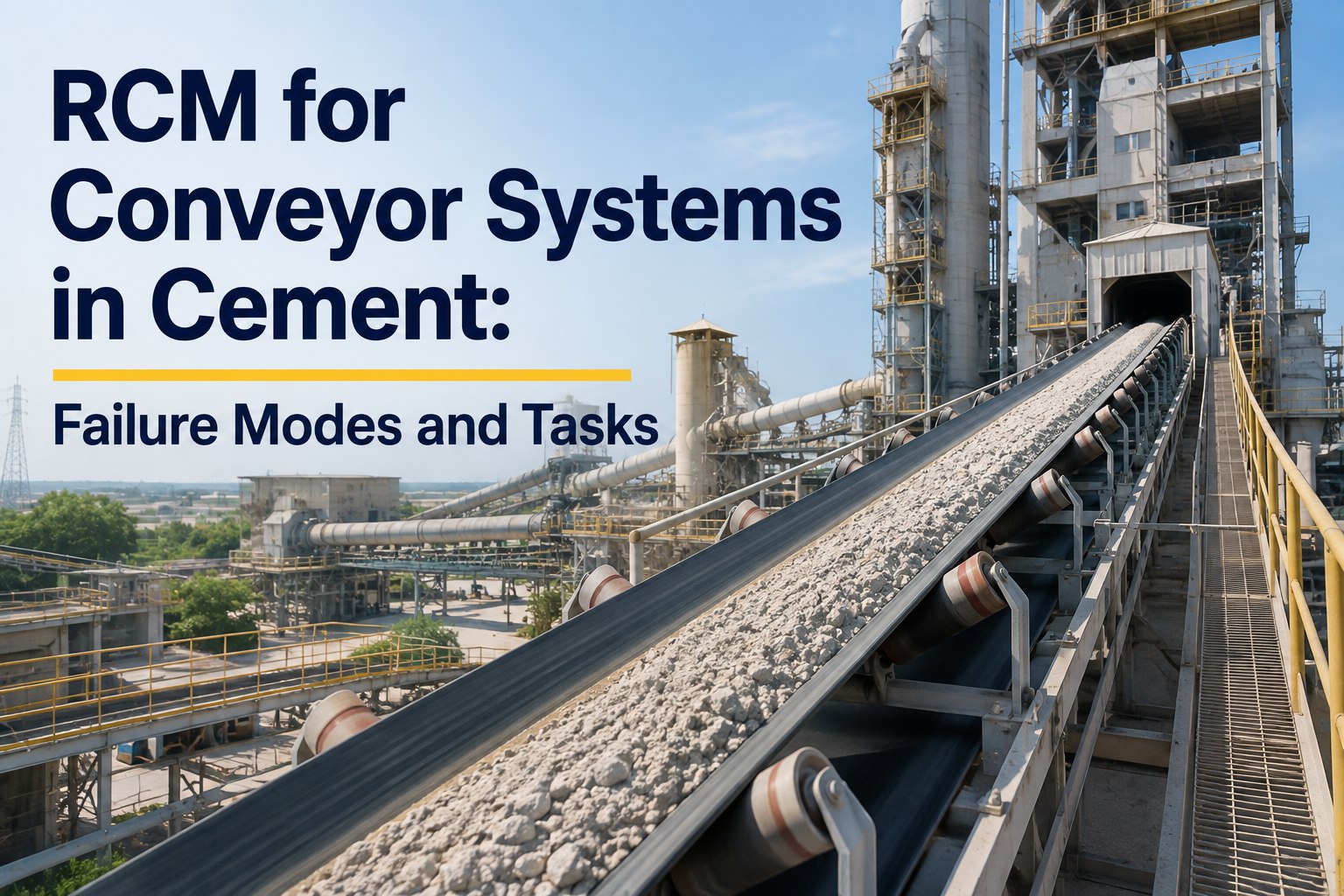
Reliability-Centered Maintenance (RCM) for conveyor systems in cement plants is the systematic process of identifying every critical failure mode—from belt tears and pulley-bearing degradation to motor overheating—and assigning the right maintenance task to prevent unplanned downtime. Cement conveyor systems operate in some of the harshest conditions in heavy industry, carrying abrasive, hot, and dusty loads that accelerate component wear. Applying a structured RCM strategy to these conveyors can reduce unplanned downtime by 30–50% and cut maintenance costs significantly. This guide breaks down the most common conveyor systems failure modes in cement, proven condition monitoring techniques, and best practices for building a defensible PM schedule. To transition from reactive firefighting to controlled reliability, you can Start Free Trial of OxMaint and put these RCM workflows into daily practice.
Are belt failures and unplanned outages costing your cement plant millions in lost clinker throughput?
A single conveyor halt can stall the entire kiln line. Without a systematic RCM strategy, maintenance teams are stuck reacting to catastrophic belt tears and seized rollers. Shift from firefighting to predictive reliability and protect your production targets.
Why RCM for Conveyor Systems in Cement Demands a Specialized Approach
Standard maintenance checklists fail in cement plants because conveyors face a unique combination of high tonnage, extreme abrasion, continuous dust ingress, and thermal stress. Implementing RCM for conveyor systems in cement requires mapping these specific stressors to asset criticality and failure history.
Common Conveyor Systems Failure Modes in Cement Plants
Identifying how your cement conveyor systems fail is the foundation of any effective RCM checklist. Below are the most common failure modes and the specific condition monitoring techniques required to catch them before production stops.
| Failure Mode | Root Cause in Cement | RCM Task & Monitoring Technique | Impact if Unmanaged |
|---|---|---|---|
| Belt Tears & Rips | Clinker tramp metal, severe impact at loading zones | Online condition monitoring (visual sensors), regular belt thickness ultrasonic testing | Full line shutdown; $15K–$50K replacement cost |
| Pulley Bearing Degradation | Heavy continuous loads, dust contamination, poor lubrication | Vibration analysis, acoustic emission monitoring, automated lubrication routes | Catastrophic pulley seizure; 12+ hours unplanned downtime |
| Idler Roller Seizure | Bearing failure from abrasive cement dust ingress | Thermography (hot spot detection), acoustic monitoring, time-based replacement PMs | Friction-induced belt fire; belt destruction |
| Drive Motor Overheating | Dust buildup on cooling fins, voltage imbalance, overloading | Thermal imaging, motor current signature analysis (MCSA) | Motor burnout; extended lead times for high-kW replacements |
| Misalignment & Drift | Structural settling, uneven loading, pulley wear | Laser alignment checks, continuous belt tracking sensors | Edge damage, material spillage, structural damage |
How OxMaint Automates Your Conveyor Systems RCM Strategy
Executing an RCM strategy across hundreds of conveyor assets requires more than spreadsheets. OxMaint's AI-powered CMMS and EAM platform translates reliability frameworks into automated, daily maintenance actions—ensuring the right task hits the right technician at the right time.
Predictive Condition Monitoring
Connect vibration, thermal, and acoustic sensor data directly to work order triggers. OxMaint uses AI to trend asset health and auto-generate tasks when failure thresholds are crossed, preventing pulley seizures and motor burnouts before they happen.
Automated PM Scheduling
Build time-based and condition-based PM schedules for belt inspections, roller replacements, and lubrication routes. Eliminate missed maintenance windows and cut unplanned downtime by up to 30% with automated, shift-aware task generation.
Mobile RCM Checklists
Equip technicians with mobile-first RCM checklists directly on the floor. Enforce step-by-step compliance for conveyor inspections, capture belt thickness readings digitally, and eliminate paper work orders entirely.
Spare Parts & Inventory Sync
Link critical conveyor components—like specialized rollers and belt splices—directly to their asset hierarchy. OxMaint tracks stock levels in real-time and auto-reorders parts when a PM or corrective work order consumes them, preventing stockouts.
The Cost of Reactive vs. RCM-Driven Conveyor Maintenance
Moving from a reactive maintenance model to a structured RCM strategy for cement conveyor systems delivers measurable ROI. Consider a typical 180-asset cement plant producing 5,000 tons of clinker per day. A single 8-hour conveyor halt costs roughly $400,000 in lost production. By implementing condition-based monitoring and automated PMs, plants typically reduce these unplanned events by 40% in the first year.
- Average MTBF drops below 60 days for critical rollers
- Emergency labor costs 3x higher than scheduled PMs
- Expensive expedited shipping for replacement belts
- Zero audit trail for safety and compliance regulators
- MTBF extended by 40-60% via predictive interventions
- Labor optimized through automated, shift-based scheduling
- Inventory stocked precisely for anticipated PM replacements
- Full digital history for ISO 55000 and safety compliance
See OxMaint on your assets — book a 30-min demo
Discover how OxMaint's AI-powered CMMS maps your cement conveyor systems failure modes to automated work orders, condition monitoring, and real-time inventory sync.
Cement Conveyor Systems RCM Checklist & Best Practices
A successful conveyor systems RCM checklist in cement must be tiered by criticality. Not every roller needs weekly inspection, but every drive pulley does. Use this structured checklist to standardize your conveyor systems inspection in cement operations.
- Visual inspection of belt tracking and edge condition at loading zones
- Auditory scan for squealing or grinding idlers along the conveyor line
- Check for material spillage and dust accumulation at transfer points
- Thermography scans of drive motors, gearboxes, and head/tail pulleys
- Vibration analysis on critical drive bearings and gearbox shafts
- Verify tensioning systems and lagging condition on drive pulleys
- Ultrasonic belt thickness testing to calculate wear rates and forecast replacement
- Review OxMaint analytics to update FMEA (Failure Modes and Effects Analysis) data
- Audit spare parts inventory for critical conveyor components and adjust min/max levels
RCM for Cement Conveyor Systems: Common Questions
Stop reacting to conveyor failures. Start engineering reliability.
Join the cement plants using OxMaint to automate RCM workflows, predict failures, and protect their production targets. Set up your asset hierarchy, PM schedules, and condition monitoring triggers in minutes.