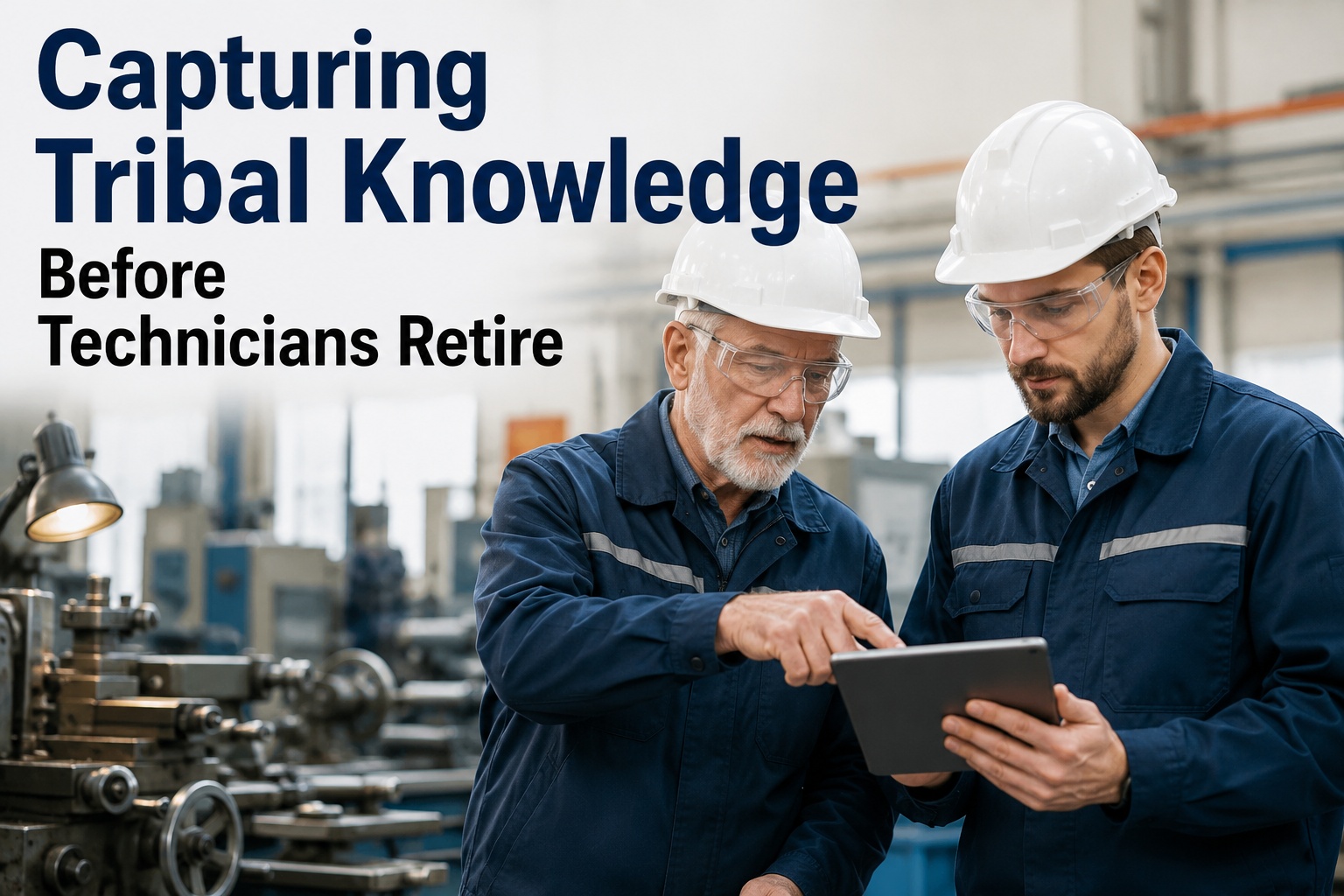
Roughly 70% of today's maintenance technicians are over 50, and with each retirement notice a quiet archive of equipment quirks, rebuild shortcuts, and failure signatures leaves the building. When that institutional memory isn't encoded in job plans, PM checklists, or a CMMS knowledge base, the next generation inherits work orders without context — and pays for it in longer MTTR, repeat failures, and safety near-misses. Capturing tribal knowledge before senior techs walk out the door is a multi-year discipline, not a one-time exit interview, and the right digital structure turns retiring expertise into scalable technician support. Tools like OxMaint make that capture part of the daily workflow, so documentation happens while the knowledge is still in use. Start Free Trial to begin encoding your team's procedures today.
What walks out the door when a 32-year veteran retires?
An experienced technician carries an estimated 10,000+ hours of equipment-specific intuition — the sounds, smells, and vibration patterns no OEM manual captures. Without a system to encode that knowledge into your CMMS, it leaves with them.
Turn undocumented know-how into searchable, scalable standard work — before the handshake retirement dinner.
A demographic cliff is already under your roof
Maintenance organizations have roughly a five-year window to transfer know-how before the bulk of Tier-1 expertise retires. The cost of waiting is measured in downtime hours, safety incidents, and onboarding months.
A 180-asset food processing plant in the Midwest estimated $42,000 in annual downtime attributable to junior technicians misdiagnosing conveyor drive faults that two retiring mechanics could solve in minutes. After a 90-day knowledge-capture sprint — 47 video job aids and 22 revised standard work plans loaded into the CMMS — mean-time-to-repair on those lines dropped 31%.
The five categories of tacit expertise at risk
Not all tribal knowledge is equal. Audit these five categories against your current CMMS records to find the most dangerous gaps.
Failure Signature Recognition
The sound a failing bearing makes at 1,750 RPM versus 3,500 RPM, the smell of an overheated VFD, the vibration pattern of a misaligned coupling under load. These sensory diagnostics take years to develop and seconds to lose.
Asset-Specific Workarounds
The hydraulic press that needs a 3-second pre-warm, the packaging line whose timing belt skips if tensioned to spec rather than 2 ft-lbs under. OEM manuals don't carry these; senior techs do.
Spare Parts Substitution Logic
Which aftermarket seal fits the legacy pump, which cross-referenced bearing lasts 3× longer, which rebuild kit is incomplete. This inventory intuition lives in notebooks, not in BOMs.
Safety and Lockout Nuances
The hidden energy source on the old divider line, the valve that looks closed but isn't, the capacitor bank that holds charge longer than the 10-minute LOTO minimum. Documented procedures miss these; veterans don't.
Vendor and Contractor History
Which rebuild shop does the best gearbox work, which technician at the OEM actually answers the phone, which warranty claim was denied and why. Relationship capital evaporates without a CRM-style note in the asset record.
A tiered documentation system built for the CMMS
Knowledge capture fails when it's treated as a side project. Use this four-tier framework inside OxMaint to structure capture as a continuous workflow, not a one-off retirement scramble.
Standard Work Procedures
- Step-by-step task lists with torque values, tolerances, and safety notes
- Required parts and special tools listed per step
- Estimated duration and skill-level tagging
- Photo references for before/after states
Troubleshooting Decision Trees
- Symptom-cause-action flowcharts for top 10 failure modes per asset
- "If X then check Y" logic with measurement thresholds
- Links to relevant OEM manuals and wiring diagrams
- Common misdiagnosis warnings from senior techs
Video Job Aids
- 60–90 second clips of complex tasks recorded on mobile
- Attached directly to work orders and asset records
- Narrated by the retiring technician during actual PMs
- Searchable by asset, task type, and failure code
Asset History and Context
- Free-text "technician notes" field on every completed work order
- Known-quirk flags on asset records
- Vendor performance ratings and contact preferences
- Modification and retrofit history with rationale
A phased rollout that captures 80% of critical knowledge in one quarter
Don't try to document everything. Start with the 20% of assets that cause 80% of downtime events and build outward. This 90-day plan is designed for a maintenance team of 8–20 technicians.
Identify and Prioritize
Pull 24 months of CMMS work-order history. Rank assets by downtime cost and frequency. Cross-reference with the retirement roster to flag assets where the primary expert is within 24 months of retirement. Target: 15–25 critical assets.
Capture in Flow
Equip senior techs with the OxMaint mobile app. During scheduled PMs and corrective work, they record 60-second video job aids, narrate decision logic, and revise standard work steps in real time. Target: 3–5 video aids and 1 revised procedure per critical asset.
Validate and Onboard
Junior technicians execute the captured procedures while senior techs observe and refine. Every revision logs to the asset record. Measure MTTR delta on the targeted assets and iterate. By day 90, the CMMS holds a searchable, video-enriched knowledge base.
What documented tribal knowledge delivers
Plants that complete a structured knowledge-capture program see measurable improvements within the first two quarters after implementation. Below are benchmarks aggregated from mid-size discrete manufacturing and process facilities.
| Metric | Before Capture | After 90 Days | After 12 Months |
|---|---|---|---|
| MTTR on critical assets | 4.2 hrs baseline | 2.9 hrs (–31%) | 1.8 hrs (–57%) |
| Junior-tech independent first-try fix rate | 38% | 61% | 74% |
| Onboarding time to independent work | 6.0 months | 4.5 months | 3.0 months |
| Repeat failures within 30 days | 14% of work orders | 9% | 5% |
| Procedure coverage on critical assets | 22% documented | 78% | 95% |
What maintenance leaders are seeing
"We had two mechanics within 18 months of retirement and zero documented procedures for the legacy filler line. OxMaint's mobile video capture let them record job aids during normal PMs — no extra meetings, no consultants. Our junior techs now fix faults in 20 minutes that used to take an hour of guessing."
"The standard-work capture workflow forced us to actually write down what we thought we knew. We found three procedures where the 'official' torque spec was wrong and the senior tech's workaround was right. That alone paid for the software."
Don't wait for a retirement party to start documenting
Every day a senior technician works without capturing their knowledge is a day of compounding risk. Start encoding procedures into your CMMS this week.
Knowledge capture, answered
How do we get senior technicians to actually participate in knowledge capture?
Make capture part of the work they already do, not a separate task. With OxMaint's mobile app, technicians record 60-second video job aids and revise standard work steps during scheduled PMs — no meetings, no forms, no extra software to learn. Pair this with a modest incentive: a $500 quarterly bonus tied to documented procedures often drives 80% participation. Frame it as legacy, not paperwork: the goal is to make their expertise permanent so the next generation isn't set up to fail. You can Book a Demo to see the mobile capture workflow in action.
What if our CMMS is already cluttered with outdated procedures?
Start with a critical-asset triage. Pull 24 months of work-order data, rank assets by downtime cost and frequency, and focus capture on the top 15–25. Archive or delete procedures older than five years that haven't been referenced. The goal is a living knowledge base on the assets that matter, not a perfect library of everything. Once the critical assets are documented, expand outward quarterly.
How long does a typical knowledge-capture program take?
A focused 90-day sprint captures roughly 80% of critical-asset knowledge when scoped to 15–25 priority assets. The first 30 days are identification and prioritization, the next 30 are in-flow capture during PMs and corrective work, and the final 30 are validation where junior techs execute the captured procedures while senior techs refine them. Full coverage of all assets is a 12–18 month continuous effort, not a project with an end date.
Can video job aids really replace written procedures?
No — and they shouldn't. Video complements written standard work, it doesn't replace it. Written procedures provide the searchable, auditable backbone required for compliance and training. Video job aids handle the tacit knowledge that text can't: the feel of a properly seated bearing, the sound of a healthy gearbox, the specific angle to access a buried bolt. The most effective knowledge bases pair a 1-page written procedure with a 60-second video on the same work order.
How do we measure the ROI of a knowledge-capture initiative?
Track four metrics before and after: MTTR on critical assets, first-try fix rate for junior technicians, onboarding time to independent work, and 30-day repeat-failure rate. Most plants see a 25–35% MTTR reduction and a 40–50% improvement in first-try fix rate within the first year. Translate that to dollars using your average downtime cost per hour. A 180-asset plant spending $42K annually on diagnosis-related downtime typically recovers software and labor costs within 3–4 months. Start your baseline today — Start Free Trial to begin tracking these metrics in OxMaint.
Encode three decades of expertise before Friday's retirement dinner
OxMaint gives you the mobile capture tools, structured standard-work templates, and searchable CMMS knowledge base to preserve what your senior technicians know — and put it to work for the team that follows them.
Free 14-day trial · No credit card