On a construction site, the repair bill is the smallest part of what a breakdown costs. When an excavator goes down, the meter that really runs is the collateral damage — four to eight crew standing idle, a rental brought in to cover, and a critical-path task slipping toward a penalty clause. And the most maddening version isn't even a broken machine: it's a $40 hydraulic fitting that isn't on the shelf, idling a $300,000 excavator for a week. Behind nearly all of it sits the same root cause — work orders, parts, and history scattered across paper, whiteboards, and someone's memory. This guide lays out the ROI of structured work order management for construction fleets, and shows how OxMaint's work order management delivers it — or book a demo to model the return on your fleet.
Maintenance KPI / Work Order Management
Work Order Management ROI Guide for Construction Maintenance Leaders
Turn scattered paper and stockouts into structured, mobile work orders — cutting downtime, killing parts delays, and putting a defensible ROI number in front of ownership.
The real cost of a breakdown
Construction downtime runs roughly $500 to $1,000+ per hour, and project delays $2,000 to $10,000 a day. The repair itself is just the visible tip — here's where the money actually goes.
Repair
Idle crew
Rental
Project penalty
The repair is often a small share of the true cost — idle crews, rental replacement, and schedule penalties stack on top of every breakdown.
Why work orders leak value on paper
The bottleneck usually isn't the wrench — it's everything around it. Paper intake quietly converts maintenance time into admin time and planned work into reactive scrambles.
Paper & whiteboard
✗~45% of tech time spent retrieving paper and documents
✗40–55% of work is reactive, not planned
✗Defects reported but never routed; history scattered
✗Stock is checked only after the tech arrives
Digital work orders
✓Operators submit from mobile; auto-assigned by skill
✓15–20% reactive; planned work dominates
✓Defect becomes a work order instantly, with full history
✓Every repair checks stock before a purchase order
Get every work order off paper
OxMaint captures requests from the field, routes them by skill, and attaches full asset history — so machines are back online faster.
The stockout that idles a $300K machine
The most expensive downtime is often a parts problem, not a repair problem. Tie inventory to your work orders and the week-long wait for a cheap part disappears.
$40→$300,000→1 week idle
1
Find your top 20 failure partsThey drive roughly 80% of unplanned parts demand.
2
Set min/max with auto-reorderAlerts fire before stock hits zero, not after.
3
Link parts to work ordersEvery repair checks stock before a purchase order.
Digital parts management cuts parts-related delays 50–75%, and emergency procurement — which runs 200–300% above contract pricing — drops 35–45%.
The ROI value drivers
Structured work order management returns value through five reinforcing streams, each one chipping away at the downtime that drains a construction budget.
Downtime ↓ ~44%
Shifting from reactive to proactive maintenance cuts unplanned downtime dramatically.
Reactive ratio ↓
From 40–55% reactive on paper down to 15–20% with a digital CMMS.
Parts delays ↓ 50–75%
Linking inventory to work orders ends the wait-for-a-part stoppage.
Emergency spend ↓ 35–45%
Auto-reorder replaces premium-priced emergency procurement.
Asset life ↑ ~28%
Consistent, documented PM extends the working life of every machine.
The numbers
A construction fleet moving to condition-triggered, work-order-driven maintenance over 18 months documented results that pay for the platform many times over.
62%
Fewer unplanned breakdowns
34%
Lower maintenance cost
Every dollar in preventive work saves roughly five in reactive repair, and McKinsey puts AI-driven maintenance ROI at 10:1 to 30:1 within 12 to 18 months. With downtime this expensive, the case makes itself.
Expert Review
"I manage close to five hundred assets, and the thing that took me years to internalize is that the repair invoice is the cheapest number in the whole event. It's the idle operators, the rental I had to mobilize, and the day I lost on the critical path that actually hurt. Two changes moved the needle more than anything: getting work orders off paper so a reported defect couldn't just evaporate, and linking parts to those work orders so I stopped discovering a stockout with a $300,000 machine already parked. Once the data was clean, the unplanned-downtime rate dropped from the industry-typical twenty-to-thirty percent toward single digits — and that's where the money is."
Reviewed by a heavy-civil equipment manager, 20+ years overseeing 400+ construction assets.
See the ROI on your fleet
Walk through mobile work orders, parts-linked repairs, and a board-ready savings model built from your own equipment data.
Frequently asked questions
What does a construction equipment breakdown really cost?
Far more than the repair bill. Construction downtime runs roughly $500 to $1,000+ per hour once you add idle crew, rental replacement, and schedule impact, and project delays can cost $2,000 to $10,000 a day in idle labor, missed milestones, and subcontractor penalties. A single excavator failure can idle four to eight crew standing by. The repair is the small, visible part. See the full picture in
OxMaint.
Why is paper-based work order management so expensive?
Because the paper is where the time goes. Maintenance staff can spend around 45% of their time just retrieving physical work orders and documents instead of fixing equipment, and defects reported on paper often never reach the right person. Fleets without a digital system run 40 to 55% reactive, versus 15 to 20% with a CMMS.
Book a demo to see the digital workflow.
How do spare parts stockouts extend downtime?
This is the quiet killer: a machine is often down not because something broke, but because the part to fix it isn't on the shelf. A $40 hydraulic fitting can idle a $300,000 excavator for a week, and emergency procurement runs 200 to 300% above contract pricing. Linking parts to work orders so every repair checks stock first is the fix. See parts management in
OxMaint.
How much can a CMMS reduce reactive maintenance?
Substantially. Fleets without digital maintenance average 40 to 55% reactive work; those running a CMMS typically run 15 to 20%. Shifting that ratio is what drives the savings, because reactive repairs cost multiples of planned work and trigger the collateral downtime costs. Digital parts management alone cuts parts-related delays 50 to 75%.
Book a demo to model the shift.
What's the ROI and payback on work order management?
The returns are large because downtime is so expensive. A construction fleet moving to condition-triggered maintenance documented 62% fewer breakdowns, 34% lower maintenance cost, and 28% longer equipment life over 18 months. Every dollar in preventive work saves roughly five in reactive, and McKinsey puts AI-driven maintenance ROI at 10:1 to 30:1 within 12 to 18 months.
Book a demo to project yours.
Does work order management work for remote, multi-site fleets?
Yes — that's where it pays most. Equipment moves between jobsites and crews work where there's little connectivity, so a mobile work order system with offline capture keeps the record complete and the asset history travelling with the machine. A multi-site dashboard rolls up utilization, cost per hour, and reactive ratio across every project. Run it across sites in
OxMaint.
How do we start without a big software project?
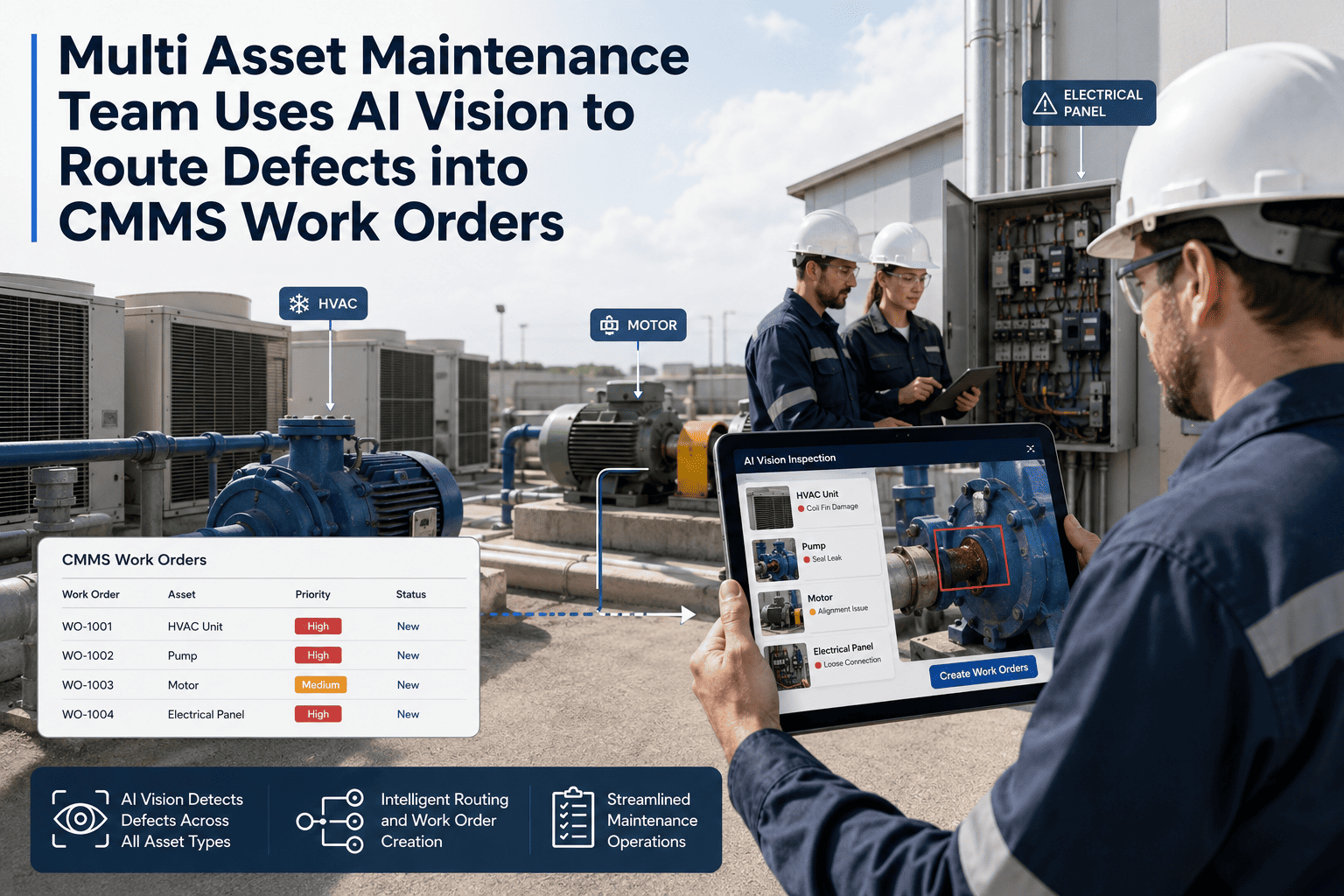
You don't need a big-bang rollout. Start by digitizing intake — operators submit requests from a phone with photos — then layer in PM scheduling and parts min/max as you go. Pre-shift digital inspections alone, with defect-to-work-order routing, deliver a fast 15 to 25% downtime reduction and require no sensors.
Book a demo to map a phased start.
How does OxMaint manage construction work orders?
OxMaint captures requests from the field on mobile, auto-assigns by skill and priority, attaches full asset and repair history, and checks parts stock before a repair stalls. PM triggers on hours, meters, or calendar; emergency defects route instantly; and every close feeds cost-per-asset and downtime reporting. It's built for spread-out, equipment-heavy fleets. Run it on yours with a
free trial.
Stop paying for the breakdown twice
Structure the work order, link the parts, and put your maintenance data to work — so the next $40 part never idles a $300,000 machine again.



.png)