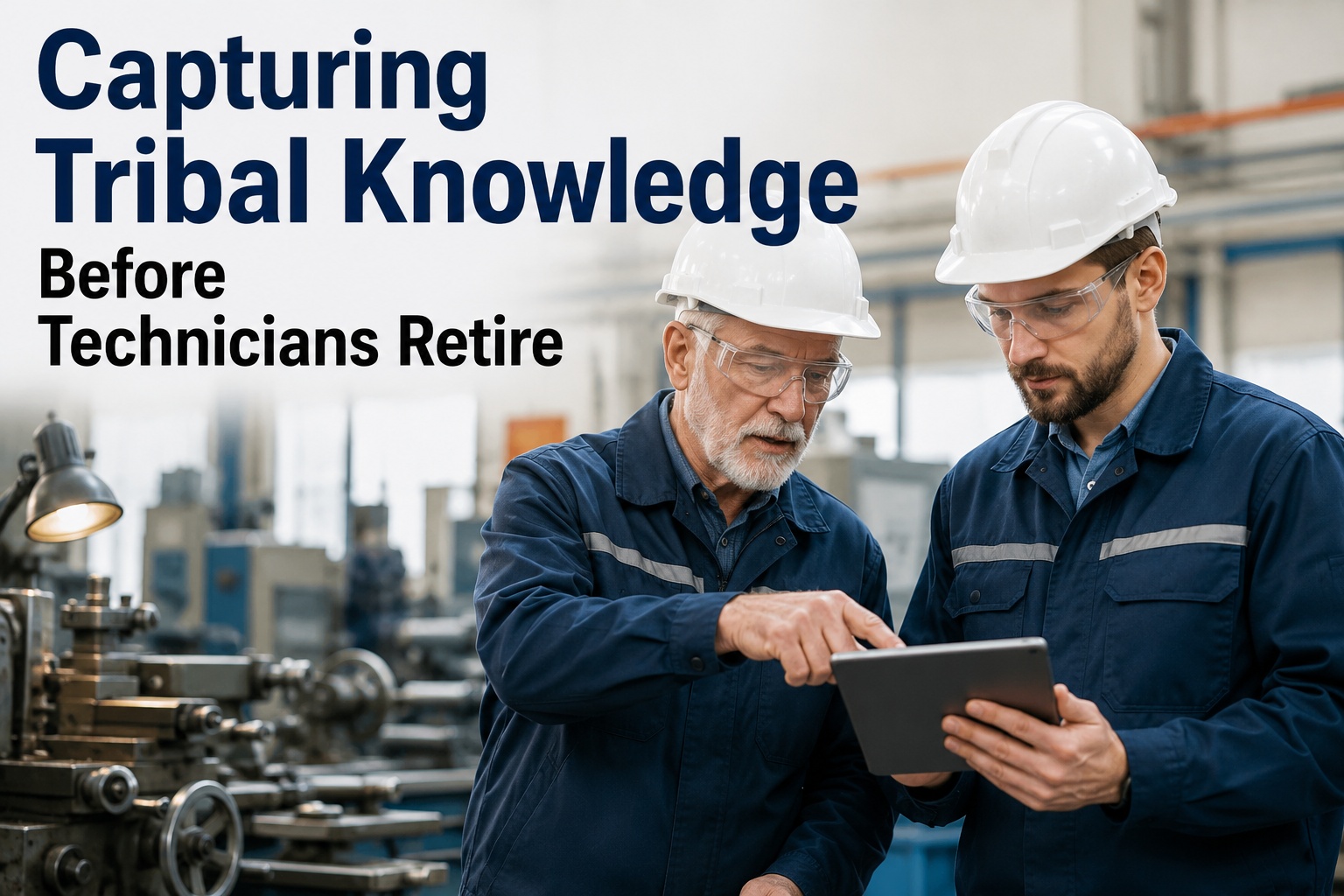
Senior maintenance technicians retire with 20–30 years of equipment knowledge locked in their heads — which pumps cavitate under specific load conditions, which motors overheat in summer months, which valves leak after 18 months regardless of manufacturer specs. When they leave, that knowledge disappears, forcing new technicians to relearn failure patterns through expensive trial and error. In 2026, AI is solving the tribal knowledge crisis by analyzing historical work order data, technician notes, and failure patterns to auto-generate standard operating procedures, troubleshooting guides, and predictive maintenance schedules. Facilities deploying AI knowledge capture report 60% faster training times for new technicians, 40% reduction in repeat failures, and preservation of critical institutional knowledge that would otherwise vanish with retiring employees. This complete guide covers AI-driven SOP generation, work order pattern analysis, technician knowledge extraction methodologies, and the 45-day implementation timeline that captures and codifies your team's tribal knowledge before it walks out the door. If your facility faces upcoming retirements and no documented process knowledge, start a free trial with OxMaint or book a demo to see AI-generated SOPs from your existing work order history.
Tribal Knowledge Capture 2026
AI Implementation Guide
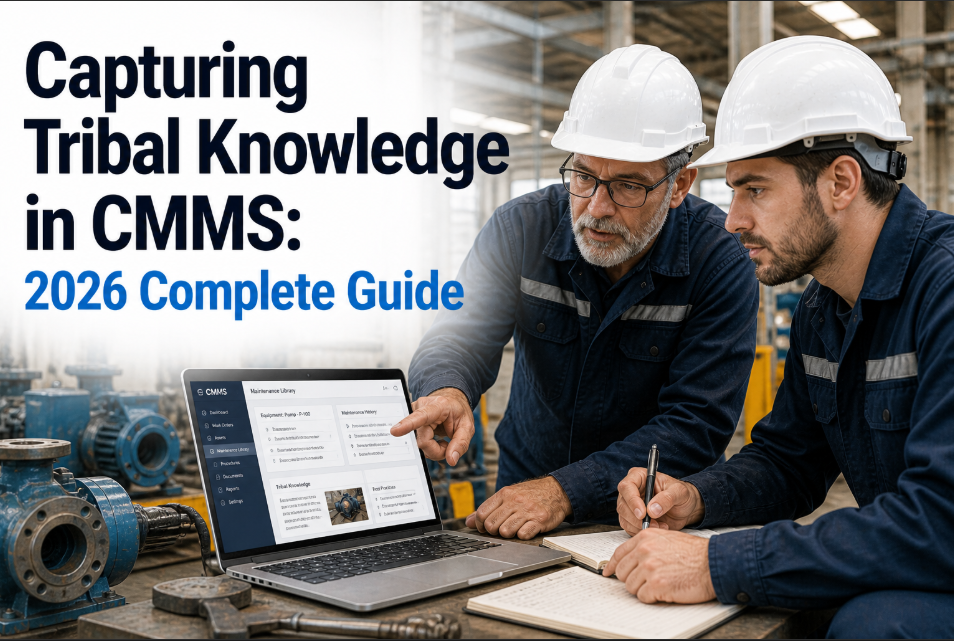
Capturing Tribal Knowledge in CMMS: AI-Powered Knowledge Transfer Guide 2026
Stop losing decades of technician expertise when senior employees retire. Use AI to extract tribal knowledge from work orders, auto-generate SOPs, and train new technicians in weeks instead of years.
10,000 Hours
Average institutional knowledge lost when 30-year senior technician retires
60%
Faster new technician training with AI-generated SOPs vs traditional apprenticeship
73%
Of facilities report no formal knowledge transfer process for retiring technicians
40%
Reduction in repeat failures after AI codifies historical troubleshooting knowledge
AI-Generated SOPs from Your Historical Work Order Data
OxMaint analyzes 5–10 years of completed work orders, technician notes, and failure patterns to auto-generate equipment-specific SOPs, troubleshooting guides, and predictive maintenance schedules. Capture tribal knowledge before senior technicians retire. Free for 30 days.
What Is Tribal Knowledge — And Why Losing It Costs $180,000 Per Retiring Technician
Tribal knowledge is the undocumented expertise, shortcuts, workarounds, failure patterns, and equipment-specific quirks that technicians learn through years of hands-on experience but never write down. It is the knowledge that a specific motor overheats when ambient temperature exceeds 85°F, that a particular pump seal leaks after exactly 14 months regardless of manufacturer warranty, that a certain valve requires 20% more torque than spec sheet recommends. This knowledge lives only in technicians' heads — passed informally through apprenticeship, lunch conversations, and on-the-job training. When senior technicians retire, that knowledge vanishes, forcing new hires to rediscover failure patterns through expensive trial and error over 3–7 years. The financial impact: facilities lose an average $180,000 in productivity, repeat failures, and extended troubleshooting time per retiring 30-year technician. For operations teams facing upcoming retirements with no knowledge capture process in place, start a free trial to begin extracting tribal knowledge from existing work order data, or book a demo for a guided knowledge transfer implementation.
Tribal Knowledge in Maintenance Operations
Undocumented technical expertise, equipment-specific operational knowledge, failure pattern recognition, troubleshooting shortcuts, and workaround procedures acquired through years of hands-on experience but never formally recorded in SOPs, manuals, or training materials.
Examples of Tribal Knowledge at Risk:
Equipment quirks: "Motor 3B vibrates at startup but settles after 2 minutes — normal behavior, not a fault"
Failure predictors: "When pump discharge pressure drops 3 PSI over 48 hours, impeller is wearing — replace within 2 weeks"
Seasonal patterns: "Chiller efficiency drops 15% every August — increase PM frequency June–September"
Workarounds: "Valve actuator sticks in winter — apply heat gun for 30 seconds before operation"
Vendor-specific fixes: "This brand of bearing requires grease type XYZ despite manual saying ABC — learned after 3 failures"
Troubleshooting shortcuts: "If Error Code 42 appears, bypass sensor check procedure and go straight to wiring harness — 90% of cases"
The Tribal Knowledge Crisis — 2026 Workforce Statistics
The maintenance workforce is aging faster than any other industrial sector. In 2026, 42% of maintenance technicians are over age 55, and retirement rates are accelerating. Facilities report average 18-month gaps between when senior technicians retire and when replacement hires reach equivalent productivity. This knowledge transfer crisis is hitting manufacturing, facilities, energy, and transportation sectors simultaneously — creating a competitive advantage for operations that deploy AI knowledge capture before retirements happen.
42%
Of maintenance technicians over age 55
Bureau of Labor Statistics 2026 — highest percentage of any industrial trade. Retirement wave accelerating 2026–2030.
18 Months
Average time for new hire to reach senior productivity
Traditional apprenticeship model — new technician shadows senior for 12–18 months before working independently.
73%
Of facilities lack formal knowledge transfer process
SMRP 2025 survey — most facilities rely on informal mentoring with zero documentation or structured knowledge capture.
$180K
Knowledge loss cost per retiring 30-year technician
Combination of extended troubleshooting time, repeat failures, and new hire productivity gap over 18 months.
3–7 Years
Time to relearn tribal knowledge through trial and error
Without documented procedures, new technicians rediscover equipment quirks and failure patterns one breakdown at a time.
60%
Faster training with AI-generated SOPs
Facilities using AI knowledge capture report new technicians reach productivity in 6–8 months vs 18 months traditional.
The Four Types of Tribal Knowledge — And How AI Captures Each
Tribal knowledge is not a monolithic category — it breaks into four distinct types, each requiring different AI extraction methodologies. Understanding which type you are trying to capture determines the data sources and AI models required.
How specific assets behave under different conditions, normal vs abnormal operational characteristics, equipment quirks that are not documented in manuals.
Examples:
"Pump 4A cavitates below 40 PSI suction pressure" | "Motor 7B runs 10°C hotter than identical motors — normal for this unit" | "Conveyor belt tracking drifts left in high humidity — adjust tension weekly in summer"
AI Capture Method:
Natural language processing analyzes technician notes in work orders, extracts equipment-specific observations, clusters similar patterns across multiple work orders, generates equipment behavior profiles
Which early warning signs precede specific failures, seasonal failure patterns, failure mode correlations, predictive indicators learned through repeated breakdown analysis.
Examples:
"When bearing temperature rises 5°C over 72 hours, bearing fails within 2 weeks" | "Seal leaks happen every 14–16 months regardless of PM schedule" | "Electrical failures spike in winter — moisture condensation in panels"
AI Capture Method:
Machine learning analyzes historical failure data, identifies leading indicators that precede failures, quantifies time windows between warning signs and failures, generates predictive rules
Which diagnostic steps to skip, which failure causes to check first, vendor-specific quirks, workarounds for intermittent faults, efficient troubleshooting sequences learned through trial and error.
Examples:
"Error Code 23 is always wiring harness — skip sensor checks" | "Intermittent trips resolve 80% of time by reseating connection at terminal block 4" | "This VFD brand resets after power cycle — try that before calling vendor support"
AI Capture Method:
Decision tree algorithms analyze work order sequences — which diagnostic steps were performed, in what order, which steps led to solution — builds probabilistic troubleshooting flowcharts
Non-standard procedures that work better than documented methods, equipment modifications made over years, installation quirks, vendor manual corrections learned through failures.
Examples:
"Manual says use grease A, but grease B lasts 3x longer on this bearing type" | "Valve actuator requires 85 ft-lbs torque despite 70 ft-lbs spec — learned after 2 leaks" | "Install gasket dry — any sealant causes leak after thermal cycling"
AI Capture Method:
Compares technician notes against manufacturer specifications, flags deviations, identifies successful workarounds through repeat work order analysis, documents as equipment-specific procedure modifications
How AI Extracts Tribal Knowledge from Work Order Data
The AI knowledge capture process is not interviewing senior technicians and transcribing their stories — it is mining 5–10 years of completed work orders, technician notes, failure records, and parts usage patterns to identify statistically significant equipment behaviors, failure predictors, and troubleshooting patterns. The AI finds knowledge the technicians themselves may not consciously recognize they possess.
Step 1
Historical Work Order Data Ingestion
AI ingests 5–10 years of completed work orders from CMMS — including technician notes, failure descriptions, parts used, labor hours, completion photos, and post-repair performance data. Minimum dataset: 2,000+ completed work orders for statistically significant pattern extraction.
Data Sources: Work order notes, failure codes, parts lists, labor time, technician assignments, completion status, follow-up work orders
Step 2
Natural Language Processing on Technician Notes
NLP algorithms parse unstructured technician notes (typically 50–500 words per work order) to extract equipment behaviors, failure symptoms, root causes, and corrective actions. Converts free-text notes into structured knowledge entities.
Extraction Targets: Symptoms, root causes, corrective actions, parts replaced, observations, workarounds, warnings, follow-up recommendations
Step 3
Pattern Recognition and Clustering
Machine learning clusters similar work orders — identifying equipment that fails repeatedly for the same reason, failure modes that share common root causes, seasonal failure patterns, and predictive failure indicators that appear across multiple events.
Pattern Types: Recurring failures, seasonal correlations, leading indicators, failure mode clusters, technician-specific fix patterns
Step 4
Troubleshooting Decision Tree Generation
AI analyzes which diagnostic steps technicians performed, in what sequence, and which steps led to successful resolution. Builds probabilistic troubleshooting flowcharts showing most-efficient diagnostic paths per failure mode.
Output: "If symptom X, check Y first (78% success rate), then Z (15% success rate), then escalate to vendor (7% cases)"
Step 5
Standard Operating Procedure Auto-Generation
System synthesizes extracted knowledge into equipment-specific SOPs, predictive maintenance rules, troubleshooting guides, and training materials. Each SOP references the historical work orders used as evidence — full audit trail.
Generated Documents: Equipment behavior profiles, failure prediction rules, troubleshooting flowcharts, PM interval recommendations, parts lists
Step 6
Knowledge Validation and Continuous Learning
Senior technicians review AI-generated SOPs for accuracy (validation rate typically 85–92%). Validated knowledge becomes training material. System continues learning from new work orders — SOPs update automatically as new patterns emerge.
Validation Metrics: Technician approval rate, new hire training time reduction, repeat failure rate change, troubleshooting time improvement
45-Day Tribal Knowledge Capture Implementation Timeline
This timeline represents the proven deployment path for AI knowledge capture on 50–100 critical assets in a manufacturing, facilities, or industrial operation. The process extracts knowledge from historical data without disrupting current operations or requiring extended technician interviews. Teams ready to begin knowledge capture before senior retirements can follow the guided workflow built into OxMaint — start a free trial to upload historical work order data and see AI pattern analysis, or book a demo for a knowledge capture roadmap specific to your facility.
Week 1–2
Historical Data Collection and Preparation
Export 5–10 years of completed work orders from existing CMMS or maintenance records
Identify 50–100 highest-criticality assets for priority knowledge capture
Confirm minimum 2,000+ work orders with technician notes (required for statistical significance)
Import historical data into OxMaint AI knowledge extraction module
Validate data quality — ensure technician notes are readable and failure codes are consistent
Deliverable: 5–10 years historical work order data imported, 50–100 priority assets identified, data quality validated
Week 2–3
AI Pattern Analysis and Knowledge Extraction
AI analyzes technician notes using natural language processing (2–3 days processing time)
Machine learning identifies recurring failure patterns, seasonal trends, predictive indicators
System clusters similar work orders and builds failure mode correlation maps
Troubleshooting decision trees auto-generated from diagnostic step sequences
Review AI-identified patterns with senior technicians for validation
Deliverable: AI pattern analysis complete, failure predictors identified, troubleshooting decision trees generated
Week 3–4
SOP Auto-Generation and Senior Technician Validation
AI auto-generates equipment-specific SOPs for 50–100 priority assets
System creates troubleshooting guides with probabilistic diagnostic flowcharts
Predictive maintenance rules generated from failure pattern analysis
Senior technicians review and validate AI-generated documents (validation sessions: 2–3 hours per asset)
Technicians add context, corrections, and additional observations to AI drafts
Deliverable: 50–100 equipment-specific SOPs generated and validated at 85–92% accuracy rate
Week 4–6
Knowledge Deployment and New Technician Training
Finalize SOPs and publish in CMMS — linked directly to asset records
Build mobile-accessible troubleshooting guides for field technicians
Create structured training program using AI-generated knowledge base
Train new technicians using equipment-specific SOPs and troubleshooting flowcharts
Measure training time reduction vs traditional apprenticeship model
Deliverable: Knowledge base deployed, new technician training program live, baseline metrics established for training time reduction
Ongoing
Continuous Learning and Knowledge Update
AI continues analyzing new work orders as they are completed
System updates SOPs automatically when new patterns emerge
Technicians flag knowledge gaps or inaccuracies for AI refinement
Track new hire productivity improvement and repeat failure rate reduction
Expand knowledge capture to additional assets based on ROI validation
Deliverable: Self-updating knowledge base that improves continuously — zero maintenance required after initial deployment
ROI of Tribal Knowledge Capture — Cost Avoidance and Training Acceleration
Tribal knowledge capture delivers financial returns through two mechanisms: preventing knowledge loss cost (extended troubleshooting, repeat failures, new hire productivity gap) and accelerating new technician training (6–8 months to productivity vs 18 months traditional). This ROI model uses a 150-employee manufacturing facility with 3 senior technician retirements over 24 months.
Knowledge Loss Cost — Without AI Capture (Baseline)
New hire productivity gap (3 hires × 18 months × $25K productivity loss)$135,000
Extended troubleshooting time without documented procedures (480 hours × $75/hr)$36,000
Repeat failures from rediscovered knowledge (12 events × $8,500 downtime)$102,000
Informal mentoring time (senior technicians training new hires: 600 hours × $85/hr)$51,000
Total 2-Year Knowledge Loss Cost$324,000
With AI Knowledge Capture — Cost Reduction
New hire productivity gap (3 hires × 8 months × $25K productivity loss — 60% faster training)$60,000
Troubleshooting time with SOP guidance (180 hours × $75/hr — 62% reduction)$13,500
Repeat failures (4 events × $8,500 — 67% reduction from documented failure predictors)$34,000
Structured training time (200 hours × $85/hr — formalized vs informal mentoring)$17,000
AI knowledge capture platform cost (OxMaint CMMS, 2-year cost)$3,840
Implementation labor (120 hours team time × $85/hr)$10,200
Total 2-Year Cost with AI Capture$138,540
$185,460
2-Year Net Savings
Knowledge loss cost avoided ($324K) minus implementation cost ($139K)
57%
Cost Reduction
Total knowledge loss cost reduced from $324K to $139K over 2 years
60%
Training Time Reduction
New technicians reach productivity in 8 months vs 18 months traditional apprenticeship
1,322%
2-Year ROI
Total savings ($185K) divided by implementation cost ($14K platform + labor)
How OxMaint Delivers AI Knowledge Capture
OxMaint is not a standalone knowledge management tool — it is a unified CMMS with AI tribal knowledge extraction built into the core platform. The system analyzes your existing work order history and auto-generates SOPs without disrupting current operations or requiring extended technician interviews.
H
Historical Work Order Data Mining
Import 5–10 years of completed work orders from any CMMS or maintenance records system. AI processes 10,000+ work orders in 48 hours — extracting equipment behaviors, failure patterns, and troubleshooting sequences from unstructured technician notes.
N
Natural Language Processing Engine
NLP algorithms parse free-text technician notes (50–500 words per work order) to extract symptoms, root causes, corrective actions, and equipment-specific observations. Converts informal notes into structured knowledge entities.
P
Pattern Recognition and Failure Prediction
Machine learning identifies recurring failure modes, seasonal patterns, leading indicators, and predictive rules. System quantifies: "When vibration increases X%, failure occurs within Y days (confidence: 87%)".
S
Auto-Generated SOP Builder
AI synthesizes extracted knowledge into equipment-specific SOPs, troubleshooting flowcharts, and predictive maintenance rules. Each SOP references the historical work orders used as evidence — full transparency and audit trail.
V
Senior Technician Validation Workflow
AI-generated SOPs routed to senior technicians for validation. Technicians approve, reject, or edit AI drafts. Validation feedback improves AI accuracy — typical approval rate 85–92% on first draft.
C
Continuous Learning and Knowledge Updates
System continues analyzing new work orders as they are completed. SOPs auto-update when new patterns emerge. Knowledge base improves continuously without manual maintenance — self-updating documentation.
Frequently Asked Questions
How much historical data is needed for AI to generate useful SOPs?+
Minimum dataset: 2,000+ completed work orders covering 3–5 years of operation. Optimal dataset: 5,000+ work orders covering 5–10 years. The AI identifies statistically significant patterns — more data produces higher-confidence knowledge extraction. Work orders must include technician notes (50+ words per work order on average) for NLP analysis to be effective. If historical data is sparse, AI can still extract knowledge but validation rate drops from 85–92% to 65–75%. Facilities with robust work order documentation (detailed technician notes, failure codes, parts used) see highest AI accuracy. Want to assess whether your historical data is sufficient for AI knowledge extraction —
start a free trial and upload a sample dataset for preliminary analysis.
Can AI knowledge capture replace the need for senior technicians to train new hires?+
No — AI knowledge capture accelerates training but does not replace hands-on mentoring. The AI extracts and documents tribal knowledge (equipment behaviors, failure patterns, troubleshooting shortcuts) that would otherwise take new technicians 3–7 years to learn through trial and error. But practical skills — torque technique, wiring proficiency, diagnostic intuition — still require supervised practice. The documented knowledge base shortens the apprenticeship period from 18 months to 6–8 months by front-loading equipment-specific knowledge that traditionally was learned one breakdown at a time. Senior technicians remain essential for validating AI-generated SOPs and providing hands-on skills training — the AI just makes their knowledge transfer 60% more efficient.
What happens if AI-generated SOPs contain errors or inaccurate recommendations?+
All AI-generated SOPs go through mandatory senior technician validation before publication. Validation workflow routes AI drafts to subject matter experts who approve, reject, or edit each document. Industry benchmark: 85–92% of AI-generated content approved on first draft, 8–15% requires minor edits, under 5% rejected as inaccurate. The system learns from validation feedback — when a technician marks a recommendation as incorrect, the AI adjusts its models. After 90 days of continuous learning, approval rates typically exceed 95%. Every published SOP includes audit trail showing which work orders were used as evidence — full transparency. If a technician questions an SOP recommendation in the field, they can review the underlying work order data and flag for revision. The knowledge base is version-controlled with full change history.
How quickly can we deploy AI knowledge capture before senior technicians retire?+
Implementation timeline: 45 days from historical data import to validated SOP publication. The process is not interview-dependent — AI extracts knowledge from historical work orders without requiring extensive technician time. Senior technicians spend 2–3 hours per critical asset validating AI-generated SOPs — total validation time for 50 assets: 100–150 hours over 2–3 weeks. This means even technicians with 3–6 month retirement timelines can participate in knowledge validation. The critical success factor: starting before retirements happen. Facilities that wait until after senior technicians leave lose the validation layer and must rely on AI-generated content without subject matter expert review (accuracy drops to 70–80% without validation). Ready to start knowledge capture before upcoming retirements —
book a demo and bring your retirement timeline for a project roadmap.
AI Tribal Knowledge Capture — OxMaint Platform
Preserve 30 Years of Technician Expertise Before It Retires
OxMaint analyzes 5–10 years of completed work orders and auto-generates equipment-specific SOPs, troubleshooting guides, and predictive maintenance rules. Capture tribal knowledge in 45 days — before senior technicians retire and take decades of expertise with them. Train new technicians in 8 months instead of 18. Free for 30 days.
60%
Faster new technician training
$185K
2-year knowledge loss savings
45 Days
Implementation timeline
85–92%
AI SOP accuracy after validation