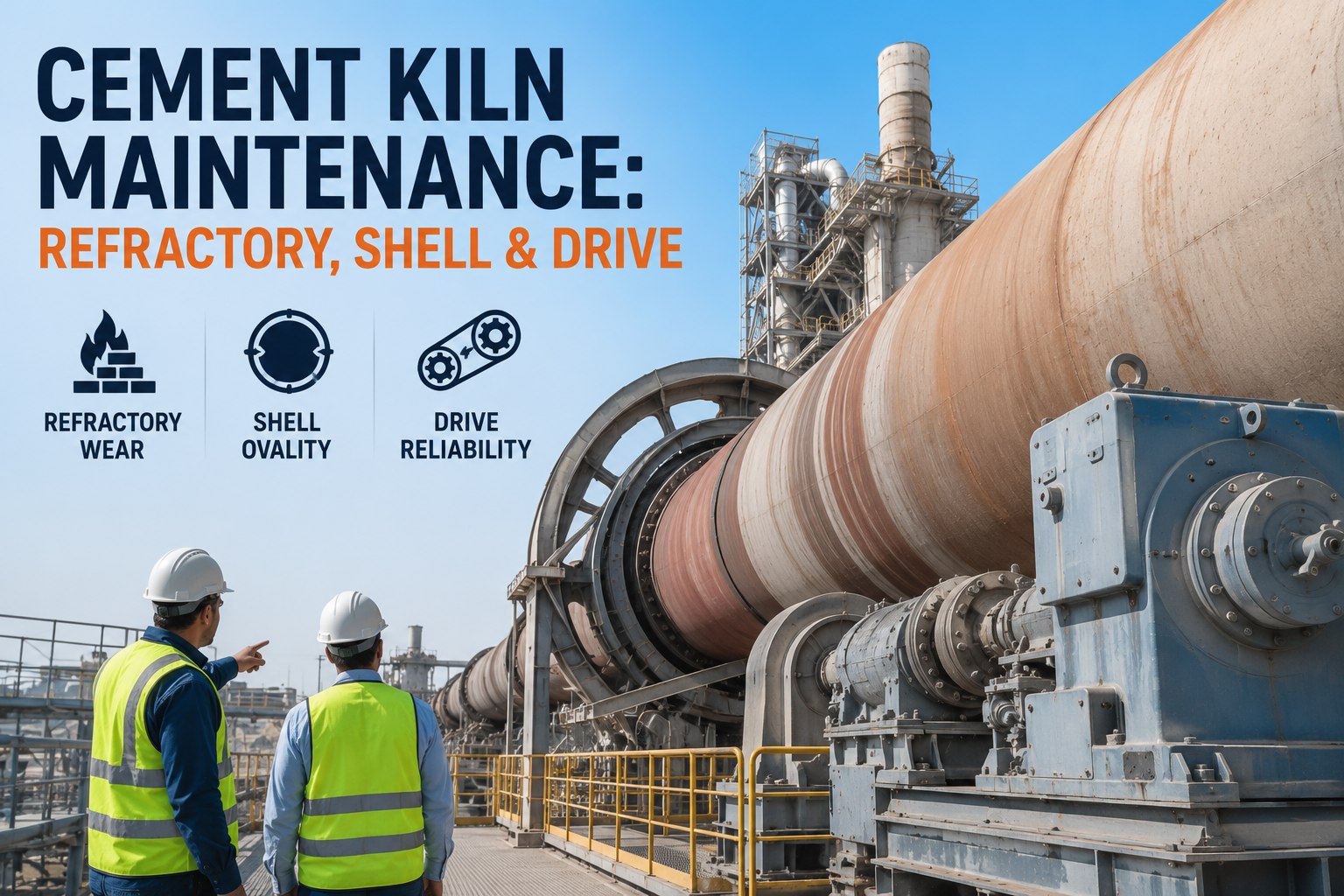
The rotary kiln is the single most valuable, most complex, and most consequential asset in a cement plant. A single hour of unplanned kiln downtime costs a producer somewhere between $20,000 and $85,000 in direct production loss, and a catastrophic event — a red shell, a refractory collapse, a support roller seizure — puts 5 to 14 days of clinker production on the ground worth $1.4 million to $4.8 million per event, with emergency refractory and shutdown labor adding 40 to 80% on top of the planned repair cost for the same work. Reactive cement plants routinely lose 3 to 5% of annual clinker production to kiln downtime alone, while world-class producers holding structured refractory campaigns, shell health monitoring, and drive PM discipline hold kiln availability above 90%. The failure modes are not mysterious — every major kiln failure produces detectable signals weeks in advance, and the difference between the two operating classes is not luck but the monitoring cadence and the CMMS discipline that turns signals into planned interventions. Oxmaint is the CMMS built for cement kilns — zone-level refractory campaign tracking, shell temperature integration with brick thickness records, tyre migration and ovality logging, drive train PM cadence, and the audit trail required for refractory warranty claims and insurance inspections. Start a free Oxmaint trial to run cement kiln maintenance on the CMMS, or book a demo to see the CMMS mapped to your kiln's refractory zones and drive train.
Cement Plant · Rotary Kiln · Refractory & Drive CMMS
Cement Kiln Maintenance: Refractory, Shell & Drive — The 2026 Guide
Zone-level refractory tracking, shell ovality control, tyre migration monitoring, and drive train PM cadence — everything a cement producer needs to hold kiln availability above 90% on one CMMS platform.
-
$20K–$85K
cost per hour of unplanned cement kiln downtime — before emergency labor premium
-
3–5%
of annual clinker production lost to kiln downtime in reactive-maintenance plants
-
12–24 Mo
typical refractory campaign life — with proper zone-level management
-
0.4–0.6%
maximum ovality threshold as fraction of kiln diameter — above this, refractory damage accelerates
Why Cement Kiln Maintenance Is Its Own Discipline
Four Conditions That Make the Kiln a Different Maintenance Problem
Cement plants operate multiple maintenance disciplines — raw mill, coal mill, cement mill, and utilities each carry their own PM programs. The kiln is different because it is the single largest consequence-of-failure asset in the plant and the one system that cannot be inspected internally during operation. Understanding the four defining conditions is the starting point for any real reliability program.
-
01
Extreme Operating Environment
Burning zone temperatures of 1400 to 1500°C. Thermal cycling every shutdown. Corrosive alkali, sulfur, and chloride atmospheres. Continuous mechanical stress from rotation and material load.
-
02
No Internal Inspection Access
Impossible to see refractory condition while the kiln runs. Every internal inspection requires a planned or forced shutdown. Everything else is inferred from external indicators.
-
03
Whole-Plant Consequence
A kiln stop halts raw mill, coal mill, and cement mill within hours as stockpiles exhaust. One kiln failure cascades into a total plant shutdown, not a single-asset event.
-
04
Signals Precede Failure by Weeks
Shell temperature drift, tyre migration change, ovality deformation, drive vibration — every major failure telegraphs itself weeks in advance if the monitoring cadence catches it.
The Kiln Anatomy
Four Systems That Together Make the Rotary Kiln Work
Every rotary kiln resolves into four discrete engineering systems — shell, refractory lining, drive train, and support structure. Each has its own failure signature, its own inspection method, and its own PM cadence. Oxmaint holds each as a distinct sub-asset under the kiln parent record so cadences do not collide.
-
A1
Kiln Shell
Steel cylindrical structure carrying the entire load. Ovality, temperature profile, thickness, and weld integrity define its health. Shell condition dictates refractory survival.
Components: shell plates, longitudinal and circumferential welds, tyre pads, seals
-
A2
Refractory Lining
The internal firebrick and castable protecting the shell from process temperatures. Zone-specific materials chosen for each zone's chemistry and thermal conditions.
Components: basic bricks, alumina bricks, castables, coating layer, expansion allowance
-
A3
Drive System
Girth gear, pinion, main drive motor and reducer, plus auxiliary drive for slow rotation during cool-down and heat-up. The single point of rotation for the entire kiln.
Components: girth gear, pinion, main motor, reducer, auxiliary drive, hydraulic thrust
-
A4
Supports & Tyres
Two or three support stations depending on kiln length. Riding rings (tyres) transfer kiln weight to support rollers. Alignment defines even loading across every station.
Components: tyres, support rollers, thrust rollers, trunnion bearings, base frames
The Refractory Zone Map
Five Zones Along the Kiln — Each With Its Own Refractory and Campaign Life
A modern rotary kiln lining is not one refractory material — it is five discrete zones running from the inlet to the outlet, each with its own thermal condition, chemistry, wear mechanism, and appropriate brick specification. Zone-level campaign life tracking is the difference between reactive replacement and planned campaigns. Oxmaint holds every zone's brick thickness, hot-spot events, and campaign start date against the kiln record.
Preheating Zone
Feed enters. Lower temperatures but highest mechanical abrasion from raw meal. Inlet seals and feed chain damage are the primary failure modes here.
Refractory: abrasion-resistant alumina, castables
Life: 24–36 months
Calcining Zone
CaCO3 dissociates to CaO and CO2. Moderate temperatures. Calcination coating protects the brick from thermal shock — coating instability is the main failure signature.
Refractory: high-alumina bricks (60–70% Al2O3)
Life: 18–24 months
Safety / Transition Zone
Between calcining and burning. Thermal shock zone as temperature climbs steeply. Coating may or may not adhere depending on chemistry.
Refractory: magnesia-alumina spinel, dolomite
Life: 12–18 months
Burning / Sintering Zone
1400 to 1500°C. Clinker forms. The hottest, most chemically aggressive, most-monitored zone. Coating stability determines everything. Failure here is the most expensive event on the kiln.
Refractory: magnesia-spinel, magnesia-chrome
Life: 8–15 months
Cooling / Outlet Zone
Clinker discharges. Rapid cooling. Mechanical wear from clinker abrasion is dominant. Outlet nose ring, discharge seals, and kiln hood refractory.
Refractory: high-alumina, castables, nose ring segments
Life: 18–30 months
The Five Refractory Failure Modes
Every Refractory Failure Traces to One of Five Root Mechanisms
Refractory does not simply wear out uniformly. Industry data across cement kilns converges on five distinct failure mechanisms — each with its own signature, its own root cause, and its own prevention path. Every zone's failure record inside Oxmaint carries the mode as a structured field so recurring patterns surface.
-
F1
Chemical Attack
Alkali (K2O, Na2O), sulfur, and chloride penetrate brick pores at high temperature. Cause structural degradation from within. Common in kilns with high-sulfur fuel or alternative fuels.
-
F2
Thermal Shock & Cycling
Every shutdown and startup cycles brick through 1000+ °C differentials. Repeated cycling causes spalling — thin flakes progressively falling off the hot face until the brick is thinned enough to fail.
-
F3
Mechanical Abrasion
Raw meal, clinker, and coating fragments sliding on the hot face wear the brick mechanically. Dominant mode in inlet and outlet zones where material velocity is highest.
-
F4
Coating Instability
The clinker coating layer protects burning-zone brick from direct thermal load. Unstable coating detaches in sheets, taking brick surface with it. Diagnosed via shell temperature spikes.
-
F5
Shell Ovality Distortion
Ovality above 0.4 to 0.6% of kiln diameter creates tangential shear stress on every brick ring. Bricks crush at the pinch point and loosen at the opening — annular spalling in uniform flakes.
The Signal Reality
Every Major Kiln Failure Produces Detectable Signals Weeks Before Catastrophic Damage
Shell temperature elevations of just 15 to 20°C above baseline. Tyre migration exceeding 20mm per revolution. Ovality creeping past the 0.5% threshold. Support roller vibration edging up. Every one visible weeks in advance. The difference between plants holding 90% availability and plants running below 85% is not luck — it is the monitoring cadence and the CMMS discipline that turns each signal into a planned intervention.
Shell Health Monitoring
Four Vital Signs That Tell You What the Kiln Cannot Show You Directly
Because the kiln's interior is inaccessible during operation, shell condition monitoring is the primary diagnostic surface. Four measurements taken together define kiln health — and every one integrates with Oxmaint so the readings sit against the kiln asset record with thresholds and automatic work order triggers.
-
V1
Hot Shell Temperature
Continuous IR scanner along the shell length. Baseline profile established per zone. Deviation of 15 to 20°C signals brick thinning, coating loss, or hot spot developing.
Cadence: Continuous
-
V2
Shell Ovality
Geometric survey measures deformation from perfect circle. Threshold 0.4 to 0.6% of kiln diameter. Excess ovality crushes brick edges at the pinch point.
Cadence: Weekly to monthly
-
V3
Tyre Migration
Relative rotational movement between riding tyre and shell. Normal 4 to 12 mm per revolution. Above 20 mm indicates tyre pad wear and impending shell fatigue.
Cadence: Weekly
-
V4
Axial Alignment
Kiln axis must run true across all support stations. Misalignment causes uneven riding ring load, roller skew, and longitudinal brick crunching zones.
Cadence: Every planned shutdown
The PM Cadence Matrix
Which Kiln System Gets Serviced at Which Interval
The full kiln PM program runs on five parallel clocks — from continuous shell scanner monitoring through the campaign-scale refractory replacement. Below is the working cadence matrix Oxmaint fires against every kiln asset.
| System | Daily | Weekly | Monthly | Shutdown | Campaign |
|---|---|---|---|---|---|
| Refractory | |||||
| Shell (Temp/Ovality) | |||||
| Drive Train | |||||
| Supports & Tyres | |||||
| Alignment |
Amber = major intervention during planned shutdown or campaign turnaround. Navy = routine PM cycle during operation.
Where Manual Programs Break
Four Gaps Every Cement Plant Kiln Audit Finds
-
01
Shell Temperature Untied to Brick Thickness
Shell scanner shows 280°C. Nobody knows whether that means 90% remaining lining or 40%. Same reading, completely different response — one is a red-shell emergency.
-
02
Refractory Campaign in Spreadsheets
Zone-level campaign start dates in a workbook nobody trusts. No idea how much life remains in the burning zone. No planned refractory campaign window — just wait for failure.
-
03
Tyre Migration Not Trended
Migration measured weekly and written in a logbook. Never trended. Tyre pad wear crosses the damage threshold months before anybody notices from the paper record.
-
04
Alignment History Missing
Last hot alignment was at the last major turnaround. Cold alignment before that. No structured history to detect drift trends. Roller loading imbalance discovered from bearing failures.
Built for Cement Kilns
How Oxmaint Runs the Full Kiln Reliability Program
-
Zone-Level Refractory
Every Zone's Campaign Tracked Independently
Preheat, calcining, transition, burning, cooling — each with its own brick spec, campaign start date, thickness record, and remaining life projection.
-
Shell Scanner Integration
IR Scanner Feeds Directly Into the CMMS
Continuous temperature profiles logged against the kiln asset. Threshold deviations trigger work orders automatically. Historical trending catches slow drift.
-
Temp-to-Thickness Link
Shell Reading Interpreted Against Actual Brick
Every temperature reading linked to the last measured brick thickness for that zone. 280°C never sits alone — the software knows whether that means concern or emergency.
-
Ovality & Migration
Trended Over Time, Not Just Logged
Weekly ovality and tyre migration measurements plotted against the design thresholds. Approach to the damage limit surfaces months before the limit itself.
-
Drive Train PM
Girth Gear, Pinion, Motor, Reducer Cadence
Every drive component on its own PM interval. Vibration analysis, oil analysis, gear contact pattern inspection. Auxiliary drive tested on schedule.
-
Campaign Planning
Refractory Replacement Windows Forecasted
Remaining life per zone drives the campaign forecast. Replacement scheduled into planned shutdowns — not driven by an unexpected failure event.
Measured Outcomes
What Cement Plants Gain With Oxmaint on the Kiln Program
-
90%+
Kiln Availability
Structured refractory campaigns, shell monitoring, and drive PM push kiln availability into the world-class range versus the reactive 85% baseline.
-
Weeks
Early Warning
Shell hot spot detection, tyre migration trending, and ovality tracking surface failure signatures weeks before they force a stop.
-
Planned
Refractory Campaigns
Zone-level remaining life projection lets producers schedule refractory campaigns into planned shutdown windows instead of reacting to failures.
-
40–80%
Emergency Premium Avoided
Planned refractory work costs 40 to 80% less than the same work done as an emergency shutdown. Structured campaigns capture that entire delta.
Frequently Asked
Cement Kiln Maintenance & CMMS Questions
What is the maximum acceptable shell ovality for a cement kiln?
Modern high-capacity kilns must maintain an ovality ratio below 0.4 to 0.6% of the kiln diameter. Above this threshold, the tangential shear stress on the refractory increases sharply — bricks are crushed at the pinch point of rotation and loosened at the opening point, causing annular spalling in uniform flakes. Weekly to monthly ovality measurement logged in Oxmaint catches the drift before it reaches the damage threshold. Sign up for Oxmaint to trend shell ovality against the design threshold.
What is normal tyre migration versus a damage threshold?
Normal tyre migration — the relative rotational movement between the riding tyre and the shell — sits at 4 to 12 mm per revolution. Some migration is desirable, helping distribute heat around the shell. Migration exceeding 20 mm per revolution indicates the tyre pads between shell and tyre are worn, allowing the tyre to float. This causes shell ovality deformation under the tyre, accelerates refractory cracking, and progresses to shell fatigue cracking if not addressed.
Why must shell temperature be linked to brick thickness records?
A shell scanner reading of 280°C means completely different things depending on how much refractory remains behind it. On a fresh burning-zone lining with 200mm of magnesia-spinel brick, 280°C is normal. On a lining thinned to 100mm, 280°C is an emergency approaching red-shell condition. Same reading, opposite response. Oxmaint stores the last measured brick thickness against every zone so the software interprets temperature readings correctly. Book a demo to see linked temperature and brick thickness in Oxmaint.
How is refractory campaign life projected per zone?
Each zone carries its own historical campaign life — burning zone typically 8 to 15 months, transition 12 to 18, calcining 18 to 24, preheat 24 to 36, cooling 18 to 30. Oxmaint holds the current campaign's start date, cumulative hot spot events, thickness measurements from every inspection window, and projects remaining life against the zone's historical baseline. Refractory replacement windows can then be scheduled into planned shutdowns instead of reacting to a failure event. Sign up for Oxmaint to run zone-level refractory campaign forecasting.
Monitor · Plan · Sustain
Every Catastrophic Kiln Failure Had Signals That Were Visible Weeks Before the Stop
The shell temperature that crept up 20°C in the burning zone. The tyre migration that pushed past 20mm per revolution. The ovality reading nobody plotted against threshold. The refractory campaign that ran past the historical burning-zone life. Every one visible weeks ahead. Every one closable by a CMMS that runs zone-level refractory tracking, links shell readings to brick records, trends every vital sign, and turns each signal into a planned intervention. Oxmaint is the CMMS built for cement kiln reliability.