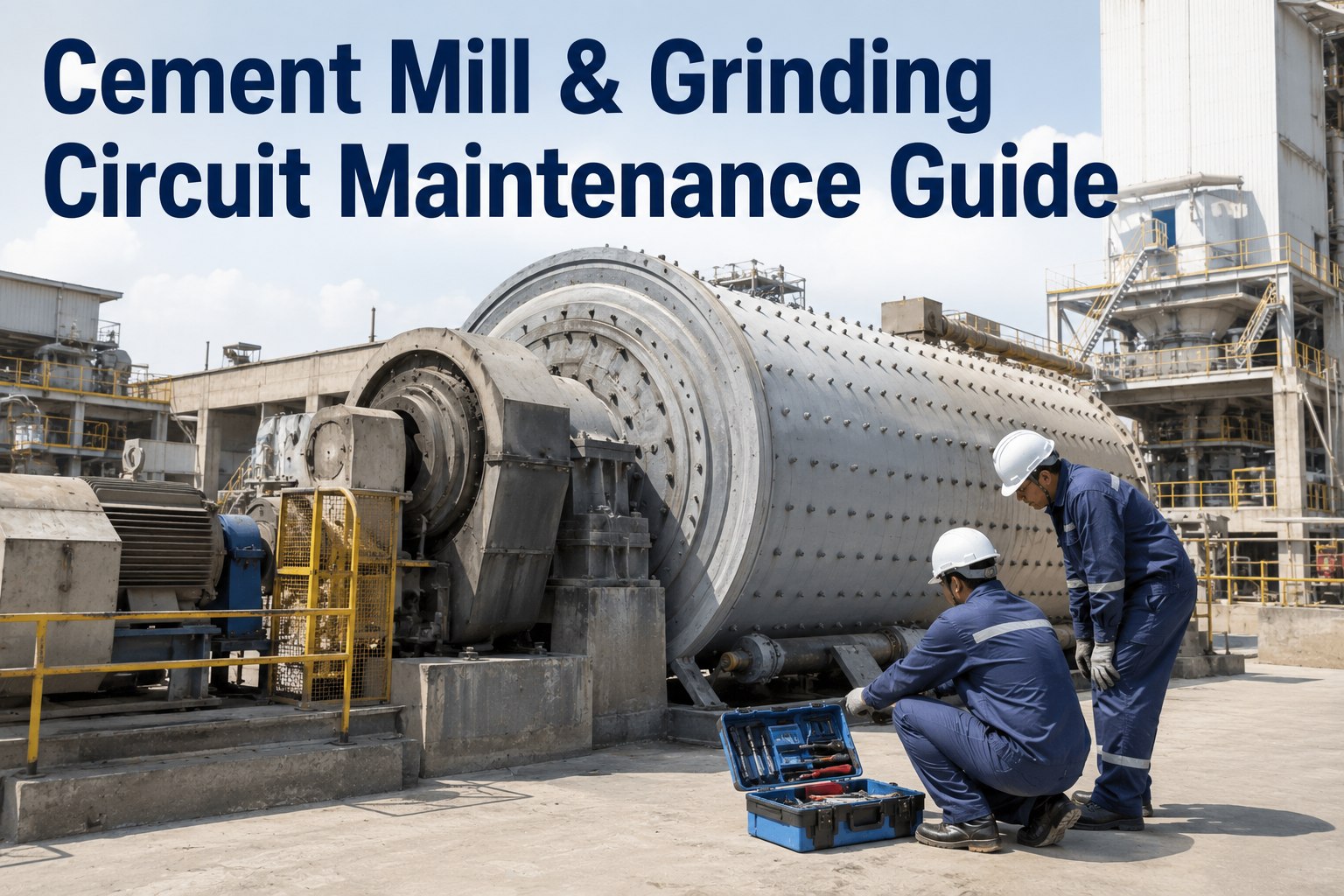
Unplanned kiln shutdowns cost US cement producers an average of $28,000 per hour in lost clinker output — yet 68% of those shutdowns trace directly to missed preventive maintenance tasks that existed on a paper schedule nobody checked. The gap between a maintenance plan on paper and a maintenance plan executed in the field is exactly where Oxmaint operates. Book a demo to see how Oxmaint CMMS cuts cement plant downtime by up to 40% across kiln, mill, and crusher operations.
Oxmaint schedules kiln, mill, and crusher PM automatically — sending mobile work orders to your technicians, triggering predictive alerts before failures, and syncing with SAP. US cement plants using Oxmaint report $1.4M+ in avoided downtime costs in year one.
Cement plant maintenance management requires structured PM scheduling across four critical equipment categories — rotary kilns, vertical roller mills, crushers, and conveyor systems — with predictive analytics layered on top. Oxmaint digitizes the full maintenance cycle: asset hierarchy, PM work orders, condition-based triggers, and CMMS-to-SAP integration. All without spreadsheets, paper rounds, or disconnected data.
The Four Equipment Categories That Drive Cement Plant Reliability
Each category carries its own failure mode, its own PM frequency, and its own cost when maintenance slips. Book a demo to see how Oxmaint structures PM schedules for your specific equipment mix.
Shell temperature scanning, tire slip monitoring, thrust roller alignment, and refractory brick life tracking — all scheduled against kiln operating hours in Oxmaint. AI-based thermal anomaly detection triggers work orders before refractory failure forces unplanned shutdown.
Roller wear measurement intervals, hydraulic pressure trending, grinding table crack inspection, and separator rotor bearing vibration — all linked to asset-level PM work orders in Oxmaint. Vibration threshold breaches auto-generate inspection tasks before bearing failure.
Liner wear tracking, toggle plate inspection intervals, bearing temperature monitoring, and screen deck condition assessments — scheduled by operating tonnage or time in Oxmaint. OBD/telematics integration pulls real-time crusher load data to trigger condition-based PM at the right moment.
Belt tension checks, idler roller lubrication rounds, pulley lagging inspection, and drive gearbox oil analysis — all managed in Oxmaint with route-based mobile work orders. PLC integration enables automatic conveyor health alerts before belt splice failure or idler seizure causes raw material feed interruption.
Schedule Every PM. Catch Every Failure — Before It Stops the Kiln.
Oxmaint connects your asset register to mobile PM work orders, predictive alerts, and SAP integration — in one system your maintenance team will actually use. Book a demo to see your kiln and mill PM schedule configured live.
Technology Stack: How Modern Cement Plants Prevent Failures
Reactive maintenance is the most expensive maintenance strategy in cement. The shift to predictive and condition-based maintenance requires integrating four technology layers — and connecting them to a CMMS that acts on the data.
Thermal cameras mounted on kiln shell detect refractory hotspots in real time. Computer vision identifies conveyor belt tears, idler failures, and clinker cooler plate conditions — feeding Oxmaint with automatic work order triggers without manual inspection.
A virtual model of your rotary kiln or VRM runs in parallel with the physical asset — simulating thermal load, mechanical wear, and energy consumption. Oxmaint integrates digital twin failure predictions directly into PM work order scheduling, adjusting intervals dynamically as operating conditions shift.
Real-time operating data — crusher RPM, conveyor belt speed, drive motor amperage — streamed from PLC controllers into Oxmaint. Condition-based maintenance triggers fire when parameters cross defined thresholds, replacing fixed time-based intervals with usage-based PM that reduces both over-maintenance and under-maintenance.
Oxmaint work orders sync bidirectionally with SAP PM and SAP MM — purchase requisitions for spare parts generate automatically from Oxmaint when critical stock drops below reorder levels. Maintenance cost data flows back to SAP CO for accurate equipment lifecycle costing without manual data entry.
Oxmaint CMMS — Implementation Roadmap for Cement Plants
A structured four-phase deployment gets your cement plant from paper-based maintenance to a fully operational predictive CMMS — without disrupting production schedules or requiring an IT project.
Every kiln, mill, crusher, and conveyor registered in Oxmaint's asset hierarchy — with equipment specifications, spare parts lists, and maintenance history imported from existing records. Failure mode library built per equipment type from OEM documentation and plant maintenance history.
Preventive maintenance schedules configured per asset — daily, weekly, monthly, and operating-hour-based triggers. Mobile work orders activated for field technicians via QR-scanned equipment tags. Book a demo to see mobile PM activation for your kiln and mill equipment.
Vibration baselines established per asset. AI thermal monitoring connected for kiln shell scanning. PLC data streams configured for conveyor and crusher condition monitoring. Anomaly-based work order triggers activated — replacing time-based PM with usage and condition-based intervals where sensor data is available.
Oxmaint work orders synchronized with SAP PM. Spare parts purchase requisitions auto-generated from Oxmaint stock alerts. Maintenance KPI dashboard showing MTBF, MTTR, planned vs unplanned ratio, and cost per equipment type — exportable for plant manager and VP Operations review.
Cement Plant Maintenance KPIs — Industry Benchmarks vs Oxmaint Results
These benchmarks represent typical cement plant performance before and after deploying a structured CMMS with predictive analytics. Gap between current state and target state represents the financial opportunity.
Oxmaint vs Competing CMMS Platforms — Cement Plant Maintenance
Most general-purpose CMMS platforms handle basic work orders. Cement plant maintenance requires equipment-specific PM templates, predictive analytics integration, and SAP connectivity — capabilities that separate specialized platforms from generic solutions.
| CMMS Capability | Oxmaint | MaintainX | UpKeep | Fiix | Limble | IBM Maximo | Hippo CMMS | Infor EAM |
|---|---|---|---|---|---|---|---|---|
| Cement-specific PM templates | Yes | Generic | No | Generic | Generic | Custom | No | Custom |
| Predictive analytics / AI triggers | Yes | No | No | Partial | No | Yes | No | Yes |
| SAP PM / ERP integration | Yes | No | No | Partial | No | Yes | No | Yes |
| PLC / OBD condition triggers | Yes | No | No | Partial | No | Yes | No | Partial |
| Mobile work orders — offline capable | Yes | Yes | Yes | Partial | Yes | Partial | Yes | Partial |
| Kiln refractory life tracking | Yes | No | No | No | No | Custom | No | Custom |
| Deploy in weeks without IT project | Yes | Yes | Yes | Varies | Yes | No | Yes | No |
| Spare parts auto-requisition | Yes | Generic | Generic | Yes | Generic | Yes | Generic | Yes |
From Reactive to Predictive — in 6 Weeks
Oxmaint deploys cement plant CMMS with predictive analytics, SAP integration, and mobile field activation — without an IT project or consultant engagement. Book a 30-minute demo to see your deployment timeline.
Client Results — Cement Plants Using Oxmaint CMMS
Outcomes from cement plant deployments where Oxmaint replaced paper-based or legacy CMMS systems within the first year of operation.
We went from chasing paper PM records across three shifts to having every technician complete their rounds on mobile — with photographic evidence. Our kiln availability improved from 91% to 96.4% in the first operating year with Oxmaint.
Oxmaint Platform Features for Cement Maintenance Teams
Time-based, meter-based, and condition-based PM triggers per asset — work orders auto-generated and routed to the right technician without manual planning.
Vibration, temperature, and pressure thresholds monitored per asset — Oxmaint generates inspection work orders automatically when readings deviate from baseline.
Technicians access, complete, and close work orders on mobile — with checklist completion, photo capture, and parts usage logged at the equipment, not at a desk afterward.
MTBF, MTTR, planned vs unplanned ratio, and cost per equipment type — visible to plant managers and VP Operations in real time, with trend comparison across reporting periods.
Critical spare inventory tracked in Oxmaint with reorder alerts and automatic purchase requisition generation to SAP MM — preventing stockout delays during equipment failures.
Bidirectional work order sync with SAP PM and cost posting to SAP CO — maintenance data lives in Oxmaint for field use, and flows to SAP for financial and procurement control.
Frequently Asked Questions
Cut Cement Plant Downtime by 40% — Starting in Week One
Kiln, mill, and crusher PM schedules live in Oxmaint within 6 weeks — with predictive alerts, SAP integration, and mobile field activation included. No IT project. No consultant.