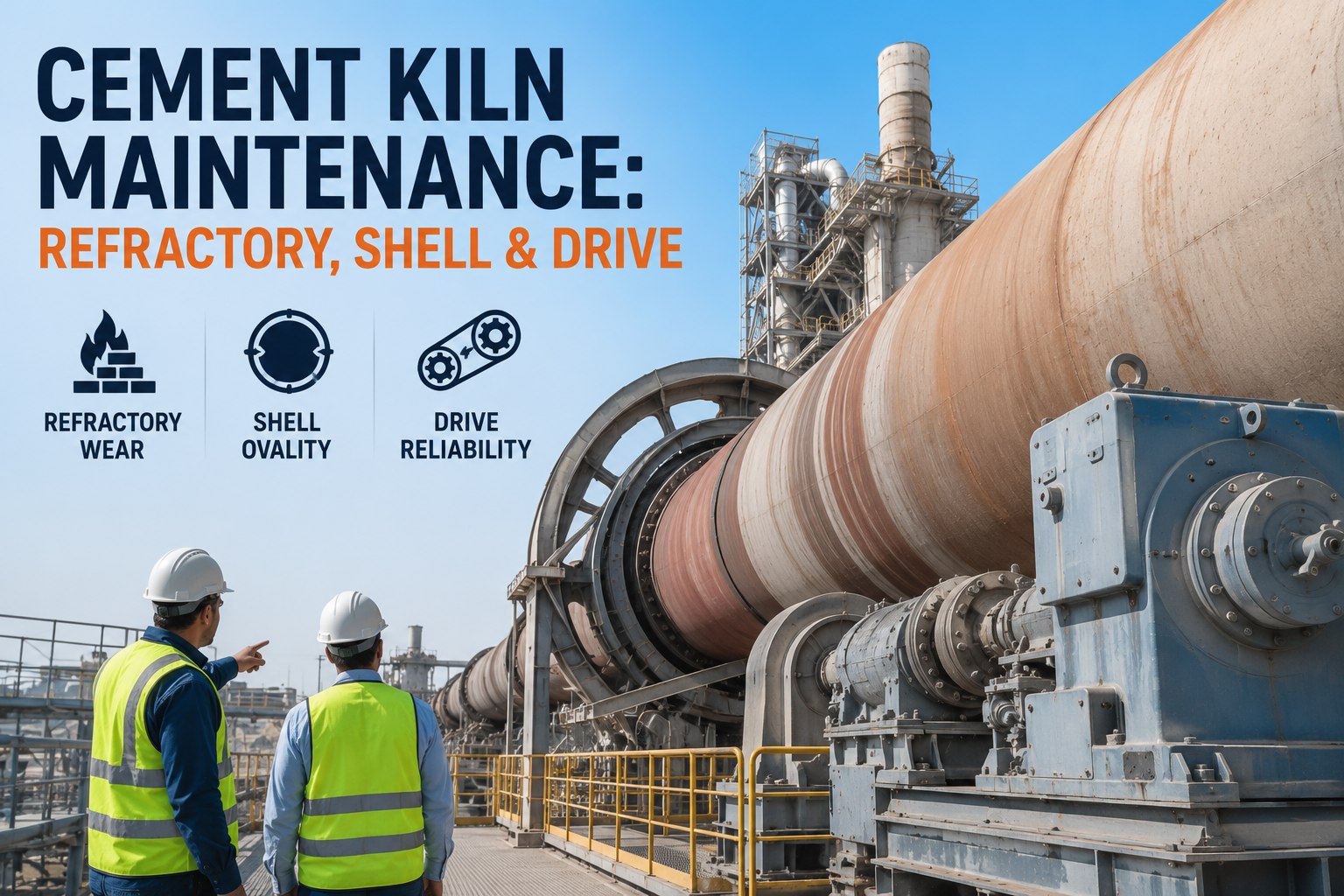
A single rotary kiln shutdown costs $50,000 to $300,000 per hour in lost production, emergency labor, and damaged equipment. Yet most unplanned kiln stops are preceded by weeks of detectable signals — gradual shell temperature rise as coating thins, increasing tire slip during heat cycles, bearing load changes as alignment shifts. The AI and sensor technology to read those signals exists. The gap is the maintenance system that converts signals into scheduled interventions before the emergency occurs. Sign up for Oxmaint to connect your kiln monitoring data to predictive work orders.
Rotary Kiln Predictive Maintenance: AI-Powered Monitoring and Refractory Tracking
Replace reactive kiln shutdowns with AI-driven monitoring that detects shell hot spots 30+ days early, tracks refractory wear across the campaign, and generates maintenance work orders before failures occur.
Why Rotary Kilns Fail Without Predictive Monitoring
The rotary kiln is the highest-cost, highest-consequence asset in a cement plant. It runs continuously at temperatures above 1,450°C in the burning zone, with a steel shell that must be protected from direct flame contact by refractory brick. When that protection fails — through refractory wear, coating loss, brick spalling, or tire misalignment — the consequences are not proportional to the maintenance gap that caused them. A week of unmonitored shell temperature rise becomes a $2M red kiln emergency. Understanding the failure pathways makes the case for predictive monitoring unambiguous.
Refractory Failure
Brick spalling or coating loss exposes the shell directly to burning zone temperatures. Shell heats from 200°C to above 400°C in hours. Beyond 400°C, steel loses structural integrity and permanent deformation begins. Full reline: 2–4 weeks downtime.
Detection: Shell temperature trending — 2–3°C/day rise rate signals thinning coatingTire Slip and Ovality
Excessive tire slip during heat-up and cool-down generates heat and wear between tire and shell pad. Tire ovality from worn support pads or excessive tire elevation causes shell flexing that cracks refractory. Both detectable below 0.1 RPM with thermal monitoring.
Detection: Tire slip measurement + ovality sensors + ML correlation with thermal dataSupport Roller Misalignment
Thrust roller misalignment generates axial forces on the kiln shell, creating uneven loading on tire and roller contact surfaces. Misalignment accelerates tire and roller wear and can cause shell crank — eccentricity between rotation axis and shell centreline. Hot kiln alignment required when detected.
Detection: Bearing load trending, axial movement sensors, continuous ovality monitoringDrive and Girth Gear Failure
Girth gear and pinion wear from inadequate lubrication or misalignment generates vibration signatures detectable weeks before failure. Drive system faults — motor current anomalies, gearbox bearing wear, spindle coupling degradation — are identifiable through motor current signature analysis.
Detection: Vibration analysis on girth gear/pinion + motor current trendingInlet/Outlet Seal Failure
Kiln inlet and outlet seals prevent air ingress and false air infiltration that disrupts combustion and increases fuel consumption. Seal wear is gradual but measurable through CO content monitoring and false air calculation. Planned seal replacement is far less costly than the cumulative energy waste from deteriorating seals.
Detection: False air measurement + combustion analysis + visual inspection at shutdownBearing Overheating
Support roller and thrust roller bearings operate under massive load from the kiln weight. Both under-lubrication and over-lubrication contribute to premature failure. Ultrasonic monitoring detects lubrication issues before temperature rise becomes visible. Thermal imaging is complicated by surrounding refractory, requiring modified approaches.
Detection: Ultrasonic bearing monitoring + hydraulic thrust device monitoringReactive vs. AI-Powered Kiln Maintenance
The contrast between reactive and predictive kiln maintenance is not about technology sophistication — it is about the cost and timing of every intervention. Book a demo to see how Oxmaint structures predictive kiln monitoring for your specific configuration.
AI Monitoring Capabilities for Rotary Kilns
Modern AI kiln monitoring does more than raise alarms. It correlates signals across multiple systems — shell temperature, torque, tire slip, bearing load, and drive current — to distinguish genuine degradation from process variation, and to identify which component is degrading before the alarm fires. Sign up now to explore these capabilities in your plant.
Graduated Shell Temperature Alerts
Infrared linescanners provide full circumferential thermal imaging across the entire kiln length — not spot measurements. The system compares each zone against its historical baseline, not an absolute threshold, to distinguish genuine refractory thinning from process-normal temperature variation. AI analyzes the rate of temperature rise per zone: a zone increasing at 2–3°C per day indicates thinning coating that will reach critical temperature in predictable days. Alerts are graduated — Watch (330°C), Alert (350°C), Critical (380°C) — giving operators time to adjust flame position, schedule partial reline, or plan a kiln stop before emergency conditions develop.
Refractory Life Prediction and Campaign Tracking
Refractory brick life depends on thermal cycling frequency, burning zone temperature, fuel type, and chemical composition of the feed. A universal wear rate model produces inaccurate predictions because each installation's wear pattern differs. Oxmaint builds a campaign-specific refractory life model for each kiln section by logging thermal history, shutdown frequency, and shell temperature trends throughout the campaign. The model predicts remaining brick life for each zone from actual operating data — enabling reline scope and timing to be planned before the campaign ends, rather than discovered during an emergency inspection.
Tire Slip and Shell Ovality Monitoring
Tire slip — relative movement between kiln shell and supporting tire — is most damaging during heat-up and cool-down phases when thermal stress is highest. Continuous monitoring at speeds below 0.1 RPM captures these critical transition events that periodic manual measurement misses entirely. Shell ovality — caused by worn tire support pads, excessive tire elevation, or dogleg conditions — is monitored by correlating ovality sensor data with tire migration, thermal conditions, and ML-identified anomaly patterns. The system distinguishes between the four distinct root causes of increased ovality, enabling targeted corrective action rather than generic tire adjustment.
Continuous Alignment and Axial Balance Monitoring
Hot kiln alignment — measuring kiln axis, shell crank, and roller positions while the kiln runs at temperature — is traditionally performed on an interval basis, providing a snapshot every 3–6 months. Continuous monitoring of kiln crank, shell ovality, drive misalignment, and axial balance converts these periodic snapshots into a real-time condition picture. The system identifies when alignment has drifted sufficiently to require correction, rather than scheduling hot alignment at fixed intervals. This extends the hot alignment interval for well-maintained kilns while ensuring deteriorating kilns are corrected before damage accumulates.
Automated Work Order Generation from Sensor Thresholds
Detection without action is just data. When any monitored parameter crosses a defined threshold — shell temperature trending above 350°C, tire slip exceeding the normal range, bearing load increasing beyond baseline, drive vibration rising above the alarm level — Oxmaint automatically generates a prioritized maintenance work order with the detected anomaly, recommended action, and equipment history attached. The work order is scheduled during the next available maintenance window, not queued as a manual task that depends on someone reviewing the monitoring dashboard. This eliminates the lag between detection and intervention that turns manageable faults into emergencies.
Historical Data Logging for Long-Term Trend Analysis
A single campaign generates terabytes of kiln monitoring data. The value of that data extends beyond the current campaign — historical thermal images, shell temperature profiles, tire slip records, and bearing load trends from previous campaigns are the training data for the refractory life model and the baseline against which current anomalies are assessed. Oxmaint stores complete kiln monitoring history in the asset record, enabling maintenance engineers to compare current campaign behavior against all previous campaigns and identify whether apparent anomalies are new patterns or within historical normal variation.
Prevent the next red kiln event with AI monitoring
Cement plants using Oxmaint detect developing hot spots 30+ days before they become emergencies, predict refractory life from actual campaign data, and schedule relines during planned windows instead of emergency stops.
Monitoring Parameters: What to Track and Why
Effective kiln predictive maintenance requires monitoring parameters across four physical systems simultaneously. Tracking any one system in isolation misses the cross-system correlations that distinguish genuine degradation from process variation — and misses the failure modes that only become visible through multi-parameter correlation.
| System | Parameters | Failure Mode Detected | Detection Method | Action Threshold |
|---|---|---|---|---|
| Shell and Refractory | Shell surface temperature — full circumference per zone | Refractory thinning, brick spalling, coating loss | Infrared linescanner — continuous | Watch 330°C · Alert 350°C · Critical 380°C |
| Tire and Shell | Tire slip, shell ovality, tire migration, thermal warp | Tire wear, support pad wear, shell deformation, crank | Thermal + ovality sensors + ML correlation | Slip above rated limit · Ovality above OEM tolerance |
| Support Rollers | Bearing load, axial balance, roller temperature, alignment | Misalignment, bearing degradation, thrust wear | Hydraulic thrust monitoring + bearing monitoring | Load deviation above 10% of baseline trending |
| Drive System | Girth gear vibration, pinion wear, motor current, drive torque | Gear mesh wear, misalignment, motor degradation | Vibration analysis + motor current signature | Vibration above 4.5 mm/s RMS · Current imbalance rising |
| Inlet/Outlet Seals | False air ingress, CO content, seal gap measurement | Seal deterioration, combustion efficiency loss | Combustion gas analysis + visual inspection | False air above 10% · CO deviation from target band |
Swipe to view all columns on mobile
Measurable Impact of AI Kiln Monitoring
These outcomes are documented from cement plant deployments with AI-driven kiln monitoring and predictive maintenance workflows — not theoretical projections.
Transform your kiln maintenance documentation
From thermal scanner data to refractory life records to bearing monitoring history — Oxmaint provides the platform that connects kiln sensor data to scheduled maintenance actions and campaign-length asset records.
Frequently Asked Questions
What temperature should trigger an immediate kiln response for shell overheating?
The industry standard graduated response is: 330°C — watch closely and increase monitoring frequency; 350°C — alert operations and adjust flame position to reduce local heat load; 380°C — critical alarm, prepare for unplanned stop if temperature does not respond to flame adjustment within defined window; 400°C — steel begins to lose structural integrity and permanent deformation risk is immediate. The key insight is that by the time 400°C is reached, corrective window has typically closed. The value of AI monitoring is catching the 2–3°C/day upward trend at 310–320°C, which provides weeks of intervention window. Sign up for Oxmaint to configure graduated kiln shell temperature alerting.
How does AI differentiate between genuine refractory thinning and normal process temperature variation?
Process-normal temperature variation responds to changes in fuel rate, feed chemistry, and burning zone length — it affects multiple zones simultaneously and correlates with process setpoint changes. Genuine refractory thinning produces temperature rise in a specific zone that is persistent, progressive (rising at a measurable rate per day), and uncorrelated with process parameter changes. AI models build a zone-specific baseline for each kiln that accounts for grade-specific and speed-specific temperature profiles, eliminating the false alarms that prevent operators from trusting fixed-threshold monitoring systems. Book a demo to see how Oxmaint's condition-normalised kiln alerting works.
What is the correct maintenance response when tire slip is detected to be above the normal range?
The response depends on the root cause. Excessive tire slip from worn tire support pads requires pad replacement at the next planned kiln stop — padding wear is a gradual, scheduled maintenance item. Tire slip during heat-up from thermal expansion mismatch may be addressable through controlled heat-up rate adjustment without mechanical intervention. Tire migration — the tire shifting axially along the shell — indicates insufficient friction between tire and pad and requires mechanical correction. The reason root cause identification matters: replacing pads when the actual cause is migration, or adjusting heat-up rate when pads are worn, produces temporary improvement that does not address the underlying condition. ML correlation of tire slip with ovality, shell temperature, and axial movement data identifies the specific cause. Log all tire slip events with kiln operating conditions in Oxmaint to build the correlation database.
How does Oxmaint integrate with existing kiln monitoring systems like infrared scanners and SCADA?
Oxmaint connects to existing kiln monitoring infrastructure via OPC-UA, Modbus TCP/IP, and historian connections including OSIsoft PI. Most cement plants already have infrared shell scanners, thermocouple arrays, and drive monitoring systems — the data exists but is siloed in separate displays without integration to the maintenance system. Oxmaint ingests this data and connects it to the asset record, triggering PM work orders when any parameter crosses the configured threshold. New hardware is rarely required for the core monitoring functions — the integration project typically completes in 3–6 weeks. Sign up free to begin your integration assessment.