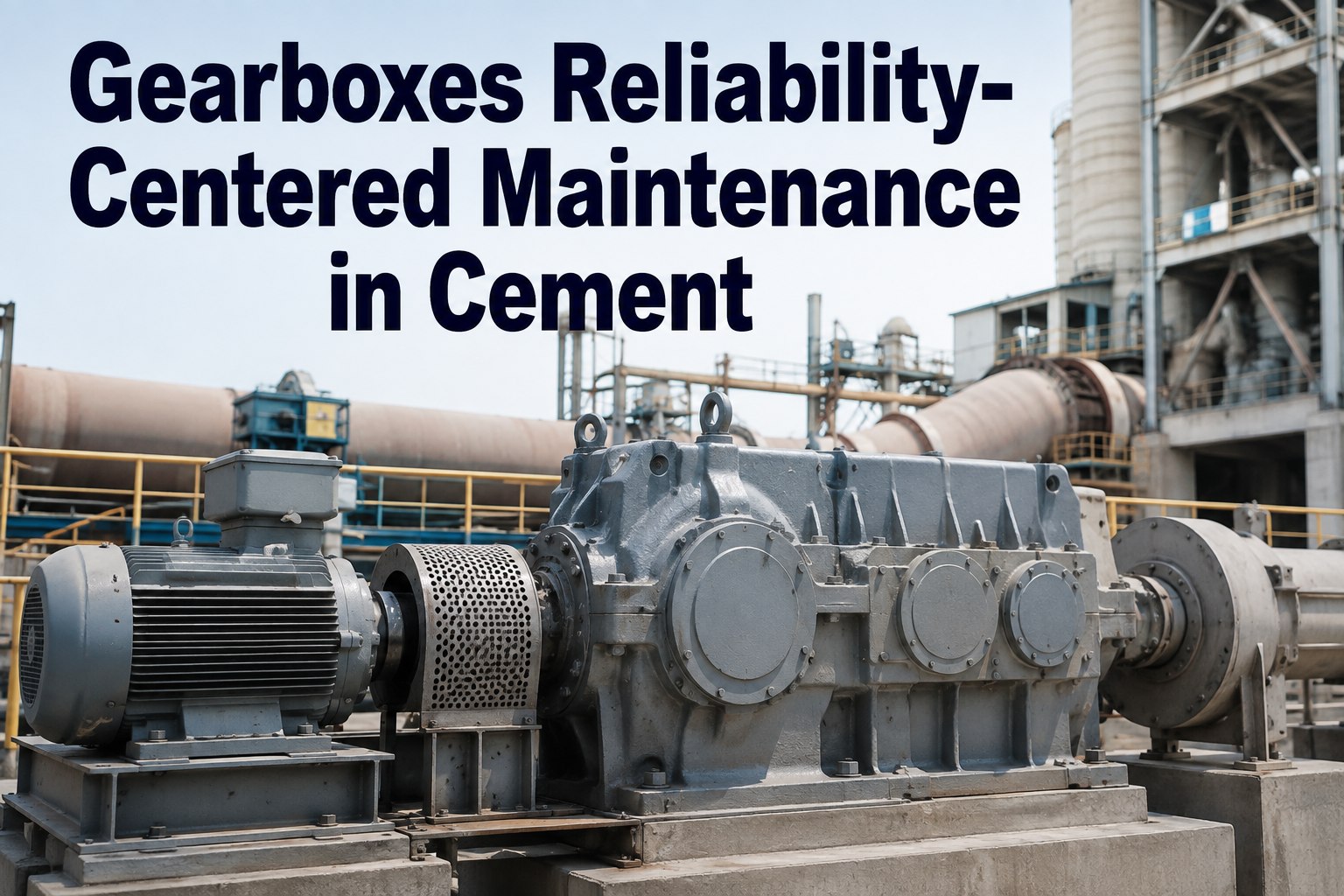
Reliability-centered maintenance for gearboxes in cement plants is the difference between a kiln that runs 330 days a year and one that loses $50,000 every unplanned outage. Cement gearboxes operate under extreme shock loads, abrasive dust, and thermal stress, making a structured RCM strategy essential for preventing catastrophic failures. This guide covers industry-specific failure modes, condition monitoring techniques, and proven preventive maintenance schedules that top cement producers use to maximize gearbox reliability. From inspection checklists to PM optimization, you'll find actionable best practices you can implement today—and when you're ready to put them into daily practice, Start Free Trial with OxMaint to automate the entire workflow.
Is one gearbox failure costing your plant $50K+ per day in lost production?
Cement gearboxes fail under extreme loads, abrasive dust, and thermal cycling. A structured RCM approach detects early-stage faults up to 3 months before catastrophic failure—cutting unplanned downtime by 40–60% and extending asset life by 2–5 years.
Common gearbox failure modes in cement plants
Over 70% of cement gearbox failures trace back to four root-cause categories. Identifying which failure mode dominates your asset population is the first step in building an effective RCM strategy.
Abrasive Wear & Micro-Pitting
Cement dust infiltration degrades lubricant film strength, causing accelerated gear-tooth wear. Prevalent in raw mill and crusher gearboxes where particulate ingress exceeds ISO 4406 cleanliness targets. Typically detectable via ferrography 6–12 weeks before functional failure.
Bearings & Overheating
Heavy shock loads on kiln drives and roller presses accelerate bearing fatigue. Thermal stress from continuous operation above 80°C degrades lubricant viscosity, leading to spalling and cage failure. Vibration analysis catches bearing defect frequencies at stage 1—weeks before secondary damage.
Misalignment & Imbalance
Foundation settlement, thermal growth, and coupling wear create angular and offset misalignment. Cement plant environments amplify these forces—1mm of misalignment can reduce coupling life by 50% and increase energy draw by 5–10%. Laser alignment checks should occur quarterly.
Lubricant Degradation
Oxidation, contamination, and additive depletion account for nearly 40% of gearbox failures industry-wide. In cement's high-temperature, high-particulate environment, oil analysis intervals should be halved compared to general industry. Without predictive oil monitoring, degradation goes unnoticed until visible damage appears.
Cement gearboxes condition monitoring best practices
A tiered monitoring strategy combining continuous and route-based techniques catches 85–90% of gearbox faults before they escalate. Here's how to layer the right technologies for cement's harshest assets.
| Monitoring Technique | Target Failure Mode | Detection Lead Time | Frequency for Cement Gearboxes | Cost Range / Channel |
|---|---|---|---|---|
| Vibration Analysis (Continuous) | Bearing defects, gear wear, misalignment | 4–12 weeks | 24/7 on critical kiln & mill drives | $1,200–$3,500 |
| Oil Analysis (Route-Based) | Wear metals, contamination, viscosity loss | 6–16 weeks | Every 30 days (vs. 90 general industry) | $40–$120 / sample |
| Thermography (IR Camera) | Overheating bearings, lubrication starvation | 2–8 weeks | Monthly inspection routes | $6K–$15K (camera) |
| Acoustic Emission | Early-stage cracking, pitting | 8–20 weeks | Quarterly on high-speed gearboxes | $800–$2,500 / sensor |
| Ultrasonic Thickness | Housing wear, wall thinning | Long-term trend | Annually | $1K–$4K (gauge) |
The cost of reactive vs. RCM-driven gearbox maintenance
A 180-asset cement plant spending $42K/year on reactive gearbox repairs transitioned to an RCM program with OxMaint. Here's the documented 12-month outcome.
- 14 unplanned gearbox failures annually
- Average downtime: 18 hours per event
- $50K lost production per outage
- Spare-parts stockout rate: 28%
- PM compliance tracking on spreadsheets
- 5 unplanned failures (64% reduction)
- Average downtime: 6 hours per event
- $50K lost production avoided 9 times
- Spare-parts stockout rate: 4%
- 92% PM compliance, automated tracking
Gearbox RCM checklist for cement plants
Use this tiered checklist to structure daily, monthly, and quarterly inspection routines for every critical gearbox in your cement operation.
Operator Round Checks
- Visual oil level & leak inspection
- Abnormal noise / vibration walk-by
- Surface temperature check (≤80°C)
- Breather function & clogging check
- Foundation bolt tightness (visual)
Mechanical Inspection
- Oil sample for particle count & metals
- Thermographic scan of bearings & housing
- Vibration route data collection
- Coupling alignment verification
- Filter differential pressure check
- Seal & gasket integrity inspection
Predictive Maintenance
- Full FFT vibration spectrum analysis
- Acoustic emission baseline comparison
- Lubricant degradation (RPVOT test)
- Gear tooth contact pattern inspection
- Backlash & end-float measurement
- RCM logic review: failure mode update
How OxMaint drives gearbox reliability in cement
OxMaint's AI-powered CMMS and EAM platform turns your RCM strategy from theory into daily practice—automating work orders, predictive alerts, and compliance across every gearbox, technician, and shift.
Predictive Maintenance Alerts
AI analyzes vibration, oil, and thermal data to predict gearbox failures 3–12 weeks in advance. Automatically generates work orders when thresholds breach—cutting unplanned downtime 30–50%.
Automated PM Scheduling
Build gearbox-specific PM schedules based on operating hours, cycles, or calendar. Auto-assigns to technicians via mobile app—driving PM compliance above 90% and eliminating spreadsheet tracking.
Asset Hierarchy & Spare-Parts Linkage
Map every gearbox to its parent kiln, mill, or crusher—and link critical spare parts by asset. Reduces stockout rates from 28% to under 5% and cuts parts search time by 70%.
Mobile Technician App
Technicians receive work orders, fill inspection checklists, upload photos, and close jobs from the field—even offline. Eliminates paper work orders and reduces data entry time by 80%.
How to implement RCM for cement gearboxes in 90 days
A phased rollout ensures quick wins and builds organizational buy-in. Here's the proven 90-day path from reactive to reliability-centered gearbox maintenance.
Month 1 — Asset Criticality & FMEA
Build asset hierarchy in OxMaint. Conduct Failure Mode and Effects Analysis for top 20 critical gearboxes. Rank by risk priority number (RPN). Outcome: documented failure modes and criticality ranking.
Month 2 — Monitoring & PM Build-Out
Install vibration sensors on top 10 assets. Configure oil analysis routes. Build PM templates in OxMaint for daily, monthly, and quarterly tasks. Train operators and mechanics on mobile checklist app.
Month 3 — Predictive Tuning & Review
Activate AI alert thresholds based on 30-day baseline data. Conduct first RCM review meeting—adjust PM intervals based on findings. Measure PM compliance, mean time between failures, and downtime hours.
See OxMaint on your gearboxes—book a 30-minute demo
Walk through a live RCM dashboard, predictive alerts, and automated PM workflows configured for cement plant assets. See how quickly you can move from spreadsheets to a system that prevents failures before they happen.
Cement gearboxes RCM — frequently asked questions
What is reliability-centered maintenance for gearboxes in cement?
RCM for cement gearboxes is a structured methodology that identifies specific failure modes for each asset, then applies the right maintenance tactic—predictive, preventive, or run-to-failure—based on consequence and detectability. Unlike generic PM programs, RCM prioritizes maintenance effort by risk, ensuring critical kiln and mill drives get continuous monitoring while less critical units receive route-based checks. OxMaint's CMMS enforces this logic through automated task generation tied to failure-mode analysis.
How often should cement gearboxes be inspected?
Daily operator walk-downs, monthly mechanical inspections, and quarterly predictive analysis form the baseline for cement gearbox inspection. High-criticality assets like kiln drives and raw mill gearboxes should have continuous vibration monitoring with 24/7 alert thresholds. Oil analysis should run every 30 days in cement—double the frequency of general industry—due to dust ingress and thermal stress.
What are the most common failure modes for gearboxes in cement plants?
The four dominant failure modes are abrasive wear and micro-pitting from dust-contaminated lubricant, bearing fatigue from shock loads and overheating, misalignment from foundation settlement and thermal growth, and lubricant degradation from oxidation and additive depletion. Together these account for over 70% of cement gearbox failures. You can explore full monitoring strategies and detection timelines by booking a demo.
How much does an RCM program cost for a cement plant?
A typical 180-asset cement plant invests $50K–$80K in the first year for sensors, oil analysis, training, and CMMS software. With average first-year savings of $300K–$500K from prevented downtime and reduced repair spend, payback typically occurs in 2–4 months. OxMaint's platform includes work order automation, predictive analytics, and mobile inspection—starting with a free 14-day trial.
How long does it take to implement RCM for cement gearboxes?
A focused 90-day rollout covers asset criticality ranking, FMEA, sensor installation, PM template build-out, and technician training. Full maturity—where AI predictive models have 6–12 months of baseline data—takes 6–9 months, but measurable downtime reduction typically appears within the first 60 days as automated PMs and oil analysis catch existing developing faults.
Stop firefighting gearbox failures—start preventing them
Join cement plants that cut unplanned downtime by 40–60% with OxMaint's AI-powered RCM platform. Build your asset hierarchy, automate PM schedules, and predict failures before they cost you a single hour of production.
Free 14-day trial · No credit card

-optimizing-your-maintenance-strategy.png)