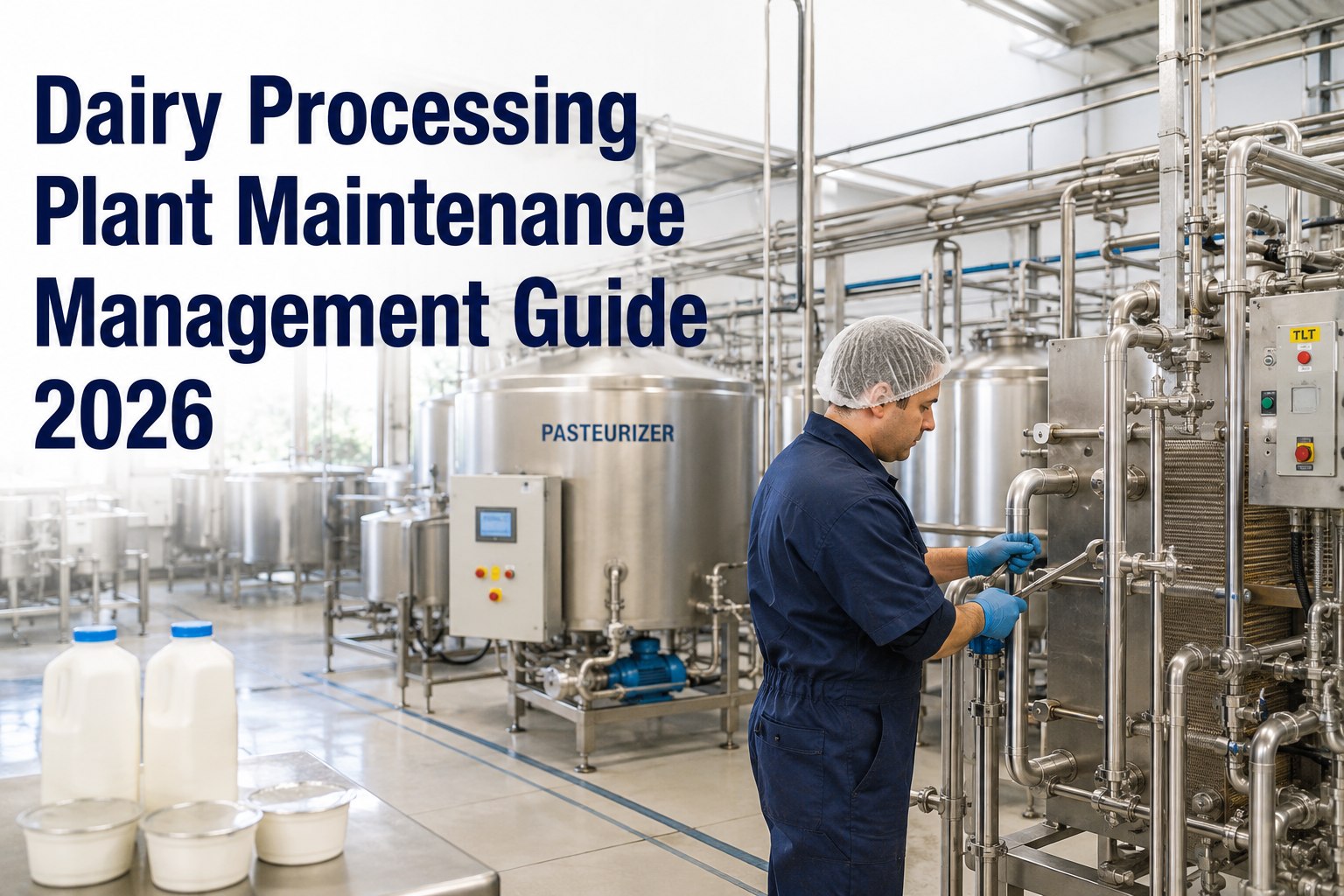
Dairy processing equipment operates under microbial contamination pressures that no other food manufacturing category matches. A pasteuriser that misses its holding time by three seconds, a separator that runs with a worn seal, or a homogeniser that accumulates residue in an inadequately cleaned valve body — each is not a maintenance failure in the conventional sense. Each is a potential pathogen introduction point into a product consumed without any further kill step. The maintenance discipline required to prevent these events is simultaneously a reliability discipline and a food safety discipline, and the CMMS managing dairy plant maintenance must treat them as inseparable. Dairy plant maintenance software built for the specific requirements of pasteurisation, separation, CIP, and cold chain continuity keeps dairy operations both running and compliant across every FDA inspection, every GFSI audit, and every shift handover.
Dairy Plant Maintenance Software: Equipment and Compliance
Automate CIP schedules, manage pasteuriser PM, track separator and homogeniser maintenance, and generate FDA-compliant records — all from one mobile-first platform built for dairy processing operations.
The pasteuriser is the critical control point for pathogen destruction in dairy. Every maintenance action — seal replacement, flow diversion valve service, plate gasket inspection, holding tube recertification — must be documented with the same rigour as a HACCP CCP record, because a maintenance failure can compromise the critical limit.
Flow diversion valve testing — daily functional check with record
Plate inspection and gasket replacement — per operating hours
Temperature sensor calibration — weekly with certificate record
Regulatory21 CFR Part 1240.61 (milk pasteurisation) · PMO Appendix H flow diversion valve test records · HACCP CCP corrective action documentation · Annual state regulatory inspection compliance
SEP
Separators and Clarifiers
Centrifugal separators operate at very high rotational speeds with tight seal tolerances. Seal and gasket failure creates a microbiological harborage point that survives CIP cycles and reintroduces contamination into the process stream. Separator PM intervals are measured in running hours and must be tracked per individual machine.
Bowl disassembly and seal inspection — per operating hours (typically 2,000 hr)
Bearing vibration and temperature — continuous with alert thresholds
Ejection mechanism function test — shift start verification
Gear oil analysis — quarterly with contamination flags
Regulatory3-A Sanitary Standard 100-13 (centrifugal equipment) · PMO Appendix J equipment approval and inspection schedule · GFSI SQF Edition 9 §11.3 equipment maintenance records
HMG
Homogenisers
Homogeniser plunger seals and valve seats are high-wear components operating under extreme pressure cycles. Worn valve seats create pressure drop and fat globule size variation affecting product specification — and worn seals create contamination ingress points. PM intervals are calibrated to operating pressure cycles rather than calendar time.
Plunger seal replacement — pressure-cycle-count trigger
First and second stage valve seat inspection — weekly visual
Pressure gauge calibration — weekly with certificate log
Crankcase oil level and quality check — daily pre-start
Regulatory3-A Sanitary Standard 609-xx (homogenisers) · ISO 9001 §7.1.5 measurement equipment calibration · FSMA PCHF §117.80 equipment maintenance procedures and records
CIP
CIP Systems
Every CIP cycle must meet its design parameters — chemical concentration, temperature, flow rate, and contact time — or the equipment it cleans carries forward microbiological risk. CIP system maintenance ensures that the cleaning system itself is delivering designed conditions, not just running through the motions. Sign up to configure OxMaint's CIP schedule automation — free.
Chemical concentration verification — conductivity calibration per run
CIP temperature sensor calibration — weekly with record
Return pump and valve inspection — quarterly mechanical check
RegulatoryFSMA 21 CFR Part 117.135 sanitation preventive controls · HACCP sanitation monitoring and verification records · BRC Issue 9 §4.11 cleaning and disinfection programme
FILL
Filling and Packaging Lines
Dairy filling lines for UHT and ESL products operate under aseptic conditions. Filler nozzle condition, sealing jaw calibration, and aseptic barrier integrity are maintenance items that directly affect both food safety and product quality — a filler with worn sealing jaws produces packages with deficient seal integrity regardless of the product's microbiological status.
Sealing jaw temperature and pressure calibration — shift start
Filler nozzle condition and sanitisation verification — per run start
Raw milk reception, intermediate storage silos, and finished product cold rooms must maintain continuous temperature compliance from farm gate to despatch. A storage tank temperature deviation is a potential Grade A milk violation under PMO — refrigeration system PM and temperature monitoring calibration are maintenance requirements with direct regulatory consequence.
Silo and reception tank temperature calibration — daily verification log
Agitator function check — contamination risk from stagnation
Cold room door seal inspection — monthly with replacement record
RegulatoryPMO Grade A raw milk storage ≤7°C requirement · 21 CFR Part 1240.61 refrigeration records · FSMA PCHF §117.90 temperature-controlled storage maintenance
Dairy-specific PM templates. CIP automation. FDA records. All in OxMaint.Free to start. Pasteuriser, separator, CIP and cold chain templates included. Live in 3–5 days.
How does OxMaint automate CIP scheduling for dairy processing equipment?
OxMaint generates CIP work orders automatically based on configurable triggers — production run count, elapsed time since last CIP, or manual supervisor trigger. Each CIP work order contains the complete cleaning procedure for that specific circuit: chemical type, concentration target, temperature range, contact time, flow rate requirement, and rinse verification steps. The operator records actual parameters achieved — conductivity reading, temperature reached, cycle duration — directly in the OxMaint mobile app. Any deviation from designed parameters is flagged as a mandatory corrective action before the equipment can return to service. Completed CIP records are permanently stored in the equipment's asset history, searchable by date, circuit, and product type — immediately exportable for FSMA review or GFSI audit presentation. Sign up to configure your CIP schedule in OxMaint — free.
How does OxMaint handle pasteuriser maintenance records for PMO compliance?
The Pasteurised Milk Ordinance requires that HTST pasteuriser equipment — particularly the flow diversion valve, temperature sensors, and timing devices — is inspected, tested, and recorded on defined schedules. OxMaint manages the PMO-required maintenance schedule by creating work orders for each required test (daily flow diversion valve test, weekly temperature recorder calibration check, and annual holding time verification), enforcing a mandatory completion checklist for each, and storing completed records with technician identity and timestamp in the pasteuriser's asset record. For the annual regulatory inspection visits required under PMO, OxMaint generates a pasteuriser maintenance history report presenting all test records, corrective actions, and calibration certificates in a format usable for the state regulatory inspection process. Book a demo to see OxMaint's PMO pasteuriser maintenance record format.
Can OxMaint track separator maintenance intervals by operating hours across multiple machines?
Yes. OxMaint tracks operating hours per separator as a counter in the asset record — incremented either via API from the machine control system or manually at each shift by the operator. PM work orders for bowl disassembly, seal inspection, and bearing service are triggered automatically when the operating hour counter reaches the configured threshold — independently for each machine. In a dairy plant with four separators operating at different utilisation levels, each machine reaches its PM interval at a different calendar date depending on actual hours run. OxMaint handles this correctly by default — unlike calendar-based systems that schedule all four machines on the same date regardless of actual run hours. The separator asset record stores the complete history of each PM cycle: which seals were replaced, bowl condition found, engineer who performed the work, and return-to-service timestamp.
Dairy CMMS · FDA Compliance · OxMaint
Pasteurised. Compliant. Documented. Every Run, Every Shift.
OxMaint manages dairy processing maintenance from pasteuriser CCP records to separator operating hours, CIP cycle documentation to cold chain temperature compliance — built for dairy, free to start.