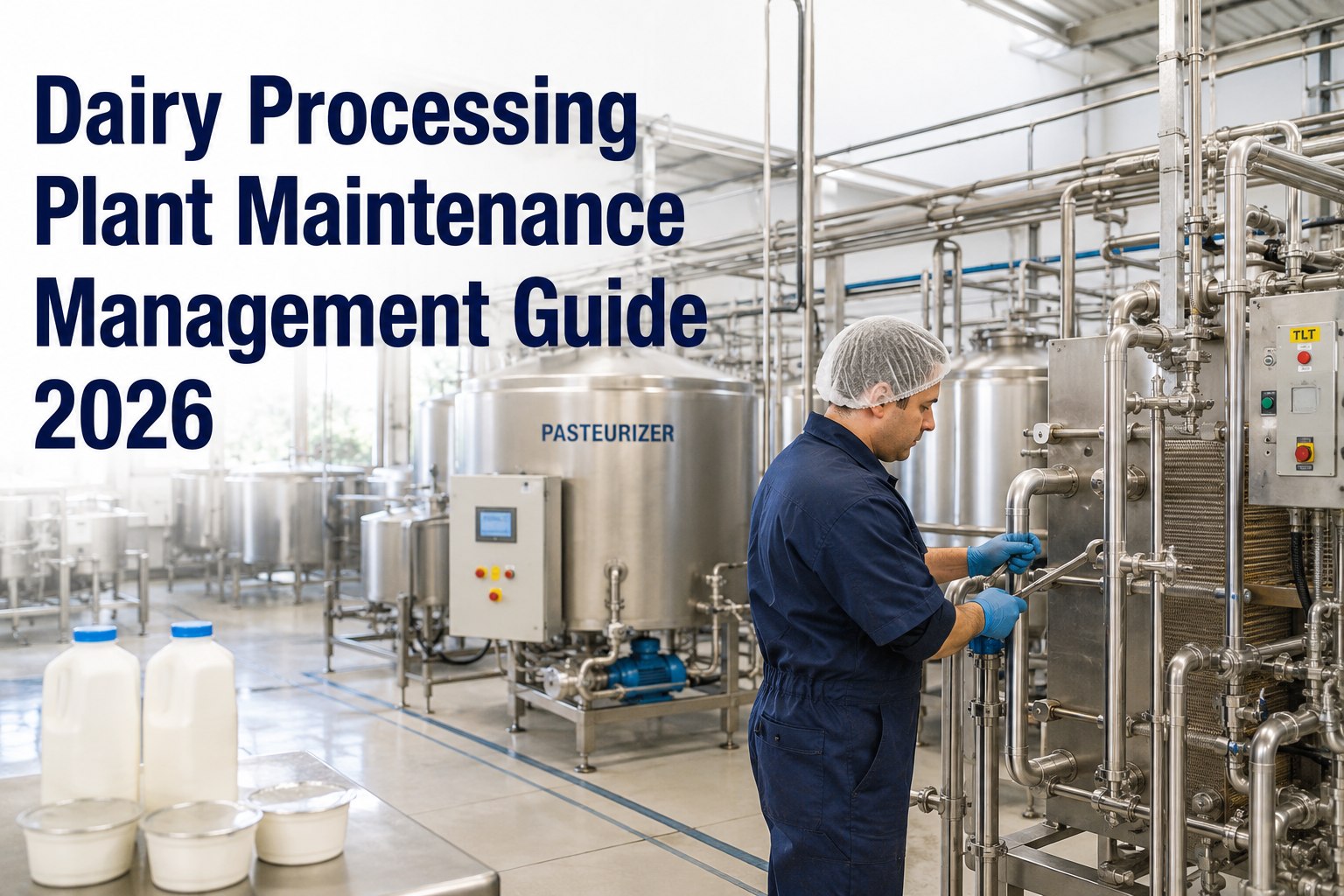
Dairy processing plant maintenance management demands a rare blend of food-safety rigor and heavy wet-side equipment reliability — a single missed pasteurizer PM or CIP cycle can trigger a pathogen event, a product recall, or a PMMO compliance failure. Effective dairy plant maintenance coordinates preventive maintenance (PM) on separators, homogenizers, and pasteurizers with real-time work-order control, spare-parts inventory, and audit-ready documentation. OxMaint brings all of this into one AI-powered CMMS so maintenance and reliability teams keep uptime and compliance aligned — start your Start Free Trial to see it on your assets today.
Can your dairy plant survive a 6-hour pasteurizer outage during peak production?
Dairy processing facilities lose an average of $18,000–$50,000 per hour during unplanned critical equipment downtime — and that is before the cost of discarded milk, CIP re-runs, or compliance penalties. OxMaint structures your dairy plant PM, CIP scheduling, and compliance documentation so breakdowns are predicted, not reacted to.
Critical dairy plant maintenance tasks by equipment type
Dairy processing maintenance covers a narrow but high-stakes equipment set. Each asset class below carries distinct failure modes, PM intervals, and compliance implications — missing any one of them puts throughput, product safety, and audit standing at risk.
Pasteurizers (HTST & UHT)
Verify flow-diversion valve response weekly, calibrate chart recorders & data loggers monthly, and inspect heat-exchanger plates for pinholes every 90 days. A failed seal or a miscalibrated divert valve can mean incompletely pasteurized milk entering the packaging line — a critical PMMO deviation.
Centrifugal Separators
Discharge bowl solids on cycle, monitor vibration trends, and replace bowl bearings at manufacturer hours. Separator vibration above 4.5 mm/s RMS nearly always signals bearing wear or imbalance — catch it early or face a $40K–$80K rebuild and 3 days of lost production.
Homogenizers
Inspect valve seats and impact rings every 500 operating hours; monitor pressure-differential drift. Worn homogenizer valves reduce particle-size uniformity, directly affecting product shelf life and mouthfeel — and a single failed valve seat can contaminate an entire batch.
CIP Systems
Calibrate conductivity & temperature probes monthly, verify spray-ball rotation, and audit chemical dosing accuracy. A CIP cycle running 8°C below target or 0.3% short on caustic can leave biofilm — invisible until a coliform test comes back positive.
Cooling & Storage Tanks
Inspect agitator seals, verify temperature logs hit ≤4°C within 2 hours of milking, and service refrigeration compressors on a 6-month cycle. A refrigeration failure on a 30,000-litre silo means dumping the entire load — a $20K+ write-off in raw product alone.
Filling & Packaging Lines
Lubricate conveyor chains weekly, inspect filler seals & nozzles daily, and track OEE by line. Packaging lines are the bottleneck where downtime translates most directly to lost cases shipped — a 5% OEE improvement on a 10K-case/day line is 500 more units daily.
PMMO, FDA & HACCP compliance documentation for dairy plants
A dairy plant maintenance program lives or dies on documentation. The Pasteurized Milk Ordinance (PMMO), FDA 21 CFR Part 110, and your HACCP plan all require that PM tasks were completed, signed, and timestamped — auditors do not accept verbal assurance or spreadsheet gaps.
| Compliance Requirement | Documentation Needed | Typical Audit Frequency | Risk of Non-Compliance |
|---|---|---|---|
| PMMO Pasteurization Records | Daily time/temperature charts, divert-valve test logs, seal-integrity checks | Quarterly (state regulator) | Plant license suspension, product hold |
| HACCP Critical Control Points | CCP monitoring records, deviation logs, corrective action reports | Annual + internal | Recall, regulatory action |
| CIP Cycle Verification | Temperature, conductivity, flow & time logs per circuit | Monthly internal | Pathogen risk, re-cleaning cost |
| Preventive Maintenance Logs | Completed work orders, parts used, technician sign-off | Annual (SQF/BRC) | Audit non-conformance, score downgrade |
| Calibration Records | Probe & gauge calibration certificates, as-found/as-left data | Annual (ISO 9001/22000) | Invalidated HACCP data |
| Spare Parts Traceability | Batch/lot of food-grade lubricants & seal materials installed | Annual (BRCGS) | Allergen cross-contact risk |
OxMaint automatically captures timestamped, technician-signed work-order records for every PM — so when an auditor asks for the last 12 months of pasteurizer divert-valve tests, you export the report in seconds, not days.
Dairy plant PM scheduling calendar: what to do and when
A well-structured dairy plant PM calendar follows the production rhythm — daily sanitation windows, weekly CIP validations, monthly probe calibrations, quarterly plate inspections, and annual regulatory testing. Here is a proven cadence that keeps OEE above 85% and audit-ready year-round.
Sanitation-coupled checks
Inspect filler nozzles & conveyor lube during CIP downtime; verify silo temperature logs hit ≤4°C; log pasteurizer chart-recorder readings; check homogenizer pressure differential. Time budget: 30–45 min per line.
Critical valve & seal inspections
Test pasteurizer flow-diversion valve (FVV) response; inspect separator discharge bowl; check CIP spray-ball rotation; lubricate packaging-line chains. Assign to weekend sanitation crew for minimal production impact.
Calibration & trend review
Calibrate CIP conductivity & temperature probes; review vibration trends on separators & homogenizers; audit chemical dosing accuracy; pull OxMaint MTBF/MTTR reports for top 10 failure modes. Time budget: one shift.
Heat exchanger & motor servicing
Open HTST plates for pinhole inspection; perform oil analysis on critical motors; replace homogenizer valve seats (500-hr cycle); deep-service refrigeration compressors. Coordinate with production planning 2 weeks out.
Regulatory testing & rebuilds
State pasteurizer regulatory testing; full separator bowl rebuild; IR thermographer scan of all electrical panels; update HACCP plan with OxMaint failure data from the past 12 months. Budget 3–5 days of planned downtime.
How OxMaint CMMS solves dairy processing maintenance challenges
OxMaint was built for the dual pressure of dairy operations: keep wet-side equipment running at 85%+ OEE while maintaining PMMO and HACCP audit-readiness without paper chaos. Here is how four core capabilities map directly to dairy plant outcomes.
Automated PM scheduling by asset & season
Auto-generate work orders based on runtime hours, calendar intervals, or production batches — so pasteurizer FVV tests and CIP calibrations never slip through the cracks during peak-season volume surges.
AI-driven predictive maintenance analytics
Vibration, temperature, and pressure data from separators and homogenizers feed OxMaint's AI models to flag bearing wear and valve degradation weeks before failure — letting you schedule rebuilds, not react to breakdowns.
One-click PMMO & HACCP audit reports
Every completed work order is timestamped, GPS-stamped, and technician-signed. When a state regulator or SQF auditor asks for 12 months of CIP temperature logs or FVV test records, export the full report in one click — no paper, no gaps.
Food-grade spare-parts inventory control
Track food-grade lubricants, FDA-compliant seals, and gasket lots by batch number. Auto-reorder critical spares (separator bearings, homogenizer valves) at minimum-stock thresholds so a $200 part never causes a $40K outage.
Dairy maintenance ROI: what a 180-asset plant saves with OxMaint
Consider a mid-sized dairy processing plant running 180 tracked assets — 2 HTST pasteurizers, 6 separators, 4 homogenizers, 12 CIP circuits, and 30+ cooling and packaging units. Here is the financial impact of moving from spreadsheet-and-clipboard maintenance to OxMaint over 12 months.
| Investment & Return (Year 1) | Without OxMaint | With OxMaint | Difference |
|---|---|---|---|
| Unplanned downtime hours | 720 hrs/yr | 300 hrs/yr | −420 hrs |
| Maintenance labor (overtime) | $180,000 | $120,000 | −$60,000 |
| Spare-parts inventory carrying cost | $145,000 | $98,000 | −$47,000 |
| Product spoilage / rework | $130,000 | $45,000 | −$85,000 |
| OxMaint platform cost | $0 | $24,000 | +$24,000 |
| Total annual cost | $1.81M | $1.49M | −$318K saved |
Payback period for this 180-asset dairy plant: under 2 months. The OxMaint subscription pays for itself with a single prevented separator breakdown or silo loss event.
See OxMaint on your dairy assets — book a 30-min demo
We will map your pasteurizers, separators, CIP circuits, and packaging lines into a live OxMaint workspace and show you exactly how much downtime you can eliminate in the first 90 days.
Dairy plant maintenance management: frequently asked questions
What is dairy plant maintenance management?
Dairy plant maintenance management is the structured coordination of preventive, predictive, and reactive maintenance on processing equipment — pasteurizers, separators, homogenizers, CIP systems, cooling tanks, and packaging lines — while maintaining PMMO, FDA, and HACCP compliance documentation. A CMMS like OxMaint automates work-order scheduling, parts inventory, and audit reporting so nothing falls through the cracks.
How often should pasteurizers be serviced in a dairy plant?
Pasteurizers require daily chart-recorder verification, weekly flow-diversion valve (FVV) response testing, monthly data-logger calibration, and quarterly heat-exchanger plate inspection for pinholes. Annual regulatory testing is mandated by the PMMO. OxMaint auto-generates each of these PM tasks on the correct interval and captures signed completion records for audit readiness — start your free trial to set it up on your equipment.
What does a dairy CMMS do that spreadsheets cannot?
A dairy CMMS automatically triggers PM work orders based on runtime hours or calendar intervals, tracks spare-parts inventory with lot-level traceability for food-grade lubricants and seals, uses AI to predict equipment failures from vibration and temperature data, and exports one-click audit reports. Spreadsheets cannot auto-trigger tasks, predict failures, or guarantee the timestamped sign-off records that PMMO and SQF auditors require.
How do you schedule CIP maintenance without disrupting production?
CIP maintenance is scheduled during production gaps — typically between batch runs or during overnight sanitation windows. The key is to calibrate conductivity and temperature probes monthly, verify spray-ball rotation weekly, and audit chemical dosing accuracy during planned CIP downtime. OxMaint integrates CIP PM tasks into the master production calendar so maintenance and operations teams see the same schedule.
How long does it take to implement a CMMS in a dairy plant?
A typical mid-sized dairy plant (100–250 assets) goes live on OxMaint in 2–4 weeks. The process includes asset import, PM-schedule setup, parts-inventory migration, and technician training. We provide a guided onboarding — book a 30-minute demo and we will scope your timeline based on your equipment list and compliance requirements.
Stop firefighting. Start preventing.
Join the dairy processing plants that cut unplanned downtime 30–50% and sail through audits with zero non-conformances — powered by OxMaint AI-driven CMMS.
Free 14-day trial · No credit card