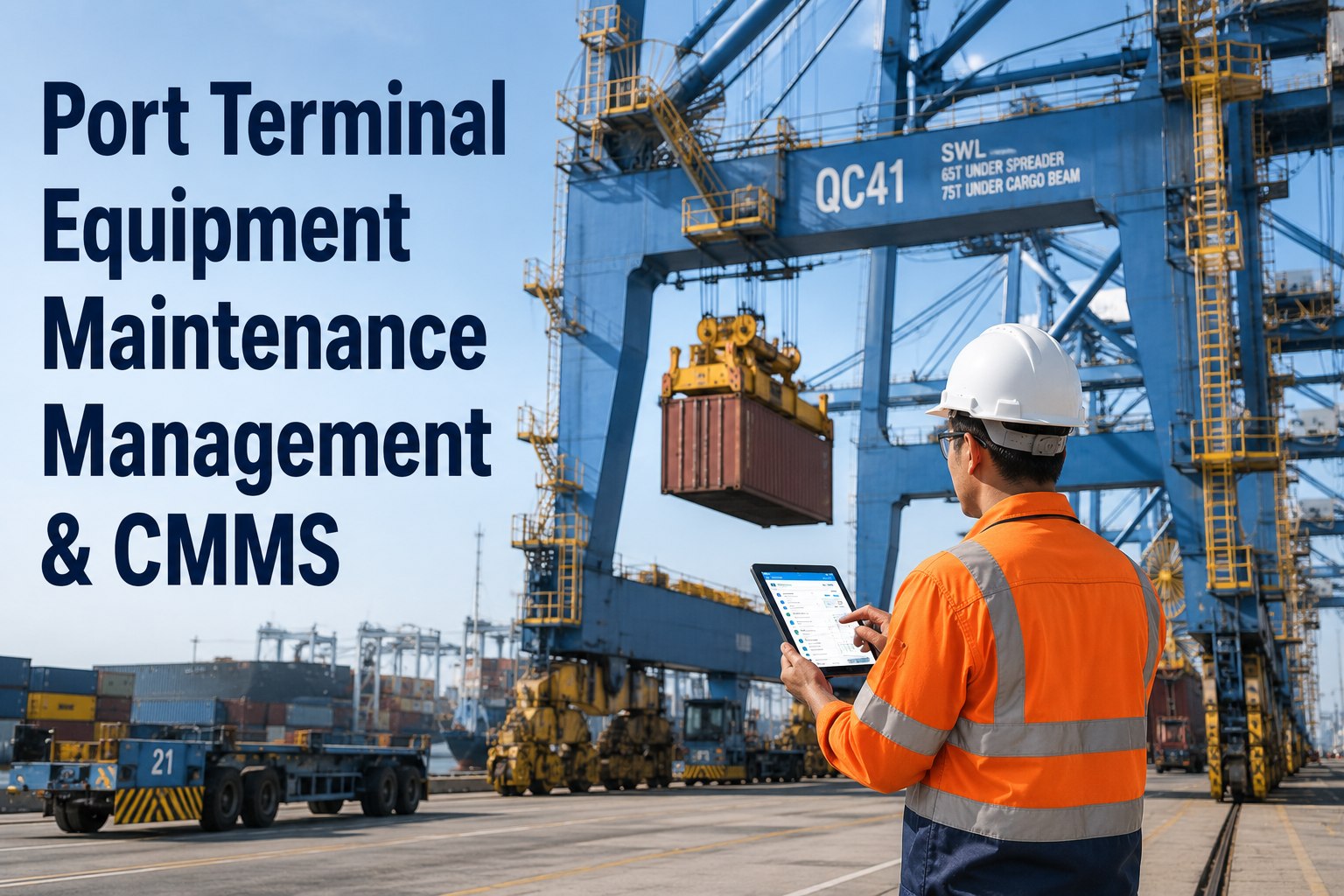
Port terminal maintenance management is the discipline of keeping ship-to-shore cranes, RTG cranes, straddle carriers, and terminal handling equipment available at the 95%+ uptime standards that vessel schedules demand. A single hour of unplanned quay crane downtime can delay a vessel berth, cascade into missed TOS windows, and cost a container terminal upwards of $50,000 in lost productivity and demurrage. OxMaint delivers an AI-powered port equipment CMMS that centralizes port crane PM, automates inspection compliance, and integrates seamlessly with your Terminal Operating System to keep container handling reliability high. See how OxMaint transforms terminal equipment maintenance when you Start Free Trial or book a personalized demo today.
Every Crane Downtime Event Has a Vessel Schedule Consequence
When a ship-to-shore crane goes down, the entire quay waits. OxMaint port CMMS prevents unplanned failures with predictive maintenance, automated PM schedules, and TOS-aligned work order management — protecting your berth productivity and vessel turnaround times.
The Real Cost of Reactive Port Equipment Maintenance
Container terminal maintenance teams operating on spreadsheets and reactive workflows face 3-5x higher unplanned downtime rates than those using a structured port CMMS. When a 180-asset terminal averages just 2 hours of unplanned STS downtime per week, the annual productivity loss easily exceeds $5.2 million. Transitioning to a preventive and predictive maintenance model flips this equation.
Example: 4 STS cranes averaging 100 unplanned hrs/yr at $50K/hr = $20M annual exposure.
Terminals typically achieve 400-700% ROI in Year 1 by shifting from reactive to planned port crane PM.
Port Equipment Maintenance: STS Cranes, RTGs & Straddle Carriers
Effective port facility maintenance requires distinct PM strategies for different equipment classes. From the high-cycle structural fatigue of ship-to-shore crane maintenance to the drive-train wear in RTG crane maintenance, each asset class demands specific inspection intervals, spare parts buffers, and compliance tracking.
Ship-to-Shore Crane PM
Quay crane maintenance demands rigorous structural inspection, boom hoist wire rope monitoring, and trolley brake assessments. Automated PM triggers ensure ISO 4309 compliance and eliminate missed magnetic brake inspections.
RTG Crane Maintenance
Rubber-tired gantry cranes suffer unique wear on steering systems, diesel-hybrid drives, and spreader twistlocks. Track runtime hours, schedule automated diesel fluid analysis, and manage tire replacements.
Straddle Carrier Maintenance
High-cycle straddle carriers require laser wheel alignment checks, lift cylinder seal monitoring, and spreader frame inspections. OxMaint tracks lifting chains and structural NDT testing against strict hour-based intervals.
Reach Stacker & Mafi
Heavy reach stackers face extreme drive-train and hydraulic stress. Manage transmission fluid intervals, chassis structural welds, and tire pressure monitoring through mobile work orders executed right in the yard.
How OxMaint CMMS Solves Container Terminal Maintenance
OxMaint is an AI-powered Enterprise Asset Management (EAM) platform built for the realities of 24/7 port operations. By connecting your maintenance workflows directly to terminal operations, OxMaint eliminates the blind spots that cause unplanned downtime.
AI-Powered Predictive Maintenance
OxMaint analyzes vibration, oil analysis, and runtime data from crane sensors to predict bearing and gearbox failures weeks before they happen. Predictive algorithms cut unplanned crane downtime by 30-50%.
TOS Integration & Work Orders
Integrate directly with your Terminal Operating System (TOS) to automatically trigger maintenance work orders when equipment health drops or runtime thresholds are met, ensuring vessel schedules are never blocked.
Spare Parts & Inventory Control
Never halt a quay crane PM for a missing wire rope or spreader twistlock. OxMaint tracks spare parts inventory in real-time, automatically generating purchase orders when stock hits minimum reorder points.
Audit-Ready Compliance Tracking
Digitize terminal crane PM checklists and safety inspections. OxMaint maintains immutable logs of every inspection, technician signature, and compliance standard (ISO 45001, OSHA) for instant audit readiness.
Port CMMS vs. Spreadsheets: A Terminal Maintenance Comparison
Running a modern container port maintenance program on spreadsheets, whiteboards, or legacy on-premise software leaves reliability teams blind to developing failures. Here is how OxMaint port equipment CMMS compares to the status quo.
| Maintenance Capability | Spreadsheets / Manual | OxMaint Port CMMS |
|---|---|---|
| Work Order Dispatch | Manual paper routes, delayed radio calls | Automated mobile dispatch, real-time status |
| PM Scheduling | Calendar-based, frequently missed | Runtime & condition-based automated triggers |
| Spare Parts Tracking | Manual stock counts, emergency sourcing | Real-time inventory with auto-reorder points |
| TOS Integration | Disconnected data silos | Seamless API integration with TOS platforms |
| Failure Prediction | Reactive breakdown response only | AI-driven predictive failure alerts |
See OxMaint on Your Port Assets
Book a 30-minute demo and discover how OxMaint port equipment CMMS can increase your crane availability by 15% in the first 90 days.
Port Terminal Equipment Maintenance & CMMS
What is port terminal equipment maintenance management?
Port terminal maintenance management is the process of scheduling, executing, and tracking preventive and corrective maintenance for heavy container handling equipment like ship-to-shore cranes, RTGs, and straddle carriers. Using a port CMMS like OxMaint ensures assets meet the 95%+ availability rates required to keep vessel berthing schedules on time.
How does a port CMMS integrate with a Terminal Operating System (TOS)?
A modern port equipment CMMS integrates with a TOS via API connections, allowing maintenance teams to automatically receive work orders based on equipment runtime or operational health alerts. This eliminates siloed data and ensures that terminal operations are never disrupted by unplanned equipment failures. You can explore seamless TOS integration when you Start Free Trial.
Why is ship-to-shore crane maintenance so critical for port operations?
Ship-to-shore cranes are the primary bottleneck for vessel turnaround. A single STS crane failure can halt an entire berth, costing a container terminal upwards of $50,000 per hour in lost productivity and vessel demurrage. Rigorous quay crane PM and predictive maintenance are essential to prevent these high-cost downtime events.
How often should RTG cranes and straddle carriers undergo preventive maintenance?
RTG cranes typically require preventive maintenance checks every 250 runtime hours, while straddle carriers require structural and drive-train inspections every 500 hours, with NDT testing every 2,000 hours. OxMaint automates these triggers based on real-time equipment telemetry so no PM interval is ever missed.
How long does it take to implement a port equipment CMMS?
Implementing a cloud-based port CMMS like OxMaint typically takes 2 to 4 weeks, depending on the number of assets and existing data formats. Our team assists with data migration from spreadsheets and onboarding technicians to ensure rapid adoption. Schedule a walkthrough of the implementation process by booking a demo at Calendly.
Stop Reacting to Equipment Failures. Start Predicting Them.
Join the port terminals using OxMaint to cut unplanned downtime by up to 50%, streamline their maintenance operations, and keep vessel schedules moving.
Free 14-day trial · No credit card required