
Unplanned downtime costs the average large manufacturing plant $253 million per year — and the per-hour cost has doubled since 2019. Yet only 59% of facilities use a CMMS, and 49% still track maintenance in spreadsheets. The math is devastating: plants running manual maintenance processes absorb 3-4x the repair costs of those using structured digital systems, while their mean time to repair stretches to 81 minutes per incident versus 30-40 minutes for digitally equipped teams. A Computerized Maintenance Management System is no longer a software upgrade — it is the operating system of every manufacturing plant that wants to survive the next decade of rising equipment costs, retiring workforces, and relentless production pressure. Oxmaint delivers a manufacturing-grade CMMS that connects work orders, assets, inventory, and teams on one platform — deployed in days, not months.
This guide covers everything manufacturing leaders need to evaluate, implement, and maximize CMMS value: core capabilities, smart factory integration, ROI benchmarks, implementation roadmaps, and the specific workflows that separate world-class maintenance organizations from reactive firefighting operations.
What a CMMS Actually Does in a Manufacturing Plant
A CMMS is a centralized digital platform that manages every aspect of maintenance operations — from the moment an equipment issue is detected to the final closure of the work order and the data analysis that prevents the same problem from recurring. In manufacturing, where production schedules are measured in minutes and equipment availability directly determines revenue, the CMMS becomes the nervous system connecting machines, technicians, planners, and management into a single coordinated operation.
Work Order Management
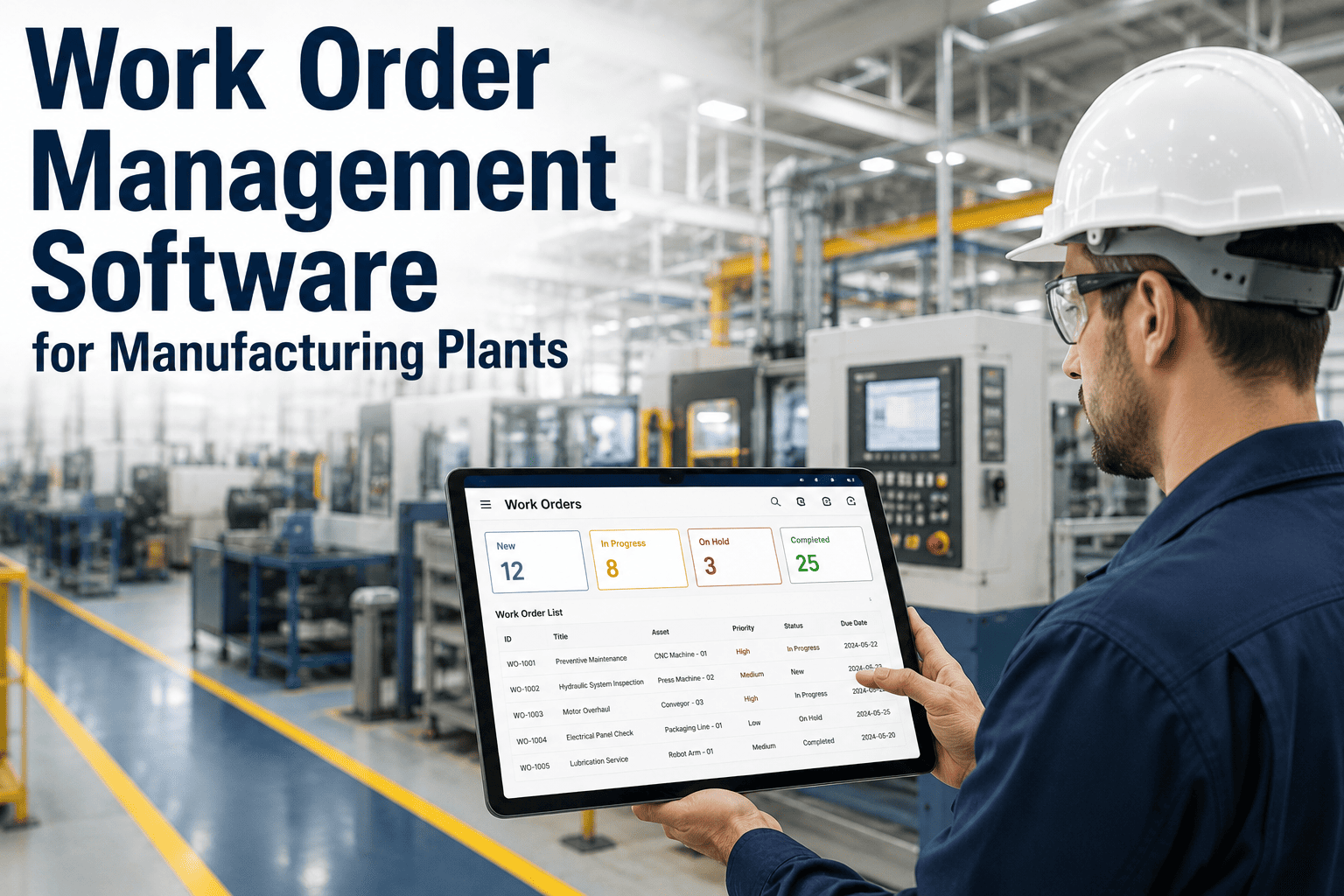
Create, assign, prioritize, and track every maintenance task from request to completion. Automatic routing based on asset criticality, technician skill, and shift availability. Mobile access lets technicians update status, log parts used, and attach photos from the factory floor — eliminating the return-to-desk bottleneck that kills reactive response times.
Preventive Maintenance Scheduling
Calendar-based, meter-based, and condition-based PM scheduling that automatically generates work orders at the right interval for each asset. The system tracks PM completion rates, flags overdue tasks, and adjusts schedules when production demands shift. Predictive maintenance can reduce machine downtime by 30-50% and extend equipment lifespan by 20-40%.
Asset Registry and Lifecycle Tracking
Complete digital record of every piece of equipment: manufacturer specs, installation date, maintenance history, failure codes, associated spare parts, and total cost of ownership. With the average age of industrial machines now at 24 years — the oldest in nearly 70 years — lifecycle visibility is essential for replacement planning and capital allocation.
Inventory and Spare Parts Control
Track every spare part linked to the asset it serves, with automated reorder alerts, min-max stock levels, and barcode/QR scanning for fast warehouse operations. When 55% of maintenance professionals cite rising parts costs as the primary reason for higher downtime expenses, inventory precision is a direct profit lever.
Analytics, KPIs, and Reporting
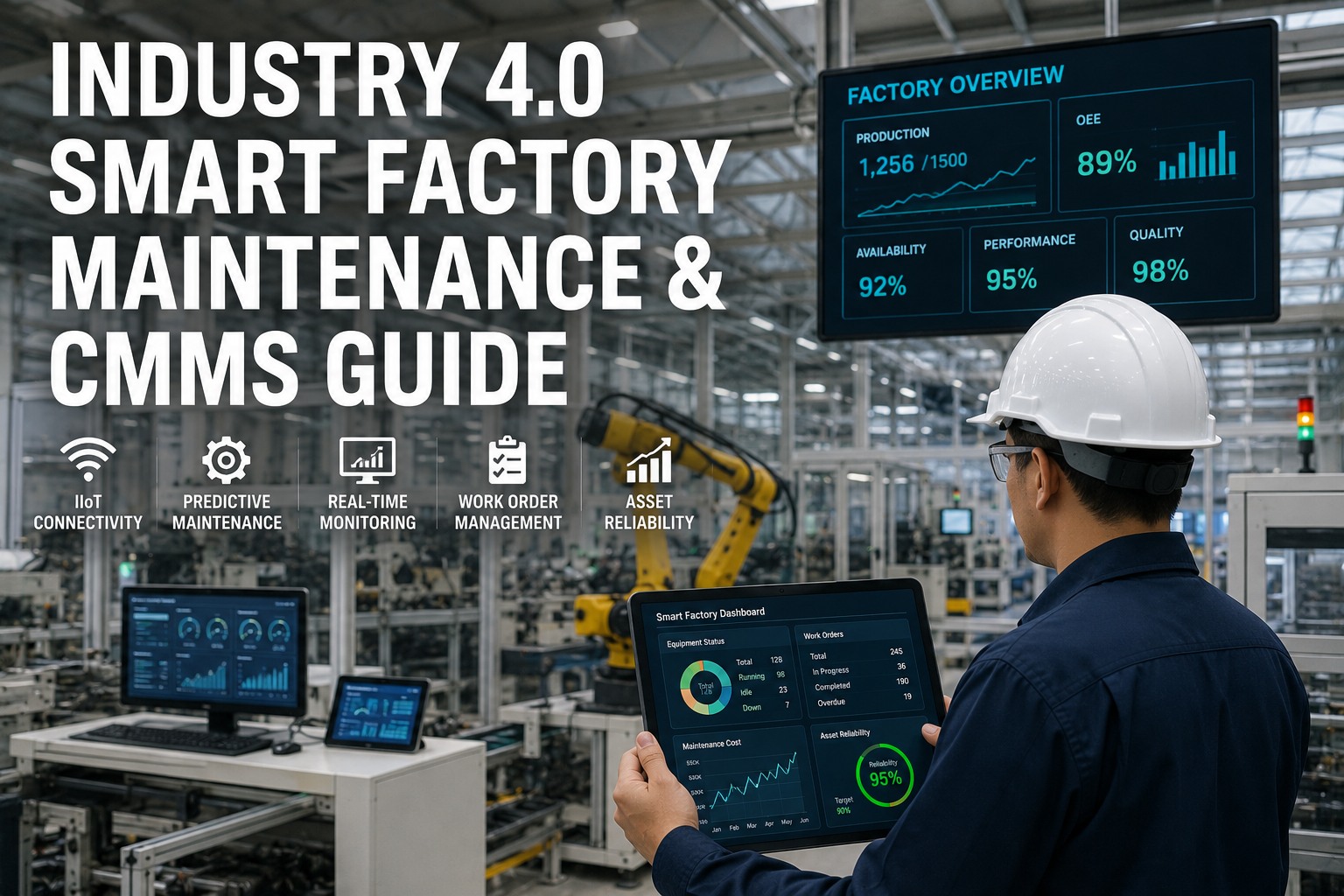
Real-time dashboards tracking MTBF, MTTR, OEE, PM completion rates, backlog hours, and maintenance cost per unit produced. 85% of manufacturing facilities now have digital dashboards — because data-driven maintenance decisions consistently outperform experience-based guessing, especially as 40% of the experienced workforce approaches retirement.
Compliance and Safety Management
Automated audit trails for OSHA, ISO 55000, EPA, and industry-specific regulatory requirements. Digital LOTO procedures, safety checklists, and inspection logs stored in a tamper-proof system. Manufacturing faces strict compliance standards — a CMMS generates audit-ready documentation automatically, eliminating the manual reporting burden that drains skilled technicians from actual maintenance work.
Your Factory Deserves a CMMS Built for Manufacturing
Oxmaint gives your maintenance team work order automation, preventive scheduling, mobile access, spare parts tracking, and KPI dashboards — live in days, not months. No IT department required.
Traditional vs. Smart Factory Maintenance
The gap between traditional maintenance operations and CMMS-equipped smart factory maintenance is not incremental — it is structural. Plants still running paper-based or spreadsheet-driven maintenance are competing against facilities where sensor data triggers work orders automatically, AI predicts failures weeks in advance, and technicians carry the entire maintenance knowledge base in their pocket. With 92% of manufacturers believing smart manufacturing is critical to competitiveness in the next three years, the question is not if you will adopt — it is whether you adopt before or after your competitors.
Traditional Maintenance
CMMS-Driven Smart Factory
Manufacturing Maintenance Maturity Model
Every manufacturing plant sits somewhere on a five-level maturity curve. Understanding your current level — honestly — determines which CMMS capabilities to prioritize first. Jumping from Level 1 to Level 5 in one project is a recipe for failure. The most successful implementations move one level at a time, proving value at each stage before expanding scope. Sign up for Oxmaint and assess your current maturity level with our guided onboarding process.
Reactive / Firefighting
~30% of plantsEquipment runs until failure. No scheduled maintenance. Work is assigned verbally. No failure history tracked. Parts are purchased on emergency basis. Technicians spend 70%+ of time on unplanned repairs.
Planned / Calendar-Based PM
~35% of plantsBasic preventive maintenance on fixed schedules. CMMS tracks work orders and PM compliance. Asset registry exists but may be incomplete. Spare parts tracked but often inaccurate. Reactive work still exceeds 50% of total maintenance effort.
Condition-Based / Proactive
~20% of plantsSensors and IoT devices monitor critical assets in real time. Maintenance triggered by actual equipment condition, not arbitrary schedules. CMMS integrates with sensor data for automated alerting. Failure mode analysis drives strategy. 48% of plants now use connected devices for real-time monitoring.
Predictive / Analytics-Driven
~12% of plantsAI and machine learning models predict failures weeks before they occur. CMMS-ERP-MES integration enables maintenance scheduling around production demands. Digital twins simulate asset behavior. 32% of teams have implemented AI solutions, with 65% planning adoption within 12 months.
Autonomous / Self-Optimizing
~3% of plantsFully integrated maintenance-production ecosystem. AI autonomously schedules maintenance during optimal windows. AR-guided repairs for less experienced technicians. Complete digital thread from sensor to financial reporting. Maintenance is a profit center, not a cost center.
ROI Benchmarks: What CMMS Delivers for Manufacturers
The investment case for CMMS in manufacturing is backed by consistently documented returns across industries. These are not projections — they are measured outcomes from manufacturing facilities that have completed implementation and tracked performance for 12+ months. Book a demo to calculate your plant-specific ROI potential.
Maintenance Cost Reduction
Digitizing operations through CMMS reduces costs by eliminating emergency procurement, optimizing PM intervals, and reducing technician idle time
Equipment Lifespan Extension
Predictive and preventive maintenance extends asset life by catching degradation before it reaches the point of irreversible damage
Downtime Reduction
Documented OEE improvements from plants implementing CMMS-driven predictive maintenance with integrated sensor networks
Maintenance Cost Cut
Plants combining CMMS with predictive tools report over 50% reduction in total maintenance expenditure within the first 18 months
Staff Productivity Gain
Maintenance teams report higher productivity after implementing predictive maintenance, as planned work replaces reactive scrambling
Fewer Unplanned Breakdowns
Automotive plant achieved 20% reduction in unplanned breakdowns within 6 months by integrating CMMS, ERP, and IoT sensors
CMMS Implementation Roadmap for Manufacturing Plants
The most common CMMS implementation failure is scope creep — trying to deploy every feature simultaneously across every department. Successful manufacturing implementations follow a staged rollout that delivers quick wins early, builds user adoption momentum, and expands capabilities as the data foundation matures. Oxmaint's guided onboarding follows this exact progression.
Foundation: Asset Registry and Work Orders
Register all production-critical assets with location, specifications, and maintenance history. Launch digital work order creation, assignment, and completion tracking. Train core maintenance team on mobile app workflows. This alone eliminates paper processes and creates the data capture foundation for everything that follows.
Structure: PM Scheduling and Inventory Setup
Load preventive maintenance schedules for all Tier 1 and Tier 2 assets. Configure automated PM work order generation. Set up spare parts inventory with min-max levels and barcode scanning. Link parts to assets so every consumption is tracked to the equipment it serves.
Intelligence: KPI Dashboards and Condition Monitoring
Activate maintenance KPI dashboards: MTBF, MTTR, OEE, PM completion rate, reactive vs. planned ratio, and cost per unit. Integrate IoT sensors on highest-criticality assets for condition-based alerting. Begin failure code analysis to identify chronic equipment problems that PM alone cannot solve.
Integration: ERP/MES Connection and Predictive Analytics
Connect CMMS to ERP for financial reporting and procurement automation. Integrate with MES for production-aware maintenance scheduling — repair during planned changeovers, not during peak runs. Deploy AI-powered predictive maintenance on assets with sufficient historical data. Launch cross-shift knowledge sharing through standardized procedures and failure libraries.
Optimization: Continuous Improvement and Scale
Expand to all plant areas and support departments. Implement AR-guided repair procedures for complex tasks. Deploy digital twins for scenario planning. Establish multi-plant benchmarking. Build the continuous improvement cycle that transforms maintenance from a cost center into a competitive advantage.
Start Your Smart Factory Maintenance Journey
Join the 70% of plants investing in CMMS and digital maintenance. Oxmaint deploys in days — not months — with guided onboarding, pre-built manufacturing templates, and mobile-first design built for the factory floor.
Choosing the Right CMMS: What Manufacturing Plants Should Prioritize
Not all CMMS platforms are built for manufacturing environments. Office-oriented facility management tools lack the production integration, sensor connectivity, and shop-floor usability that manufacturing demands. Here are the non-negotiable selection criteria for any manufacturing plant evaluating CMMS options.
Mobile-First Design
Technicians work on the factory floor, not at desks. The CMMS must be fully functional on phones and tablets, including offline capability for areas with poor connectivity. If techs cannot update work orders from the line, they will not use it.
IoT and Sensor Integration
With 45% of plants implementing sensor-enabled maintenance and 48% using connected devices, the CMMS must accept real-time data feeds and convert them into automated alerts and work orders — not just store readings.
ERP/MES Connectivity
Maintenance data must flow into financial systems (ERP) and production systems (MES) without manual re-entry. Integration enables production-aware scheduling and automated procurement — the two capabilities that deliver the fastest ROI.
AI and Predictive Capabilities
65% of maintenance teams plan to adopt AI within 12 months. Choose a platform with built-in or easily integrated AI for failure prediction, root cause suggestion, and automated work order generation from pattern recognition.
Rapid Deployment
Traditional CMMS implementations take 6-12 months. Cloud-based platforms like Oxmaint deploy in 1-2 weeks for Phase 1. Manufacturing cannot afford month-long configuration projects — choose a system that delivers value from week one.
Scalability Across Sites
For multi-plant operations, the CMMS must support standardized taxonomies, cross-plant spare parts visibility, and consolidated reporting while allowing plant-level customization. 57% of manufacturers are adopting cloud technologies specifically for multi-site scalability.
Frequently Asked Questions
What is a CMMS and how does it work in a manufacturing plant?
A Computerized Maintenance Management System (CMMS) is a centralized software platform that manages all maintenance operations in a manufacturing facility — including work order creation and tracking, preventive maintenance scheduling, asset registry management, spare parts inventory, compliance documentation, and performance analytics. It works by digitizing every maintenance interaction: when equipment needs attention, a work order is created (manually or automatically from sensor data), assigned to the right technician, tracked through completion, and logged with parts used, time spent, and failure codes. This creates a continuous data stream that enables data-driven maintenance decisions, predictive capabilities, and measurable performance improvement.
How long does it take to implement a CMMS in a manufacturing facility?
Modern cloud-based CMMS platforms can deliver Phase 1 functionality (digital work orders and asset registry) within 1-2 weeks. Full implementation including PM scheduling, inventory management, IoT integration, and analytics dashboards typically takes 3-6 months following a staged rollout approach. Traditional on-premise CMMS installations historically took 6-12 months, but cloud solutions have dramatically compressed timelines. The key is starting with the highest-impact capability first — usually work order management — and expanding incrementally as user adoption solidifies.
What is the typical ROI of CMMS implementation in manufacturing?
Manufacturing plants consistently report 15-30% reduction in overall maintenance costs, 30-50% reduction in unplanned downtime, 20-40% extension of equipment lifespan, and 45% reduction in time spent on maintenance documentation. Most plants achieve positive ROI within 6-12 months of full deployment. The largest returns come from plants that integrate CMMS with IoT sensors and ERP systems — one automotive plant documented a 20% reduction in unplanned breakdowns and 15% lower maintenance costs within just six months of integrated deployment.
Can a CMMS integrate with our existing ERP and production systems?
Yes — and this integration is increasingly considered essential rather than optional. Modern CMMS platforms offer standard API connections to major ERP systems (SAP, Oracle, Microsoft Dynamics) and MES platforms. Integration enables automatic procurement triggers when parts hit reorder points, maintenance scheduling that avoids production peak periods, financial reporting that ties maintenance costs to production output, and a single source of truth across operations, maintenance, and finance departments. CMMS-ERP-MES integration is now considered the standard for competitive manufacturing operations.
How does CMMS help with the manufacturing workforce shortage?
With 40% of the manufacturing workforce retiring by 2030 and 45% of maintenance leaders citing labor shortage as their biggest challenge, CMMS directly addresses the knowledge and capability gap in three ways. First, it captures institutional knowledge in structured procedures, failure code libraries, and documented repair histories — so expertise does not walk out the door when senior technicians retire. Second, AI copilots within the CMMS can suggest probable root causes and repair procedures to less experienced technicians. Third, mobile access and streamlined workflows make each technician more productive — doing more maintenance with fewer people is not optional, it is the mathematical reality of the demographic shift.
What is the difference between CMMS and EAM software?
CMMS focuses on day-to-day maintenance execution: work orders, PM scheduling, inventory, and technician workflows. Enterprise Asset Management (EAM) encompasses the full asset lifecycle including capital planning, procurement, depreciation, disposal, and long-term financial optimization. In practice, modern CMMS platforms have absorbed many EAM capabilities, making the distinction less clear. For most manufacturing plants with 500-5,000 assets, a full-featured CMMS provides all necessary functionality. EAM becomes relevant for very large enterprises managing 10,000+ assets across multiple countries with complex capital planning requirements.
Is a cloud-based or on-premise CMMS better for manufacturing?
Cloud-based CMMS is now the dominant choice for manufacturing, with 57% of manufacturers adopting cloud technologies for scalability and flexibility. Cloud advantages include faster deployment (weeks vs. months), lower upfront cost, automatic updates, mobile access without VPN complexity, and multi-site scalability without server infrastructure at each location. On-premise may still be preferred in environments with strict data sovereignty requirements or extremely limited internet connectivity. However, modern cloud CMMS platforms offer offline mobile capability and data encryption that address most security concerns. The CMMS market trend is decisively toward cloud — small and medium enterprises account for 69% of new CMMS adoption, almost entirely on cloud platforms.


.png)

