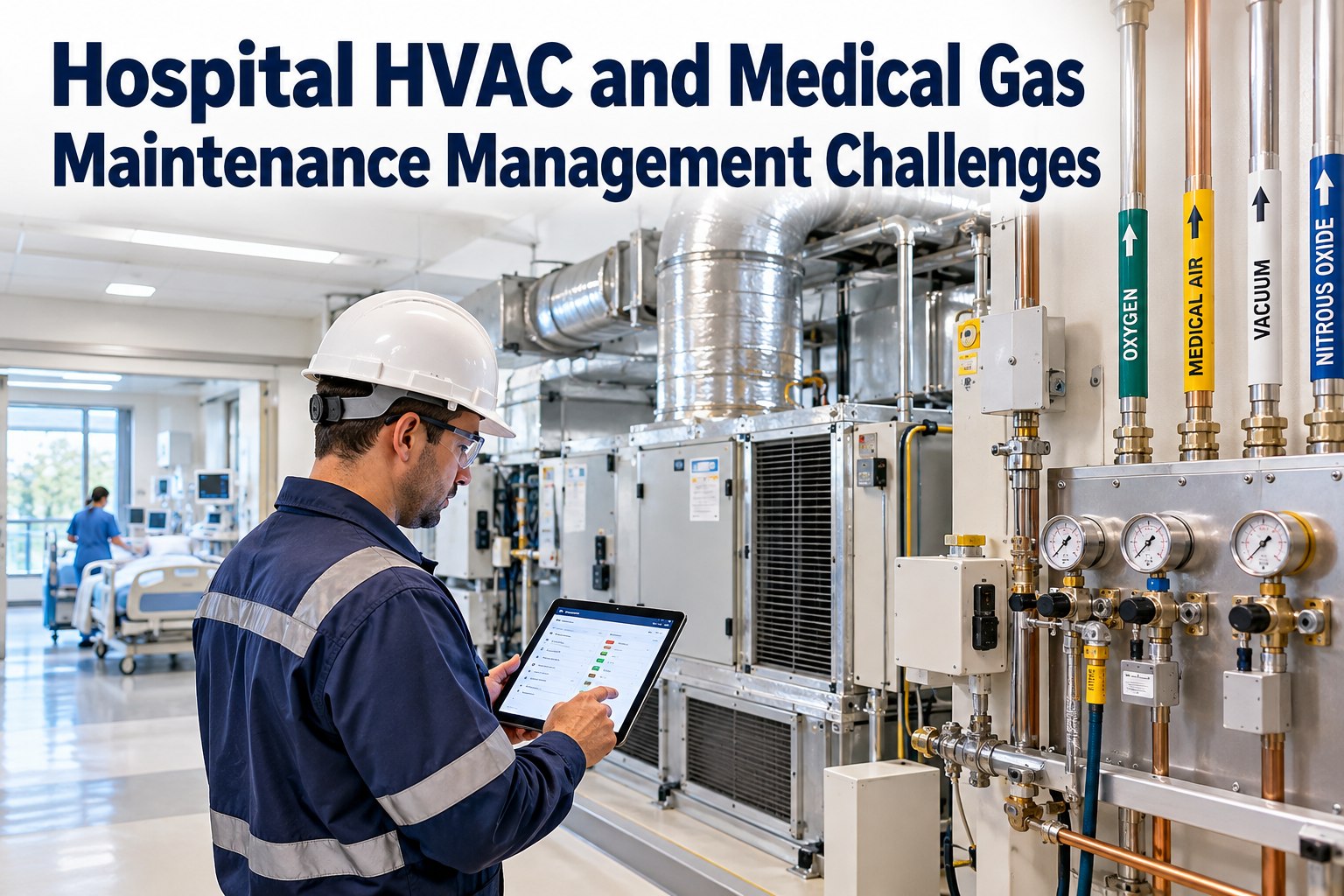
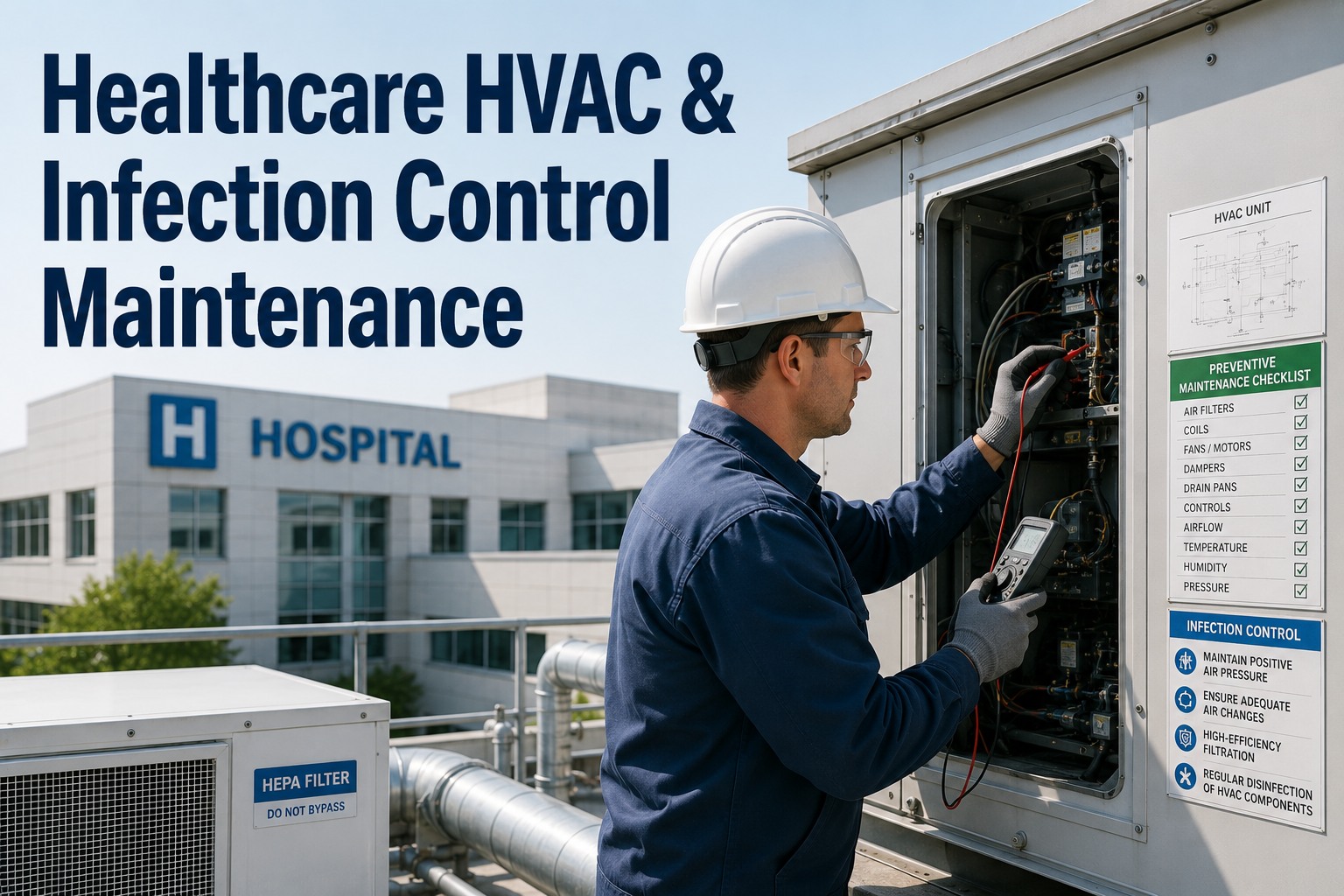
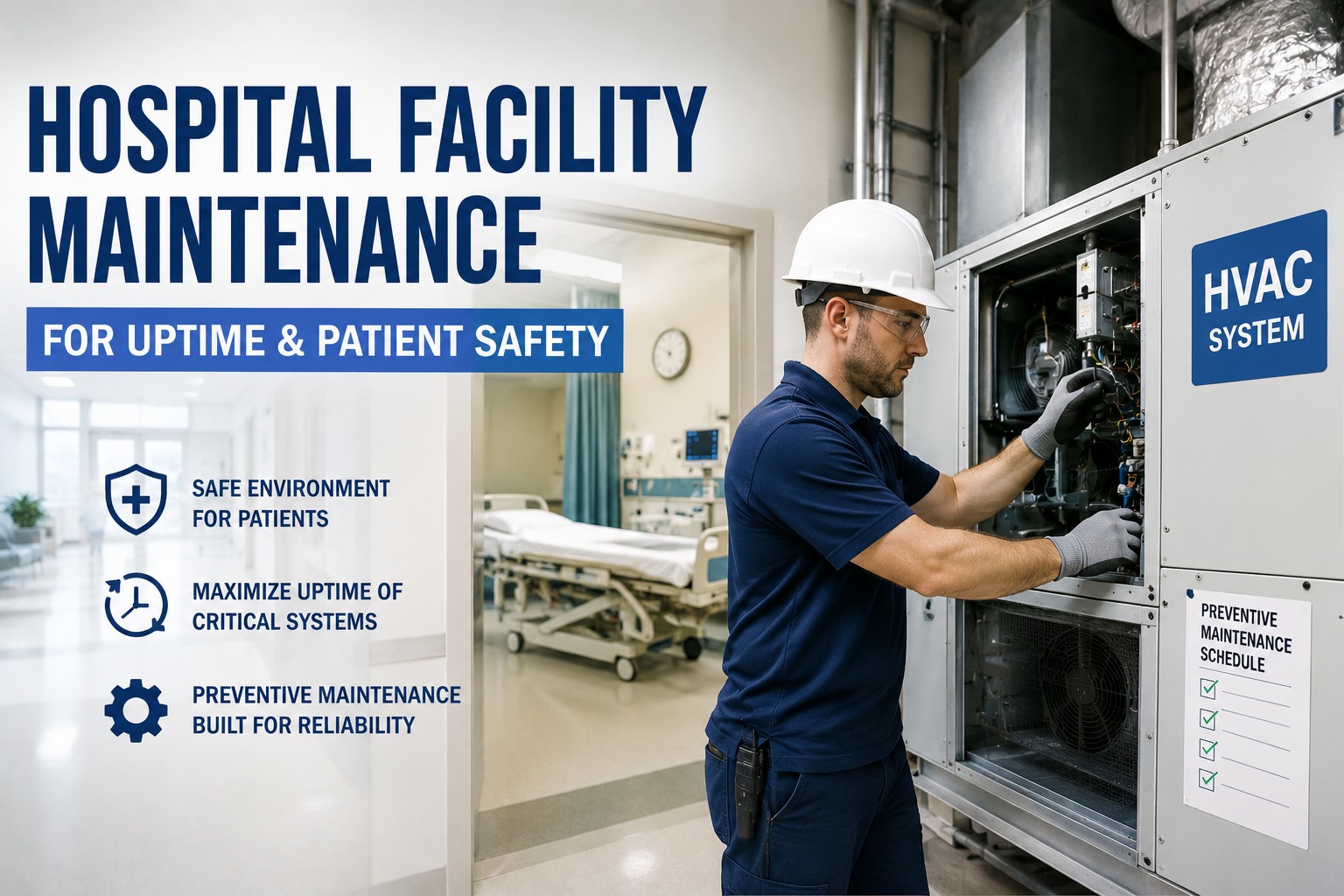
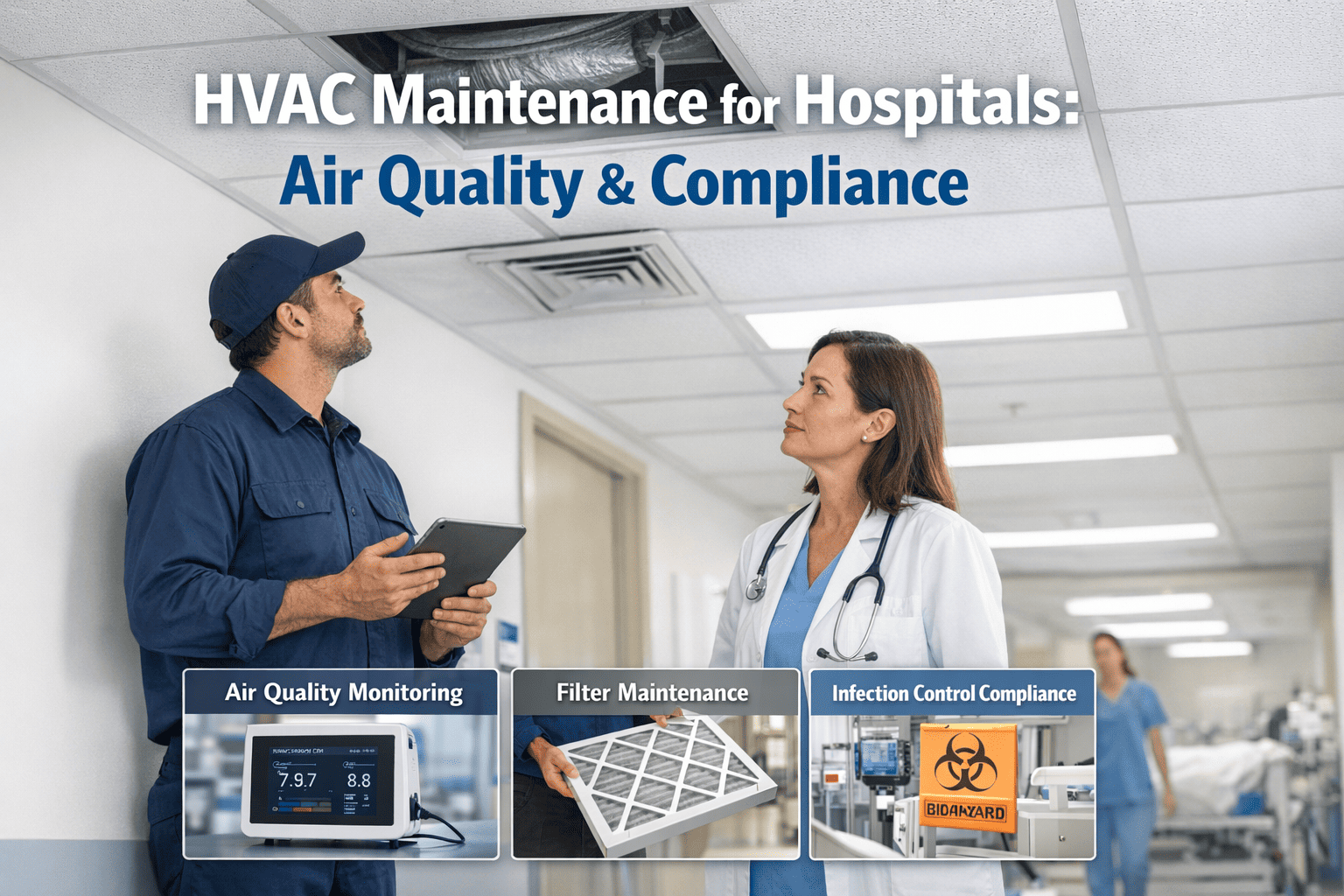
Healthcare HVAC is the only building system where a fouled coil or a stuck damper can become a surgical-site infection, a failed survey, and a loss of Medicare deemed status — all from the same root cause. This guide covers healthcare HVAC maintenance and pressure compliance the way a facilities director actually works it: the room-by-room ASHRAE 170 numbers, how pressure relationships fail at the envelope rather than the air handler, HEPA and filter management, and the record trail that survives a Joint Commission or CMS tracer. Start free on OxMaint to build your space-by-space compliance register, or book a demo.
ASHRAE 170 · FGI · Joint Commission PE · CMS CoP
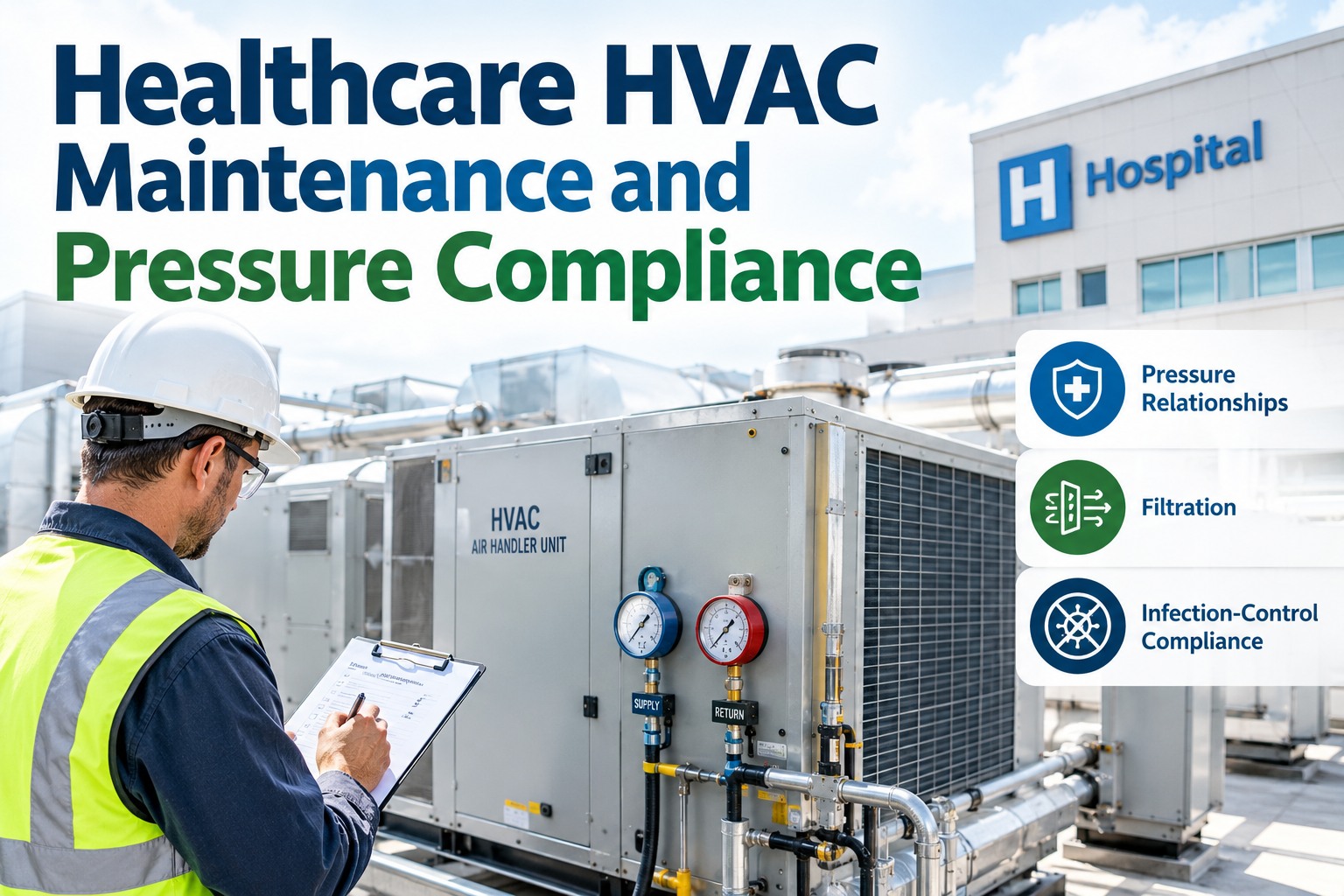
Healthcare HVAC Maintenance & Pressure Compliance
Pressure relationships, air changes, filtration, and the defensible record trail — mapped room by room to the standard surveyors actually check.
60+
Distinct space types ASHRAE 170 assigns a pressure relationship, air-change rate, and filter minimum
20
Minimum total air changes/hr for an operating room — 4 of them outdoor air
±0.01
Inches w.g. minimum pressure differential that separates a compliant critical space from a citation
Top 2
Physical-environment standards are among the most-cited in hospital surveys, year after year
Why Healthcare HVAC Is Not Commercial HVAC
A commercial HVAC program keeps people comfortable and keeps energy in budget. A healthcare HVAC program does that too — but underneath it carries three obligations no office building faces: it maintains directional airflow so contaminated air can never drift toward a sterile space, it holds air-change rates high enough to dilute airborne pathogens generated during care, and it produces a documented record that a surveyor can trace on demand. Miss any one and the consequence is not a warm lobby — it is a healthcare-associated infection, a Requirement for Improvement, or a threat to the accreditation that lets the facility bill Medicare at all.
Directional Airflow
Positive pressure pushes clean air out of an OR so nothing infiltrates. Negative pressure pulls air in to an isolation room so nothing escapes. The direction is the control — and it fails silently.
Dilution & Filtration
High air-change rates flush airborne contaminants; MERV and HEPA stages strip particulates and microbial carriers. Both degrade slowly as coils foul and filters load — with no alarm.
Defensible Records
Pressure logs, filter-change history, TAB reports, and excursion documentation. The performance can be perfect and still be a finding if the records can't prove it.
The Room-by-Room Reference · ASHRAE 170 Table 7-1 in Practice
ASHRAE Standard 170 is the mechanical-design standard behind healthcare ventilation, and the part a facilities team lives in is its ventilation table — the room-by-room grid of pressure relationship, minimum total air changes, minimum outdoor air, filtration, and humidity. Below are the critical spaces surveyors trace most often. These are the widely referenced minimums from the 2021 edition; the numbers a specific room is actually held to depend on the edition in force when it was built or last renovated.
| Space | Pressure | Total ACH | Outdoor ACH | Filtration | Temp / RH |
|---|
| Operating Room | Positive | 20 | 4 | MERV 16 (HEPA typical) | 68–75°F · 20–60% |
| Airborne Infection Isolation (AII) | Negative | 12 | 2 | Exhaust direct outdoors | Per design |
| Protective Environment (PE) | Positive | 12 | 2 | HEPA supply | Per design |
| Sterile Processing — Clean | Positive | 4 | 2 | MERV 14+ | Per design |
| Sterile Processing — Decon | Negative | 6 | 2 | Exhausted | Per design |
| General Patient Room | Neutral | 6 | 2 | MERV 13+ | 70–75°F · max 60% |
Directional convention: an OR pushes air out to protect the wound; an AII room pulls air in to contain TB, measles, or varicella; a PE room pushes out to shield an immunocompromised patient from environmental fungal spores such as Aspergillus. A single reversible room can never serve both AII and PE — the standard prohibits switching controls.
Where Pressure Actually Fails · It's the Envelope, Not the AHU
The instinct on a pressure alarm is to blame the air handler. In the field it is almost always the room envelope. Total air changes drop quietly every year as coils foul, filters load, and belts slip — a room balanced to 20 ACH can be delivering 15 today with no alarm and no setpoint change. Pressure relationships fail at the boundary: door sweeps, ceiling penetrations left open after cabling work, blocked return grilles, a VAV box that lost its minimum. Walk the room, not just the mechanical room.
01
Door & Envelope Leakage
Worn door sweeps, warped doors, and gaps let air short-circuit the pressure boundary. The single most common source of a negative/positive failure.
02
Ceiling Penetrations
Cabling, plumbing, and retrofit work leave unsealed penetrations above the ceiling that bleed pressure into the plenum. Invisible from the floor.
03
Blocked Returns / VAV Drift
Obstructed return grilles and VAV boxes that slipped below minimum flow quietly rebalance the room. Airflow is fine at the AHU and wrong at the door.
04
Coil & Filter Loading
Fouled coils and loaded filters bleed total ACH month over month. No threshold alarm fires — the room simply drifts out of its design air-change rate.
Build Your Space-by-Space Compliance Register — Free Forever
A facilities team that manages healthcare HVAC without a documented space-by-space classification can't demonstrate compliance for a single room — because the standard is different for every room. Set up OxMaint's free plan and classify each space with its pressure relationship, air-change target, and filter schedule. No card, no time limit.
Filter Management · The Two-Stage Discipline
Healthcare filtration is a staged system, and each stage has its own inspection and replacement logic. The move that separates a program from a scramble is replacing on measured pressure drop rather than the calendar — and documenting every change with location, date, and installed efficiency so the record answers the surveyor's question before it's asked.
Stage 1 · Pre-Filter
MERV 7–8
Captures large particulate, protects the coil and downstream stages. Highest change frequency; the workhorse that keeps the expensive stages alive.
Stage 2 · Final Filter
MERV 14–16
The clinical-grade stage for patient-care areas — captures bacterial carriers and most viral aerosols. Inspect final filters and frames monthly for pressure drop and bypass.
Critical Stage · HEPA
≥99.97% @ 0.3µm
Final stage for ORs, PE rooms, and compounding pharmacies. Certified on install and periodically challenge-tested; a failed HEPA is a direct infection-control exposure.
The Compliance Record Trail · What a Tracer Actually Pulls
When a surveyor walks a critical space, the room can be performing perfectly and still generate a finding if the documentation can't prove it. A defensible healthcare HVAC program keeps five record streams live at all times — and keeps them retrievable in the moment, not reconstructable after the exit conference.
Pressure Differential Logs
Continuous or documented readings for every critical space, with permanently installed monitors on AII and PE rooms and a local visual indicator of direction.
Filter-Change History
Per-location record: date, installed MERV/HEPA efficiency, measured pressure drop at change, and the tech. Proves the two-stage discipline over time.
Temp & Humidity Records
OR range is a band, not a point — logs are read at every reading. A 20–60% RH space is out of range at 19 or 61, and surveyors read the excursions.
TAB / Airflow Verification
Testing-and-balancing reports confirming each room hits its design ACH. The document that catches the silent drift from 20 to 15 air changes.
Excursion & Corrective Action
Every out-of-range event with the response, the fix, and the return-to-range timestamp. Surveyors expect excursions; they cite the absence of a documented response.
PM & Utility Risk Records
The preventive-maintenance history and utility-systems risk inventory behind the HVAC assets — the paperwork the utility-systems standard is cited for missing.
Who Enforces It · The 2026 Regulatory Map
Healthcare HVAC compliance is enforced by a stack of overlapping authorities, and one thing changed for 2026 worth flagging in your own survey-prep documents.
ASHRAE 170
The engineering standard. Sets the target pressure, ACH, filtration, and temp/humidity numbers per space in Table 7-1 — the grid everything else gets checked against.
FGI Guidelines
The design-and-construction rulebook many states adopt; the 2022 edition incorporates ASHRAE 170-2021. This is what governs a new build or renovation.
Joint Commission — PE Chapter
As of Jan 1, 2026, EC and Life Safety folded into one Physical Environment chapter. Ventilation-in-critical-areas — formerly EC.02.05.01 EP 15/16 — now sits under PE.04.01.01, EP 3. The engineering requirements are unchanged; the citation number moved.
CMS Conditions of Participation
42 CFR 482.41 requires a safe, sanitary environment. Loss of accreditation risks deemed status — the ability to bill Medicare and Medicaid without a separate CMS survey.
Action item: if your policies, checklists, or survey-prep binders still cite EC.02.05.01 for ventilation, update the reference to PE.04.01.01, EP 3. The number changed on January 1, 2026 — the pressure, air-change, and filtration requirements behind it did not.
How OxMaint Runs the Healthcare HVAC Program
The classification, scheduling, logging, and record retrieval all live on one platform — every critical space carried as a classified asset with its own compliance profile, so a pressure log, a filter change, and a survey-ready export are three clicks apart instead of three binders apart.
Classify
Space Register
Every room carried with its pressure relationship, ACH target, filter stages, and temp/RH band — the space-by-space classification compliance is measured against.
Schedule
PM by Space Type
Filter inspections monthly, HEPA certification cycles, TAB verification, coil cleaning — PM cadence driven by each space's classification, not one generic schedule.
Log
Pressure & Environment
Pressure differential, temperature, and humidity captured against each space's band, with excursions flagged and the corrective-action loop opened automatically.
Document
Filter & Change History
Every filter change logged with location, installed efficiency, and measured pressure drop — the two-stage discipline written down as it happens.
Export
Survey-Ready Records
Pressure logs, filter history, excursion responses, and PM records pulled per space on demand — the tracer's question answered before the exit conference.
Route
WO to Right Craft
A pressure excursion or overdue filter auto-generates a work order to controls or mechanical, with the space classification and requirement attached.
Make Your Next Survey a Records Pull, Not a Scramble
Free forever plan — no card, no time limit. Classify your critical spaces, log pressure and filter changes as they happen, and export the record trail per room the moment a tracer asks. Or book 30 minutes and we'll map your OR suite, isolation rooms, and sterile processing onto the platform end to end.
Frequently Asked Questions
What pressure relationship and air-change rate does an operating room require?
Under the widely referenced ASHRAE 170-2021 minimums, an OR holds positive pressure of at least +0.01 in. w.g. to all adjoining spaces, a minimum of 20 total air changes per hour with at least 4 outdoor air changes, MERV 16 final filtration (HEPA in practice), and 68–75°F at 20–60% RH. The exact numbers a given room is held to depend on the edition in force when it was built or last renovated.
How is an airborne infection isolation room different from a protective environment room?
Opposite airflow. An AII room is negative — air pulled in and exhausted directly outdoors — to contain pathogens like TB, measles, and varicella, at a minimum of 12 ACH. A PE room is positive with HEPA supply to keep environmental fungal spores away from immunocompromised patients. The standard prohibits a single reversible room from switching between the two functions.
Why does a room's air-change rate drop when nothing changed?
Because total ACH decays quietly. Coils foul, filters load, and belts slip over a year, and a room balanced to 20 ACH can be delivering closer to 15 with no alarm and no setpoint change. This is why testing-and-balancing verification matters — it catches the silent drift that outdoor-air damper position never reveals.
Did the Joint Commission ventilation standard number change?
Yes. As of January 1, 2026, the Environment of Care and Life Safety chapters were consolidated into a single Physical Environment chapter, and the ventilation-in-critical-areas requirement moved from EC.02.05.01, EP 15/16 to PE.04.01.01, EP 3. The engineering requirements are identical — only the citation reference moved, so update your survey-prep documents.
How do we keep HVAC records defensible against a Joint Commission or CMS tracer?
Keep five streams live and retrievable per space: pressure differential logs, filter-change history with installed efficiency and pressure drop, temperature and humidity records read against the band, TAB airflow verification, and excursion-with-corrective-action documentation. A room can perform perfectly and still be cited if the record can't be pulled on demand.
Set it up free on OxMaint.