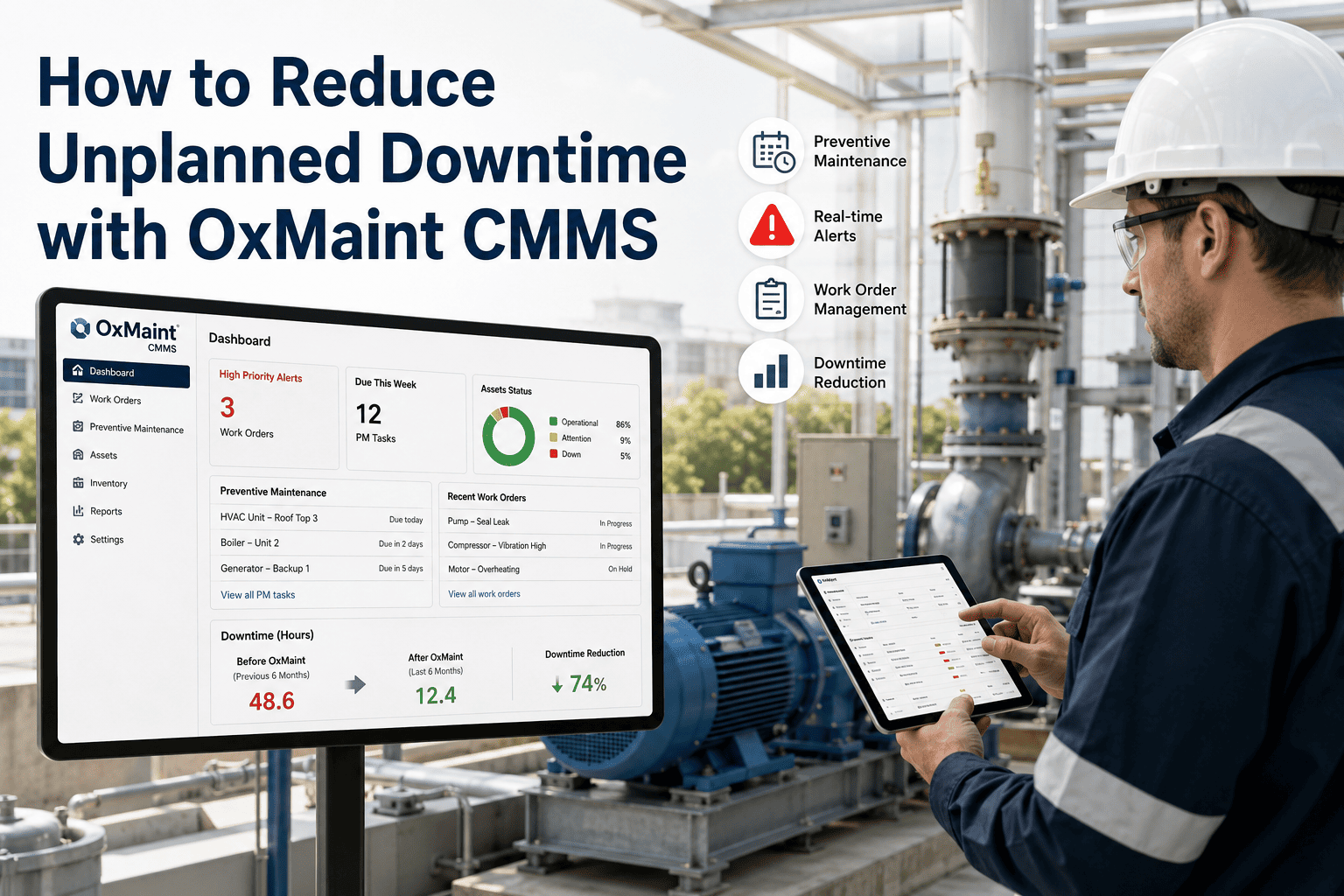
Unplanned downtime in utilities is not random — it is predictable. Every unplanned outage has a maintenance precursor: a missed lubrication interval, a vibration trend that was never analyzed, a thermal anomaly ignored because there was no system to surface it. The U.S. Department of Energy estimates that unplanned downtime costs industrial and utilities facilities between $50,000 and $250,000 per hour depending on asset criticality — and 82% of these events are preventable with condition-based monitoring. OxMaint CMMS with Digital Twin Maintenance gives utilities teams a live, physics-based replica of every critical asset — surfacing failure risks before the outage occurs, not after. This guide covers how digital twin technology reduces unplanned downtime, the KPIs that matter, and what implementation looks like in a utilities environment.
What Is Digital Twin Maintenance?
A digital twin is a continuously updated virtual replica of a physical asset — fed by IoT sensors, maintenance history, and operational data. Unlike static asset records, a digital twin reflects the asset's actual condition in real time, enabling predictive maintenance decisions days or weeks before a failure would occur.
The 6 Signals Digital Twin Catches Before Failure
Stop Reacting. Start Predicting.
OxMaint's Digital Twin Maintenance is built for utilities teams that need early warning — not incident reports. Book a 30-minute demo to see how it maps to your asset environment.
Unplanned vs. Planned Maintenance: The Cost Reality
Implementation Timeline: Digital Twin in a Utilities Environment
Expert Review
The utilities sector is unique because the consequence of unplanned downtime is not just financial — it is operational continuity for entire communities. What makes digital twin technology transformative in this context is not the sensor data itself, but the causal model underneath it. A vibration reading in isolation is a number. A vibration reading placed against the asset's operational history, its load profile, its last service date, and its MTBF trend becomes an early warning signal. That is what OxMaint's digital twin approach provides — context that turns raw data into a maintenance decision that prevents the next outage. The facilities I have seen make the most dramatic downtime reductions are not the ones that invested the most in sensors — they are the ones that invested in the intelligence layer that makes sensor data actionable.
Every Unplanned Outage Was Predictable — Catch the Next One First
OxMaint Digital Twin Maintenance gives your team the early warning window to intervene before the failure — not after the damage report. Book your demo and see your critical assets in a live condition model.
Frequently Asked Questions
What is digital twin maintenance and how does it reduce unplanned downtime in utilities?
Digital twin maintenance creates a continuously updated virtual model of each physical asset — fed by real-time sensor data, maintenance history, and operational parameters. Instead of waiting for equipment to fail or relying on fixed calendar-based PMs, the digital twin detects early deviation from expected operating conditions and generates a predictive work order in OxMaint days or weeks before failure would occur. Utilities using this approach report 60–72% reductions in unplanned outages because intervention happens in the early warning window, not in the failure response window.
How long does it take for digital twin monitoring to start reducing downtime events?
Most utilities facilities begin seeing the first condition-triggered work orders within 30–60 days of deployment, once OxMaint has calibrated asset baselines from operational sensor data. Measurable MTBF improvement typically appears at the 90-day mark, and the full 60–72% downtime reduction benchmark is generally reached between month six and month twelve. The timeline depends on the number of assets monitored, existing sensor infrastructure, and baseline maintenance program maturity. Early results — faster detection, fewer emergency dispatch events — are visible within the first month for assets where sensor data is already flowing.
Does OxMaint require new sensors or does it work with existing IoT infrastructure?
OxMaint is compatible with most industrial IoT sensor platforms, including Siemens, Rockwell, and generic MQTT-based sensors, allowing facilities to leverage existing sensor investments. For assets without current monitoring, OxMaint supports a phased sensor deployment approach — prioritizing highest-criticality assets first. A full sensor inventory is not required to begin — OxMaint can build digital twin baselines from maintenance history and operational data alone, with sensor feeds added incrementally as the program scales. Contact the OxMaint team to review your existing sensor environment before deployment.
What KPIs improve most measurably after implementing digital twin maintenance in utilities?
The three KPIs that show the most consistent improvement are reactive work ratio (typically dropping from 35–45% down to 12–18% within 12 months), MTBF on monitored assets (improving 30–90 operating hours per critical asset class), and maintenance cost per asset (declining 22–35% as planned interventions replace emergency responses). Energy efficiency also improves as the digital twin identifies assets running outside their efficiency curves. Book a demo to see how OxMaint tracks and reports all of these KPIs from your specific asset environment.





.png)