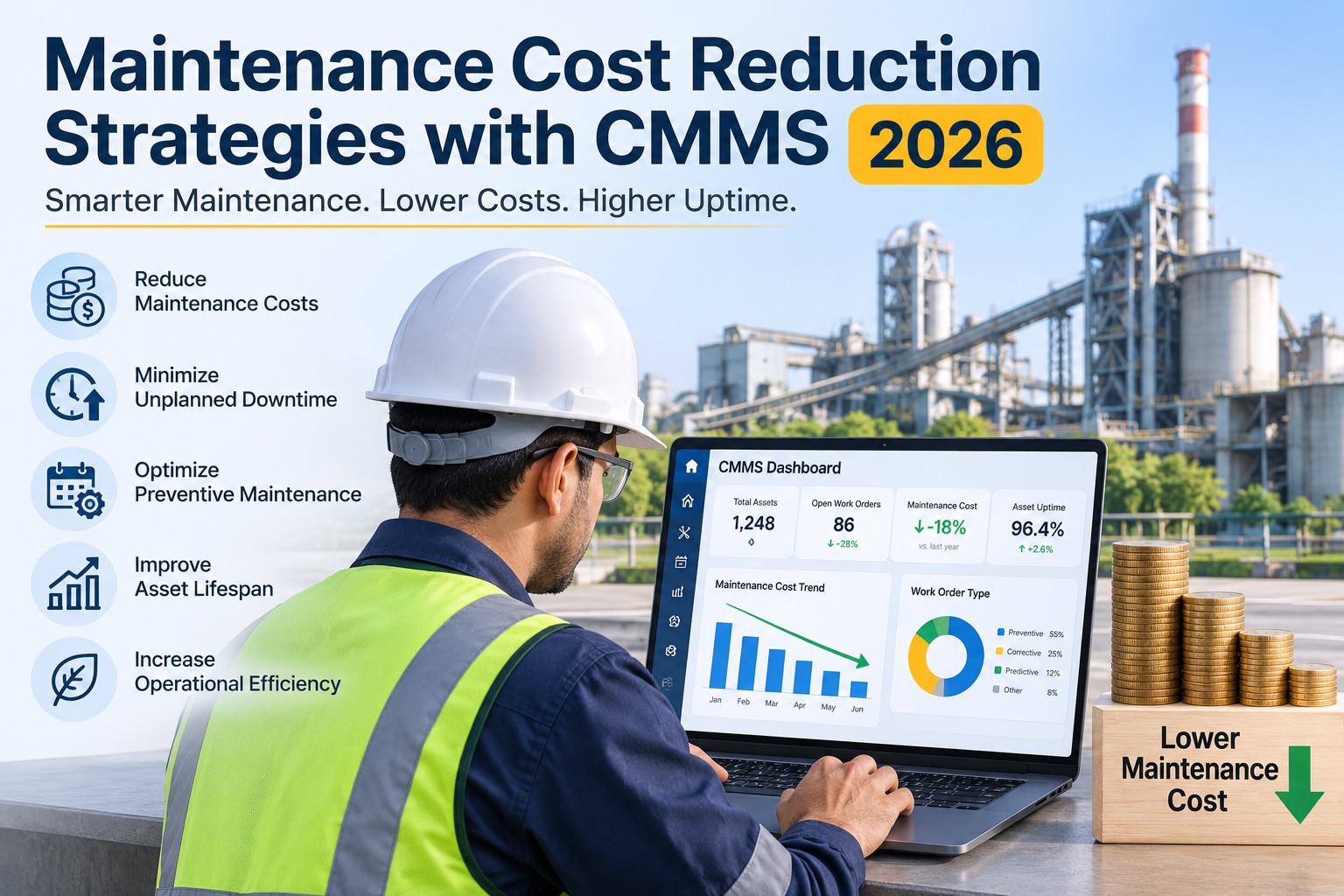
Maintenance cost reduction strategies with CMMS in 2026 combine preventive maintenance optimization, vendor management, and predictive maintenance adoption into a single coordinated cost program. Industrial plants that deploy a modern CMMS typically cut maintenance costs 20–35% within the first 12 months by reducing unplanned downtime, rationalizing spare-parts inventory, and eliminating paper work orders. OxMaint maintenance management software helps maintenance leaders execute cost reduction defensibly — documenting PM ROI, analyzing vendor spend, integrating PdM, and delivering a CMMS-driven cost reduction program that consistently produces documented savings without hurting reliability. The fastest way to see the platform on your assets is to Start Free Trial or book a personalized 30-minute demo with our team.
Cut Plant Maintenance Costs 20–35% With CMMS-Driven Cost Reduction
Maintenance budgets are rising 6–9% annually across heavy industry while reactive repair costs 3–5× more than planned work. OxMaint's AI-powered CMMS turns that spiral into a defensible, data-backed cost reduction program — without sacrificing reliability or compliance.
How CMMS Cost Savings Actually Work: The Formula
Maintenance cost reduction is not guesswork — it is the mathematical difference between what reactive firefighting costs your plant and what a disciplined, CMMS-driven preventive and predictive program costs. When you quantify the gap, the ROI becomes undeniable.
Shifting from reactive to preventive and predictive maintenance reduces unplanned outages. A single avoided pump failure on a production line can save $8K–$50K per hour in lost throughput.
Rationalizing critical spares, setting min/max levels, and eliminating obsolete stock frees working capital. Most plants carry 20–30% excess inventory that a CMMS identifies within 90 days.
Tracking vendor performance and redirecting routine work to in-house technicians — guided by CMMS work-order history — cuts outside contractor invoices meaningfully within one quarter.
Technicians spend 30–60 minutes per shift searching for parts, manuals, or approvals. A mobile CMMS eliminates that scavenger hunt and puts every work order in their pocket.
A 180-asset food processing plant spending $42K/month on maintenance deployed OxMaint and implemented a structured PM optimization and spare-parts rationalization program. Within 6 months they reduced unplanned downtime by 34%, cut inventory carrying cost by $28K, and eliminated $11K/month in emergency contractor calls — netting $187K in documented annual savings against a $14K CMMS investment. That is a 13× CMMS ROI in year one alone.
Five Proven Strategies to Reduce Maintenance Costs in 2026
A maintenance cost strategy only works when it is layered, measurable, and enforced by software — not tribal knowledge. These five streams are how high-performing reliability teams systematically reduce downtime cost and defend their budgets to finance.
Optimize Preventive Maintenance Schedules
30–50% of PMs in most plants are either redundant, too frequent, or address low-criticality assets. OxMaint's PM ROI documentation identifies which preventive tasks actually prevent failures — and which are burning labor hours without reducing downtime. Adjusting intervals based on failure history typically cuts PM labor 15–22% while improving uptime.
Integrate PdM to Catch Failures Before They Happen
Vibration analysis, oil analysis, thermography, and IoT sensor data integrated into your CMMS shift maintenance from time-based to condition-based. PdM adoption reduces unplanned downtime 30–50% and extends asset life 20–40% — the single largest lever in maintenance cost management.
Rationalize Spare-Parts Inventory and Cut Carrying Cost
Every dollar tied up in obsolete or duplicate parts is working capital your plant cannot deploy elsewhere. OxMaint's spare-parts inventory module sets min/max levels based on actual usage, flags slow-moving stock, and links parts directly to asset BOMs — reducing inventory 15–25% without increasing stockout risk.
Control Contractor Costs With Spend Analytics
Outside contractors cost 2.5–4× more per hour than in-house technicians. OxMaint tracks every contractor work order — labor hours, parts markup, repeat calls, and SLA compliance — so you can redirect routine work internally, renegotiate contracts, and document exactly where vendor dollars go.
Reduce Energy Waste Through Maintenance Discipline
Degraded bearings, clogged filters, and misaligned drives silently inflate energy consumption 5–15%. By scheduling condition-based energy maintenance tasks inside OxMaint — compressed air leak surveys, motor efficiency checks, steam trap inspections — plants cut utility bills by $30K–$120K annually, a cost reduction most maintenance teams overlook entirely.
How Fast Does CMMS Deliver Financial ROI?
Most maintenance leaders ask finance for budget before they ask for software. The table below maps a realistic 12-month payback timeline so you can walk into that conversation with defensible numbers.
| Phase | Timeline | Key Actions | Typical Savings |
|---|---|---|---|
| Baseline | Month 1–2 | Asset register imported, criticality ranked, work-order data migrated from spreadsheets | Visibility into true maintenance spend established |
| PM Optimization | Month 2–4 | Eliminate redundant PMs, adjust intervals, automate scheduling | 8–12% labor cost reduction |
| Inventory Cleanup | Month 3–5 | Rationalize spares, set min/max, link to BOMs, clear obsolete stock | $15K–$50K working capital freed |
| PdM Integration | Month 4–8 | Connect sensor data, vibration and oil analysis, trigger condition-based work orders | 20–35% downtime cost reduction |
| Vendor Analytics | Month 6–10 | Track contractor SLAs, redirect routine work, renegotiate underperforming contracts | 10–20% contractor spend cut |
| Full Program | Month 10–12 | Quarterly cost reviews, KPI dashboards, continuous improvement loop | 20–35% total maintenance budget reduction |
OxMaint Capabilities That Drive Measurable Maintenance Savings
OxMaint is not just a digital work-order system — it is an AI-powered CMMS and EAM platform purpose-built for maintenance financial management. Each capability below maps directly to a cost-reduction lever and a measurable outcome your CFO will accept.
AI-Powered PM Optimization
OxMaint analyzes failure history and work-order completion data to recommend optimal PM intervals — eliminating redundant tasks and surfacing under-maintained critical assets. Outcome: 15–22% reduction in PM labor cost with no increase in failures.
Predictive Maintenance Integration
Connect vibration, temperature, and oil-analysis sensors directly to asset records. OxMaint's AI triggers condition-based work orders before failures occur. Outcome: 30–50% reduction in unplanned downtime and 20–40% longer asset life.
Smart Spare-Parts Inventory
Auto-calculated min/max levels, BOM-linked parts, and slow-stock alerts ensure you carry what you need — not 25% excess. Outcome: 15–25% inventory carrying cost reduction and dramatically fewer stockout-driven emergency purchases.
Vendor Spend Analytics
Every contractor work order — labor hours, parts markup, repeat calls, SLA breach — is tracked and benchmarked. Outcome: 10–20% contractor spend reduction through contract renegotiation and in-house redirection of routine work.
CMMS Cost Reduction vs. Status Quo: What It Really Costs to Wait
The cost of NOT acting is rarely line-itemed on a P&L — but it shows up in overtime, expedited parts, lost production, and audit findings. Here is what the side-by-side actually looks like.
| Cost Dimension | Spreadsheets & Reactive | OxMaint CMMS-Driven |
|---|---|---|
| Work Order Management | Paper tickets, lost history, tribal knowledge | Digital work orders with full history, photos, and parts tracking |
| PM Compliance Rate | Typically 50–65% — many PMs skipped or late | 90–98% automated scheduling and completion tracking |
| Unplanned Downtime | $8K–$50K/hr, 3–5× the cost of planned work | 30–50% reduction through PdM and condition-based triggers |
| Inventory Carrying Cost | 20–30% excess, no min/max discipline | 15–25% reduction, auto-reorder, BOM-linked spares |
| Compliance & Audit | Hours of manual report assembly per audit | One-click reports, ISO 55000 and FMCSA-ready documentation |
| Year-One ROI | None — costs rise 6–9% annually | 5–13× return on software investment |
What Documented Maintenance Savings Look Like
"We cut our monthly maintenance spend from $42K to $31K in six months. OxMaint's PM optimization alone eliminated 180 hours of unnecessary preventive tasks per quarter — and our uptime actually improved. The ROI was undeniable by month four."
"Spare-parts inventory was our silent budget killer — $380K tied up with no discipline. OxMaint flagged $92K of obsolete stock in the first 60 days and set auto-reorder on everything else. We reinvested that capital into vibration sensors."
See How Much Your Plant Could Save With OxMaint
Book a 30-minute demo and we will map your asset base, current maintenance spend, and projected CMMS cost savings — live on your data.
Maintenance Cost Reduction With CMMS — Answered
How much can a CMMS reduce maintenance costs?
Most industrial plants see 20–35% maintenance cost reduction within 12 months of deploying a CMMS, driven primarily by PM optimization, reduced unplanned downtime, and spare-parts rationalization. The exact figure depends on how reactive your current program is — plants running entirely on spreadsheets and emergency repairs see the largest gains. You can validate the projection for your asset base when you Start Free Trial and import your work-order history.
What is the typical ROI timeline for CMMS implementation?
Most OxMaint customers achieve full payback within 4–8 months. The fastest savings come from eliminating redundant PMs (month 2–4) and clearing obsolete inventory (month 3–5), while larger gains from predictive maintenance and downtime reduction compound from month 4 onward. A typical 180-asset plant nets 5–13× return on software cost in year one.
How does preventive maintenance optimization reduce costs?
PM optimization identifies preventive tasks that are too frequent, redundant, or applied to low-criticality assets — then adjusts intervals based on actual failure history. This typically cuts PM labor 15–22% while maintaining or improving uptime, because technicians spend time only on tasks that genuinely prevent failures rather than calendar-driven busywork.
Can a CMMS help with maintenance budget reduction without hurting reliability?
Yes — and this is the core promise of a CMMS-driven cost strategy. By shifting from reactive to condition-based maintenance, you spend less on emergency repairs and more on targeted, data-backed interventions. OxMaint documents every decision with failure history and PM ROI data, so budget cuts are defensible to finance and never come at the expense of asset availability. Book a Demo to see this workflow live.
What maintenance metrics should we track to prove cost savings?
Track unplanned downtime hours, PM compliance rate, mean time between failures (MTBF), mean time to repair (MTTR), inventory carrying cost, contractor spend as a percentage of total maintenance cost, and cost per asset per month. OxMaint's analytics dashboard surfaces all of these automatically — giving you a defensible, real-time view of maintenance financial performance for board-level reporting.
Start Your Maintenance Cost Reduction Program Today
Every month you wait, reactive maintenance costs compound. Join the plants using OxMaint to cut costs 20–35%, document every saving, and prove maintenance ROI to leadership.
Free 14-day trial · No credit card