A pharmaceutical manufacturing facility operates under a compliance regime that has no equivalent in any other industry. Every maintenance action taken on production equipment — every calibration, every lubrication round, every parts replacement — generates a record that may be examined by the FDA, the EMA, or another regulatory authority during a GMP inspection. The consequences of an incomplete, inaccurate, or missing maintenance record are not limited to a minor observation: they can trigger a Form 483 observation, a warning letter, or — in cases of systematic data integrity failure — a consent decree that halts production at the facility. The paper-based maintenance record systems that most pharmaceutical plants inherited from previous decades are structurally incompatible with 21 CFR Part 11 data integrity requirements: they cannot provide the audit trail, electronic signature, and record-keeping permanence that modern GMP inspection requires. A pharmaceutical CMMS purpose-built for GMP compliance replaces the paper maintenance record not just with a digital version of the same document, but with an audit-ready, Part 11-capable electronic record system that converts maintenance compliance from an inspection risk into a demonstrable organisational strength.
Pharmaceutical Manufacturing CMMS: GMP Compliance Guide
How a compliant CMMS delivers 21 CFR Part 11 electronic records, automated validation documentation, and complete audit trails — converting maintenance into a GMP compliance asset rather than an inspection liability.
GMP Maintenance Requirements: What the Regulations Actually Require
Four regulatory frameworks govern maintenance records in pharmaceutical manufacturing. Each creates specific requirements that a maintenance management system must satisfy — or leave the facility exposed during inspection. Book a demo to map OxMaint's compliance features to your specific regulatory framework.
FDA cGMP for Finished Pharmaceuticals
Section 211.68 requires computerised systems used in GMP functions to meet Part 11 standards for electronic records. Section 211.67 requires written procedures for equipment cleaning and maintenance. Section 211.68 requires that equipment maintenance and use records are kept for each piece of equipment. OxMaint generates these records automatically from every completed work order.
Electronic Records and Electronic Signatures
Part 11 sets the standards for electronic records and signatures in FDA-regulated industries. Key requirements: audit trail that records all changes with date, time, and user identity; electronic signatures that cannot be repudiated; record integrity protection against alteration; system validation documentation. OxMaint's immutable work order records, timestamped signatures, and change-log audit trail are designed to meet Part 11 requirements.
Computerised Systems (European Framework)
The EU equivalent of 21 CFR Part 11, with additional requirements for data governance, supplier qualification, and periodic system reviews. Annex 11 explicitly requires that computerised systems used in GMP activities are validated for their intended purpose, and that audit trail functionality is activated and reviewed as part of routine quality oversight. OxMaint supports Annex 11 compliance including supplier qualification documentation for the CMMS itself.
Pharmaceutical Quality System
ICH Q10 requires a systematic approach to equipment maintenance as part of the Pharmaceutical Quality System — specifically, written procedures for equipment maintenance, calibration programmes with documented records, and maintenance history as an input to risk assessment. OxMaint's PM compliance data, MTBF trends, and equipment history reports directly support ICH Q10's process performance and product quality monitoring requirements.
Six OxMaint Capabilities That Directly Address GMP Compliance Requirements
These six capabilities distinguish a GMP-capable CMMS from a general maintenance system used in a pharma facility. Sign up to evaluate OxMaint's GMP compliance features — free.
Immutable Audit Trail with 21 CFR Part 11 Compliance
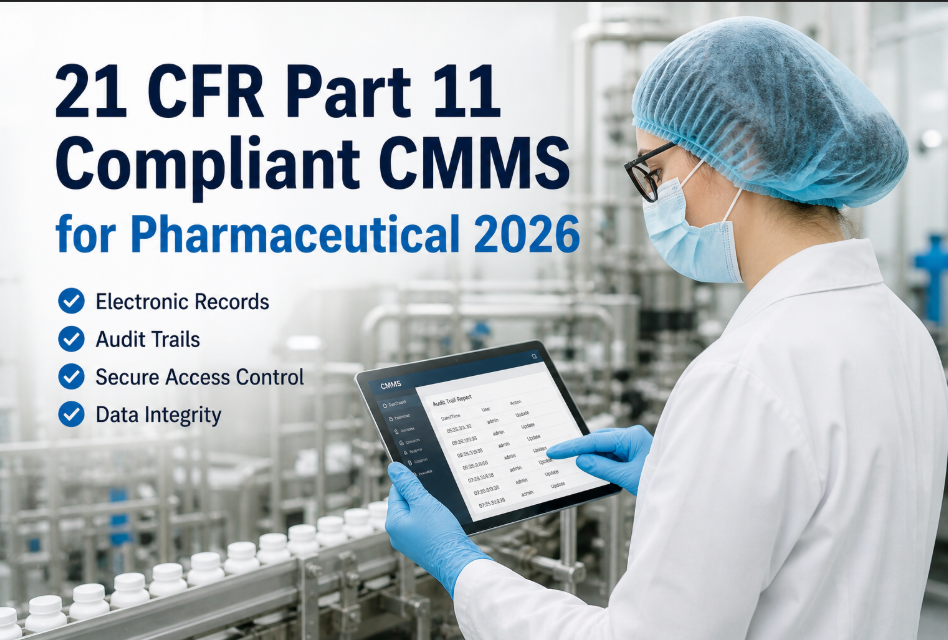
Every work order action — creation, assignment, field update, completion, approval, and any subsequent modification — generates a timestamped, user-attributed audit log entry. The audit log is immutable: no user, including system administrators, can delete or modify an audit trail entry. Every record shows the original value, the new value, the date and time of change (to the second), and the identity of the user who made the change. This is the core Part 11 requirement for audit trail integrity — and it operates automatically on every work order without any configuration.
Electronic Signatures on Work Order Completion and Approval
OxMaint's electronic signature functionality requires the approving user to re-authenticate (username and password or biometric, depending on device) at the point of signing a work order closure or approval. The signature is captured with a meaning statement (e.g., "I certify that the maintenance described in this work order was performed as documented"), a date/time stamp, and the user's full name and role. Electronic signatures cannot be delegated or transferred between users — each signature is attributed to the authenticated individual. This meets the individual accountability requirement of 21 CFR Part 11.100.
Equipment Qualification Status Tracking and Expiry Alerts
Each asset in OxMaint can be assigned qualification statuses — IQ, OQ, PQ completion dates, requalification due dates, and calibration certificate expiry dates. When a qualification or calibration approaches its expiry window, OxMaint automatically generates an alert and, if configured, a PM work order for the requalification activity. Equipment with expired qualification status is flagged in the asset record — providing the Quality department with real-time visibility of qualification coverage without a manual tracking spreadsheet. Sign up to configure equipment qualification tracking in OxMaint — free.
SOP-Linked PM Checklists with Mandatory Field Enforcement
PM work orders in OxMaint are linked to specific SOPs — the checklist items in the work order match the procedure steps in the SOP exactly. Mandatory fields can be configured: a technician cannot close the work order without completing every required field, recording every measurement, and attaching every required photo. This eliminates the "completed but incomplete" record — the most common documentation failure found in FDA maintenance inspections. Every PM closure generates a complete, SOP-consistent record.
Inspection-Ready Maintenance History Reports
OxMaint generates equipment maintenance history reports formatted for regulatory inspection use — sortable by date, work order type, technician, or fault category, with all associated documentation (photos, certificates, completion notes) linked directly in the report. An inspector asking for "all maintenance performed on Reactor 3 in the last 24 months" receives a complete, structured record in under 30 seconds rather than requiring a staff member to manually compile paper records over hours. This is the difference between an inspection that builds confidence and one that creates uncertainty. Book a demo to see OxMaint's inspection-ready report generation.
PM Compliance Dashboard for Quality Oversight
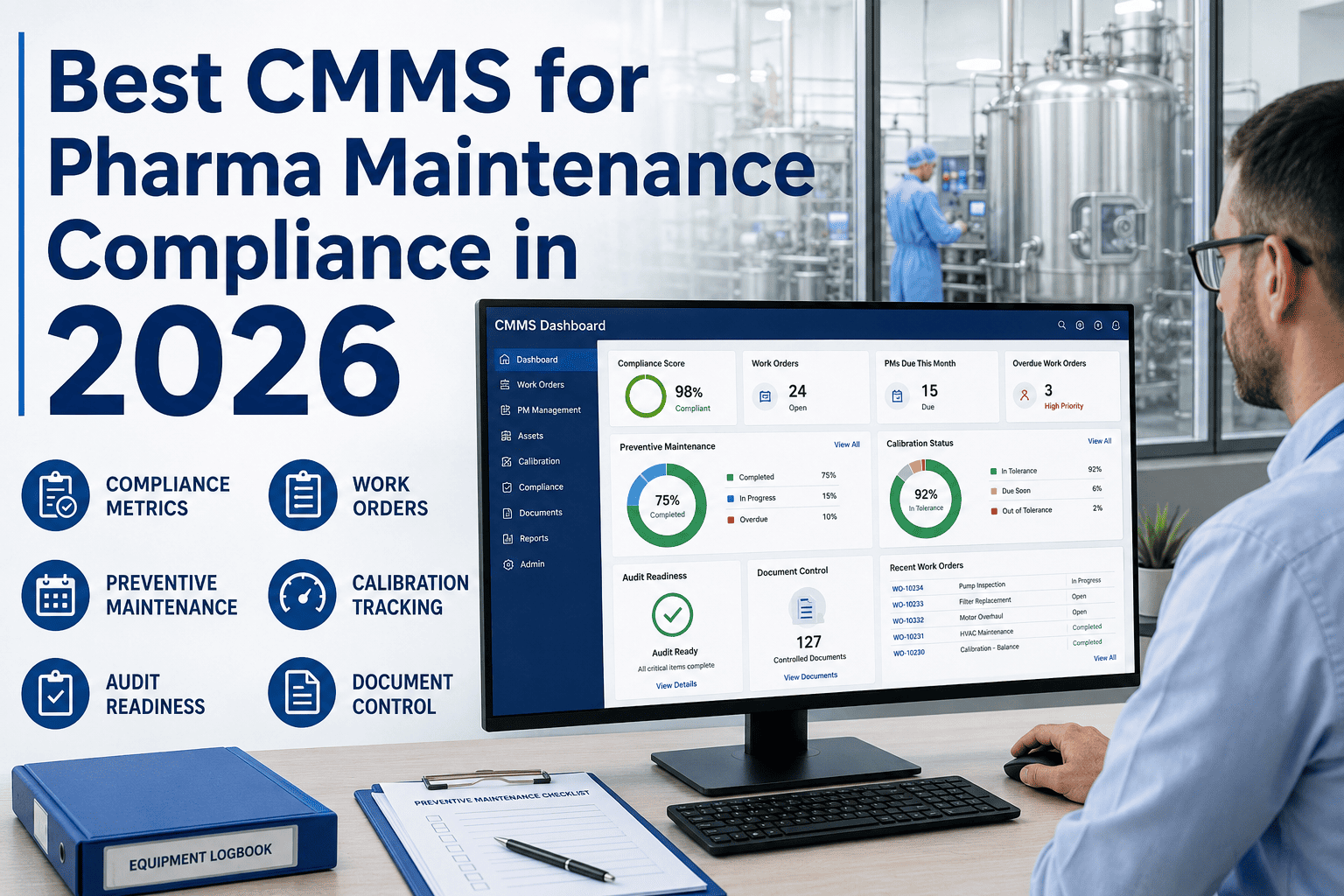
OxMaint's PM compliance dashboard provides the Quality department and site management with real-time visibility of maintenance programme execution — PM completion rate by equipment category, overdue PM alerts, and upcoming PM schedule for the next 30 days. This data supports ICH Q10's process performance and product quality monitoring requirement, and provides the quantitative evidence of maintenance programme effectiveness that regulators expect to see in quality management reviews. The dashboard is accessible to Quality management without a maintenance system login — read-only access can be granted to QA personnel for oversight purposes.
Audit trail, electronic signatures, qualification tracking, and inspection-ready reports — free to evaluate on your own equipment records.
Frequently Asked Questions
What is 21 CFR Part 11 and how does it apply to pharmaceutical CMMS?
What does a pharmaceutical CMMS audit trail need to capture?
Does OxMaint require formal computer system validation (CSV) for GMP use?
Audit-Ready Maintenance Records. Every Work Order. Every Signature.
OxMaint delivers the 21 CFR Part 11 audit trail, electronic signatures, qualification tracking, and inspection-ready reports that pharmaceutical GMP maintenance requires — free to start, validation documentation included.



.png)