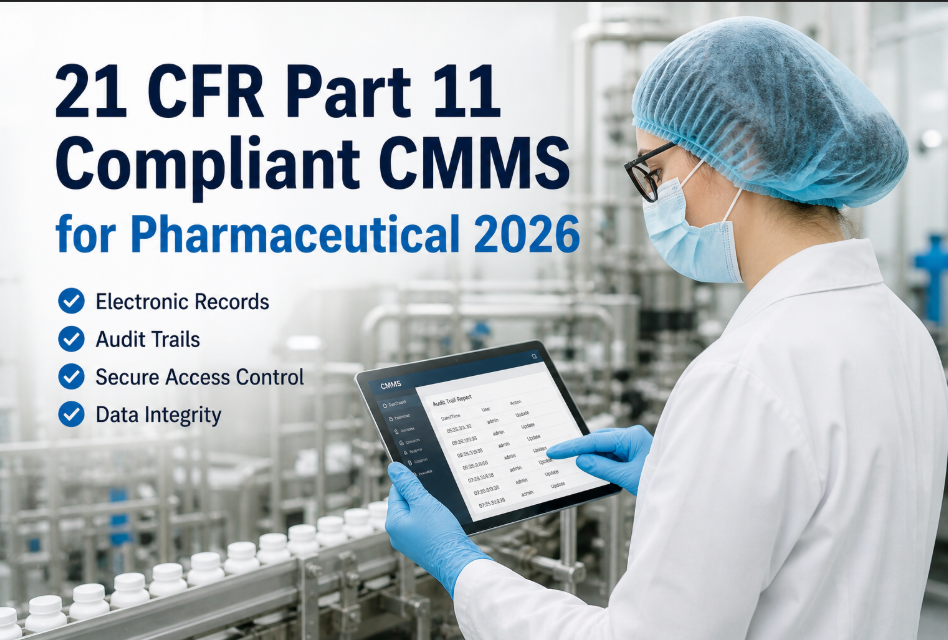
An FDA investigator arrives at your pharmaceutical facility unannounced. They request the complete maintenance and calibration records for your fill-finish line — every work order, every inspection, every part replacement, every electronic signature — for the past 24 months. If your records live in spreadsheets, paper binders, or a CMMS that generates PDFs without cryptographic audit trails, that inspection ends very differently than it does for a facility running a validated, 21 CFR Part 11-compliant maintenance management system. FDA 483 observations for inadequate maintenance records have increased 34% since 2022. Non-compliance penalties for electronic records violations range from warning letters to consent decrees that halt production entirely. The financial exposure dwarfs any CMMS investment by a factor of 100 or more. This is the complete guide to 21 CFR Part 11 compliant CMMS for pharmaceutical and biotech operations in 2026 — what the regulation requires, where most maintenance systems fail, and how Oxmaint's compliant platform eliminates the audit risk. To see Oxmaint's 21 CFR Part 11 compliant electronic records and audit trails configured for pharmaceutical maintenance, start a free 30-day trial or book a demo to walk through the compliance architecture for your facility.
21 CFR Part 11 Compliance
Pharma CMMS 2026
FDA Audit Readiness
21 CFR Part 11 Compliant CMMS for Pharmaceutical 2026: Electronic Records, Audit Trails, and E-Signatures That Pass FDA Inspection
The complete guide to selecting, validating, and operating a 21 CFR Part 11 compliant maintenance management system for pharmaceutical, biotech, and medical device operations — covering electronic records integrity, audit trail requirements, e-signature controls, and FDA inspection readiness.
34%
Increase in FDA 483 observations for inadequate maintenance records since 2022
$100M+
Potential production halt cost from a consent decree triggered by 21 CFR Part 11 non-compliance
91%
Compliance audit pass rate for facilities using validated CMMS vs. 58% with manual records
60%
Reduction in audit preparation time with CMMS-generated electronic audit trails vs. paper records
Oxmaint Is Built for 21 CFR Part 11 Compliant Pharmaceutical Maintenance
Cryptographic audit trails, role-based e-signature workflows, immutable electronic records, validation documentation package — all included. No separate compliance module. No add-on fees. Free for 30 days.
What 21 CFR Part 11 Requires From a Maintenance Management System
21 CFR Part 11 — issued by the FDA under 21 Code of Federal Regulations — establishes the requirements for electronic records and electronic signatures used in FDA-regulated environments, including pharmaceutical manufacturing, biotech, and medical device facilities. For maintenance management, the regulation applies to every maintenance work order, equipment calibration record, preventive maintenance log, inspection report, and change control document generated in electronic form. The regulation has two core requirements: electronic records must be accurate, reliable, consistent, and readily retrievable — and electronic signatures must be as legally binding as handwritten signatures with controls that prevent repudiation or forgery. A CMMS that stores records in editable spreadsheet format, generates PDFs without embedded metadata, or uses password-only "signature" controls is not 21 CFR Part 11 compliant — regardless of what a sales team claims. Start a free trial to review Oxmaint's compliance architecture in detail or book a demo and bring your validation team to assess the technical controls.
The 8 Technical Requirements of 21 CFR Part 11 — and How Oxmaint Meets Each
01
Audit Trails — Automatic and Secure
Regulation Requirement: Computer-generated, time-stamped audit trails that independently record the date and time of operator entries and actions that create, modify, or delete electronic records.
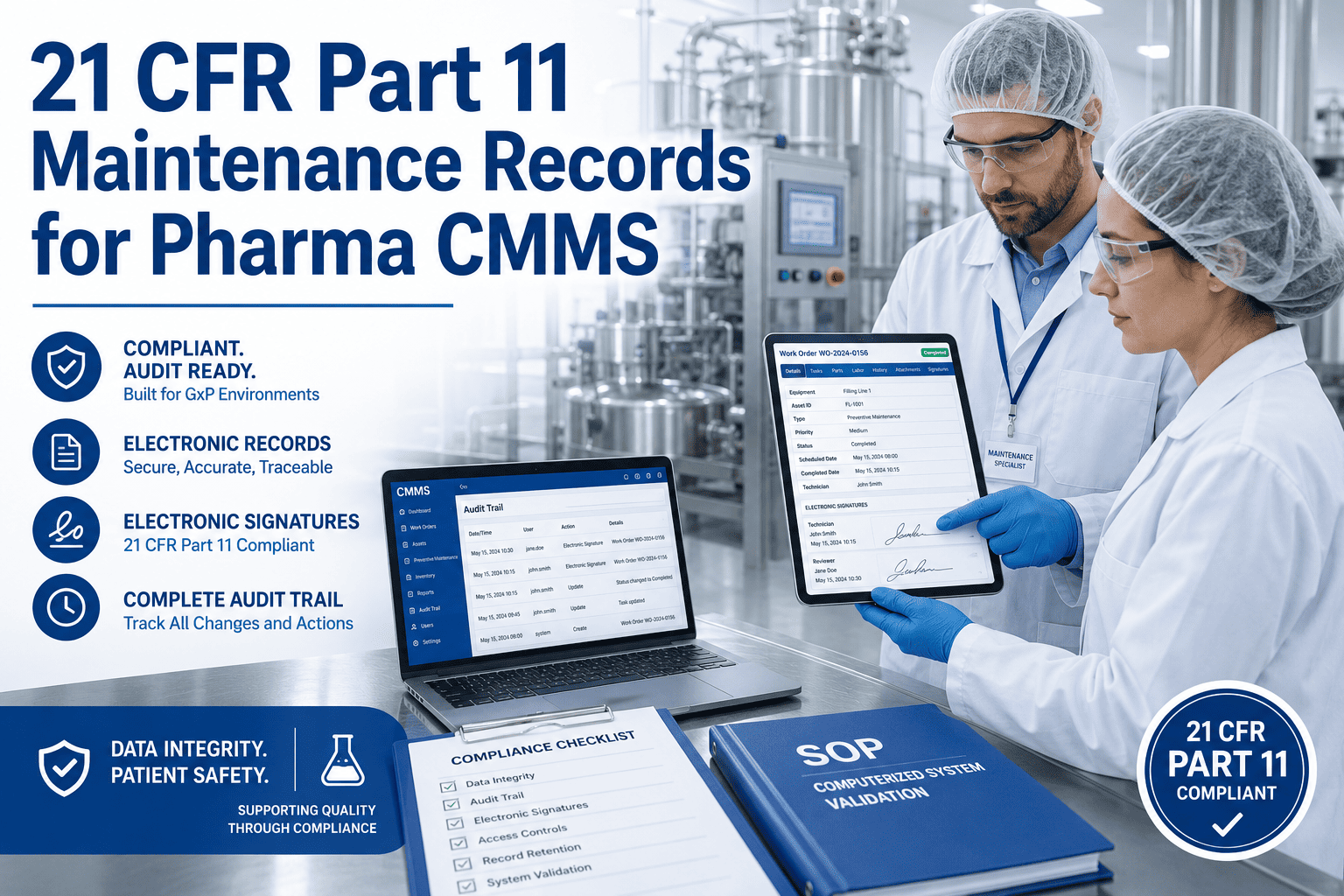
Oxmaint: Every create, read, update, and delete action on any work order, asset record, or PM schedule is logged with operator ID, timestamp, prior value, new value, and action type. Audit trail records are cryptographically signed and cannot be modified or deleted by any user — including system administrators.
02
Electronic Signatures — Identity Verification
Regulation Requirement: Electronic signatures must be unique to each individual, cannot be reused or reassigned, and must be linked to their respective electronic records in a way that prevents copying or falsification.
Oxmaint: Digital signatures require re-authentication at point of signing — username plus password confirmation for closed records. Signatures are embedded in the record with a cryptographic hash. Role-based signature workflows enforce multi-party review: technician executes, supervisor reviews and approves, QA countersigns when required.
03
Record Integrity — Immutability Controls
Regulation Requirement: Electronic records must be accurate, reliable, consistent, complete, and available throughout the records retention period. Systems must protect records from improper alteration or destruction.
Oxmaint: Closed work orders are write-protected at the database level. Any amendment creates a new revision record with the original preserved. Database backups are encrypted and stored with geographic redundancy. Records are available for export on demand in FDA-accepted formats.
04
Access Controls — User Authentication
Regulation Requirement: System access must be limited to authorized individuals. Systems must use at least two distinct identification components — typically ID and password — and must detect and respond to unauthorized access attempts.
Oxmaint: Role-based access control with individual user authentication. SSO integration with enterprise identity providers. Automatic session timeout. Failed login lockout after configurable attempt limit. All access events logged in the audit trail. Privileged access management separates system administration from production record access.
05
Sequentially Numbered Records
Regulation Requirement: Electronic records used in lieu of paper records must meet all the requirements of applicable regulations, including record numbering, retention, and retrieval requirements.
Oxmaint: Work orders, PMs, inspections, and calibration records are assigned sequential, system-generated identifiers that are unique, permanent, and searchable. Record numbering cannot be modified or reset by any user. Cross-references between related records maintain full document linkage for inspector review.
06
Operational System Checks
Regulation Requirement: Systems must use operational checks to enforce permitted sequencing of steps and events — preventing steps from being skipped, reordered, or bypassed in regulated procedures.
Oxmaint: PM and inspection procedures are configurable as gated sequential steps. Each step must be confirmed before the next becomes available. Mandatory fields enforce data completeness at each checkpoint. Signature steps are gated — the record cannot advance to the next phase without the required signatures completed in order.
07
Validation Documentation
Regulation Requirement: Persons who use closed or limited access electronic record systems shall employ procedures and controls designed to ensure the authenticity, integrity, and, where appropriate, the confidentiality of electronic records throughout the records retention period.
Oxmaint: Provides a complete Computer Software Assurance (CSA) documentation package including IQ/OQ/PQ templates, risk assessment worksheets, test scripts, and vendor assessment questionnaire aligned to FDA's 2022 CSA guidance. Validation package reduces qualification effort by 60–70% vs. blank-slate CMMS validation.
08
Record Retrieval and Inspection Readiness
Regulation Requirement: Records must be readily retrievable within an inspectionally appropriate time frame and must be provided promptly to FDA investigators upon request.
Oxmaint: Full-text search across all work orders, asset records, and audit trails. Predefined inspection report templates export filtered records by asset, date range, technician, or record type in PDF and CSV format. Inspection mode provides read-only investigator access to specified record sets without exposing unrelated operational data.
4 Ways Non-Compliant CMMS Systems Create FDA Audit Risk
01
Editable Records With No Audit Trail
Any CMMS that allows work order records to be edited, deleted, or overwritten after closure — without logging the original value, the changed value, the operator, and the timestamp — fails 21 CFR Part 11 Section 11.10(e). Spreadsheet-based maintenance records are automatically non-compliant. Many entry-level CMMS platforms have the same problem: records are editable by administrators with no logging.
02
Password-Only "Signatures" Without Re-Authentication
A checkbox marked "approved" or a typed name in a signature field does not constitute a 21 CFR Part 11 electronic signature. The regulation requires that signing is an affirmative act — re-authentication at the moment of signing — that links the signatory's identity to the record cryptographically. Generic mobile apps and lightweight CMMS tools routinely fail this requirement.
03
No Validation Documentation Package
A CMMS that is technically compliant but has no validation documentation is still an audit liability. FDA investigators expect to see Installation Qualification (IQ), Operational Qualification (OQ), and Performance Qualification (PQ) evidence — or an equivalent Computer Software Assurance (CSA) risk-based assessment. Absence of validation documentation is an automatic 483 observation.
04
Gaps Between PM Schedule and Execution Records
FDA investigators reviewing maintenance records for a specific asset look for a complete, unbroken sequence: scheduled PM, executed PM, technician signature, supervisor approval, and any associated deviations. Gaps in the sequence — missed PMs with no documented justification, signatures added days after the work — create compliance findings that cascade into broader investigation scope.
21 CFR Part 11 Compliance: Compliant vs. Non-Compliant CMMS
| Compliance Requirement |
Non-Compliant Systems |
Oxmaint 21 CFR Part 11 Platform |
Audit Risk Difference |
| Audit trail for record changes |
No trail or admin-accessible log only |
Immutable cryptographic audit trail, admin-inaccessible |
483 observation eliminated |
| Electronic signature controls |
Checkbox or typed name field |
Re-authentication at signing with cryptographic link to record |
Legally binding signature compliance |
| Record immutability |
Records editable after closure |
Closed records write-protected at database level |
Data integrity fully preserved |
| Validation documentation |
None provided — customer responsible |
IQ/OQ/PQ templates and CSA package included |
60–70% validation effort reduction |
| Inspection readiness |
Manual PDF assembly — hours to days |
Pre-built inspection report export in minutes |
60% audit preparation time reduction |
| Step sequencing for procedures |
Free-form completion, steps skippable |
Gated sequential steps, mandatory field enforcement |
Procedure compliance enforced at execution |
What 21 CFR Part 11 Compliant CMMS Delivers to Pharmaceutical Operations
91%
Compliance Audit Pass Rate
Facilities using validated CMMS with electronic audit trails vs. 58% for those using manual or partially digital records — documented across FDA facility inspections
60%
Audit Prep Time Reduction
CMMS-generated export of structured electronic records vs. manual assembly of paper and PDF maintenance files — measured in hours per inspection event
70%
Validation Effort Reduction
Oxmaint's pre-built IQ/OQ/PQ template package and CSA risk assessment worksheets reduce qualification project scope vs. blank-slate CMMS validation
$0
Compliance Module Add-On Cost
21 CFR Part 11 controls are built into the Oxmaint core platform — not a separate paid compliance tier. Every feature, every audit trail, every e-signature tool is included in the standard license
Frequently Asked Questions
Does Oxmaint require formal validation (IQ/OQ/PQ) before use in a pharmaceutical facility?+
Yes — any computer system used to create, modify, maintain, archive, retrieve, or transmit electronic records subject to FDA inspection requires qualification under 21 CFR Part 11 and current GMP expectations. Oxmaint provides a complete qualification package aligned to FDA's 2022 Computer Software Assurance (CSA) guidance — including risk-based test scripts, IQ/OQ/PQ documentation templates, vendor assessment questionnaire, and a supplier qualification letter. This reduces qualification project duration from the typical 12–16 weeks for a blank-slate CMMS to 4–6 weeks for most pharma facilities.
Book a demo and bring your validation team to review the qualification package in detail.
What is the difference between 21 CFR Part 11 compliance and GMP maintenance compliance?+
21 CFR Part 11 governs the format and controls of electronic records and signatures — how records are created, signed, stored, and protected. GMP maintenance compliance (under 21 CFR Parts 211 and 820) governs the substance of what maintenance activities must be performed, documented, and reviewed. A compliant CMMS must meet both: 21 CFR Part 11 controls ensure the electronic records are audit-ready, and GMP-aligned PM programs ensure the right maintenance activities are being performed on the right schedule. Oxmaint's pharma configuration addresses both layers — audit trail controls and regulatory-aligned PM scheduling in one system.
Can Oxmaint support both EU GMP Annex 11 and FDA 21 CFR Part 11 requirements simultaneously?+
Yes. EU GMP Annex 11 and FDA 21 CFR Part 11 share the same core technical requirements — audit trails, electronic signatures, access controls, data integrity, and validation. The primary differences are in validation terminology and documentation structure. Oxmaint's electronic records architecture satisfies both frameworks simultaneously. For operations with manufacturing sites subject to both FDA and EMA inspection — common for global pharma companies — a single Oxmaint deployment with appropriate configuration supports dual-regulatory compliance across the portfolio.
Start a free trial to review the compliance configuration options for your regulatory scope.
What happens to our compliance records if we migrate from our existing CMMS to Oxmaint?+
Historical records from prior CMMS systems should be retained in the original system for the duration of the required retention period — typically the equipment lifecycle plus the applicable records retention requirement (commonly 1–3 years post-equipment retirement for maintenance records). Oxmaint handles ongoing records from go-live date. The migration process includes a formal data migration qualification (DMQ) assessment to ensure any historical data brought forward into Oxmaint is verified for integrity and attributed correctly. Oxmaint's implementation team provides DMQ documentation templates as part of the pharmaceutical onboarding package.
21 CFR Part 11 Compliant CMMS — Oxmaint
Your Next FDA Inspection Should Be Something You Are Ready For.
Immutable audit trails. Re-authenticated e-signatures. Gated procedure compliance. Inspection-ready record export in minutes. Validation documentation package included. Oxmaint turns FDA inspection readiness from a fire drill into a standing operational posture — and does it without a compliance module surcharge or a 12-month implementation timeline.
91%
Audit pass rate with validated CMMS
60%
Less audit preparation time
70%
Validation effort reduction
$0
Compliance add-on fees