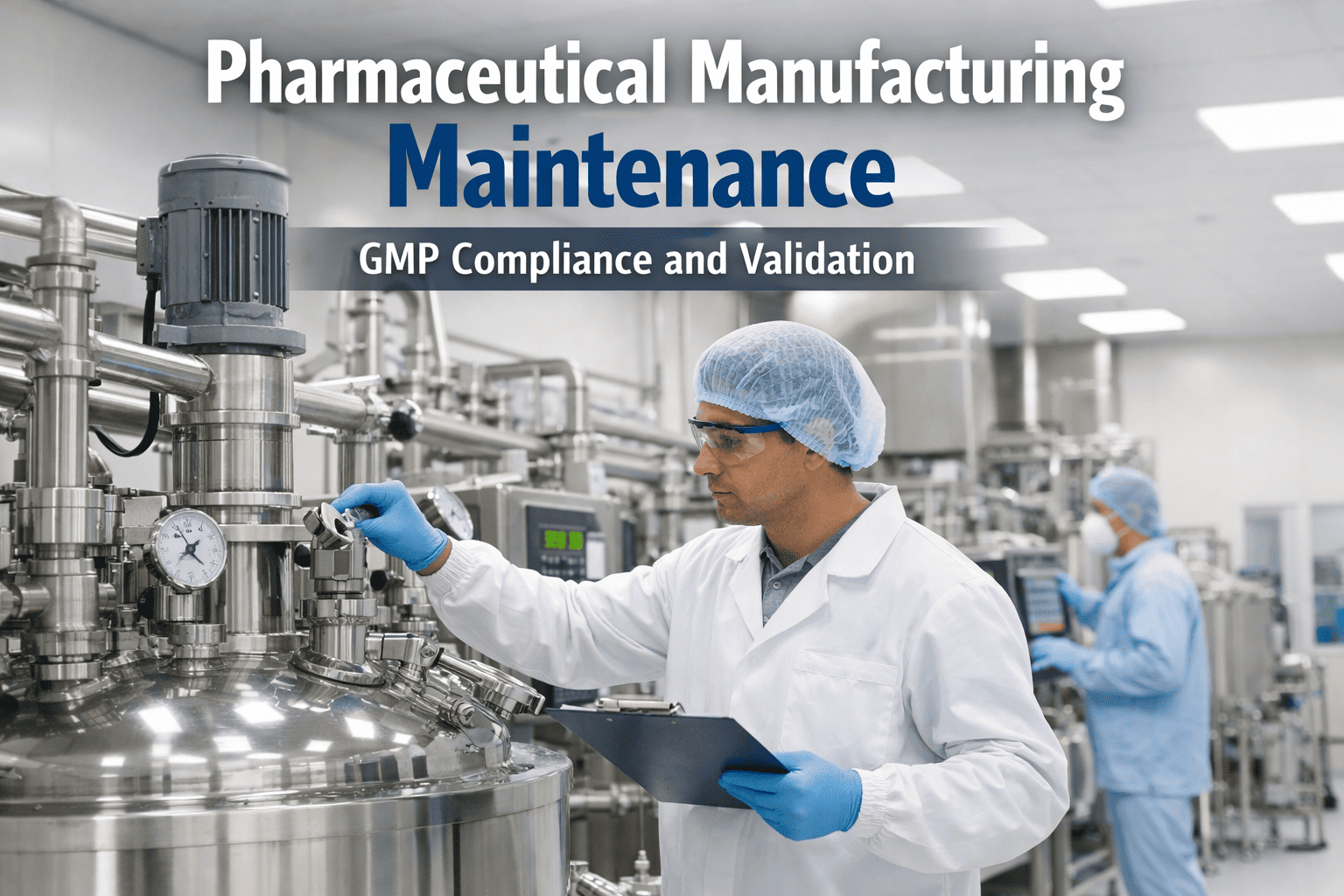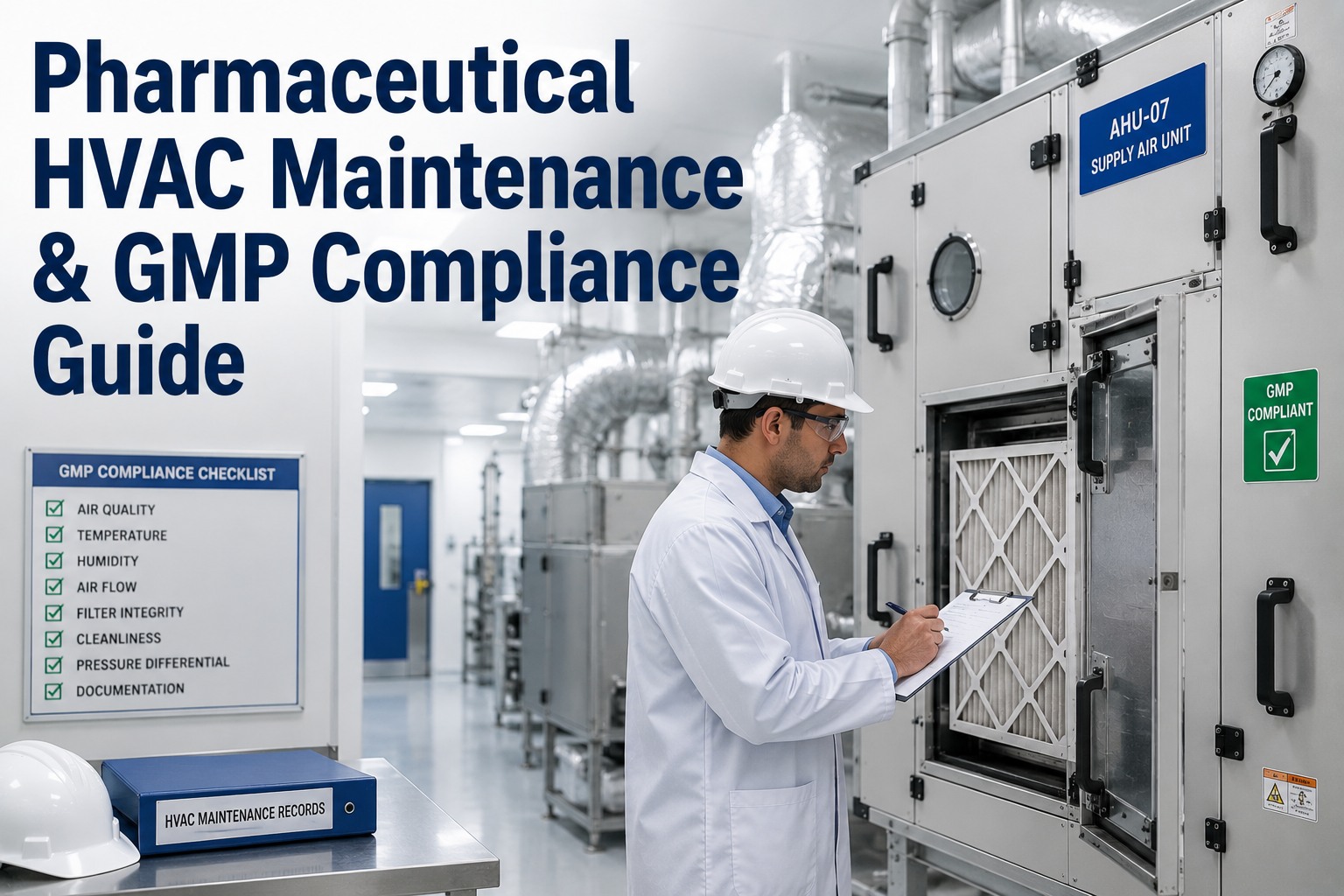
Pharmaceutical HVAC maintenance and GMP compliance go hand in hand — cleanroom classification, pressure cascade management, and rigorous validation all depend on HVAC systems that perform identically every single shift. A single undocumented filter change or uncalibrated pressure differential can trigger a Form 483 observation, invalidate a batch, or halt production. This guide breaks down the GMP HVAC requirements that facility and validation teams must meet, from filter integrity testing and duct cleaning to change control, and shows how a pharmaceutical HVAC CMMS like OxMaint keeps every work order, reading, and signature audit-ready. Ready to eliminate paper maintenance logs and pass your next inspection? Start Free Trial to see how OxMaint digitalizes your entire preventive maintenance program.
Can your pharmaceutical HVAC maintenance records survive an FDA audit tomorrow?
Most pharma facilities lose audit points not because HVAC systems fail — but because maintenance documentation is incomplete, undocumented, or scattered across spreadsheets and paper logs. OxMaint gives you a validated, fully traceable CMMS built for 21 CFR Part 211 and GMP HVAC requirements — every filter change, pressure reading, and calibration digitally signed and instantly retrievable.
What GMP requires from pharmaceutical clean room HVAC systems
EU GMP Annex 1, FDA 21 CFR Part 211, and ISO 14644-1 collectively demand that pharmaceutical HVAC systems maintain particle counts, temperature, humidity, and pressure cascades within validated parameters — and that every maintenance activity preserving those parameters is documented, reviewed, and retrievable. Here is what inspectors actually look for.
Pressure Differential Cascade
GMP requires a minimum 10–15 Pa differential between adjacent classified zones, with corridor pressure cascading from cleanest to least clean. Inspectors verify continuous monitoring data and alarm logs — any breach must trigger a documented deviation and impact assessment.
HEPA Filter Integrity
HEPA filters in Grade A/B cleanrooms require in-situ integrity testing (PAO or DOP) at least every 6 months, with complete records of filter ID, test date, upstream/downstream concentrations, and pass/fail criteria — plus immediate replacement and revalidation when penetration exceeds 0.01%.
Air Change Rate Compliance
Grade A zones typically require 0.36–0.54 m/s unidirectional airflow; Grade B/C/D rooms need 20–60 air changes per hour depending on classification. HVAC PM schedules must verify and document airflow at each grille during scheduled and unscheduled maintenance.
Change Control & Documentation
Any HVAC component change — filter swap, damper adjustment, sensor recalibration — must pass through formal change control: proposed change, risk assessment, QA approval, execution record, and post-change verification, all linked and traceable in a Part 11-compliant system.
Pharmaceutical HVAC PM schedule: critical tasks by frequency
A defensible pharma HVAC PM program is built on time-based and condition-based triggers that align with validation commitments. Missing a scheduled task is a deviation; the table below maps the maintenance activities inspectors expect to see on your pharmaceutical HVAC schedule, with typical frequencies and the documentation each task generates.
| HVAC PM Task | Cleanroom Grade | Frequency | Required Documentation |
|---|---|---|---|
| HEPA filter integrity test (PAO/DOP) | A / B | Every 6 months | Filter ID, test report, penetration %, pass/fail, reviewer signature |
| Pressure differential sensor calibration | All grades | Every 12 months | Calibration certificate, pre/post data, as-found/as-left values |
| Pre-filter replacement (G4/M5) | All grades | Every 3 months or on DP | Work order, filter batch/lot, replacement date, technician ID |
| Duct cleaning & inspection | C / D | Annually | Cleaning SOP reference, inspection photos, cleanliness verification |
| AHU coil cleaning & drain pan treatment | All grades | Every 6 months | Work order, cleaning agent used, microbiological swab results |
| Airflow velocity measurement at each grille | A / B / C | Quarterly | Grille ID, velocity readings, calculated ACPH, deviation flags |
| Temperature & humidity mapping | All grades | Annually + post-change | Mapping protocol, data logger IDs, max/min excursions, report |
| Recovery time test (particle decay) | A / B / C | Every 12–24 months | Test protocol, baseline particle count, recovery time, acceptance criteria |
The 21 CFR Part 11 documentation chain every GMP HVAC task must produce
Inspectors do not just check that maintenance happened — they check the documentation chain. Each pharmaceutical HVAC maintenance event must generate a complete, contemporaneous, and attributable record. The checklist below mirrors what an auditor will request during a GMP inspection; OxMaint's pharmaceutical HVAC CMMS auto-generates every item as part of each work order.
The cost of paper-based HVAC records: a 12-month scenario
Consider a mid-size sterile injectables facility operating 8 Grade B cleanrooms and 12 Grade C support areas — roughly 40 AHUs, 120 HEPA terminals, and 200+ pressure differential sensors. The maintenance team manages HVAC PM on spreadsheets and paper logs. Over 12 months, this facility typically experiences:
- 3–4 audit findings per year tied to missing or illegible maintenance records, each requiring 20–40 hours of investigation and CAPA documentation
- 1–2 batch losses from undetected pressure excursions where the sensor drifted but the calibration was overdue by 6–8 weeks
- 120+ labor hours per month spent transcribing paper readings, chasing signatures, and building inspection-ready reports
- $180K–$250K in annual avoidable cost from batch loss, rework, and compliance overhead
After implementing OxMaint, the same facility eliminates paper logs, auto-triggers calibrations before due dates, and produces a complete GMP audit trail in under 60 seconds. The payback: a 70% reduction in documentation labor, near-zero record-related findings, and full confidence on inspection day.
See OxMaint on your HVAC assets — book a 30-minute demo
Walk through a live GMP HVAC PM schedule, change control workflow, and audit-ready documentation trail configured for a pharmaceutical facility just like yours.
How OxMaint's pharmaceutical HVAC CMMS keeps you audit-ready
OxMaint was built for regulated environments — every feature maps directly to the GMP documentation and traceability demands that pharma facility teams face. These four capabilities translate directly into measurable compliance, time, and cost outcomes.
Automated PM Scheduling & Triggers
OxMaint auto-generates GMP HVAC work orders based on validated schedules — calendar-based, usage-based, or condition-based from integrated BMS/SCADA data. Never miss a HEPA test or sensor calibration again. Outcome: 100% on-time PM completion, zero overdue-task findings.
21 CFR Part 11 Electronic Records
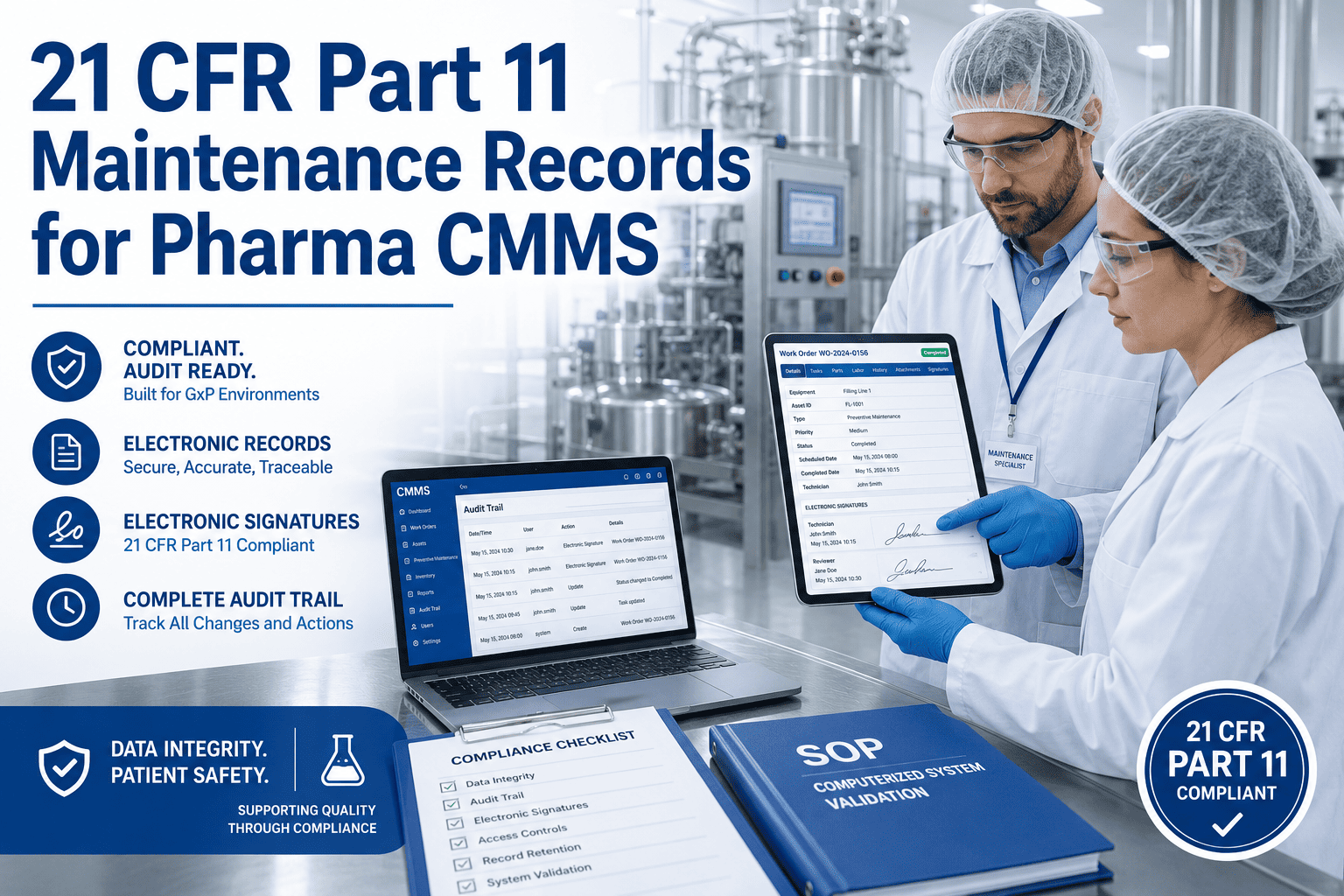
Every work order, measurement, and signature in OxMaint carries a secure, time-stamped audit trail with e-signatures meeting Part 11 requirements. Build inspection-ready dossiers in one click. Outcome: 90% reduction in audit prep time, from days to hours.
Real-Time Pressure & Environmental Monitoring
OxMaint integrates with building management systems and IoT sensors to ingest pressure, temperature, humidity, and particle count data — flagging excursions and auto-creating deviation work orders. Outcome: 60% faster deviation response, preventing batch-impacting events.
Change Control & Deviation Management
Trigger a linked change control record from any HVAC work order, route it through risk assessment and QA approval, and close the loop with post-change verification — all inside one platform. Outcome: 50% shorter change control cycle time, with zero orphaned records.
What happens when HVAC compliance is left to spreadsheets
The gap between a spreadsheet-driven maintenance program and a validated CMMS is not just about efficiency — it is about risk exposure. Below is what maintenance and validation teams typically experience before and after switching to OxMaint.
| Dimension | Spreadsheets & Paper Logs | OxMaint Pharmaceutical HVAC CMMS |
|---|---|---|
| PM Scheduling | Manual reminders; tasks slip through gaps during staff turnover | Automated triggers; 100% on-time completion with escalation alerts |
| Documentation | Illegible paper logs, scattered Excel files, missing signatures | Part 11-compliant e-records with audit trail generated automatically |
| Audit Response Time | 3–5 days to assemble records for an inspection request | Under 60 seconds — filter by asset, date, or task and export |
| Deviation Detection | Reactive; discovered during next scheduled reading or worse, during audit | Real-time sensor integration flags excursions and auto-creates work orders |
| Change Control | Separate paper system, disconnected from work orders, easily orphaned | Integrated workflow from work order to risk assessment to QA approval |
| Inspection Outcome | 3–4 findings per year; recurring 483 risk on HVAC documentation | Zero documentation-related findings; clean inspections |
Frequently asked questions about pharmaceutical HVAC maintenance & GMP
How often should HEPA filters be integrity tested in a pharmaceutical cleanroom?
HEPA filters in Grade A and Grade B cleanrooms must undergo in-situ integrity testing (PAO or DOP) at least every 6 months per EU GMP Annex 1 and FDA guidance. Grade C and D environments typically require annual testing. Any filter failing the 0.01% penetration threshold must be replaced immediately, with revalidation and a change control record documenting the swap, the new filter's lot number, and post-replacement test results.
What pressure differential is required between cleanroom grades under GMP?
GMP requires a minimum 10 Pa differential between adjacent zones of different cleanliness, though 10–15 Pa is standard practice to ensure cascade direction from cleanest to least clean. Higher differentials may be needed for specific process containment. Pressure must be continuously monitored with alarms, and any excursion outside the validated range must be documented as a deviation with a risk-based impact assessment on product quality.
What HVAC documentation does an FDA inspector request during a GMP audit?
Inspectors typically request the HVAC validation master plan, current P&IDs and as-built drawings, PM schedules and completed work orders for the past 2–5 years, HEPA integrity test reports, pressure monitoring logs and alarm histories, calibration records for all sensors, change control records for any HVAC modifications, and deviation/CAPA files. A pharmaceutical HVAC CMMS like OxMaint lets you produce all of this in under a minute. Book a Demo to see how.
Does a CMMS need to be 21 CFR Part 11 compliant for pharmaceutical HVAC maintenance?
Yes — if the CMMS is used to create, modify, or store GMP records (work orders, calibrations, deviations, change controls), it must meet 21 CFR Part 11 requirements: secure electronic signatures, immutable audit trails, version control, and restricted access. OxMaint is designed with these controls built in, so every HVAC maintenance record is legally equivalent to a paper record with a handwritten signature and fully defensible in an inspection.
How do I switch from spreadsheet-based HVAC maintenance to a validated CMMS?
The switch typically takes 4–8 weeks: migrate your existing asset register and PM schedules into OxMaint, configure work order templates for each HVAC task type, integrate BMS/sensor data feeds, validate the system (IQ/OQ/PQ), and train technicians on mobile work order execution. OxMaint provides onboarding support and pre-configured pharmaceutical HVAC PM templates so your team can go live fast. Start Free Trial to explore the platform today.
Make every HVAC maintenance record audit-proof
Join pharmaceutical facility teams who replaced paper logs and spreadsheets with OxMaint — automated PM scheduling, Part 11-compliant records, and real-time monitoring in one platform. See it live on your assets in 30 minutes.
Free 14-day trial · No credit card