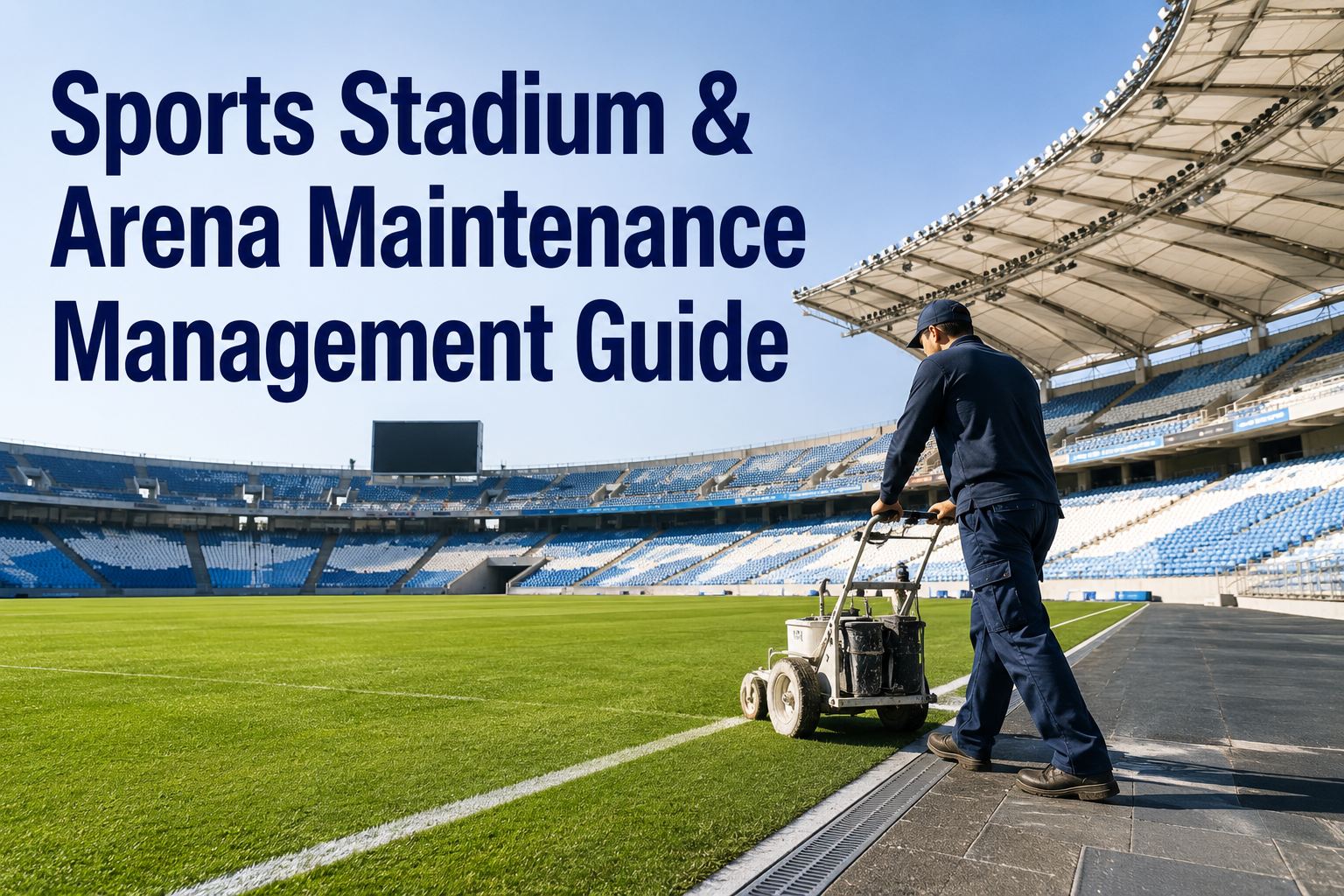
Sports stadium and arena maintenance is fundamentally event-driven — every game day, concert, or tournament stress-tests every system simultaneously, from field/court surfaces and seating to scoreboards, HVAC, and irrigation. Arena facilities management teams that deliver flawless fan experiences do so by orchestrating preventive maintenance, real-time work orders, and post-event inspections through a centralized CMMS built for high-throughput venues. OxMaint provides sports venue maintenance teams with event-readiness workflows, cross-event PM scheduling, and AI-powered asset tracking that keeps operations continuously game-ready. You can explore the full platform when you Start Free Trial or book a personalized walkthrough below.
Is your venue ready for 60,000 fans in 48 hours — and the next event 72 hours after that?
Sports stadium and arena maintenance is unforgiving: every event day is a live stress test of turf, seating, scoreboards, HVAC, lighting, and life-safety systems. OxMaint's event-driven CMMS orchestrates readiness workflows, preventive maintenance, and post-event inspections so nothing falls through the cracks between sellout crowds.
Stadium facility management challenges that break traditional CMMS
A sports venue maintenance operation isn't a factory — it's a high-profile, publicly scrutinized facility that swings from zero occupancy to maximum capacity in hours. Here's what makes arena operations maintenance uniquely demanding:
Event-driven workload spikes
A 65,000-seat stadium may host 3 events in a week, then go dark for 18 days. Traditional fixed-interval PM schedules can't adapt to this rhythm — you need event-triggered readiness checklists that fire automatically when a new event is booked.
Massive, diverse asset base
A modern arena manages 8,000–15,000 tracked assets: natural and synthetic turf, irrigation zones, Jumbotrons, LED ribbon boards, concession equipment, escalators, generators, fire suppression, and seating bowl sections — each with its own PM cycle and compliance requirement.
Zero tolerance for fan-facing failures
A scoreboard blackout during a nationally televised game or a restroom outage at halftime isn't a maintenance ticket — it's a brand crisis. Reactive maintenance in sports venues carries reputational costs that dwarf repair costs by 5–10x.
Regulatory & life-safety compliance
Seating inspections, fire system certifications, elevator/escalator permits, and emergency egress testing are non-negotiable. A missed inspection can mean six-figure fines, event cancellation, or insurance complications — and auditors demand documented proof.
Sports complex maintenance checklist: critical PM tasks by system
Use this tiered PM framework to structure your arena PM schedule. Every task below maps directly to a work-order template in OxMaint, triggered by event calendar, usage hours, or calendar interval.
How to schedule arena maintenance around the event calendar
A typical NFL or Premier League venue runs a 7-day event cycle. Here's how a stadium CMMS orchestrates work orders across that window — ensuring every system is certified ready before gates open and fully inspected after fans leave.
7 days before event — Readiness audit
Auto-generate event-readiness work orders: scoreboard pixel test, seating bowl walk-through, concession equipment verification, HVAC filter check. Assign to crews with deadlines at T-2. OxMaint triggers these automatically when the event is booked.
2 days before — System certification
Close all readiness work orders, verify fire system tests, confirm generator failover, complete turf grooming and line marking. Any open red-flag items escalate to the operations director automatically.
Event day — Live monitoring
Stadium operations team monitors real-time asset dashboards. Reactive work orders flow to mobile devices with location data. Average response time target: under 12 minutes for fan-facing issues.
1 day after — Post-event inspection
Automated post-event checklists fire within 2 hours of venue clear: seating damage scan, turf repair assessment, restroom plumbing check, trash & spill cleanup. Generated work orders feed into the next event's readiness cycle.
What does stadium CMMS software cost — and what does it save?
A mid-size arena (25,000 seats, 90 events/year, ~10,000 assets) typically spends $1.8M–$3.2M annually on maintenance operations. Here's the ROI math when moving from spreadsheets and reactive work orders to an AI-powered CMMS like OxMaint.
| Cost / Savings Area | Before OxMaint (spreadsheets + reactive) | With OxMaint CMMS | Annual Impact |
|---|---|---|---|
| Unplanned equipment failures | 180–240 reactive work orders/year | 60–80 (65% reduction via PM) | $310K saved |
| Event-day downtime (scoreboard, HVAC, restrooms) | 42 cumulative hours/year | 8–12 hours/year | $185K saved |
| Compliance fines & permit penalties | $45K–$80K/year (missed inspections) | Near-zero (auto-scheduled & documented) | $62K saved |
| Spare parts inventory carrying cost | $240K (overstocked, disorganized) | $165K (optimized min/max) | $75K saved |
| Technician overtime (event-day emergencies) | $120K/year | $48K/year (proactive scheduling) | $72K saved |
| Total estimated annual savings | $704K | ||
Worked example: A 32,000-seat multipurpose arena spending $2.4M/year on maintenance operations deployed OxMaint across 9,200 assets. Within 8 months, unplanned failures dropped 61%, event-day reactive tickets fell from 14/game to 4/game, and compliance audit prep time went from 3 weeks to 2 days. Net first-year savings: $680K — a 9-month payback on software + implementation.
How OxMaint powers event-driven stadium and arena maintenance
OxMaint was built for the rhythm of sports venue FM — where every event is a deadline and every asset failure is public. Here's how our AI-powered CMMS maps to the unique demands of stadium operations maintenance:
Event-calendar-triggered work orders
Connect your booking calendar to OxMaint. When an event is scheduled, the system auto-generates pre-event readiness checklists, post-event inspection tasks, and cross-event PM windows — no manual scheduling required. Outcome: 90% reduction in missed pre-event tasks.
AI-powered predictive maintenance
OxMaint's AI analyzes vibration, temperature, and usage data from HVAC chillers, escalator motors, and generators to predict failures 7–21 days before they happen. Outcome: 30–50% cut in unplanned downtime during events.
Mobile-first inspection & compliance
Technicians complete seating, fire system, and egress inspections on mobile devices with photo capture and digital signatures. Every record is timestamped, geo-tagged, and audit-ready. Outcome: eliminate paper work orders; audit prep drops from weeks to hours.
Live analytics & KPI dashboards
Real-time visibility into MTBF, MTTR, PM compliance rate, and event-readiness scores across every asset category. Operations directors see a live readiness heatmap before every event. Outcome: 95%+ PM compliance; data-driven capital replacement planning.
See OxMaint run your next event-readiness workflow — book a 30-minute demo
We'll map your venue's asset hierarchy, event calendar, and PM cycles live in OxMaint. Walk away with a readiness workflow tailored to your stadium — whether you manage a 3,000-seat arena or a 70,000-seat stadium.
Stadium and arena maintenance — frequently asked questions
What is stadium CMMS software and how does it work for sports venues?
A stadium CMMS is a computerized maintenance management system designed to handle the event-driven workload of sports venues. It manages work orders, preventive maintenance schedules, asset tracking, spare-parts inventory, and compliance documentation — all tied to the event calendar. When an event is booked, the CMMS automatically generates pre-event readiness checklists and post-event inspection tasks, ensuring every system from turf to scoreboards is certified ready before gates open. You can see this in action when you Book a Demo.
How often should stadium turf and field surfaces be inspected?
Natural turf requires weekly inspection during growing season and daily checks during event weeks — monitoring mowing height, irrigation coverage, compaction, and pest activity. Synthetic surfaces should be G-max tested quarterly for impact attenuation, with monthly visual inspections for seam separation and infill distribution. OxMaint automates these schedules and logs every inspection with photos for liability protection.
How much does sports venue maintenance software cost?
CMMS pricing for sports venues typically ranges from $15–$45 per user per month, depending on asset count, event volume, and modules needed (predictive maintenance, inventory, analytics). For a 20-person maintenance team, annual software costs run $18K–$36K — against average savings of $400K–$700K from reduced downtime, fewer emergency repairs, and optimized inventory. OxMaint offers a free 14-day trial with no credit card required.
What are the most critical assets to track in arena operations maintenance?
Priority assets include life-safety systems (fire suppression, emergency lighting, egress paths), fan-facing systems (scoreboards, HVAC, restrooms, concession equipment), playing surfaces (turf, courts, irrigation), and vertical transportation (elevators, escalators). A typical arena tracks 8,000–15,000 assets. OxMaint's asset hierarchy organizes these by zone, system, and criticality — with automated PM schedules tied to each asset's risk profile.
How do you switch from spreadsheet-based maintenance to a stadium CMMS?
Start by auditing your current asset list, PM schedules, and compliance requirements — then import them into OxMaint. Most venues complete initial setup in 2–4 weeks: asset hierarchy first, then PM templates, then event-readiness workflows. OxMaint's team assists with data migration and onboarding. The biggest quick win is replacing paper inspection forms with mobile checklists, which immediately improves compliance documentation and technician accountability.
Make your next event day the most reliable one yet
Join the stadium and arena operations teams using OxMaint to cut unplanned downtime 30–50%, achieve 95%+ PM compliance, and walk into every event day knowing every system is certified ready.
Free 14-day trial · No credit card

.png)