A power plant shift logbook that records "turbine bearing — temperature normal" is valuable only until the next shift discovers the bearing has failed. The written log describes what the operator believed at the time — not what the asset's condition actually was. Power plant teams deploying visual asset condition monitoring integrated with OxMaint's shift logbook and CMMS replace belief-based entries with evidence-based records — AI cameras capture the actual thermal and visual state of every monitored asset on every shift, and that evidence feeds directly into the shift log, the asset condition history, and the work order queue simultaneously. When an operator's shift logbook entry is backed by an AI camera image timestamped to the same moment, it becomes a compliance document, not just a note. For power plant maintenance managers accountable for availability targets and regulatory inspections, this integration between visual condition monitoring and CMMS shift logging is the foundation of a modern, defensible maintenance program.
Shift Logbook · Visual Monitoring · Power Plant CMMS
Visual Asset Condition Monitoring with CMMS Integration for Power Plants
How AI vision connects to OxMaint's shift logbook and CMMS — building evidence-backed asset condition records from every shift, every day, without manual data entry.
Shift Logbook Entry: Before vs. After AI Vision
Manual Entry
"GT-02 bearing temp — normal. No issues observed."
No evidence. No timestamp on condition. No asset link. Unverifiable.
AI Vision + OxMaint
"GT-02 Bearing — Thermal image: 84°C. AI confidence: 98%. Status: Normal range. Image attached to asset record."
Evidence-backed. Timestamped. Asset-linked. Audit-ready.
87%
of power plant shift log entries lack visual evidence — making condition claims unverifiable in audits
3 shifts
average lag between initial condition change and work order creation using manual shift logs alone
100%
of AI-monitored asset conditions auto-logged in OxMaint shift record with visual evidence attached
What Visual Condition Monitoring Adds to Each Shift Logbook Entry
Thermal Baseline Capture
AI camera records the actual temperature of every monitored asset per shift — not the operator's estimate. Baseline deviation triggers automatic log entry and condition status update in OxMaint.
Visual Condition Score
Computer vision assigns a condition score (Good / Monitor / Action Required) to each asset per inspection cycle — giving the shift log a consistent, machine-generated condition language that doesn't vary by operator.
Change Detection Flagging
OxMaint compares each shift's visual capture to the previous baseline — flagging condition changes above configured thresholds for automatic work order generation without waiting for the next scheduled inspection.
Shift-to-Shift Handover Evidence
When an outgoing shift records an observation in OxMaint, the AI camera image from that shift cycle is automatically attached — giving the incoming crew visual proof of the asset's state at handover, not a verbal summary.
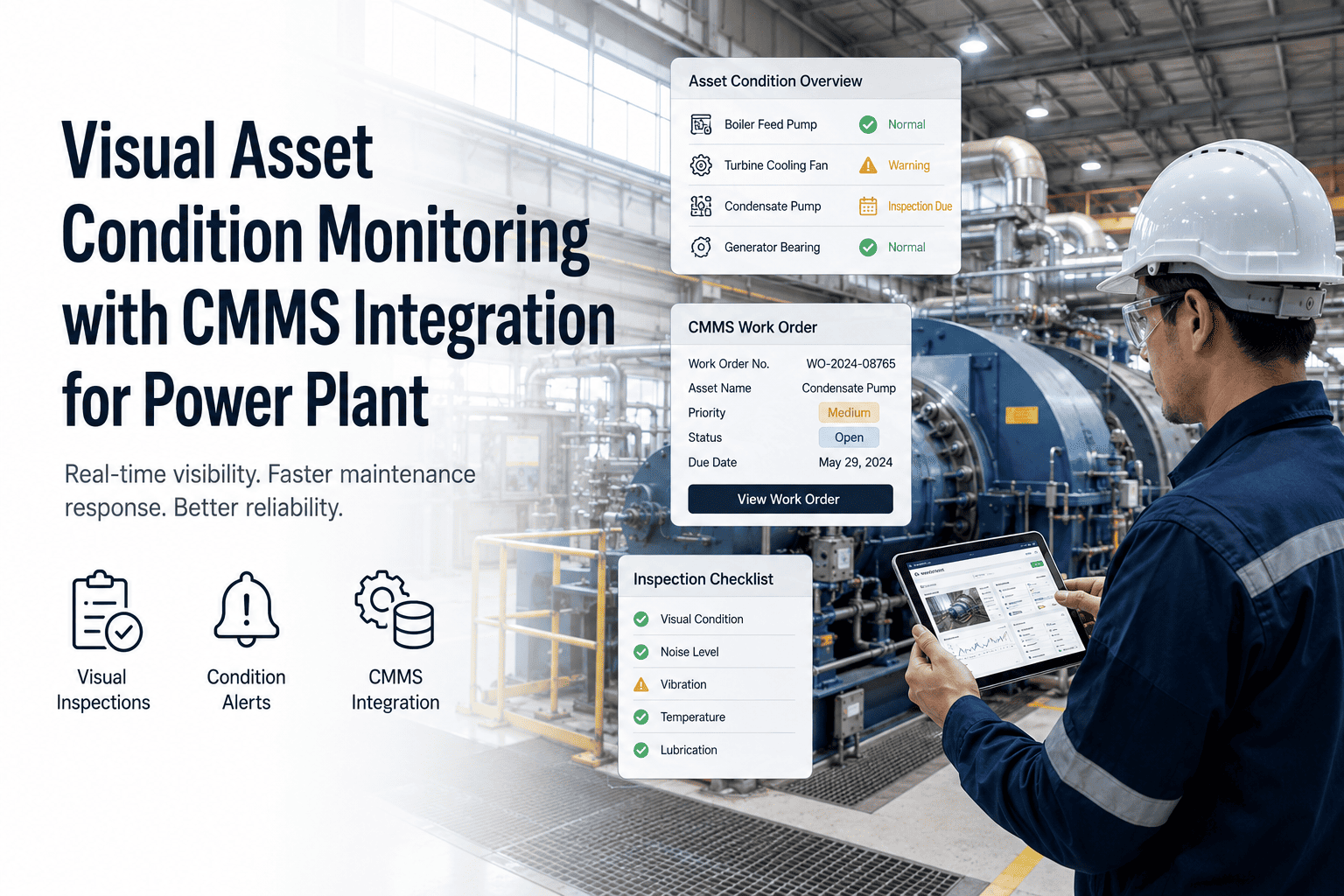
Power Plant Asset Condition Monitoring Dashboard: What OxMaint Shows
Asset
Last AI Scan
Condition Score
Trend
Action Required
Gas Turbine GT-01
Current shift
Good
Stable — 14 shifts
None — next PM on schedule
HV Transformer TR-Main
Current shift
Monitor
Degrading — 3 shifts
Thermal inspection — WO #48201
Cooling Tower CT-02
2 hours ago
Good
Stable — 22 shifts
None — PM current
BFP Pump A
Current shift
Action Req.
Rapid change — 1 shift
Seal inspection — WO #48204 OPEN
Switchgear Panel B
30 min ago
Good
Stable — 8 shifts
None — next scan in 30 min
Expert Review — Shift Logbook & Visual Monitoring Integration
The shift logbook is the primary source of truth for what happened to a power plant's assets during any given operating period. When that logbook is populated with manual operator estimates rather than AI camera evidence, its reliability degrades with every subjective entry. Integrating visual condition monitoring with OxMaint's shift logbook replaces opinion with measurement — and that measurement is attached to the asset record, time-stamped, and available to the next shift without verbal handover. In my experience across multiple power generation programs, this single integration reduces handover-related maintenance errors by more than any other process change available without capital expenditure.
Head of Operations, Coal and Gas Power Generation Fleet
Replace Operator Estimates with AI Visual Evidence in Your Shift Logbook
OxMaint connects AI condition monitoring to your shift logbook — every asset condition entry backed by camera evidence, every shift handover supported by visual proof.
5.2x
more accurate shift condition records when AI camera evidence replaces manual operator assessment
79%
reduction in handover-related maintenance gaps when visual evidence accompanies every shift log entry
Zero
unsubstantiated "condition normal" entries when AI camera monitoring backs every logbook record
Frequently Asked Questions
How does OxMaint's shift logbook integrate with AI visual condition monitoring?
When an AI camera scan completes in a monitored zone, OxMaint automatically creates a condition record in the shift logbook — tagged to the asset, the shift, and the camera zone, with the captured image and AI condition score attached. Operators can add manual notes to the AI-generated entry but cannot overwrite the visual evidence. This means every shift log entry for a monitored asset is evidence-backed, regardless of which operator is on duty. Shift handover reports generated by OxMaint include the AI condition summary for every monitored asset, with direct links to the most recent images.
Can visual condition monitoring replace scheduled manual inspections in a power plant?
For continuously monitored assets, AI visual condition monitoring significantly reduces the frequency of scheduled manual inspections — but doesn't eliminate them entirely. OxMaint's predictive maintenance scheduling adjusts manual inspection intervals based on AI condition trend data — extending intervals when conditions are consistently stable and shortening them when degradation patterns appear. Tactile checks, lubrication inspections, and internal access requirements still require human presence, but visual and thermal condition assessment shifts to AI camera coverage. Book a demo to see how OxMaint balances AI and manual inspection scheduling.
How does OxMaint handle condition trend analysis across multiple shifts?
OxMaint tracks condition scores per asset across every shift — building a trend line that makes gradual degradation visible before it becomes detectable in a single-shift inspection. When a condition score declines across three or more consecutive shifts, OxMaint generates a predictive maintenance alert — surfacing the trend to the maintenance supervisor before any single reading would trigger an immediate work order. This early warning capability is the core value of shift-by-shift AI condition logging: patterns that no individual operator would notice become visible at the CMMS level across the full shift history.
Can OxMaint export visual condition monitoring records for regulatory compliance reviews?
Yes — OxMaint generates exportable condition history reports per asset, covering any specified time period. Reports include every AI condition score, the supporting camera image, the shift and timestamp, and any work orders triggered by condition alerts during the review period. Power plant teams use these exports for OSHA compliance reviews, insurance assessments, and internal reliability audits. The format is structured and consistent regardless of which operators worked which shifts — eliminating the variability that makes manual shift log audits unreliable.
Build a Shift Logbook Your Auditors Can Actually Trust
OxMaint integrates AI visual asset condition monitoring with your shift logbook — replacing operator estimates with camera evidence, shift handovers with visual proof, and manual trend analysis with automatic degradation alerts.