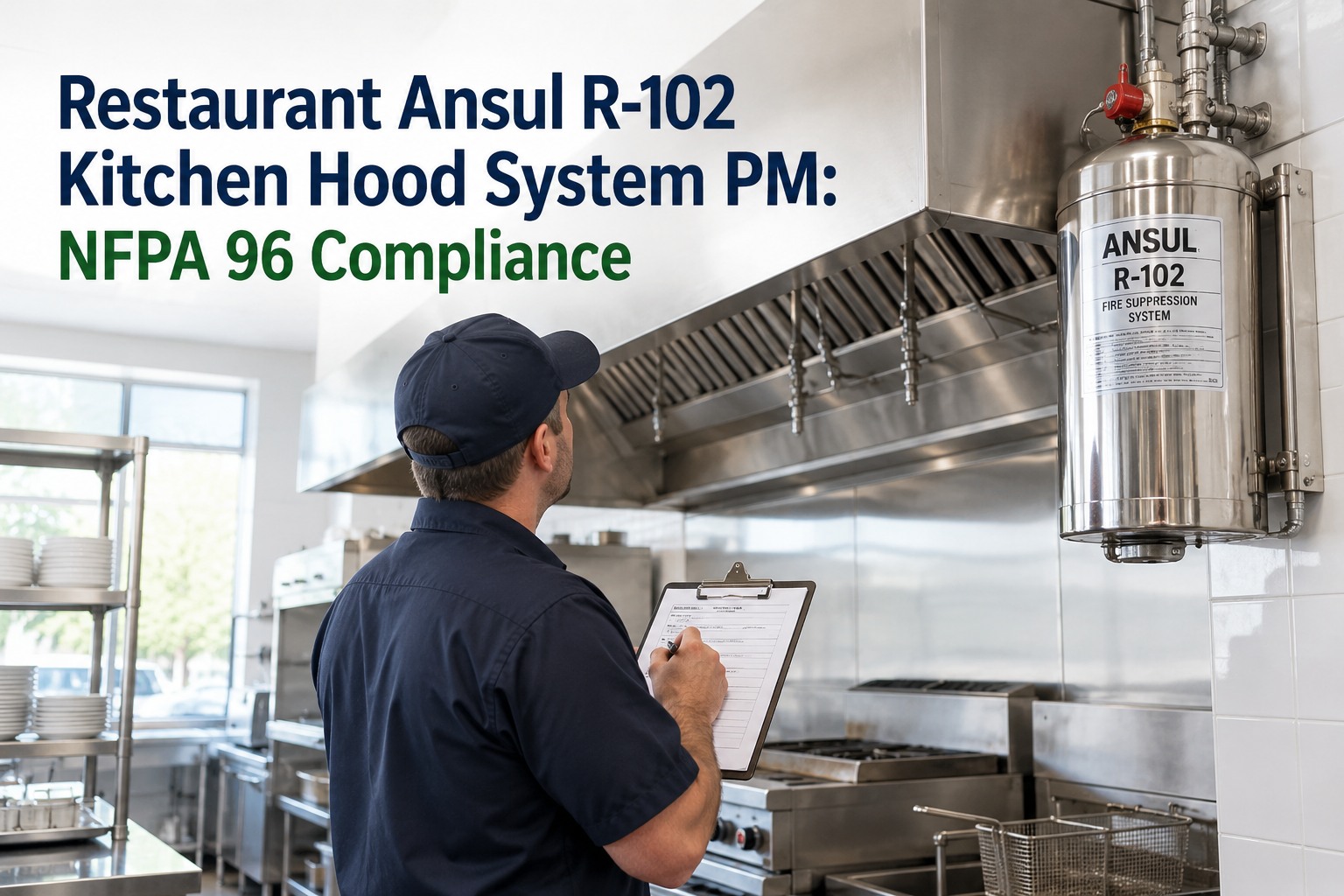
Every commercial kitchen runs on a system nobody thinks about until the worst moment — the wet-chemical hood suppression system, most often an Ansul R-102, sitting silent above the fryers and ranges waiting to knock down a grease fire in seconds. It's the highest-consequence life-safety asset in the building, and it's also the one most quietly degraded by its own environment: grease coats the fusible links, nozzles clog, cartridge pressure bleeds off, and none of it announces itself until a semi-annual inspection or a fire. NFPA 96 and NFPA 17A require that system checked every six months by a factory-authorized technician — but the failures build between those visits, which is why the restaurants that never get caught out run a layered program of monthly manager checks on top of the professional service. This guide lays out that full PM program for R-102 and similar UL 300 systems, and shows how OxMaint keeps every check on schedule and every tag audit-ready. Book a demo to put your hood system on a tracked schedule.
The System You Never Want to Use — Maintained Like You Will
Four facts every restaurant operator should know about R-102 hood suppression compliance.
6 mo
Maximum interval between professional inspections under NFPA 96 / 17A
UL 300
The listing standard for wet-chemical systems — and it's appliance-specific
Monthly
Manager visual checks NFPA expects between technician visits
Authorized
Only a factory-trained technician may service the system
How the R-102 Actually Works
Understanding the maintenance starts with the actuation chain — because every PM task maps to one link in it. When a cooking-surface fire pushes temperature past a fusible link's rating, a five-step sequence fires in seconds. If any single link in that chain is degraded, the whole system can fail when it's needed most.
1
Fusible link separates
Heat exceeds the link's temperature rating and it melts apart, releasing the detection line.
→
2
Cartridge actuates
The gas cartridge releases propellant, pressurizing the agent tank for discharge.
→
3
Agent discharges
ANSULEX low-pH liquid pushes through piping to the nozzles aimed at each appliance.
→
4
Fire knocked down
Agent cools the grease and forms a vapor-securing foam blanket that prevents reflash.
→
5
Fuel & gas shut off
Interlocks cut gas and power to the appliances, removing the fuel source.
Where the System Silently Degrades
The R-102 lives in one of the harshest environments in any building — heat, grease, and constant cycling. Four components carry the failure risk, and each is invisible until tested. This is what the PM program is really protecting.
Fusible Links
Heat cycling and grease coating degrade the solder links below their rated performance. They're replaced on a defined interval — a degraded link means delayed or failed actuation.
Nozzles & Caps
Grease clogs nozzles and even partial blockage cuts discharge coverage, leaving a cooking surface unprotected. Caps must stay present and intact to keep contamination out between services.
Agent & Cartridge
Agent tanks can lose pressure and cartridges bleed off over time. Cylinder pressure and the 6-year and hydrostatic test dates all have to be verified — the propellant has to be there when the link drops.
Detection Line & Interlocks
The detection cable, pull station, and gas/power interlocks have to actuate together. A seized pull station or a failed interlock breaks the chain even if the agent is full.
The Three-Layer PM Program
A compliant R-102 program runs on three layers at once — the daily-life cleaning that keeps grease off the system, the monthly manager check between services, and the semi-annual professional inspection. Skip the middle layer and problems accumulate unseen for six months.
ONGOING · KITCHEN STAFF
Hood, filter, and duct cleaning to keep grease off nozzles and links
Keep appliances in their approved positions under the nozzles
Report any discharge, damage, or bumped nozzle immediately
MONTHLY · MANAGER
Confirm nozzles are unobstructed and caps present
Check the gauge/pressure indicator and that the pull station is clear
Verify the inspection tag is current and components show no damage
SEMI-ANNUAL · AUTHORIZED TECH
Agent level, piping, fusible links, detection line, interlocks, pull stations
Cylinder pressure and 6-year / hydrostatic test dates
Manual test-fire via pull station; nozzles verified against layout; new tag
Never Miss a Six-Month Inspection Again
Bring your hood systems and service dates to a 30-minute session. We'll load each system into OxMaint, set the monthly manager checks and the semi-annual inspection reminders, and store every inspection tag and service report for your fire marshal — all in one place.
The Change That Voids Your Design
Here's the trap that catches even careful operators: the UL 300 listing is appliance-specific. The system was engineered to your exact cooking line — appliance types, positions, fuel, and oil. Change any of it and the original design may no longer cover the hazard, quietly voiding compliance until the system is re-evaluated. Start a free trial and log every equipment change against your system.
New or larger appliance
A bigger fryer or added range shifts the hazard zone — nozzle aim and coverage may no longer match.
Repositioned equipment
Moving an appliance out from under its nozzle leaves it unprotected, even if nothing else changed.
Different cooking oil
A change in cooking medium can alter the fire behavior the design was rated for.
Layout or exhaust change
Any ventilation or line reconfiguration can require nozzle adjustment and re-approval.
How OxMaint Runs Hood Suppression Compliance
OxMaint turns the three-layer program into a system that runs itself — the semi-annual inspection scheduled and reminded, the monthly manager check on a recurring task, every tag and service report stored against the asset, and every equipment change logged so a design-voiding modification can't slip by unnoticed. Book a demo to map your kitchens into OxMaint.
Schedule
Semi-Annual Never Slips
The six-month inspection is scheduled with lead-time reminders so it's booked before it lapses — never a missed interval.
Recur
Monthly Manager Check
The between-service visual check lands on the manager's task list every month with a simple mobile checklist.
Store
Tags & Service Reports
Every inspection tag and technician report saved against the system — pulled up instantly for a fire-marshal review.
Track
Equipment-Change Log
Log appliance swaps and layout changes against the system so a design-voiding modification triggers a re-evaluation flag.
Alert
Test-Date Warnings
Cylinder 6-year and hydrostatic test dates tracked with advance alerts — no expired cylinder caught at inspection.
Scale
Every Location, One View
One kitchen or fifty — see inspection status and open items across every restaurant on a single dashboard.
Keep Every Kitchen Inspection-Ready
Put your R-102 systems, monthly checks, service tags, and equipment changes on one platform that schedules, reminds, and stores everything the fire marshal asks for. Free forever plan available — no card required.
Frequently Asked Questions
How often must an Ansul R-102 be inspected?
At least every six months, per NFPA 96 and NFPA 17A, by a factory-authorized, trained technician. Between those professional inspections, the manager should perform monthly visual checks to confirm nozzles are clear, the pressure indicator is normal, and the inspection tag is current.
Start free to schedule both.
Why are fusible links replaced on a schedule?
Fusible links are the thermal trigger — solder-filled links calibrated to separate at a set temperature. Heat cycling, grease coating, and ambient kitchen heat degrade them below their rating over time, which can delay or prevent actuation, so they're replaced on a defined interval rather than left in service indefinitely.
Can changing my kitchen equipment void the system?
Yes. UL 300 listings are appliance-specific, so a new or larger appliance, a repositioned one, a different cooking oil, or a layout or exhaust change can alter the hazard coverage and invalidate the original design until the system is re-evaluated and re-approved. Any such change should trigger a professional review.
Book a demo to track changes.
What does the semi-annual inspection cover?
The technician checks agent levels, piping, fusible links, the detection line, interlocks, and pull stations, verifies cylinder pressure and the 6-year and hydrostatic test dates, performs a manual test-fire via the pull station, confirms nozzle placement against the current appliance layout, and applies a new inspection tag.
Does OxMaint manage kitchen fire suppression PM?
Yes. OxMaint schedules the semi-annual inspection with reminders, puts the monthly manager check on a recurring task, stores every inspection tag and service report against the system, tracks cylinder test dates with advance alerts, and logs equipment changes that could require re-evaluation — across one location or many. A free forever plan is available to trial the full workflow.