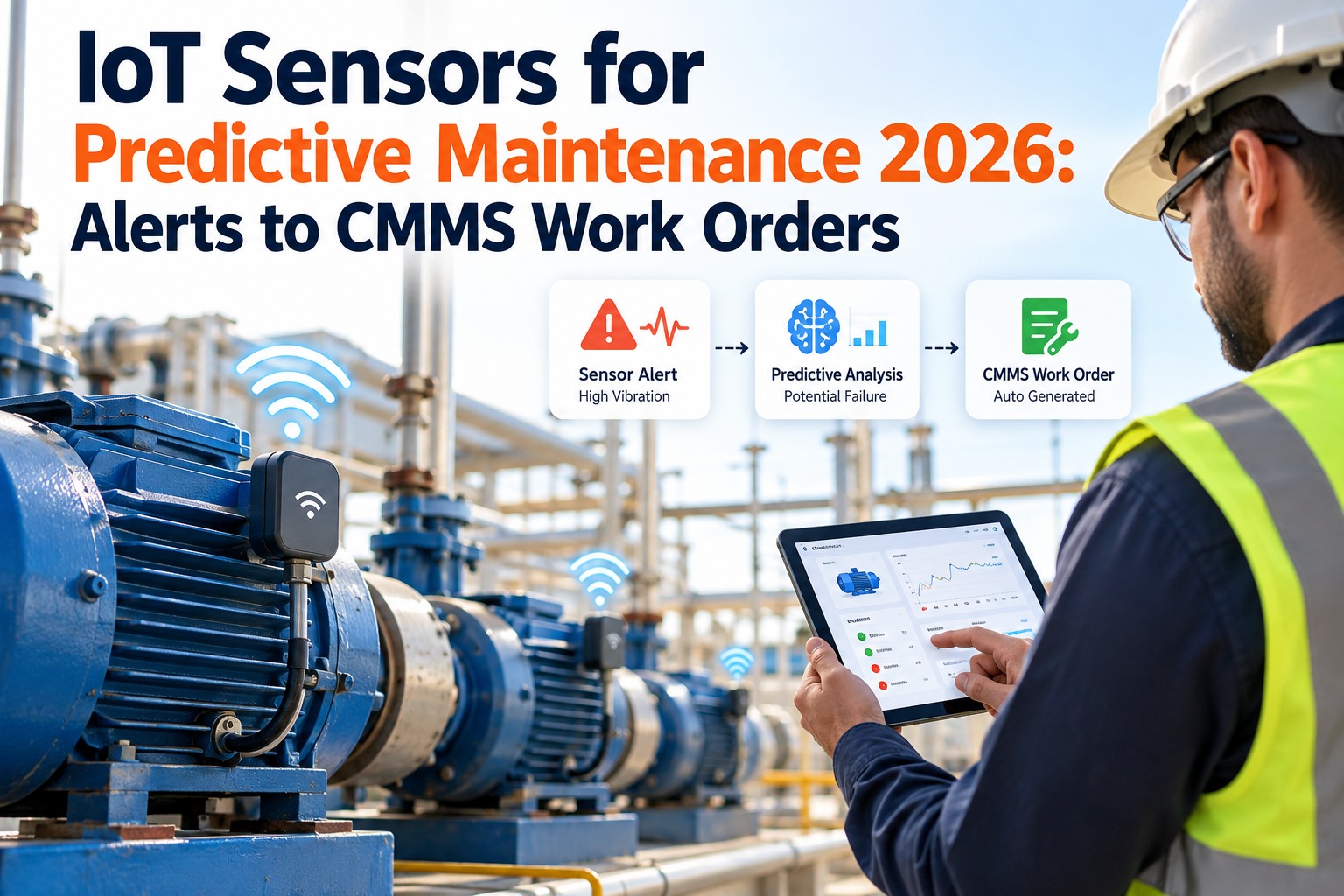
You're paying for sensors but still drowning in reactive work orders — PdM spend leaks when signals never turn into scheduled repairs. A wireless vibration ping on a chiller shouldn't become another spreadsheet row; it should arrive as a planner-ready draft work order in your EAM with asset ID, suspected failure mode and a confidence score. This guide frames wireless PdM as an operational loop and shows how Oxmaint AI pushes draft WOs into Maximo, SAP or Oracle so the EAM stays the system of record. Book a 30-minute demo to see live signal-to-draft-WO throughput.
Wireless PdM · Cost & ROI Framing · Signal → WO Loop · 2026
Wireless PdM That Actually Creates Planner-Ready Work Orders in Your EAM
Paying for sensors. Still drowning in reactive WOs. Alerts stuck in vendor portals. Oxmaint AI is the AI-powered CMMS overlay that turns wireless signals into ranked draft work orders inside Maximo, SAP or Oracle — faster signal-to-WO action, no rip-and-replace, EAM stays system of record.
4-Step
Detect → Diagnose → Prioritize → Dispatch
Signal → WO
measure throughput, not just alert count
EAM Overlay
Maximo / SAP / Oracle stay system of record
Confidence
0–100 score with the evidence that produced it
Why This Framing Matters
Bringing wireless sensors into a site is table stakes. The real question is whether those sensors reduce unplanned downtime and planner workload or simply inflate your PdM line item. Use the phrase wireless predictive maintenance cost work orders as a lens: measure not just hardware or license spend, but whether signals reliably convert to scheduled, executed work. If they don't, you're funding an illusion of PdM. Start a free trial to measure signal-to-WO throughput.
Common Failure Modes
Where PdM Budget Leaks
✕ Alert fatigue — threshold-only systems create many false positives; planners learn to ignore them
✕ Broken handoffs — sensor vendor portals, spreadsheets and emailed reports force manual re-keying into your EAM
✕ Missing context — alerts arrive without EAM asset IDs, hierarchy or suggested labor/parts, so planners must investigate before scheduling
✕ No confidence signal — everything looks equal, so low-value alerts clog the queue
At a Glance
What the Overlay Delivers
✓ Stop paying for sensors that don't change maintenance throughput — instead produce planner-ready draft WOs
✓ Oxmaint AI triages signals, scores confidence and pushes draft WOs into Maximo/SAP/Oracle
✓ EAM remains system of record — no rip-and-replace
✓ Live signal ingestion → timeline → Signal → Confidence → suggested draft WO in your EAM
Detect → Diagnose → Prioritize → Dispatch: Planner-Ready WO Reasoning
Frame wireless PdM as an operational loop. Each step is where cost or value is realized. Book a demo to walk the loop on your assets.
Step 1
Detect
Wireless vibration, temperature and electrical sensors stream to a collector or cloud endpoint. Cost appears in gateway hardware, cellular or LoRaWAN connectivity, cloud ingestion and storage. Oxmaint captures a continuous timeline that preserves context — not single spike alerts.
Step 2
Diagnose
Raw traces and telemetry become candidate faults — bearing wear, imbalance, looseness, overheating. Oxmaint merges PdM libraries, historical site data and asset metadata to generate a reasoned hypothesis and a Signal → Confidence score tied to why the system thinks a fault exists.
Step 3
Prioritize
Decide which findings become draft WOs and in what order. Oxmaint ranks events by asset criticality, recent failure patterns and confidence; only high-value / high-confidence events are promoted to suggested draft WOs to reduce noise.
Step 4
Dispatch
Drafts become scheduled, assigned work orders inside the EAM for field execution. Oxmaint populates planner-ready fields — asset ID, failure code, suggested action, trade / time estimate — and pushes a draft into Maximo/SAP/Oracle for review.
Overlay, Not Rip-and-Replace.
Oxmaint AI integrates with your existing EAM. Draft WOs appear in Maximo/SAP/Oracle as suggested orders for planners to accept, edit or defer. There's no requirement to replace your system of record — the overlay accelerates throughput and eliminates manual handoffs.
In-Product Feel — Timeline, Signal → Confidence, Suggested WO
A planner's daily view should be fast and defensible. Three views wired together turn a wireless signal into a defensible draft WO. Start a free trial to open the three views on your data.
Wireless PdM · Signal → Draft WO · Oxmaint → EAM
Timeline
Horizontal mini-charts per asset · last 90 days of key metrics; clickable points reveal raw traces and short diagnostic notes
Confidence
Signal → Confidence badge · numeric score with tooltip: trend slope, repeatability, corroborating sensors, matched failure patterns
Suggested WO
Pre-filled draft next to the timeline · asset ID, failure hypothesis, suggested steps, trade, parts checklist, "Send to EAM as Draft" button
TIMELINE Horizontal mini-charts for each asset with last 90 days of key metrics — clickable points reveal raw traces and short diagnostic notes
BADGE Explicit Signal → Confidence badge and numeric score; tooltip outlines contributing evidence
DRAFT WO Pre-filled next to the timeline with asset ID, failure hypothesis, steps, trade, parts checklist — one "Send to EAM as Draft" button
AUDIT Trail shows which sensors and models produced the recommendation so planners accept without re-investigating
Planner-Ready WO Fields That Close the Gap
Planners need actionable information in a draft WO — not another investigation. Six fields Oxmaint AI populates so the draft is executable on arrival. Book a demo to see the six fields prefilled from your signals.
01
EAM asset identifier and full location hierarchy
02
Suggested failure mode mapped to your EAM taxonomy
03
Diagnostic summary with a 24–90 day timeline showing trends and corroborating sensor data
04
Signal → Confidence score (0–100) plus reasons: trend, repeatability, corroboration
05
Suggested corrective actions or inspection steps, trade, estimated duration and likely parts
06
Provenance — sensor IDs, timestamps and links to raw traces so technicians can verify before work starts
How to Think About Cost and ROI — Operational Metrics, Not Promises
Avoid headline ROI claims. Focus on throughput metrics you can measure across three buckets — inputs, outputs and cost. Start a free trial and measure these three buckets on a pilot.
Inputs
Number of PdM alerts, ingestion volume and scope of sensors. This is the raw stream the loop starts from — measure it before drawing conclusions about the layers above.
Outputs
Draft WOs created, planner acceptance rate, time from detection to scheduled WO, and reduction in manual re-keying time. These are the throughput metrics that show whether the PdM spend is converting into scheduled work.
Cost Buckets to Track
Sensors and gateways, connectivity, Oxmaint subscription (ingestion + inference + connectors) and integration effort. Illustrative examples (not guarantees) can help set expectations during a pilot.
Implementation Approach
Four moves take a wireless PdM spend from line item to measurable throughput — pilot narrow, map once, integrate against the EAM you have, then scale by asset class. Book a demo to scope the pilot on your operation.
Pilot-First
Start with a single plant or critical asset class to validate signal-to-WO throughput and tune thresholds.
Mapping
Populate EAM asset IDs, location hierarchies and failure code mappings once; Oxmaint provides templates and guided tools.
Integration
Connects via EAM APIs or connectors; complexity depends on your EAM version and access. Integration scope and pricing are part of the demo conversation.
Scale
After pilot tuning on confidence and prioritization, roll out by asset class to preserve planner capacity and avoid overload.
What You'll See in the 30-Minute Demo
A concrete end-to-end flow — from live signal ingestion to a sample draft WO landing in Maximo/SAP/Oracle. Book this week to run it on a representative asset.
Live Signal Ingestion
Live signal ingestion into Oxmaint and a timeline visualization for a representative asset.
Open an Event
Open an event to view raw traces and the diagnostic reasoning behind the candidate fault.
Signal → Confidence Scoring
See the confidence score with the evidence that produced it — trend, repeatability, corroborating sensors, matched failure patterns.
Draft WO Card + Sample Push
A suggested draft WO card and demo push into a sample Maximo/SAP/Oracle instance as a draft ordered for planner review, plus a discussion of pilot scope, integration effort and how we tune thresholds for your operation.
"
Book a demo this week and watch a wireless PdM signal become a planner-ready draft work order inside an EAM: timeline context, transparent Signal → Confidence ranking, a pre-filled suggested WO, and a sample push into Maximo/SAP/Oracle. That 30-minute walkthrough is the fastest way to see where your PdM spend is actually converting into scheduled maintenance — and where it's still leaking value.
Oxmaint AI Content Desk
Five Common Questions — Candid Answers
Will Oxmaint replace my Maximo/SAP/Oracle?
No. Oxmaint overlays your EAM and pushes suggested draft WOs via APIs/connectors. Your EAM remains the system of record.
How much setup is required to map sensors to EAM assets and failure codes?
You'll do a one-time mapping of asset IDs and taxonomy. Oxmaint provides mapping templates and guided tools; initial tuning improves the Signal → Confidence calibration.
How does Oxmaint reduce false positives and alert fatigue?
By combining trend context, repeatability, corroborating sensors and asset criticality into one confidence signal and only promoting events above configurable thresholds to draft WOs.
Can we pilot with a small subset of sensors or a single plant?
Yes. Pilots validate throughput metrics (draft WOs, acceptance rates, time-to-schedule) and let you tune the system before scaling.
Are there hidden rip-and-replace costs or mandatory hardware upgrades?
No rip-and-replace required. Oxmaint overlays your existing systems. Hardware or gateway needs depend on your current sensor connectivity; we scope these in the demo.
Convert PdM Signals Into Scheduled Work.
Cost buckets, timelines and outcomes above are illustrative examples reflecting common deployments and are not guarantees of savings or schedules. Oxmaint AI focuses on operational throughput and hygiene — converting wireless signals into planner-ready work orders so you can measure real PdM value. Sign up to get started, or book a demo to see the loop on your data.