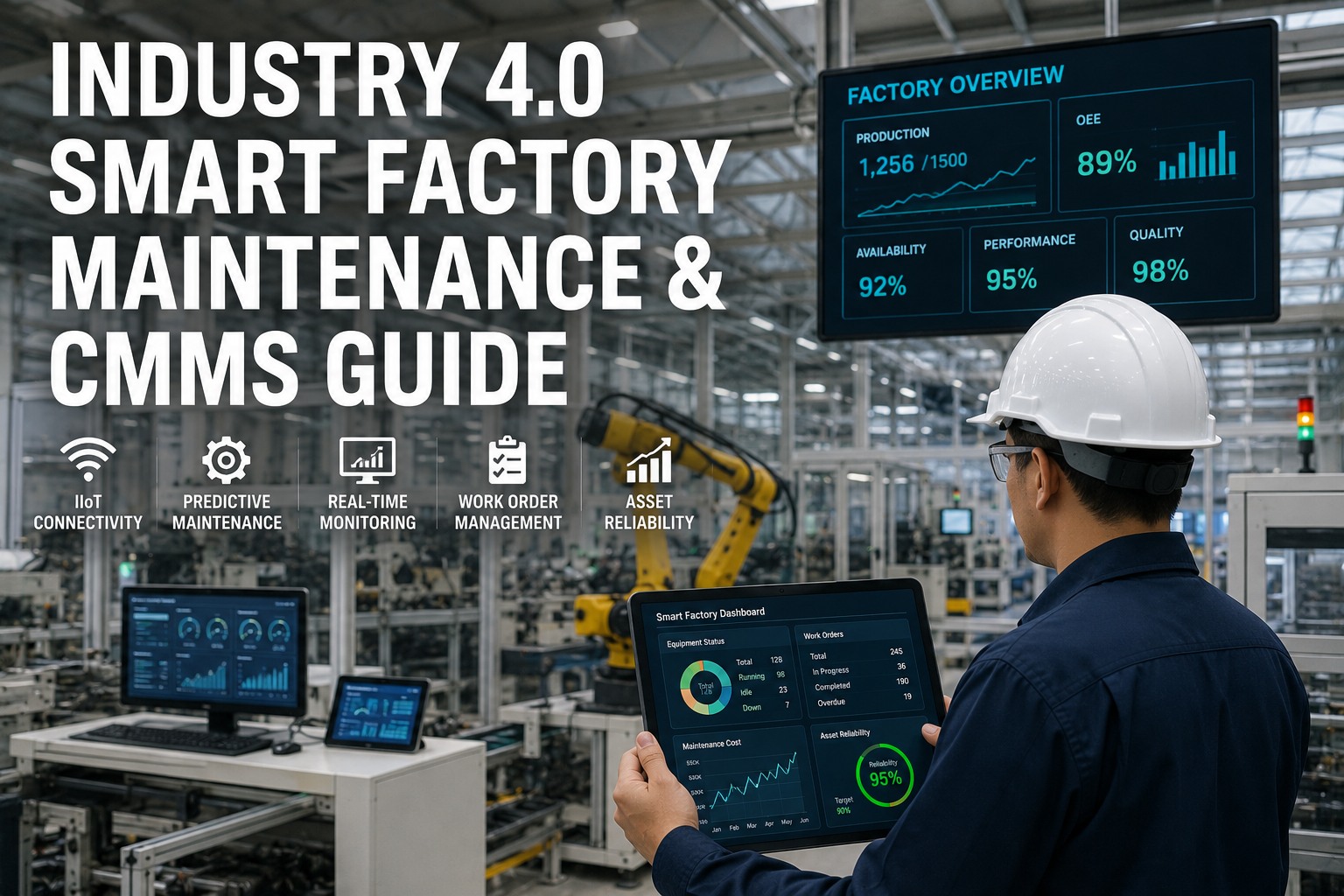
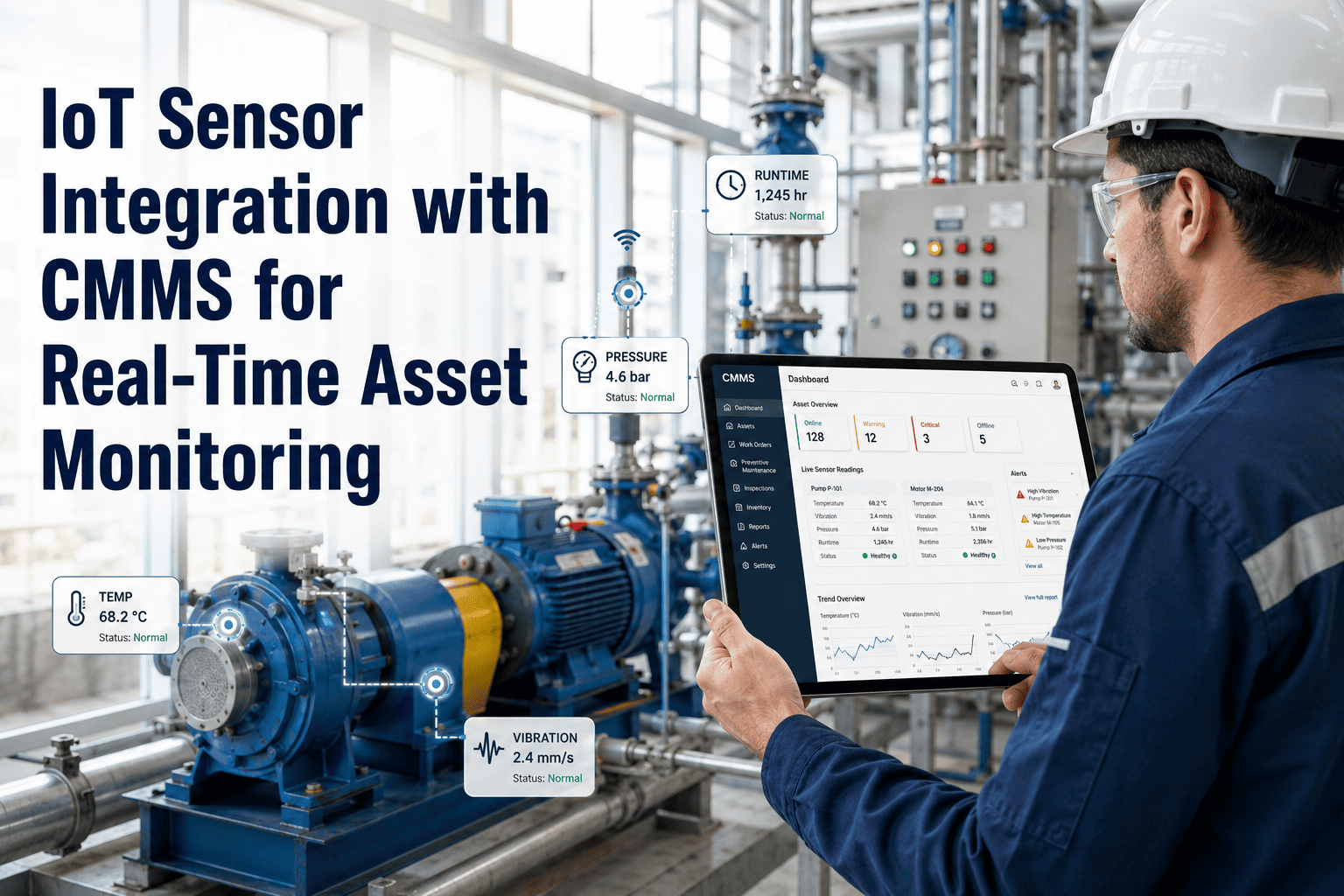
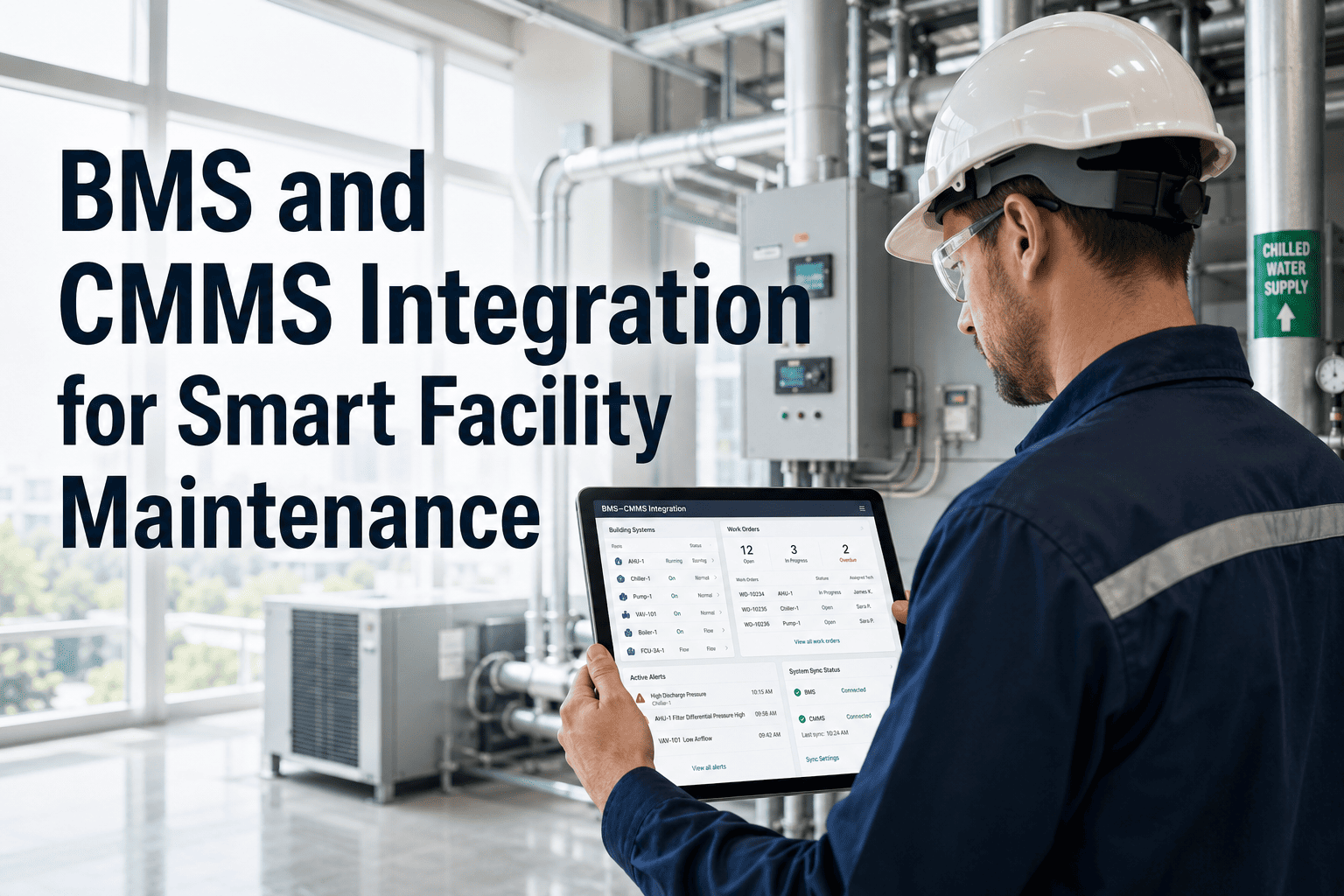
The difference between a smart factory and a factory with sensors is not hardware. It is the intelligence layer between the sensor and the maintenance action. A factory that has installed vibration sensors on 200 motors but still waits for a scheduled inspection round to review the data has the hardware of a smart factory and the operating model of a reactive one. A factory that has connected those same 200 sensors to an AI health scoring engine, automated alert routing, and CMMS work order generation — so that a bearing fault signal at 3am on a Sunday generates a planned maintenance work order before the morning shift starts — that factory is operating as a smart factory. The gap between the two is not capital expenditure. It is software, integration, and operational discipline. Industry 4.0 maintenance is the specific application of smart factory principles to the maintenance function: continuous IoT monitoring of equipment condition, AI-driven failure prediction, automated work order generation, and mobile-first execution by maintenance technicians who carry the factory's full asset intelligence in their pocket. Sign up for Oxmaint to build this operating model at your factory today.
Where Your Factory Sits on the Industry 4.0 Maintenance Maturity Scale
Smart factory maintenance is not a single destination — it is a progression across three distinct maturity levels. Most factories self-assess at a higher level than they actually operate because they have the hardware of a smart factory without the operational integration that makes it function as one. Sign up for Oxmaint to move to the highest maturity level today.
What AI + IoT Maintenance Actually Does Inside a Smart Factory
Each capability below represents a specific operational change that the Oxmaint IoT + AI platform enables — not a general Industry 4.0 principle, but a specific workflow with a specific outcome. Book a demo to see all six configured for your factory equipment.
Oxmaint's AI processes vibration, temperature, current, and process parameter data from IoT sensors in real time, producing a health score (0–100) for every monitored asset. The score updates continuously. A motor bearing developing outer race fatigue shows a score declining from 85 to 61 over 72 hours — the trend visible to the maintenance supervisor before any human inspection round would detect it. The score, its trend direction, and the contributing fault signature are all displayed on the fleet dashboard. When the score crosses the Alarm threshold, a maintenance work order is auto-generated. Sign up to activate AI health scoring.
Detection: 14–42 days advance warning on progressive fault modesWhen an AI alert generates a work order in Oxmaint, the assigned technician receives a push notification on their mobile device with the asset location, AI fault classification, parts availability confirmation, and the step-by-step procedure linked to the work order. They close the work order with a digital signature at the point of repair — no administration building trip, no paper form, no transcription delay. The maintenance record is complete when the repair is complete. In a smart factory, the maintenance technician's mobile device is the interface between the AI layer and the physical repair action.
Admin reduction: 91% less work order documentation time vs paperThe AI fault classification that identifies a specific failure mode — bearing inner race defect, pump seal failure, gearbox tooth wear — also identifies the specific parts required for the repair. Oxmaint checks current inventory against the parts requirement when the work order is generated. If the required part is not in stock, a procurement alert generates simultaneously with the work order — giving 14–21 days advance warning before the repair is due, which is enough for standard delivery at standard pricing. Emergency procurement at 1.5–2x premium pricing is eliminated from the maintenance budget. Book a demo to see inventory integration.
Emergency procurement elimination: $200k–$600k annually at typical facilitiesEquipment operating outside its design condition consumes 10–30% more energy than specification. In a smart factory, energy meters connected to Oxmaint monitor per-asset power consumption in real time against a learned baseline. A conveyor motor drawing 12% more current than its baseline at the same load is flagged for maintenance — not because it has failed, but because the efficiency degradation is costing money now and will worsen. The maintenance team receives the energy deviation alert alongside the health score trend, enabling maintenance that recovers both mechanical reliability and energy efficiency in a single planned repair event. Sign up for energy monitoring.
Energy savings: 5–8% reduction from condition-based energy maintenanceOverall Equipment Effectiveness (OEE) is the primary smart factory performance metric — combining availability, performance rate, and quality rate into a single asset health indicator. Oxmaint tracks OEE components in real time: availability from work order and downtime records, performance rate from process parameter monitoring against rated speed, and quality rate from quality system integration. When OEE drops below target on a specific asset, the AI correlates the OEE decline with the asset's health score to identify whether the cause is mechanical degradation, process adjustment, or quality-related — directing the maintenance team to the right intervention for the specific cause. Book a demo to see OEE tracking.
OEE improvement: 6–12 percentage point increase documented at smart factory deploymentsA smart factory's maintenance intelligence is most valuable when it is visible inside the production management system — not siloed in a separate maintenance dashboard that the production manager never opens. Oxmaint integrates with MES and SCADA platforms via OPC-UA, REST API, and MQTT, making asset health scores, active alerts, and planned maintenance windows visible to production schedulers. When a predictive maintenance work order is approved for Thursday's maintenance window, the MES automatically flags that asset's production schedule for adjustment. The production and maintenance functions operate from shared situational awareness rather than separate information systems. Sign up to configure MES integration.
Production impact: planned maintenance scheduled within production windows, not against themSmart Factory Maintenance vs. Traditional Factory Maintenance — What Changes Operationally
The operational difference between a smart factory maintenance programme and a traditional one is not visible in the sensor count or the software budget. It is visible in how the maintenance team spends its time and how failures manifest. Sign up for Oxmaint to shift your operation to the right column.
How the Maintenance Team's Day Changes
In a traditional factory maintenance programme, the maintenance team's day is shaped by what has already gone wrong. Work order queues are dominated by corrective events. The planning horizon is days, not weeks. The maintenance supervisor spends the first hour of each shift triaging emergency requests. The PM schedule is aspirational — 50–60% completion rate is considered acceptable because reactive events always take priority.
- Traditional: Supervisor arrives, checks overnight breakdown list, re-deploys technicians from planned PMs to reactive repairs — PM schedule slips again
- Smart factory: Supervisor arrives, reviews health score dashboard — 4 assets in Caution, 1 in Alarm with work order already approved, all PMs on schedule with 82% completion rate
- Traditional: Technician arrives at a failed asset with no information — parts may or may not be in stock, repair history in a filing cabinet somewhere
- Smart factory: Technician opens mobile work order — fault classification tells them it is a seal failure, parts are confirmed in stock at bay 3, asset repair history shows this is the third seal failure in 18 months (root cause pending)
- Traditional: Maintenance manager presents monthly report compiled over two days from paper records — data is 4–6 weeks old by the time it reaches leadership
- Smart factory: Maintenance manager opens live Oxmaint dashboard — MTBF, PM completion rate, corrective vs planned ratio, and cost per work order all current as of the last closed work order
The smart factory maintenance programme is not harder to run than a traditional one. It is actually easier — because every decision is supported by current, accurate data rather than incomplete memory and outdated paper records. Book a demo to see the Oxmaint dashboard configured for your operation.
Documented Outcomes from Smart Factory AI Maintenance Deployments
These results are drawn from verified case studies and research from Deloitte, the US Department of Energy, and McKinsey — all from documented industrial deployments, not projections. Sign up for Oxmaint to start building your own results record.
Reduction in total maintenance costs with AI-driven predictive strategy
Decrease in unplanned downtime incidents at facilities with mature AI monitoring
Return on investment from predictive maintenance programme deployment
Lower total maintenance spend vs reactive-only approaches at equivalent facilities
Annual verified savings at a CPG smart factory through AI sensor-based analytics
OEE improvement documented across smart factory AI maintenance deployments
| Performance Metric | Traditional Factory | Smart Factory — AI + IoT | Improvement |
|---|---|---|---|
| Unplanned downtime events | 15+ hrs/week average | 2–3 hrs/week | ↓ 85% |
| Fault detection timing | At failure — production stopped | 14–42 days before failure | Weeks advance warning |
| Emergency procurement spend | $840k/year typical | $180k/year | ↓ 79% |
| PM completion rate | 50–60% (reactive events take priority) | 80–90% | ↑ 30 percentage points |
| Work order documentation time | 22 min per event (manual) | Under 2 min (automated) | ↓ 91% |
| Overall Equipment Effectiveness | 72–78% typical | 84–92% | ↑ 6–14 percentage points |
| Energy consumption (maintained) | 10–30% above design spec | Within 3–5% of design spec | ↓ 5–8% energy cost |
Swipe to view full table
Most of your waste is invisible — hidden in reactive maintenance, excess inventory, and manual processes. A good AI-connected CMMS makes it visible, and once you can see it, you can eliminate it. We went from 65% of our maintenance technician time spent on reactive work to under 20% in 14 months. The other 45% went back into planned PM and improvement projects. Our maintenance cost per unit of output dropped 28% in that period and OEE on our three critical lines improved from 74% to 88%.
Your Factory Has the Hardware for Smart Maintenance. Oxmaint Provides the Intelligence Layer.
IoT sensors collect condition data. Oxmaint's AI processes it into health scores, fault classifications, and automated work orders that turn sensor readings into planned repairs — connecting the data your factory already generates to the maintenance actions it needs.
Smart Factory Maintenance with AI and IoT — Common Questions
Existing facilities represent the majority of smart factory maintenance deployments — greenfield smart factories are the exception, not the norm. Retrofit wireless IoT sensors can be mounted on existing rotating equipment, conveyor systems, hydraulic presses, and CNC machines without modification or equipment downtime. Wireless accelerometers, temperature sensors, and current transformers connect to Oxmaint via existing WiFi infrastructure or cellular edge devices. The most effective deployments start with the 15–20 highest-consequence assets in an existing facility, build evidence from those results, and expand coverage incrementally. Full factory coverage typically completes within 12–18 months of starting the first pilot deployment. Sign up for Oxmaint to discuss a retrofit deployment plan for your facility.
Oxmaint integrates with industrial automation and enterprise systems via OPC-UA (Siemens, ABB, Honeywell, Emerson, Rockwell Automation), REST API for cloud-hosted MES and ERP platforms, MQTT for IoT edge devices, and direct database connections for on-premises historians. For ERP integration, Oxmaint connects with SAP PM, Oracle EAM, and Microsoft Dynamics 365 to synchronise work orders, purchase orders for parts procurement, and maintenance cost records. For MES integration, Oxmaint provides asset health scores and planned maintenance windows to production scheduling systems so that maintenance and production planning work from shared situational awareness. Most integrations complete within 2–4 weeks of deployment start. Book a demo to discuss your specific integration requirements.
A traditional CMMS manages work orders, PM schedules, and asset records — the operational backbone of maintenance management. Industry 4.0 maintenance adds the IoT monitoring and AI analytics layer that makes the CMMS data proactive rather than reactive: instead of creating work orders after failures occur or on fixed PM calendars, the system creates work orders from AI-detected condition changes before failures occur. Oxmaint provides both layers in a single platform — the CMMS work order management, asset register, and PM scheduling that every maintenance operation needs, combined with the IoT integration and AI health scoring that makes a traditional CMMS into a smart factory maintenance system. You do not need two separate systems. Sign up for Oxmaint to activate both layers today.
Oxmaint's AI anomaly detection requires a baseline learning period of 30–60 days of normal operation across representative operating conditions before it produces reliable health scores. During this period, the system collects the "normal" signature of each asset — what vibration, temperature, current, and process parameters look like during healthy operation at different loads, speeds, and ambient temperatures. Once the baseline is established, health scores become active and anomaly detection begins. Fault classification accuracy — identifying not just that something is changing but which specific component is degrading — typically reaches operational precision within 60–90 days as the model accumulates fault pattern data. The accuracy then improves continuously with each repair outcome feedback cycle. Book a demo to see the deployment and baseline timeline for your factory equipment types.
Your Factory Already Has Most of the Hardware a Smart Factory Needs. Oxmaint Provides the Intelligence That Makes It Work.
The sensors, the network, and the equipment are already at your facility. The AI health scoring, automated alert routing, CMMS work order generation, and live KPI dashboards that convert those assets from a hardware investment into an operational advantage — that is what Oxmaint adds. Smart factory maintenance is not a capital project. It is a software decision that pays back in months.