
Building and facility operations run on hundreds of interdependent systems — HVAC units, plumbing networks, electrical infrastructure, elevators, fire suppression, and everything in between. Tracking the maintenance of each system manually, through work-order books and email threads, produces the outcome most facility managers already know: deferred maintenance accumulating into expensive reactive repairs, compliance certificates lapsing, and no clear picture of what each building system is actually costing. Facility maintenance software replaces that fragmented picture with a single platform where every work order, every inspection, and every cost record lives. This guide covers what a purpose-built facility CMMS delivers and how to select the right platform for your building operations. Book a demo of Oxmaint.ai for facility management.
Facility Maintenance Software: A Complete CMMS Guide for Building & Facility Managers
For facility managers, building operations directors, and property teams managing commercial, institutional, or industrial buildings — centralised maintenance software transforms how you schedule work, track costs, and demonstrate compliance.
Why Manual Facility Maintenance Management Fails at Scale
The problems that drive facility managers to CMMS software are consistent across building types and portfolio sizes. Every one of them has a direct cost consequence.
Deferred Maintenance Accumulates
Without a structured PM schedule and visible backlog, low-priority maintenance items are deferred repeatedly until they become urgent repairs. The cost differential between planned maintenance and emergency repair for the same fault is typically 3–5×.
Compliance Certificates Lapse
HVAC service certificates, lift inspection reports, fire alarm test records, and electrical installation condition reports all have expiry dates. Manual tracking systems miss these deadlines — creating liability exposure and regulatory non-compliance.
True Maintenance Cost Is Invisible
Without per-asset cost tracking, facility managers cannot identify which building systems are consuming disproportionate maintenance budget, cannot build evidence-based capital replacement cases, and cannot benchmark performance across their portfolio.
Contractor Work Is Untracked
Specialist contractors completing HVAC, electrical, and plumbing work leave paper job sheets that are filed and forgotten. There is no systematic record of what was done, when, by whom, and at what cost — until the next fault reveals that the previous work was either inadequate or never completed.
Tenant and Occupant Communication Gaps
Work requests submitted by building occupants through email and telephone are routed informally, frequently lost between teams, and impossible to report on — creating the experience gap that drives tenant dissatisfaction in multi-occupancy buildings.
No Asset Service History
When a building system fails, diagnosing the cause requires knowing what was done to it previously — when it was last serviced, what parts were replaced, and whether similar faults have occurred before. Without a CMMS, this history does not exist in any retrievable form.
What Facility Maintenance Software Actually Does
A facility CMMS is not a ticketing system. It is an asset management platform that connects every maintenance event — planned, reactive, or inspection-driven — to the specific building system it relates to, the cost it incurs, and the compliance record it satisfies.
Preventive Maintenance Scheduling
Configure PM schedules for every building asset — HVAC filters, boiler service, lift inspection, fire suppression testing, and BMS calibration — based on calendar intervals, runtime hours, or compliance certificate requirements. Work orders are generated automatically at the configured schedule and assigned to the responsible technician or contractor before the due date arrives.
Digital Work Order Management
Every maintenance event — whether generated by a PM schedule, a reactive fault report, or a tenant request — exists as a digital work order with a status, an assigned technician, a priority level, and a cost record. Work orders are completed on mobile with photo evidence, notes, and parts usage recorded at the point of completion — not reconstructed later from memory.
Compliance Certificate Tracking
Every statutory compliance obligation — HVAC F-gas certificates, lift thorough examination reports, electrical installation condition reports, fire alarm test records, and emergency lighting certificates — is tracked per asset with the certificate expiry date and an automatic alert that triggers the renewal process before the certificate lapses. Compliance status across the full building portfolio is visible from a single dashboard.
Asset Cost & Performance Analytics
Every work order links its parts cost, labour cost, and contractor invoice to the specific building asset it relates to. Over time, this produces the per-asset maintenance cost history that facility managers need to make evidence-based decisions about repair versus replacement, to benchmark maintenance spend against industry norms, and to build the capital expenditure cases that property owners and boards require. Start a free trial to configure asset cost tracking for your facility.
Building Systems Managed by Oxmaint.ai
Every major building system type with its specific maintenance requirements, compliance obligations, and inspection intervals — all tracked within a single platform.
HVAC
Heating, Ventilation & Air Conditioning
HVAC maintenance in commercial buildings requires a structured PM programme covering filter replacement, coil cleaning, refrigerant charge verification, belt and bearing inspection, and the statutory F-gas certification for systems containing fluorinated greenhouse gases. Oxmaint.ai manages all HVAC maintenance intervals — from monthly filter changes to annual full system service — with automatic work order generation and F-gas certificate expiry tracking that ensures compliance without manual calendar monitoring.
For buildings with Building Management Systems, Oxmaint.ai's integration capability allows BMS fault signals to automatically generate reactive work orders, creating the closed-loop response process that prevents BMS alarms from being acknowledged and forgotten without a maintenance action being taken.
ELEC
Electrical Systems & Lighting
Electrical maintenance compliance in commercial buildings requires systematic management of Electrical Installation Condition Reports, emergency lighting testing records, and fixed wire testing certificates — each with different inspection intervals and different regulatory retention requirements. In the UK, EICR certification is typically required every 5 years for commercial properties; in the US, NFPA 70E inspection requirements apply to all electrical work.
Oxmaint.ai tracks every electrical compliance certificate with expiry date alerts, stores the certificate documents against the relevant building or circuit asset, and generates inspection work orders before certificate lapse dates — giving facility managers the proactive compliance management that manual calendar systems cannot sustain across a large building portfolio.
PLMB
Plumbing & Water Systems
Water system maintenance in commercial and institutional buildings carries a specific statutory compliance dimension: Legionella risk assessment and water treatment programme management under L8 (UK) or ASHRAE 188 (US). Every water system — hot and cold water services, cooling towers, spa pools, and decorative water features — requires a documented written scheme of control with records of temperature monitoring, disinfection, and system inspection. Oxmaint.ai structures all L8/ASHRAE 188 compliance activities as scheduled work orders with automatic generation at the required frequencies and completion records that satisfy the written scheme documentation requirements.
LIFE
Lifts, Escalators & Access Control
Lifts and escalators are among the most heavily regulated assets in any commercial building, requiring thorough examinations at six-monthly intervals for lifts used by passengers (LOLER in the UK; ASME A17.1 in the US) and statutory maintenance contracts with specialist contractors. Oxmaint.ai manages lift thorough examination scheduling, stores examination reports and insurance certificates against the specific lift asset, and tracks contractor service visit records alongside the statutory compliance documentation — creating a single point of reference for everything relating to each lift's compliance and maintenance history.
FIRE
Fire Safety & Suppression Systems
Fire safety compliance in commercial buildings requires systematic documentation of fire alarm testing (weekly call point tests, six-monthly full system tests), sprinkler system maintenance, fire extinguisher inspection, emergency lighting, fire door inspection, and the annual fire risk assessment. Each of these obligations has a different frequency and a different documentation requirement — making manual tracking across a multi-building portfolio essentially impossible without a dedicated compliance management system. Oxmaint.ai generates all fire safety maintenance work orders on the correct schedule with the mandatory completion records that fire safety inspectors and insurers require.
One Platform for Every Building System, Every Work Order, Every Compliance Record
Oxmaint.ai gives your facility maintenance team the PM scheduling, compliance certificate tracking, and cost analytics that building operations require — accessible from the plant room, the office, and the field.
Full Capability Set: Oxmaint.ai Facility CMMS
Every feature your facility maintenance operation needs, built into a single platform without add-on modules.
Manual Management vs. Oxmaint.ai Facility CMMS
The performance gap between paper-based facility maintenance and a structured CMMS platform is measurable in compliance failures, reactive repair costs, and management time consumed by administration rather than operations.
| Area | Manual / Paper-Based | Oxmaint.ai |
|---|---|---|
| PM Scheduling | Calendar reminders missed when staff are absent — maintenance intervals lapse undetected | Automatic work orders generated before due dates with escalation if not actioned |
| Compliance Certificates | Certificates filed in folders — expiry dates not tracked, lapses discovered at inspection | Certificate expiry alerts 30–90 days in advance with one-click audit export |
| Contractor Records | Paper job sheets filed or discarded — no searchable history of contractor work per asset | Every contractor visit creates a digital record linked to the asset with scope, parts, and cost |
| Maintenance Costs | Costs pooled in building account — impossible to identify high-cost assets or benchmark performance | Per-asset cost tracking drives evidence-based replacement decisions and budget planning |
| Occupant Requests | Requests via email and phone — routed informally, frequently lost, impossible to report on | Digital request portal with automatic work order creation and status visibility for requestors |
Scroll horizontally on mobile
We manage 14 commercial buildings with a team of six. Before Oxmaint.ai, the compliance tracking alone took one of my team members half their working week — chasing contractor certificates, checking service dates, and compiling records for landlord reports. Now the system does all of that. My team works on actual maintenance, not administration. The first building portfolio review after implementation, we discovered that two lifts had examination certificates that had lapsed by 4 months. Both buildings had been occupied throughout. That alone told me everything about what we'd been risking with the previous system.— Head of Facilities, Commercial Property Management Company, London
Frequently Asked Questions
How long does it take to set up Oxmaint.ai for a multi-building facility portfolio?
Most facility teams are fully operational on Oxmaint.ai within 1–2 weeks of starting a free trial. Building and asset registration, PM schedule configuration, compliance certificate setup, and mobile app deployment for the maintenance team are all completed during the onboarding process. Existing service records and compliance certificates can be imported to establish the historical baseline from day one. Start a free trial to begin onboarding your facility portfolio.
Can occupants and tenants submit maintenance requests without accessing the full CMMS platform?
Yes. Oxmaint.ai provides a separate occupant request portal — accessible via a QR code or web link — that allows building occupants to submit maintenance requests without a platform login. Each request automatically creates a work order in the maintenance team's queue with the location, description, and contact details populated. Requestors receive automatic status updates as the work order progresses through the maintenance workflow. This eliminates the email and phone request routing that manual systems rely on.
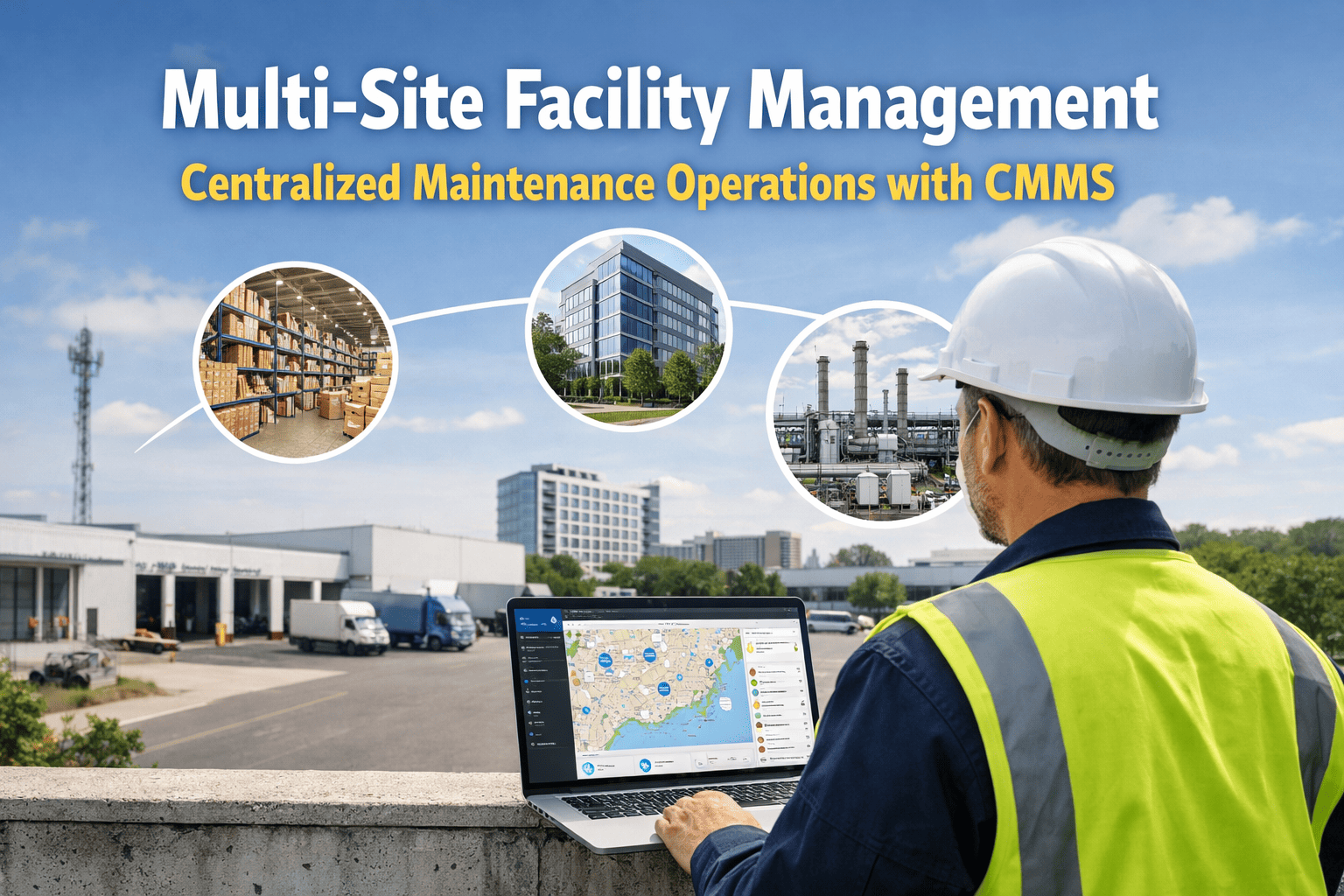
Does Oxmaint.ai support multi-site management with separate building queues but centrally visible compliance reporting?
Yes. Oxmaint.ai's multi-site configuration gives each building its own maintenance queue, asset register, and compliance dashboard — while the portfolio manager sees an aggregated view across all buildings showing overall PM compliance rate, open work order count, and certificates approaching expiry. This structure supports both in-house facility teams managing their own building and facilities management companies managing portfolios on behalf of property owners. Book a demo to see the multi-site configuration.
Can compliance certificate documents be stored within Oxmaint.ai for instant retrieval during audits?
Yes. Compliance certificates, inspection reports, contractor job sheets, and any other document relevant to a specific asset or building can be attached directly to the asset record in Oxmaint.ai. During a regulatory inspection or property management audit, the complete compliance document set for any building or system is retrievable from the platform in minutes rather than from physical filing systems that may be incomplete or not readily accessible. The platform also tracks each certificate's expiry date and generates pre-expiry alerts to the facility manager before the renewal window closes.
Your Building Systems Deserve Better Than a Spreadsheet
PM scheduling that runs itself. Compliance certificates tracked automatically. Contractor records that never get lost. Maintenance costs visible at the asset level. Oxmaint.ai delivers all of it — for single buildings, multi-site portfolios, and every facility type in between.

.png)
