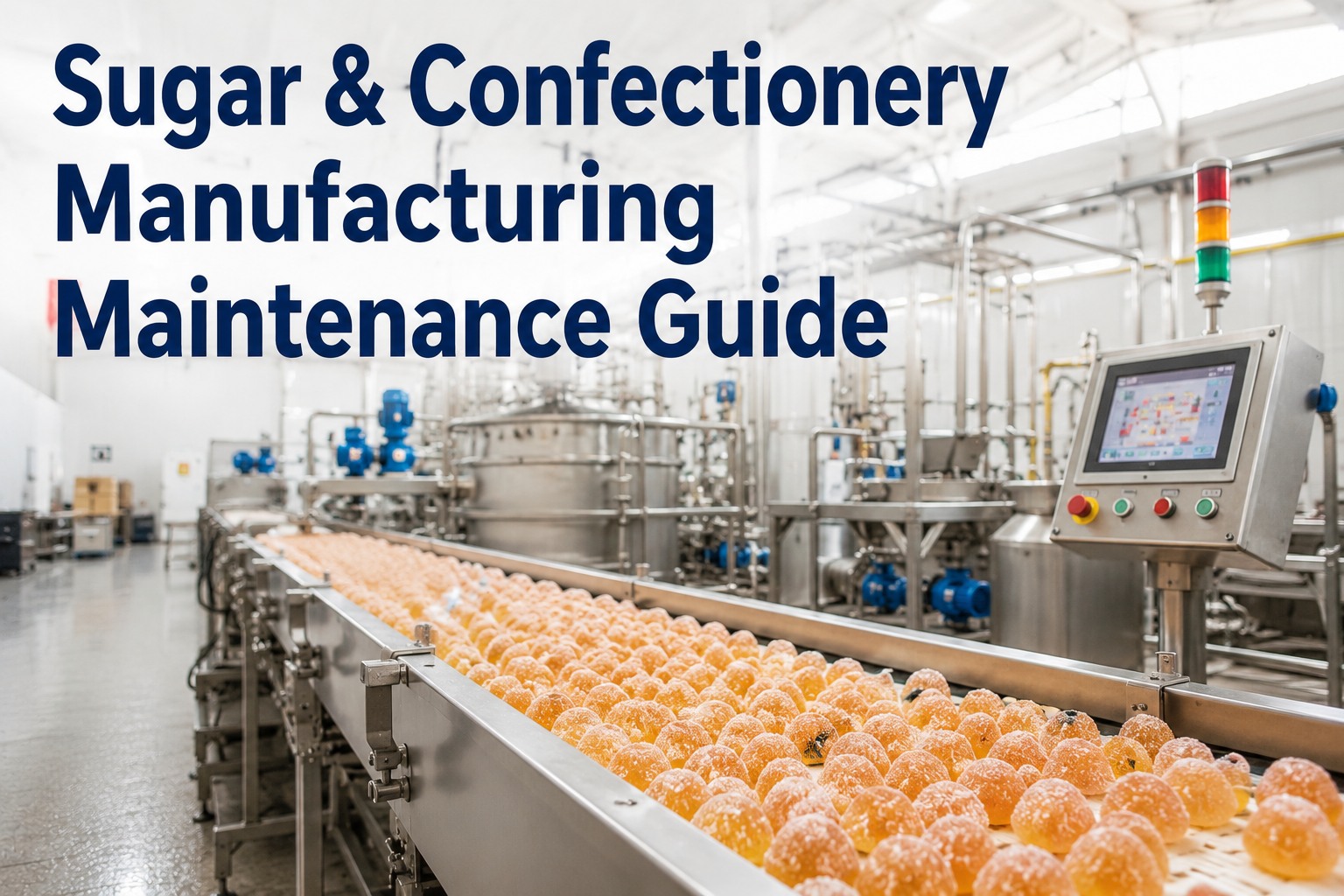
Confectionery manufacturing maintenance demands a disciplined approach to process heat, sugar handling, and packaging complexity — because a single evaporator failure or enrober breakdown can halt production for hours and spoil tons of hygroscopic product. This guide covers preventive maintenance for sugar and candy plants, from crystallization equipment PM to chocolate line upkeep, with practical schedules, cost benchmarks, and CMMS strategies that reliability teams can implement immediately. Whether you manage a sugar refinery, a chocolate plant, or a high-speed candy packaging line, the right maintenance framework cuts unplanned downtime by 30–50% and keeps audit-ready records effortless. Ready to modernize your plant? Start Free Trial and see how OxMaint streamlines every work order, PM trigger, and spare-parts lookup.
Is sugar buildup, crystallizer fouling, or enrober drift quietly costing your plant 200+ hours a year?
Confectionery and sugar manufacturing equipment operates at the intersection of thermal stress, hygroscopic material handling, and strict food-safety compliance. Without a structured PM program and a purpose-built CMMS, plants lose 15–25% of annual production capacity to unplanned downtime, rework, and spoilage. OxMaint changes that — AI-driven preventive maintenance, asset tracking, and real-time analytics built for sugar and candy operations.
Confectionery equipment maintenance: the four systems that fail most
Sugar and candy manufacturing concentrates risk in four process zones. Each requires a different PM cadence, inspection protocol, and spare-parts strategy — and each one is where plants using spreadsheets or paper work orders consistently fall behind.
Evaporators & Heat Exchangers
Sugar solutions concentrate at 70–90°C, accelerating scale formation on tube bundles. Without weekly condensate analysis and quarterly mechanical cleaning, heat-transfer efficiency drops 8–12% per month — translating to $15K–$30K in excess steam per evaporator annually.
Crystallization Equipment
Vacuum pans and cooling crystallizers face sugar encrustation, seal degradation, and agitation-bearing wear. Crystals forming on fouled surfaces reduce yield by 3–7% per batch. Bearing-vibration monitoring and seal-gland inspection catch 80% of failures before they stop production.
Enrobing & Tempering Machines
Chocolate enrobers depend on precise temperature belts (29–32°C) and viscosity control. Belt misalignment of just 2mm causes uneven coating and product rejection rates above 5%. Weekly belt tracking, tempering-unit calibration, and gearbox oil sampling prevent the most expensive rework losses in chocolate manufacturing.
Hygroscopic Material Handling
Sugar, glucose, and powdered ingredients absorb moisture at relative humidity above 60%, causing caking, bridging in silos, and blocked conveying lines. Dehumidification-system PM, conveyor-bearing grease programs, and silo-aeration checks keep material flow steady and prevent 4–8 hours of unplanned clearing per week.
Sugar plant maintenance schedule: daily, weekly, monthly, and annual tasks
A structured confectionery plant schedule organizes maintenance by frequency and criticality. The table below maps the essential PM tasks across a sugar and candy manufacturing operation — the same framework OxMaint automates with triggered work orders, digital checklists, and compliance-ready audit trails.
| Frequency | Equipment | Maintenance Task | Std. Duration | Risk if Deferred |
|---|---|---|---|---|
| Daily | Dehumidification system | Log RH% in sugar storage and packaging zones; verify condensate drainage | 10 min | Sugar caking, bridging, line blockages |
| Daily | Enrobing belt | Visual belt tracking check; clean coating curtain; verify tempering setpoint | 15 min | Coating defects, 3–5% rejection rate |
| Weekly | Evaporator condensate | Test conductivity for sugar leakage; inspect steam-trap operation | 30 min | Scale buildup, 8–12% efficiency loss/month |
| Weekly | Crystallizer seals | Inspect vacuum-seal glands; check agitator shaft for sugar accumulation | 45 min | Vacuum loss, batch yield drop 3–7% |
| Monthly | Packaging line conveyors | Grease bearings; inspect wrap-head timing; calibrate metal detector | 2 hrs | Film jams, recall risk from metal detection failure |
| Monthly | Tempering machine | Calibrate temperature probes; sample gearbox oil; inspect stirring paddle | 1.5 hrs | Bloom, viscosity drift, rework batches |
| Quarterly | Evaporator tube bundle | Mechanical descaling; inspect gaskets; verify heat-transfer coefficient | 8–12 hrs | $15K–$30K excess steam, unplanned shutdown |
| Annual | All critical assets | Full preventive overhaul; vibration analysis; non-destructive testing on pressure vessels | 2–4 days | Catastrophic failure, regulatory non-compliance |
What does reactive maintenance cost a confectionery plant versus a CMMS?
A mid-sized candy factory running 180 critical assets on spreadsheets typically spends $42,000–$65,000 annually on unplanned repairs, overtime, and spoiled product. Moving to a structured confectionery CMMS recovers that cost in 4–7 months. The formula below shows how the math works.
How OxMaint CMMS solves sugar & confectionery maintenance challenges
OxMaint is an AI-powered CMMS and EAM platform purpose-built for maintenance and reliability teams. For sugar refineries, chocolate plants, and candy manufacturers, it maps directly to the four problem zones above — turning scattered spreadsheets and reactive firefights into a predictive, audit-ready maintenance operation.
Automated PM Triggers for Process Equipment
Schedule evaporator descaling, crystallizer seal inspections, and enrober-belt checks on runtime-hours, batch counts, or calendar intervals. OxMaint auto-generates work orders with digital checklists, so no PM task slips — cutting unplanned downtime 30–50%.
AI-Driven Predictive Maintenance
Connect vibration sensors, temperature probes, and oil-analysis data to OxMaint's AI engine. It detects bearing-wear patterns in crystallizer agitators and tempering gearboxes 2–4 weeks before failure — giving you time to plan repairs during scheduled sanitation windows.
Spare-Parts Inventory for Hygroscopic Environments
Track seals, gaskets, belts, and bearings with min/max reorder points tied to consumption history. OxMaint ensures the right spare is in stock when a crystallizer seal fails — eliminating the 6–12 hour wait that reactive plants endure during peak production.
Food-Safety Compliance & Audit Trails
Every work order, inspection, and parts replacement is logged with timestamps, technician signatures, and photo evidence. OxMaint generates ISO 22000, HACCP, and FDA-ready reports in seconds — turning audit prep from a 3-day scramble into a 10-minute export.
A 180-asset candy plant cut downtime 38% in 90 days
Digital work-order migration
The plant imported 180 assets — evaporators, crystallizers, enrobers, packaging lines — into OxMaint. All existing PM tasks from spreadsheets were converted into automated triggers. Paper work orders were eliminated in week one. Technicians adopted the mobile app for checklist completion and photo capture.
PM backlog elimination
OxMaint flagged 47 overdue PM tasks — including 3 critical evaporator descales and 12 crystallizer-seal inspections. The team cleared the backlog using prioritized work-order queues. Unplanned downtime dropped from 42 hours/month to 31 hours/month as deferred maintenance was completed.
Predictive insights activate
Vibration data from crystallizer agitators fed into OxMaint's AI engine flagged two bearings trending toward failure. Both were replaced during a scheduled sanitation shutdown — avoiding an estimated 14 hours of unplanned downtime and $25,200 in lost production. Total downtime hit 26 hours/month, a 38% reduction.
See OxMaint on your confectionery assets — book a 30-minute demo
Walk through a live CMMS configured for sugar and candy manufacturing. See how automated PM triggers, predictive AI alerts, and audit-ready records fit your evaporators, crystallizers, enrobers, and packaging lines.
Confectionery manufacturing maintenance: frequently asked questions
What is included in a confectionery manufacturing maintenance program?
A complete confectionery manufacturing maintenance program covers daily inspections of dehumidification and enrobing systems, weekly evaporator condensate testing and crystallizer seal checks, monthly packaging-line greasing and tempering calibration, quarterly descaling, and annual overhauls with non-destructive testing. It should also include spare-parts management, food-safety compliance documentation, and a CMMS to automate work-order generation and track asset history.
How often should evaporators be descaled in a sugar processing plant?
Evaporators in sugar processing should be mechanically descaled every quarter, with weekly condensate-conductivity testing to monitor scale progression. Plants running high-sugar concentrations or hard feedwater may need descaling every 6–8 weeks. Deferring descaling beyond 90 days typically causes an 8–12% monthly decline in heat-transfer efficiency, adding $15K–$30K per evaporator in excess steam costs annually. You can automate these intervals in OxMaint with runtime-based PM triggers.
What CMMS features are most important for a chocolate manufacturing plant?
The most important CMMS features for chocolate manufacturing are automated PM triggers for tempering and enrobing equipment, digital checklists for food-safety compliance (ISO 22000, HACCP), spare-parts tracking for high-wear items like enrober belts and seals, predictive maintenance powered by vibration and temperature data, and mobile work-order access for technicians on the production floor. OxMaint delivers all of these in a platform designed for food-industry maintenance teams.
How do you maintain enrobing machines to prevent chocolate coating defects?
Enrobing machine maintenance requires daily belt-tracking inspection (deviation beyond 2mm causes uneven coating), weekly cleaning of the coating curtain and bottoming roller, monthly calibration of temperature probes to maintain the 29–32°C tempering window, and quarterly gearbox oil sampling. Monitoring belt tension and replacing worn scraper blades before they streak the chocolate surface can reduce rejection rates from 5% to under 1%.
How long does it take to switch a candy factory from spreadsheets to a CMMS?
Most candy factories complete the switch from spreadsheets to OxMaint CMMS in 2–4 weeks. The process involves importing your asset register, converting existing PM tasks into automated triggers, setting up spare-parts min/max levels, and training technicians on the mobile app. OxMaint provides onboarding support, and most plants see measurable downtime reduction within the first 60–90 days. Book a demo to see a migration plan tailored to your plant.
Stop losing production to deferred maintenance — start your OxMaint trial today
Join the confectionery and sugar manufacturing plants that cut unplanned downtime 30–50%, eliminated paper work orders, and made audit prep effortless. OxMaint deploys in days, not months — and your first 14 days are free.
Free 14-day trial · No credit card