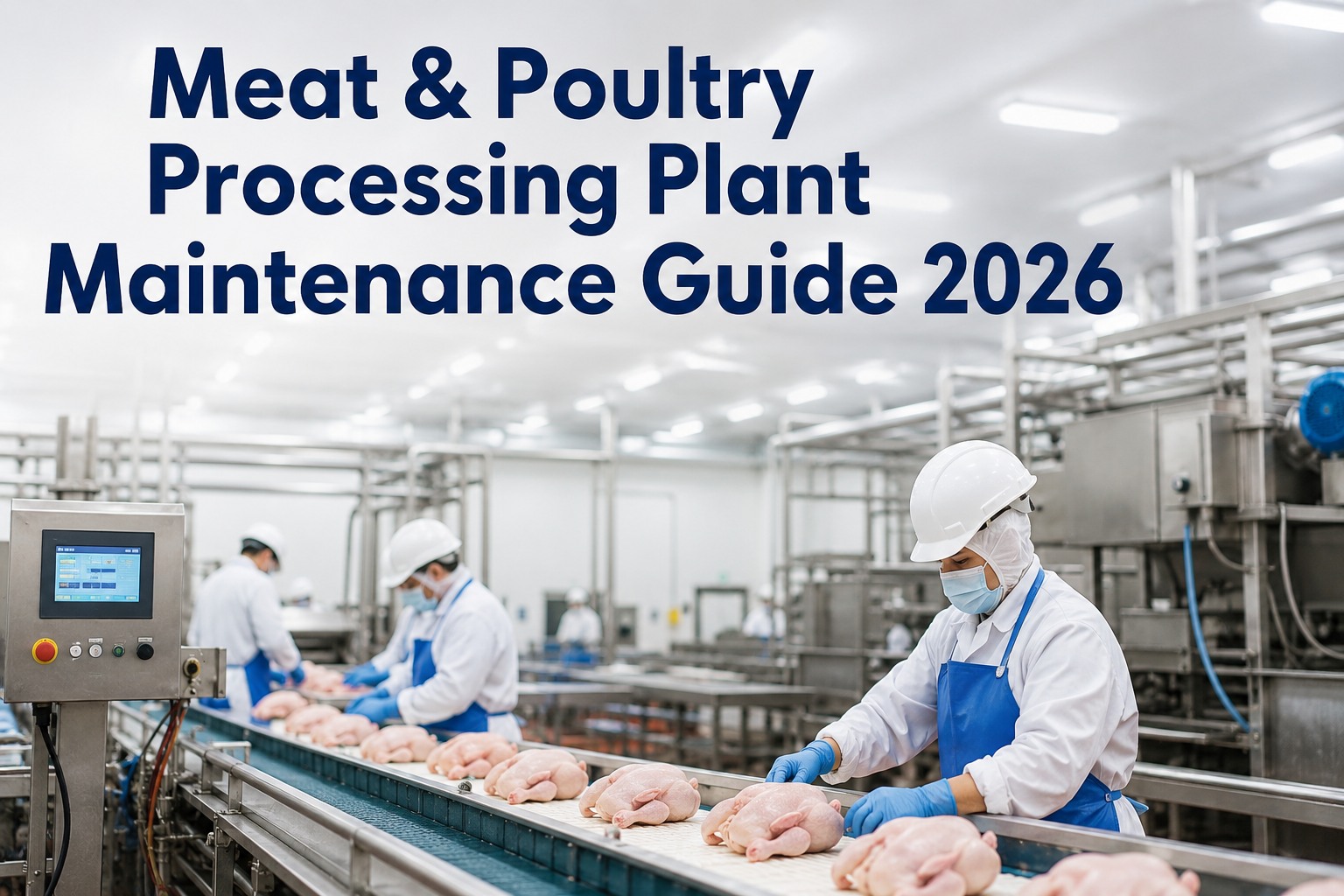
Meat and poultry processing plant maintenance is one of the most demanding operational environments in the food industry — every shift runs under continuous USDA FSIS inspection, where a single undocumented equipment failure or sanitation gap can trigger a regulatory hold, product recall, or plant shutdown. An effective meat plant PM schedule must balance high-pressure washdown protocols, sanitary equipment design, and rigorous HACCP documentation while keeping cutting, deboning, and packaging lines running at peak OEE. OxMaint delivers an AI-powered CMMS built for protein plants — integrating HACCP-compliant work orders, sanitary PM scheduling, and real-time audit trails so your maintenance program is always FSIS-defensible. Start your Start Free Trial to see how quickly you can replace reactive chaos with predictive control.
Meat & Poultry Plant Maintenance 2026
Can your maintenance program survive an unannounced USDA FSIS audit — today?
Continuous on-site federal inspection means maintenance records are regulatory documents. OxMaint structures every work order, PM trigger, and sanitation SOP into a real-time, FSIS-defensible audit trail — eliminating paper gaps that cost plants $50K–$500K per noncompliance event.
Why Meat & Poultry Maintenance Is Different
USDA FSIS inspection changes everything about your maintenance strategy
Unlike general manufacturing, a meat processing plant operates under continuous federal inspection — USDA FSIS inspectors are physically on the floor every production shift, empowered to halt lines, tag equipment, and issue Noncompliance Records (NRs) in real time. Your poultry processing maintenance program is not just a reliability function; it is a regulatory compliance system.
Every conveyor, band saw, scalding tank, chiller, and packaging line must be maintained to sanitary design standards — and every maintenance action must be documented, timestamped, and retrievable on demand. When inspectors request proof that a bone harvester was sanitized, lubricated with food-grade grease, and returned to service per SOP, plants relying on paper logs or disconnected spreadsheets scramble. Plants running a purpose-built meat plant CMMS like OxMaint retrieve the complete record in seconds — with digital signatures, parts traceability, and HACCP prerequisite tags attached.
Preventive Maintenance Schedule
Building a meat plant PM schedule that passes FSIS and protects OEE
A defensible meat processing maintenance schedule aligns equipment PM intervals with USDA HACCP maintenance prerequisites, sanitation SOPs, and manufacturer-recommended service windows — then triggers them automatically so nothing falls through the cracks during shift changes or harvest surges.
Sanitation & Pre-Op Verification
- Pre-operational sanitation inspection of all food-contact surfaces on cutters, grinders, and conveyors
- Verify ATP swab results on stainless steel processing tables and deboning equipment
- Inspect and clear floor drains, hose stations, and washdown boot-wash entry points
- Document temperature logs on chillers, scalders, and blast freezers at shift start
- Confirm food-grade lubrication on all chain drives and guide rails exposed to product zone
Cutting & Processing Equipment
- Sharpen, tension, and track band saw blades; log blade replacement for metal-detection HACCP records
- Inspect paddle deboner seals and bearings for protein buildup and leakage
- Calibrate metal detectors and X-ray reject systems using certified test wands
- Inspect stuffing horn couplings and emulsifier plate alignment on sausage lines
- Torque and lock out knife sharpener assemblies per sanitary design SOP
Refrigeration & Utilities
- Inspect ammonia compressor seals, valve packing, and relief vent paths on refrigeration racks
- Calibrate RTD temperature sensors in blast freezers and carcass coolers to ±0.5°C
- Clean and inspect condenser coils, evaporator fans, and defrost cycles on processing-floor units
- Test boiler water chemistry, steam trap function, and CIP heat-exchanger plates
- Verify emergency stop circuits and light curtains on automated packaging and palletizing lines
Sanitary Design Deep Audit
- Tear down and inspect welds, gaskets, and dead-leg zones on stuffing and emulsifying equipment
- Validate predictive vibration and thermal imaging baselines on all critical motor-driven assets
- Audit spare parts inventory for food-grade certification, lot traceability, and shelf-life expiry
- Review and update HACCP plan equipment list with FSIS inspector; reconcile asset register
- Recalibrate entire HACCP CCP monitoring instrument fleet (pH meters, thermometers, scales)
Sanitary Design & Washdown Maintenance
High-pressure washdown maintenance: protecting sanitary equipment design
Meat and poultry plants run daily washdown cycles using 1,500–3,000 PSI chlorinated alkaline cleaners at 55–60°C. This aggressive sanitation protocol — required by FSIS — destroys standard industrial equipment if maintenance teams do not actively protect IP69K-rated enclosures, sealed bearings, and stainless steel welds.
| Washdown Maintenance Risk | Conventional Plant Reaction | OxMaint-Managed Protein Plant |
|---|---|---|
| Water ingress into motor control enclosures | Reactive replacement after arc-fault failure; 4–8 hrs unplanned downtime | Quarterly enclosure seal-inspection PM auto-triggered; 90% fewer ingress faults |
| Chloride pitting on stainless steel food-contact surfaces | Detected during FSIS pre-op inspection; line held until rework complete | Passivation and weld-inspection PM scheduled every 90 days; zero pre-op holds |
| Sealed bearing failure on washdown-rated conveyors | Run-to-failure; 2 days lead time on specialty bearings, $12K lost production | Vibration + thermal predictive alerts flag degradation 3–6 weeks before failure |
| Lubricant washout on guide rails and chains | Visible product-zone grease; NR issued by inspector; batch held for QA review | Food-grade re-lubrication PM auto-sequenced after each daily washdown cycle |
| Gasket and seal degradation on stuffing and pumping equipment | Protein buildup under seals detected by sanitation crew; teardown during production | Monthly gasket-inspection PM with photo documentation in CMMS; proactive swap |
OxMaint treats every washdown cycle as a maintenance trigger — not just a sanitation event. By automatically sequencing post-washdown lubrication, seal inspections, and enclosure checks into the daily PM calendar, the system ensures that sanitary equipment design integrity is preserved shift after shift, and that every action carries a digital signature retrievable for any FSIS records request.
How OxMaint Helps
The protein plant CMMS built for FSIS compliance intensity
OxMaint maps directly to the realities of meat packing maintenance — where a missing work order signature is a regulatory event and a two-hour line stoppage is measured in thousands of pounds of lost yield. These are the four capabilities that change the math for maintenance and reliability teams in protein processing.
HACCP-Integrated Work Orders
Every work order carries HACCP prerequisite and CCP tags — so FSIS inspectors see which equipment, sanitation SOP, and critical limit each maintenance action supports, with digital signatures and timestamped completion.
Outcome: Eliminate paper record gaps and cut audit response time from hours to seconds.
Sanitary PM Auto-Scheduling
OxMaint sequences post-washdown lubrication, gasket inspections, and metal-detector calibrations automatically against your production and sanitation calendar — so PMs never collide with harvest runs or get skipped during shift changes.
Outcome: Reduce equipment-related NRs by 60–80% and lift OEE by 4–7 points.
Predictive Washdown Asset Health
AI-driven vibration and thermal analysis on motors, compressors, and bearings detects degradation 3–6 weeks before failure — critical in a washdown environment where water ingress and lubricant washout accelerate wear unpredictably.
Outcome: Cut unplanned downtime 30–50% and eliminate $10K–$40K emergency repair events.
Food-Grade Spare Parts Traceability
Track every food-grade lubricant, gasket, and blade by lot number, supplier certificate, and expiry date. When a supplier recall or FSIS traceability request lands, OxMaint identifies affected equipment and production batches in minutes — not days.
Outcome: Reduce recall exposure and parts stockouts by 40–60% with lot-level traceability.
Real-World Scenario
A 180-asset poultry plant: from reactive chaos to FSIS-defensible in 90 days
Consider a mid-size poultry processing plant running 180 critical assets — two evisceration lines, a scalding tank bank, eight chillers, and automated packaging — spending $42,000 annually on emergency maintenance and losing an additional $85,000 in production to unplanned equipment downtime. Their maintenance program ran on paper logs and a shared spreadsheet.
- 14 equipment-related NRs in 12 months — 4 resulting in line holds
- $42K/yr emergency repair spend; no predictive capability
- Audit prep took 3 maintenance supervisors a full week of record reconstruction
- Spare parts stockouts caused 6 production delays averaging 3.5 hours each
- 2 equipment-related NRs in the following 12 months — zero line holds
- $19K/yr repair spend after predictive alerts caught 8 bearing failures early
- Audit prep reduced to under 2 hours — records live in CMMS, retrievable instantly
- Zero parts-related delays; auto-reorder triggers kept critical spares at min-max
Net result: $108,000 in avoided emergency repair and downtime costs in year one — a payback period under 3 months on the OxMaint subscription. The plant's maintenance manager now walks into every FSIS review with a tablet, not a binder, and pulls any work order, PM record, or parts lot in under 30 seconds.
See OxMaint on Your Assets
Stop hoping your paper records survive the next FSIS audit
Book a 30-minute demo and see how OxMaint transforms meat and poultry plant maintenance into a proactive, HACCP-integrated, fully documented compliance system — built for the intensity of continuous federal inspection.
Frequently Asked Questions
Meat and poultry plant maintenance: what teams ask most
What is a meat processing plant maintenance schedule and why does it need USDA HACCP integration?
A meat processing plant maintenance schedule is a structured plan of preventive and corrective maintenance tasks for all food-contact and utility equipment — but in a USDA-regulated environment, it must be integrated with your HACCP plan. That means every PM on a critical asset (band saw, stuffer, metal detector, chiller) must be tagged to the corresponding HACCP prerequisite or CCP, documented with timestamps and signatures, and retrievable for FSIS inspection on demand. OxMaint automates this linkage so maintenance records serve double duty as compliance documents.
How does a CMMS help with USDA FSIS maintenance compliance?
A purpose-built CMMS like OxMaint turns every maintenance action into a compliance-grade record — capturing who performed the work, when it was done, which parts and food-grade lubricants were used, and which HACCP prerequisite it supports. During an FSIS audit, inspectors can see a complete, tamper-evident digital trail in seconds instead of sorting through paper logs. This eliminates the record gaps that trigger Noncompliance Records and line holds. You can Book a Demo to see the audit trail in action.
What are the most critical PM tasks for poultry processing equipment?
The highest-priority PM tasks for poultry processing maintenance include daily pre-op sanitation verification on all food-contact surfaces, weekly band saw blade sharpening and metal-detector calibration with certified test wands, monthly ammonia compressor and chiller inspections, and quarterly sanitary design teardowns of stuffing and deboning equipment. Equally critical is post-washdown re-lubrication with food-grade grease — if this is skipped, washout accelerates bearing failure and creates product-zone contamination risk.
How often should high-pressure washdown equipment be inspected in a meat plant?
High-pressure washdown systems and the equipment they clean should be inspected on a tiered schedule: daily visual checks of spray nozzles, hoses, and chemical dosing pumps; weekly verification of washdown water temperature (55–60°C) and chemical concentration; and monthly inspection of pump seals, hose integrity, and IP69K enclosure gaskets on all processing-floor equipment. OxMaint auto-schedules these inspections and sequences post-washdown PMs so seal and lubrication checks happen right after each sanitation cycle.
Can OxMaint replace our spreadsheet and paper-based maintenance system in a slaughter plant?
Yes — OxMaint is designed specifically to migrate plants from spreadsheets and paper logs to a digital, audit-ready CMMS. The platform imports your existing asset list, PM intervals, and parts inventory, then layers on HACCP tagging, automated PM scheduling, predictive analytics, and mobile work orders. Most protein plants are fully live within 2–4 weeks, and the switch eliminates the paper gaps, missed PMs, and audit-week panic that plague spreadsheet-based maintenance programs.
Start Your OxMaint Journey
Your maintenance program should be your strongest FSIS compliance asset
Join the protein plants using OxMaint to cut unplanned downtime 30–50%, eliminate paper audit chaos, and turn maintenance into a proactive, HACCP-defensible system — built for the intensity of continuous USDA inspection.
Free 14-day trial · No credit card