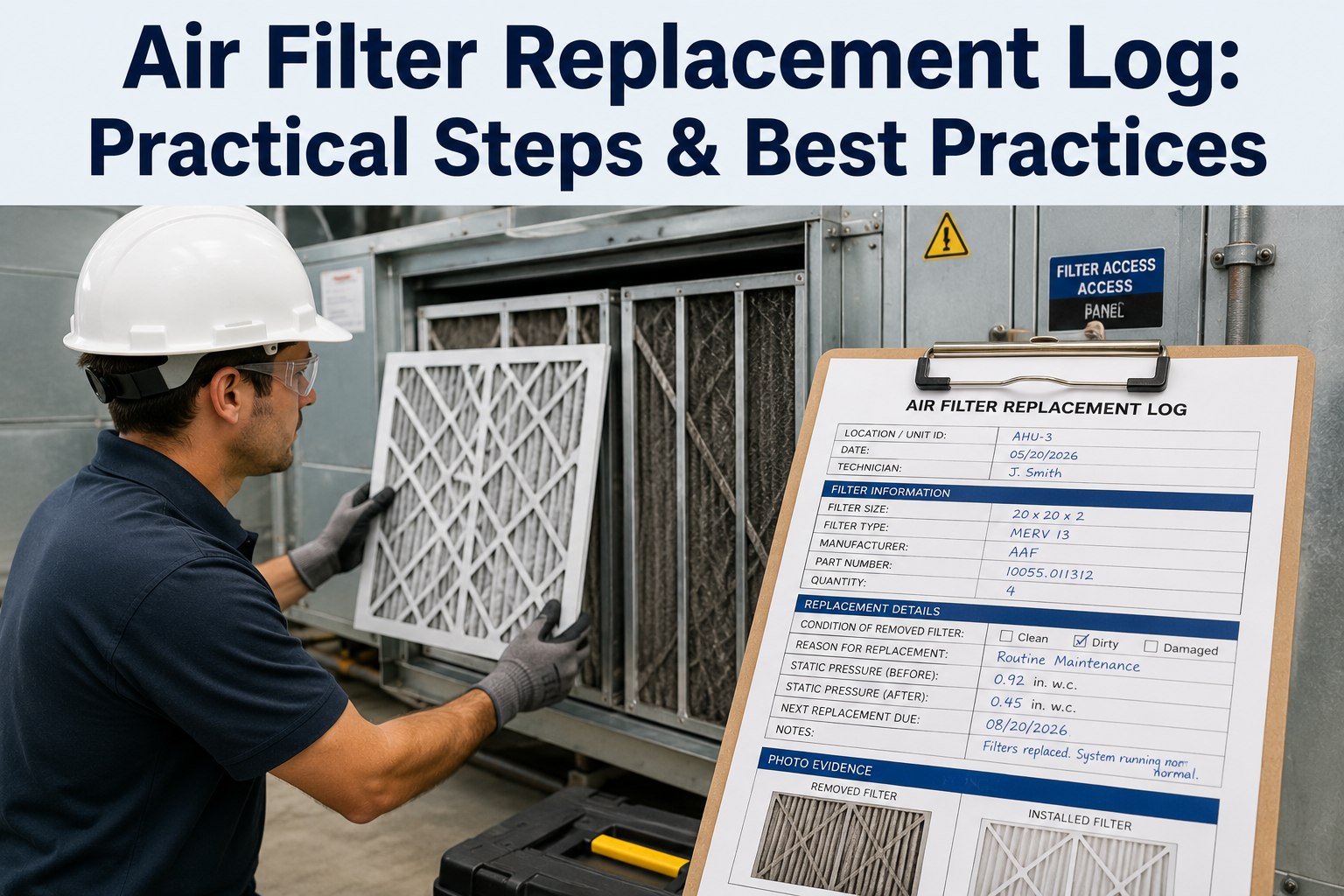
An air filter is the cheapest piece of equipment in your HVAC system and the most consequential when it fails. A loaded filter starves the coil of airflow, spikes fan energy draw, degrades indoor air quality below ASHRAE 62.1 minimums, and — in the worst case — collapses into the coil and demands a repair that costs a hundred times what a scheduled replacement would have. And yet in most commercial portfolios, the filter change program still lives on a spreadsheet, a whiteboard, or a technician's memory of "we did the third floor last month, I think." A proper Air Filter Replacement Log fixes that: every filter, every location, every change, every reading, every photo, every signature — one traceable record per asset. This guide walks the complete procedure aligned to ASHRAE 52.2, the MERV scale, and the differential-pressure logic that determines when replacement is actually due. Book a free demo to see the digital filter log workflow across your building portfolio.
1969
ASHRAE 52 first published — current version ASHRAE 52.2-2017
1–16
MERV scale for commercial HVAC · higher = finer filtration, more airflow resistance
13+
ASHRAE-recommended MERV baseline post-COVID for commercial buildings
3
Triggers that drive replacement: schedule, ΔP threshold, or visual inspection
The MERV Scale · What You're Actually Replacing
ASHRAE 52.2 defines Minimum Efficiency Reporting Value (MERV) on a 1–16 scale for HVAC applications, with test methodology covering three particle-size ranges from <10 μm down to submicron. The replacement log has to know which MERV you're running, because filter loading behaviour, expected service life, and differential-pressure thresholds all change with the MERV rating. A MERV 8 filter in a light commercial AHU behaves nothing like a MERV 14 in a healthcare pre-filter position.
MERV Range
Particle Size Captured
Typical Application
Change Interval
1–4
Large particles >10 μm
Basic residential · window units
30 days
5–8
Medium particles 3–10 μm
Standard commercial · light industrial
60–90 days
9–12
Fine particles 1–3 μm
Commercial baseline · office IAQ
60–90 days
13
Sub-micron 0.3–1 μm · virus-size
ASHRAE COVID minimum · public buildings
90 days · ΔP-driven
14–16
Sub-micron high efficiency
Healthcare · labs · cleanroom pre-filter
90–180 days · ΔP-driven
The Three Triggers That Drive Replacement
Filter replacement is not a calendar function — it's a rules function with three independent triggers. Whichever fires first, wins. A defensible log has all three encoded, and the replacement work order fires the moment any one of them crosses threshold.
Trigger 1
Time-Based Schedule
Calendar-driven cycle per MERV rating — 30 / 60 / 90 / 180 days depending on filter class, occupancy load, and outside air quality
Trigger 2
Differential Pressure Threshold
Magnehelic or BMS-monitored ΔP crosses final-resistance setpoint — typically 2× initial pressure drop, or manufacturer-specified terminal value
Trigger 3
Visual Inspection Finding
Physical damage, tear, water saturation, biological growth, or heavy soiling observed during scheduled inspection — replacement immediate regardless of clock
The Complete Replacement Procedure
The procedure below is the working sequence a technician runs from the mobile work order — from arrival at the AHU to sign-off. Every step has evidence attached to it. Missed steps become audit findings.
A1
Verify AHU identity · asset tag scanned against WO, correct unit confirmed
A2
Log pre-change ΔP · magnehelic reading captured with photo of gauge
A3
Confirm spare in hand · correct MERV, correct size, count matches slots
A4
Fan off / LOTO if required · per site energy control procedure, photo of lock/tag
B1
Photo of loaded filter in-situ · before removal, showing soiling pattern
B2
Remove filter carefully · avoid dislodging accumulated dust into downstream duct
B3
Inspect frame & gasket · check for bypass gaps, damaged seals, corrosion at rack
B4
Vacuum housing · remove loose debris from filter rack before installing new element
C1
Verify airflow direction arrow · installed filters correctly oriented for airstream
C2
Seat filter fully in rack · confirm no gap between filter frame and rack — bypass is the enemy of MERV
C3
Label new filter · install date, MERV, technician initials on filter frame or nearby tag
C4
Close access panel · confirm gasket integrity, secure fasteners to torque spec
D1
Restore fan / LOTO removal · unit back to normal operation
D2
Log post-change ΔP · new baseline pressure drop captured with gauge photo
D3
Confirm airflow at supply grille · quick visual/vane check that airflow restored to expected level
D4
E-sign completion · technician signature, next scheduled change auto-generated
Run This Procedure From Every Technician's Phone
See how OxMaint delivers the 16-step filter change to the technician as a scheduled work order — photo capture on every step, ΔP readings against the asset, e-signature at close, next change auto-scheduled. 30-minute walkthrough with your AHU list.
The Differential-Pressure Curve · Why ΔP Trending Beats Calendar Alone
A filter's pressure drop increases predictably as dust loads onto the media. Charting ΔP against time gives you the real-world service life of each filter in each AHU under actual load conditions — always more accurate than a manufacturer's calendar estimate. The best air filter logs record ΔP at every inspection and plot the curve automatically, so the replacement work order fires when the curve crosses terminal, not when the calendar says so.
Day 0
0.25" wg
Initial resistance · new filter
Day 30
0.40" wg
Normal loading
Day 60
0.60" wg
Half-life · monitor closely
Day 75
0.80" wg
Approaching threshold
Day 90
1.00" wg
Terminal ΔP · replace now
Terminal ΔP = ~2× initial pressure drop · fires replacement WO automatically
What the Log Must Capture Per Filter Change
The log is only as good as the fields it enforces. The structure below is what a defensible air filter replacement record contains — the working baseline for ASHRAE 52.2 alignment and any facility audit.
Asset & Location
AHU Asset Tag
Building / Floor / Zone
Filter Rack Position
Number of Slots
Filter Specification
MERV Rating
Size (nominal & actual)
Media Type
Manufacturer / Part No.
Change Event
Trigger Reason
Date & Time (server)
Technician ID
Work Order Reference
Readings & Evidence
Pre-Change ΔP + Gauge Photo
Loaded Filter Photo
Post-Change ΔP + Gauge Photo
New Filter Install Photo
Findings & Next Action
Frame / Gasket Condition
Bypass Observations
Corrective WO if Needed
Next Change Auto-Scheduled
Sign-Off
Technician E-Signature
Supervisor Countersign (if req'd)
Immutable Timestamp
Locked Record ID
Best Practices That Separate Good Programs From Reactive Ones
The mechanics of a filter change are simple. The program discipline around them is what separates a facility that passes every audit from one that gets cited every visit.
01
Cycle by ΔP, Not by Calendar Alone
Calendar as backstop; ΔP threshold as the primary trigger. A filter running clean at day 60 shouldn't be changed just because the calendar says so.
02
One Log Per Filter Position, Not Per AHU
Multi-slot AHUs need per-slot logs — different positions load differently. Averaging hides which slots need attention.
03
Photo Every Load and Every Install
Before and after. IAQ complaints get resolved by photo evidence of clean filter installation — nothing else convinces occupants.
04
Track Inventory Against Consumption
Filter stockouts are the #1 cause of overdue changes. Auto re-order rules tied to consumption forecasts prevent the "waiting on delivery" excuse.
05
Inspect Racks and Gaskets, Not Just Filters
A MERV 13 filter in a leaky rack behaves like a MERV 8. Bypass eliminates filtration efficiency; gasket integrity checks belong on every change.
06
Trend ΔP Across Changes, Not Just Within One
If loading rate accelerates each cycle, something upstream has changed — outside air quality, construction dust, coil fouling. Trend triggers root-cause work.
Expert Perspective · Why Filter Logs Fail and How to Fix Them
Filter programs fail for one of two reasons, and both are fixable in a week. The first is that the log lives somewhere the technician doesn't work — a shared drive, a supervisor's spreadsheet, a binder in the mechanical room nobody opens. The second is that the ΔP reading gets treated as optional, so nobody actually captures it, so nobody can see the loading curve, so the replacement decision falls back to the calendar. Fix both together by putting the log on the technician's phone as a scheduled work order that won't submit without the readings and photos, and the entire program transforms. Filter costs drop because the pretend-schedule stops replacing filters that still had 30 days of life. IAQ complaints drop because every install has photo evidence attached. Fan energy drops because loaded filters get caught before they force fan overwork. And ASHRAE 52.2 alignment stops being an annual audit scramble and starts being an automatic byproduct of doing the work in the right system.
Log at the Point of Work
Mobile capture at the AHU, not a spreadsheet at the desk. The gap between "changed" and "logged" is where records fail.
Make ΔP Mandatory
The form won't submit without pre and post readings. Without ΔP data, the calendar becomes the only trigger — and the calendar is always wrong.
Photo Evidence On Every Change
Loaded filter photo before removal, new install photo after. Two seconds each. Solves 90% of IAQ complaints and audit disputes.
How OxMaint Runs the Air Filter Replacement Program
OxMaint packages the full filter program on the CMMS your team already uses — asset records for every filter position, auto-scheduled work orders per MERV cycle, ΔP-triggered escalation from BMS integration, mobile capture with mandatory photo and reading fields, and ASHRAE-aligned audit export in seconds.
Schedule
Auto WO Generation
Per-position filter change WOs auto-generate on MERV-specific cadence, route to the assigned technician's phone
Trigger
ΔP Threshold Escalation
BMS-monitored ΔP crossing terminal setpoint fires replacement WO regardless of calendar position
Capture
Mobile Readings + Photo
Mandatory pre/post ΔP fields, loaded filter photo, install photo — form blocks close-out until captured
Inventory
Stock Alerts & Re-Order
Consumption-forecast re-order rules prevent stockouts that cause overdue changes
Trend
ΔP Loading Curves
Auto-charted ΔP over time per filter position, surface accelerated loading before it becomes a problem
Audit
ASHRAE-Aligned Export
Filter by building, AHU, date, MERV — export a defensible, signed, timestamped log in seconds for any audit
Stop Guessing When Filters Are Actually Loaded
Every change captured with readings and photos, every ΔP threshold monitored, every audit export a two-click filter. Free forever plan available to trial the full workflow across your building portfolio.
Frequently Asked Questions
What is ASHRAE 52.2 and how does it apply to filter replacement logs?
ASHRAE 52.2 is the American standard that defines the test methodology for HVAC air filter performance, expressed as a Minimum Efficiency Reporting Value (MERV) on a 1–16 scale. First published in 1969 and currently at the 52.2-2017 revision, it establishes how filters are challenged with standardized aerosols and measured across three particle-size ranges. The replacement log applies the standard by recording which MERV class is installed in each AHU position, when it was changed, why, and what the pre and post pressure drops were — so filter selection stays aligned with design intent and every change is traceable.
What MERV rating should commercial buildings use?
The commercial baseline was historically MERV 8, and MERV 9–12 remains the most common range for office buildings — effective on the fine particles (1–3 μm) that drive occupant IAQ concerns without overloading standard AHUs. Post-COVID, ASHRAE recommends MERV 13 or higher for public buildings because MERV 13 begins capturing sub-micron particles including virus-sized aerosols. Higher-MERV filters increase airflow resistance, so a MERV upgrade should always be paired with a system evaluation to confirm the AHU can handle the added pressure drop without airflow starvation.
Sign up free to load your MERV baseline per AHU.
How often should HVAC air filters actually be replaced?
The right answer is trigger-based rather than calendar-based. Time cycles are useful as backstops — 30 days for basic MERV 1–4, 60–90 days for MERV 5–12, 90+ days for MERV 13–16 — but the primary trigger should be differential pressure crossing a defined terminal value, typically about 2× the initial clean pressure drop or a manufacturer-specified final resistance. A visual inspection finding — physical damage, water saturation, biological growth — triggers immediate replacement regardless of clock or ΔP. Best-practice programs run all three triggers in parallel and replace on whichever fires first.
Why capture pre-change and post-change differential pressure?
Pre-change ΔP confirms whether the filter was actually at replacement threshold or whether the calendar fired early — over time this data tunes the schedule to real-world loading rates. Post-change ΔP establishes the new baseline against which loading will be tracked, and confirms the new filter is properly seated (bypass shows up as an abnormally low ΔP for a new filter). Together they produce the loading curve that lets a facility replace on data rather than assumption.
Book a free demo to see ΔP trending in action.
What's the difference between MERV, MPR, FPR, and HEPA?
MERV is the ASHRAE 52.2 standard scale (1–16 for HVAC, 17–20 for HEPA-class), and it's the reference used in commercial specifications and codes. MPR is a proprietary 3M scale for residential filters; FPR is a Home Depot proprietary residential scale. Both roughly track MERV but aren't directly interchangeable. HEPA (High Efficiency Particulate Air) filters are defined separately, capturing 99.97% of 0.3 μm particles — used in healthcare, labs, cleanrooms, and typically deployed downstream of MERV pre-filters. For commercial procurement and log records, MERV is the value that matters.
Does OxMaint handle the full HVAC filter program or just the log?
OxMaint runs the full program: filter position asset records, MERV-specific auto-scheduled work orders, ΔP-threshold escalation from BMS integration, mobile capture with mandatory readings and photos, inventory tracking with consumption-forecast re-order rules, ΔP loading-curve trending per filter position, and ASHRAE-aligned audit export. The log isn't a separate document — it's the natural byproduct of doing the work in the CMMS. Deployment starts with a single building or a single AHU cluster and expands out; the free forever plan is available to trial the full workflow.
Sign up free to load your first AHU.