Airports and data centers are not in the same industry, but they share an identical operational mandate zero unplanned downtime. A single hour of data center downtime now costs an average of $300,000, and a four-hour runway lighting failure at a major hub can cascade into millions in delayed flights, diverted aircraft, and SLA penalties to airlines. Both environments depend on cooling, power continuity, and predictive intelligence to keep critical assets running 24/7/365. The maintenance philosophy that protects a Tier IV data center is, mechanically, the same one that protects an international airport condition-based monitoring, structured PM execution, and CMMS-driven workflow that eliminates the gap between detection and repair. See how Oxmaint applies that philosophy across both verticals start a free trial or book a demo to see your critical assets on the platform.
Critical Infrastructure Uptime Monitoring Predictive Maintenance
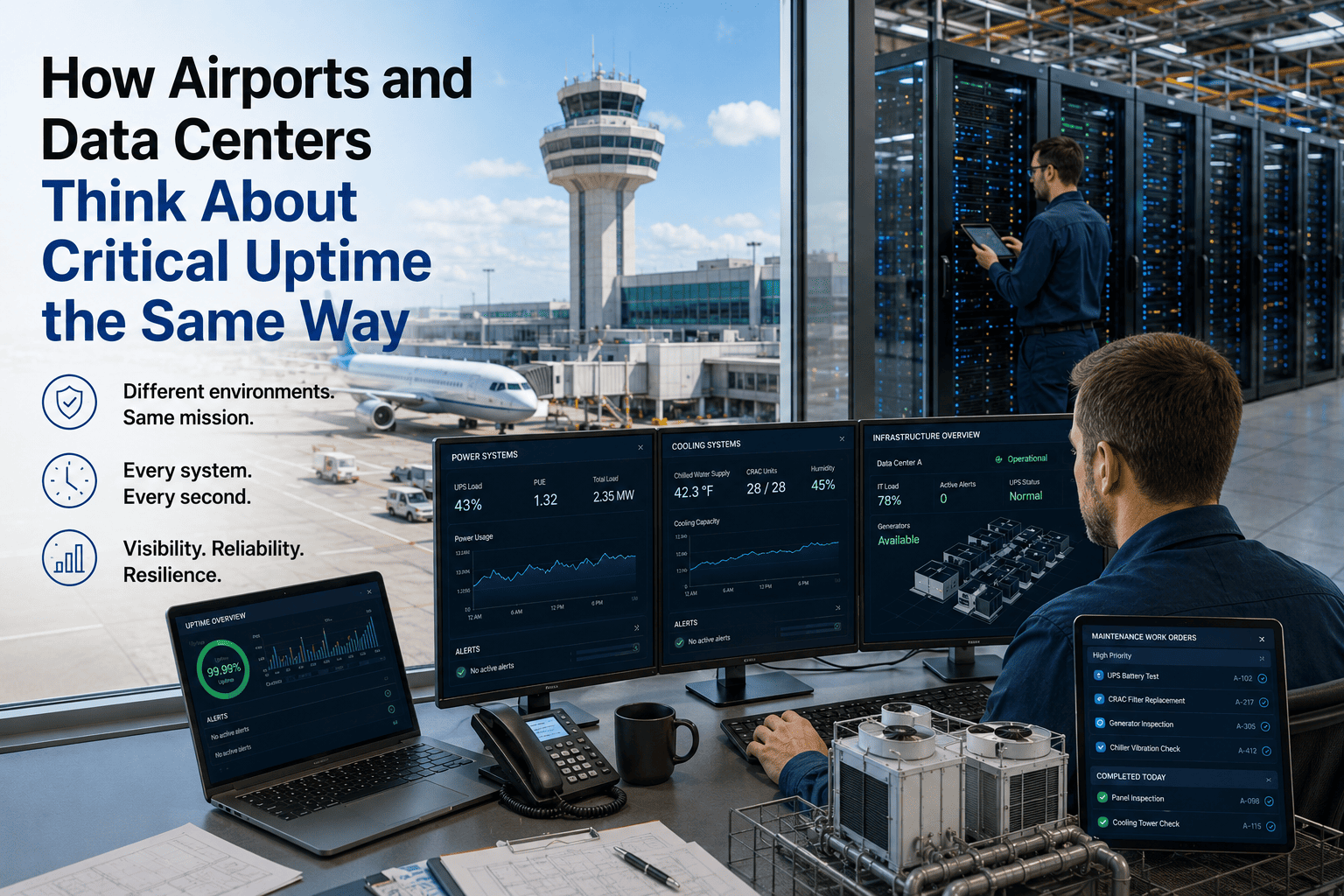
How Airports and Data Centers Think About Critical Uptime the Same Way
Two industries, one mandate. The cooling failures, power anomalies, and asset degradation that take down a data center are the same patterns that ground aircraft. This guide breaks down the shared playbook and how Oxmaint operationalizes it across both.
Uptime SLA Tiers
Tier IV / Cat III
99.995%
Tier III / Cat II
99.982%
Tier II / Cat I
99.741%
$300K
Average cost of one hour of data center downtime in 2025
5.26 min
Total annual downtime allowed at 99.999% uptime
29 min
Average duration of a cooling-related thermal event
$3.7M
Cost of a single 36-hour critical infrastructure cascade failure
Shared Operational DNA
What Airports and Data Centers Have in Common Beyond the Obvious
Both airports and data centers operate critical infrastructure where a single sub-system failure can cascade into multi-million dollar incidents within minutes. Both rely on redundant cooling, redundant power, and redundant control systems and both discover that redundancy only works when every redundant unit is itself maintained as if it were the only one. A backup CRAC unit that has not been load-tested in 18 months is not redundancy, it is theater.
Both verticals also share the same enemy reactive maintenance. The cost of reactive repair at scale is 4.8 times the cost of planned intervention, and at the scale of an international airport or a hyperscale data center, that multiplier is measured in seven figures per event. The maintenance leaders winning at uptime are the ones who have stopped reacting and started monitoring. To explore how Oxmaint structures predictive maintenance for critical infrastructure, start a free trial or book a demo with our infrastructure specialists.
The Shared Framework
The Eight Pillars of Critical Uptime Maintenance
Whether you are protecting a Tier IV colocation facility or a Category III precision approach runway, the underlying maintenance architecture is the same. These eight pillars define how high-reliability operations stay running.
01
Asset Criticality Tiering
Every asset ranked by failure impact. Tier 1 stops operations within minutes. Tier 2 degrades performance. Tier 3 is recoverable. PM frequency and spare parts strategy follow tiering.
02
Condition-Based Monitoring
Vibration, temperature, current, and pressure sensors track behavioral signatures. Deviation from baseline triggers an alert weeks before the failure actually occurs.
03
Redundancy Verification
Backup units are load-tested on a defined schedule. A redundant cooling unit that has not run in 12 months cannot be assumed functional during a primary failure event.
04
Compliance Documentation
Tier certification audits, FAA Part 139 inspections, and ISO 50001 reviews require auditable PM completion records, photo evidence, and timestamped sign-offs.
05
Mean Time to Repair Tracking
Every minute between fault detection and repair completion is measured. MTTR is the single best leading indicator of whether your team can hit five-nines uptime.
06
Spare Parts Pre-Positioning
Critical spares for Tier 1 assets are kept on-site with verified shelf-life and rotation. A 14-day OEM lead time is not acceptable for a CRAC compressor or runway light controller.
07
Cross-Site Portfolio Reporting
Multi-site operators compare PM compliance, MTTR, and incident rates across facilities to identify which sites are at risk before they fail.
08
CapEx Forecasting on Condition Data
5 to 10 year capital plans built on actual asset condition scores rather than calendar age. Investors and boards demand condition-grade lifecycle data.
Industry Pain Points
Why Critical Infrastructure Teams Still Miss Uptime Targets
Despite massive investment in redundant hardware, both airports and data centers continue to miss uptime targets. The root cause is rarely the equipment itself it is the maintenance system around the equipment. If your operation is struggling with any of the patterns below, start a free trial of Oxmaint to see condition-based monitoring in action, or book a demo for a critical infrastructure walkthrough.
01
Redundant Units Never Load-Tested
Approximately 40 percent of cooling-related outages involve a backup unit that failed to absorb load due to undiscovered maintenance issues. Redundancy on paper is not redundancy in reality.
02
Reactive Maintenance Cost Multiplier
Reactive interventions cost 4.8 times more than planned ones. At a hyperscale facility or major airport, that translates into hundreds of thousands per avoidable event.
03
Audit Documentation Crises
Tier certification reviews and FAA Part 139 audits require complete documentation. Manual evidence assembly burns 2 to 4 weeks of staff time and exposes operators to compliance findings.
04
Siloed Asset Data Across Sites
Multi-site portfolios cannot compare PM compliance, MTTR, or incident frequency across facilities. Risk concentrates invisibly until a failure exposes it.
How Oxmaint Solves It
How Oxmaint Protects Critical Uptime Across Airports and Data Centers
Oxmaint runs as the central maintenance nervous system for both verticals ingesting condition data from cooling systems, UPS banks, generator sets, runway lighting, baggage handling, and HVAC at portfolio scale. Threshold breaches auto-generate prioritized work orders with failure mode, criticality, and spare parts already attached. Ready to see this on your critical infrastructure? Start a free trial today or book a demo to map your specific asset hierarchy.
Cooling Monitoring
CRAC, Chiller, and CDU Health Tracking
Vibration, pressure, and thermal signatures monitored 24/7. AI flags degradation weeks before thermal events. Backup units automatically queued for load-test verification.
Power Continuity
UPS, PDU, and Generator Set Surveillance
Battery string degradation, transfer switch performance, and fuel system integrity all tracked at component level. Failure rate dropped 3x vs reactive operations.
Compliance
Audit-Ready Documentation in Minutes
Tier III/IV and FAA Part 139 evidence exports automatically PM completion records, photo evidence, and timestamped sign-offs in under 2 hours, not 2 weeks.
Portfolio View
Multi-Site Uptime Dashboards
Compare PM compliance, MTTR, and incident rates across every facility, terminal, or campus. Identify outlier sites before they become incident headlines.
CapEx Modeling
Investor-Grade 5 to 10 Year Forecasting
Capital plans built on actual condition scores rather than calendar age. Investor-ready CapEx models for board reporting and refinancing events.
Mobile Workflow
Technician Mobility Across Vast Facilities
Field crews access work orders, asset history, and digital checklists across terminals, server halls, and equipment yards from any smartphone with offline capability.
Reactive vs Predictive
Reactive Maintenance vs Oxmaint Predictive Program in Critical Infrastructure
The financial case for switching from reactive to predictive maintenance in critical infrastructure is unambiguous. The comparison below uses average outcomes from Tier III/IV data center operators and major airport facilities running reactive versus structured predictive programs.
| Reliability Metric | Reactive Operations | Oxmaint Predictive Program |
|---|
| Unplanned downtime per year | 52.6+ minutes | Under 5.26 minutes |
| Cooling-related thermal events | 2 to 4 per year | Approaches zero |
| UPS battery string failure rate | 3x baseline | Baseline or better |
| PM completion rate at 60 days | 58% industry average | Above 94% |
| Audit documentation prep time | 2 to 4 weeks manual | Under 2 hours, instant export |
| Cost per maintenance event | 4.8x baseline | 1.0x baseline |
| MTTR for critical asset fault | 4 to 8 hours | Under 60 minutes |
| Customer churn after outage | Significant | Minimal |
ROI and Results
What Oxmaint Delivers for Critical Uptime Operations
Critical infrastructure operators on Oxmaint report consistent outcomes within the first 12 months of deployment. These numbers come from real Tier III/IV data center and airport facility deployments start a free trial to see how the same metrics apply to your operation.
40%
Reduction in Unplanned Downtime
Critical infrastructure facilities report 40 percent fewer unplanned outages within 12 months of Oxmaint deployment.
12%
Average PUE Improvement
Data centers running Oxmaint structured cooling PM programs document 12 percent average PUE improvement over 18 months.
94%
PM Completion at 60 Days
Maintenance teams on Oxmaint hit 94 percent PM completion rate within 60 days, vs 58 percent industry average for reactive operations.
2 hrs
Audit Documentation Generation
Tier III/IV compliance documentation generates in under 2 hours from Oxmaint, vs 2 to 4 weeks of manual record assembly.
4.8x
Reactive vs Planned Cost Gap
Reactive repairs cost 4.8 times more than planned interventions predictive maintenance closes that gap permanently.
3x
Lower UPS Failure Rate
UPS battery string failure rates drop to one-third of reactive program baselines when Oxmaint monitors string voltage and impedance.
FAQ
Critical Infrastructure Uptime Common Questions
Can Oxmaint integrate with our existing BMS, SCADA, and DCIM platforms?
Yes. Oxmaint connects to existing Building Management Systems, SCADA, and DCIM platforms via API and OPC-UA so sensor data flows directly into the maintenance workflow without rip-and-replace. Vibration, temperature, current, and pressure data become work order triggers automatically.
Book a demo to see integration with your specific platforms.
How quickly can a major airport or data center go live on Oxmaint?
Most critical infrastructure facilities are operational on Oxmaint within days, not months. There is no heavy implementation, no specialized hardware required, and no multi-quarter onboarding. Asset hierarchy import, mobile rollout, and first PM cycle can all happen inside the first 30 days.
Start a free trial to begin today.
Does Oxmaint support Tier III and Tier IV compliance documentation requirements?
Yes. Oxmaint generates audit-ready Tier compliance evidence in minutes, including bi-weekly PM verification records, fault tolerance test documentation, redundancy path audits, and continuous compliance evidence required for ongoing certification.
Can the same platform handle airport asset diversity HVAC, runway lighting, baggage systems, fire systems?
Yes. Oxmaint's asset hierarchy supports portfolio, property, system, asset, and component levels with custom checklists per asset class. The same platform runs CRAC monitoring at a data center and runway edge light inspections at an international airport with full FAA Part 139 documentation.
Critical Infrastructure Uptime Predictive Maintenance Free to Start
Stop Losing Millions to Reactive Critical Infrastructure Failures
Whether you operate a Tier IV colocation facility, an international airport, or a portfolio combining both Oxmaint turns every cooling unit, UPS bank, generator set, and runway controller into a predictable, monitored, audit-ready asset. No heavy implementation. Works across multi-site portfolios. Live in days, not months.
- Real-time critical asset visibility across every facility
- Predictive failure alerts weeks before thermal events
- 5 to 10 year condition-based CapEx forecasting
Used by operations teams managing 10,000+ critical assets. Limited onboarding slots available this quarter.