Air handlers are the lungs of any commercial building — and like lungs, nobody notices them until they stop working. An air handling unit that fails in a hospital wing, a school during exam season, or a data center in summer does not just cause discomfort; it triggers emergency contractor calls, compliance incidents, and unplanned CapEx that should never have happened. The average commercial AHU fails 2.3 times per year in reactive-maintenance environments, each incident costing $4,200–$18,000 in emergency labor, parts, and downtime — costs that structured preventive maintenance reduces by 60% or more. Oxmaint's HVAC maintenance platform gives facility teams the asset visibility, PM scheduling, and mobile inspection workflows to keep every air handler performing at specification — before complaints, before failures, before the audit.
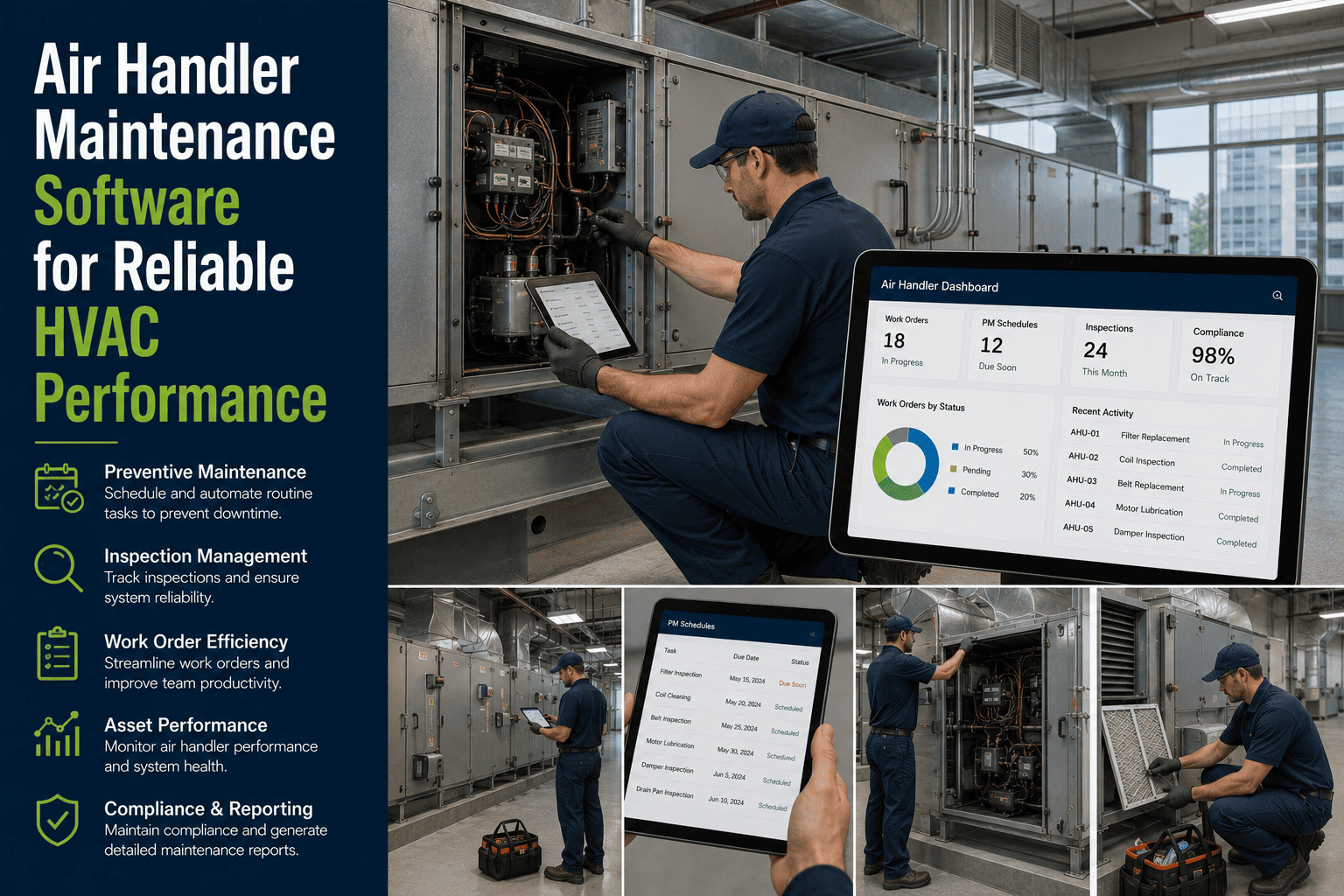
Air Handler Maintenance Software for Reliable HVAC Performance
Track service needs, automate inspections, and prevent breakdowns across every air handling unit in your portfolio — with mobile-first workflows built for how facility teams actually work.
What Is Air Handler Maintenance Software
Air handler maintenance software is a CMMS module — or a dedicated platform — that manages every service touchpoint for AHU systems: filter replacements, belt inspections, coil cleaning, bearing lubrication, damper checks, and control calibration. It replaces the clipboard-and-spreadsheet model with a digital system that schedules work automatically, assigns tasks to technicians on mobile devices, captures photo proof and timestamps, and builds a searchable service history per unit.
The difference between a generic work order tool and true HVAC maintenance software is asset intelligence. Each air handler in Oxmaint carries a condition score, a full component hierarchy (fan section, coil bank, filter array, controls), and a PM schedule calibrated to the unit's age, manufacturer spec, and building criticality. When a technician scans a QR code on AHU-12 in Building C, they see the current inspection checklist, the last three service records, any open work orders, and the next scheduled PM — all without leaving the mobile app. That is how you go from reactive to predictive, at scale — start a free trial to configure your first AHU asset register, or book a demo and we will walk through a live inspection workflow for your building type.
The AHU Maintenance Framework — 8 Critical Service Areas
Reliable air handler performance depends on eight service disciplines, each with its own inspection interval and failure signature. Miss any one consistently, and the degradation compounds into the others.
Differential pressure monitoring triggers replacements before restriction causes motor overload. Each filter event is timestamped, photographed, and logged — creating an unbroken compliance record.
Fouled cooling coils reduce heat transfer efficiency by 10–30%. Scheduled coil inspections with photo documentation confirm cleaning completion and track fouling progression between service events.
Belt tension and wear checks prevent the single most common AHU mechanical failure. Technicians log tension readings directly in the mobile app — triggering replacement work orders when readings fall outside spec.
Fan and motor bearing lubrication on schedule extends bearing life 3–5x compared to reactive replacement. Lubrication records include grease type, quantity, and technician confirmation per work order.
Stuck or slow dampers compromise ventilation rates and energy efficiency simultaneously. Quarterly actuator stroke tests are logged with pass/fail status and any corrective action taken during the visit.
Clogged condensate drains cause water damage and Legionella risk. PM schedules include drain pan cleaning and condensate line flush — with photo proof of clear flow attached to every work order.
Drifted temperature and CO2 sensors cause comfort complaints and energy waste simultaneously. Annual calibration records track sensor accuracy over time — with deviation trends flagged for early replacement.
Duct leakage above 10% of system airflow is the hidden energy cost in most commercial buildings. Periodic leak checks are logged by zone — with leakage severity ratings driving repair priority in the work order queue.
Real Scenarios — When AHU Maintenance Breaks Down
These are not hypothetical. They happen in facilities that rely on paper logs, shared spreadsheets, or disconnected work order systems — and they are entirely preventable.
Maintenance logs for AHU filter replacements in the surgical suite were incomplete — three consecutive quarterly changes had no technician sign-off. The infection control surveyor flagged the gap. No actual contamination occurred, but the incident triggered a root cause investigation, a corrective action plan, and a 6-week re-audit process. The fix was not new equipment — it was a digital log that could not be missed or left unsigned.
The AHU serving the IT server room had a blocked condensate drain. Nobody had a PM record showing the last drain cleaning. When the pan overflowed into the server rack below, the facility director could not demonstrate the maintenance schedule had been followed. The insurance claim was disputed on the grounds of inadequate maintenance records. $47,000 in equipment damage, plus a protracted claims process.
Tenants on floors 4 and 5 complained of stuffiness and temperature inconsistency for six months. The maintenance team responded to each complaint reactively — adjusting setpoints, replacing filters on complaint. Without a service history per unit, nobody identified that the AHU serving floors 4–5 had not had a coil cleaning in 26 months. One scheduled inspection found 35% fouling. A single coil clean resolved all complaints.
The AHU fan motor failed at 4 years — well within the 5-year warranty period. The manufacturer requested service records to confirm maintenance compliance. The facility could produce two paper logs from the first year, nothing after. The warranty claim was denied. A $12,400 motor replacement was paid out of the maintenance budget — for a failure that was both preventable and warrantable with proper documentation.
Every one of these scenarios has the same root cause: no structured, verifiable maintenance record per asset. Teams that move to digital AHU tracking with Oxmaint eliminate these gaps in the first week — start a free trial to set up your first AHU inspection workflow, or book a demo to see the mobile inspection process live.
How Oxmaint Works for Air Handler Maintenance
Oxmaint is not a generic work order tool with an HVAC label on it. It is built around how facility technicians actually service air handlers — on mobile, on-site, often alone, with no time to log back at the office. Here is what the daily workflow looks like.
Each air handler has a QR asset tag. Scanning it on any mobile device opens the unit's full profile — condition score, service history, current checklist, open work orders, and next PM date. No login search, no scrolling lists.
The digital checklist is configured for the specific AHU model — filter type, belt specs, coil access points. Each item requires a pass/fail reading or a numeric measurement. Nothing can be skipped without a supervisor override.
Filter condition, coil fouling level, belt wear — captured with the phone camera and attached directly to the work order. Photos are timestamped and GPS-tagged automatically. The audit record is complete before the technician leaves the mechanical room.
If the coil fouling score exceeds the threshold, a coil cleaning work order is automatically created and assigned. If belt tension is out of spec, a replacement order is queued. Nothing requires the technician to remember to report it.
The dashboard shows which AHUs have been inspected today, which are overdue, which have open corrective work orders, and which are approaching their next PM date. No status calls. No chasing technicians for updates.
When a regulatory inspector or building owner requests service records, the full AHU maintenance history — all inspections, work orders, photos, timestamps, technician sign-offs — exports as a formatted report in under two minutes.
Paper-Based vs. Digital AHU Maintenance — The Full Comparison
The operational gap between paper-based and digital AHU maintenance widens every month. Here is where the difference shows up in practice.
| Area | Paper-Based Maintenance | Digital Maintenance with Oxmaint |
|---|---|---|
| Inspection Record | Paper forms filed in binders — lost during audits, missing signatures, incomplete entries | Digital checklists with mandatory fields, timestamped completion, and photo attachments — exportable instantly |
| PM Scheduling | Calendar reminders or wall boards — missed during high-demand periods, no escalation when overdue | Automated PM triggers by calendar, runtime, or condition score — escalates to supervisor if overdue |
| Technician Accountability | No way to verify when work was done, by whom, or what was actually checked in the field | Every task timestamped, geotagged, and signed off per technician — full accountability trail per AHU |
| Fault Detection | Faults found on complaint or visual inspection — often weeks after degradation began | Condition readings trigger work orders automatically — faults addressed before they cause failure |
| Warranty Claims | Cannot demonstrate maintenance compliance — claims denied for lack of service documentation | Complete service history per unit with dates, technician records, and photo proof — claims supported |
| Energy Monitoring | No link between service history and energy consumption — waste invisible until the utility invoice | Asset condition scores correlate with energy draw — degraded units flagged for service before waste accumulates |
| Multi-Site Visibility | Each site maintains separate records — no portfolio view of AHU health, overdue PMs, or failure trends | Portfolio dashboard ranks buildings by AHU condition, PM compliance, and open corrective work orders |
| Audit Preparation | 2–4 days to compile records manually — still incomplete, unverifiable, and not accepted by some auditors | Full audit package generated in under 2 minutes — timestamped, photographic, and signed off digitally |
ROI and Results — What Structured AHU Maintenance Delivers
Facilities that move from reactive to structured AHU maintenance with digital tracking consistently report measurable improvements across energy, repair costs, asset life, and compliance readiness. These are documented outcomes, not projections.
The ROI on structured AHU maintenance software pays back in the first avoided emergency repair for most facilities — start a free trial to begin building your AHU asset register and PM schedules today, or book a demo to see a live walkthrough of the mobile inspection workflow for your facility type.
Frequently Asked Questions
How often should air handlers be inspected and serviced
What data should be captured in every AHU inspection
How does Oxmaint handle AHU maintenance across multiple buildings or sites
Can Oxmaint support HVAC compliance requirements for hospitals, schools, and food facilities
Stop Paying Emergency Rates for Failures That Were Predictable
Every reactive AHU repair is a preventive maintenance failure — and the digital record to prevent it is simpler to build than you think. See how Oxmaint turns your air handler inventory into a structured, audit-ready maintenance program in days.