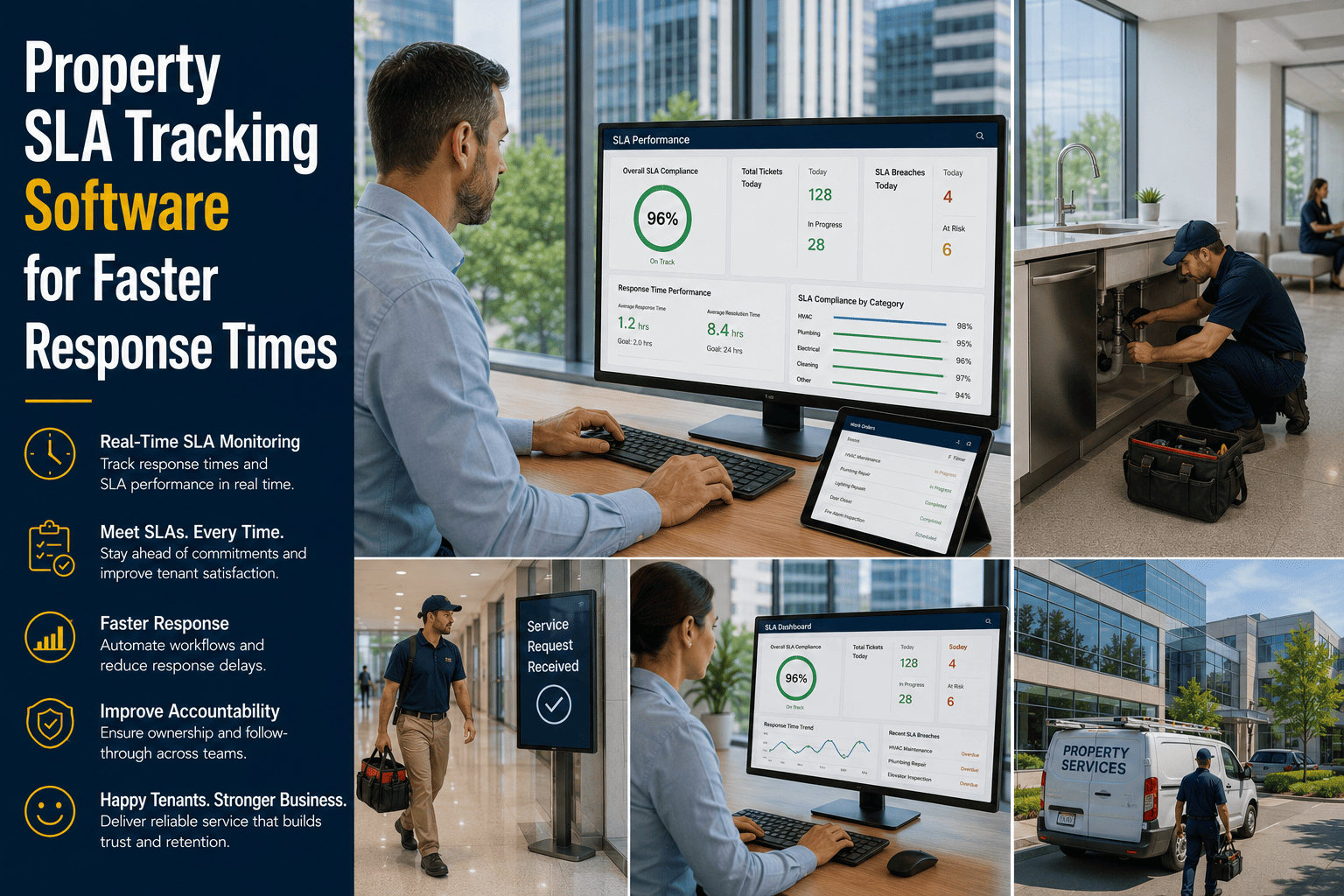
Service level agreements are the backbone of accountable property operations — yet in most facilities, SLA performance is tracked retrospectively at best, and completely invisible at worst. When a tenant submits a maintenance request, the clock starts immediately. Whether that clock is being watched, and whether the right person is responsible for stopping it, determines whether your property delivers on its commitments or accumulates a pattern of missed deadlines, tenant attrition, and compliance exposure. Research shows that 67% of tenants who do not renew cite unresolved or slow maintenance response as a primary factor — and the root cause is almost always the same: no real-time SLA visibility at the operations level. That is exactly the gap that Oxmaint's SLA tracking platform closes from day one.
Property SLA Tracking Software for Faster Response Times
Monitor response times, enforce service level commitments, and improve tenant satisfaction across every property site — with automated SLA alerts and real-time accountability dashboards.
What Is Property SLA Tracking Software
Property SLA tracking software is a CMMS capability that assigns, monitors, and enforces time-bound service commitments for every maintenance request, inspection, and work order across your property portfolio. Rather than relying on supervisors to manually check open tickets, SLA software attaches configurable response and resolution windows to each request type — and escalates automatically when those windows are approaching or breached.
A properly implemented SLA tracking system covers four time dimensions for every request: acknowledgment time (when someone confirms receipt), response time (when a technician is on-site or actively working), resolution time (when the issue is closed), and follow-up time (when tenant confirmation is obtained). Each dimension is tracked separately, benchmarked against your SLA agreements, and reported in real time across all properties. Operations teams that implement SLA software move from managing complaints to managing data — and that shift is what drives measurable improvements in tenant retention and accountability. Start a free trial to see Oxmaint's SLA dashboard configured for your property type, or book a demo and we will map your current SLA agreements directly into the platform.
Key Concepts in SLA Tracking and Response Management
Effective SLA management is built on eight operational concepts that turn vague commitments into measurable, enforceable standards across every property in your portfolio.
Emergency, urgent, and standard requests carry different SLA windows — typically 2hr, 8hr, and 48hr response respectively — automatically applied at intake based on issue category.
Automated notifications fire at configurable warning thresholds (50%, 80%, 100% of SLA window) — giving supervisors time to reassign or expedite before a breach is recorded.
Unacknowledged or unresolved tickets automatically escalate through a defined chain — technician to supervisor to property manager — ensuring no request falls through without accountability.
Monthly and rolling compliance rates by property, request category, and technician — expressed as percentage of requests meeting each SLA window within the reporting period.
Automated status updates sent to tenants at key milestones — receipt, assignment, estimated arrival, and closure — reducing inbound inquiry volume by up to 60%.
Portfolio-level dashboards compare SLA compliance rates across properties — identifying underperforming sites before they generate lease disputes or regulatory notices.
Third-party vendors receive SLA-stamped work orders and are tracked against the same response and resolution windows as internal technicians — with performance records maintained per vendor.
Every timestamp — intake, acknowledgment, response, resolution — is permanently recorded and exportable. This audit trail is the first line of defense in lease dispute resolution and regulatory audits.
The SLA Pain Points Costing Property Teams Every Quarter
SLA failures do not happen because teams do not care — they happen because the systems tracking those commitments are too slow, too manual, or too fragmented to provide real-time accountability. These are the four structural failures most property operations teams recognize immediately.
Supervisors discover SLA breaches when tenants complain — not when the window closes. Without live dashboards, the only signal that a commitment was missed is an angry email or a formal notice. By then, the reputational damage is already done and the audit trail is incomplete.
When escalation depends on a supervisor remembering to check a spreadsheet, tickets go silent for days. High-volume periods — weather events, lease renewals, seasonal maintenance cycles — overwhelm manual tracking and create SLA breach clusters that are impossible to prevent without automation.
Without a centralized platform, each property defines and tracks SLAs differently. One site uses email, another uses a whiteboard, a third uses a different spreadsheet template. Portfolio directors cannot produce a meaningful compliance report — or benchmark performance — across properties that use incompatible systems.
Third-party vendors are responsible for a large share of maintenance work, but most property teams have no mechanism to enforce or measure their SLA compliance. Contractors that consistently miss response windows remain on the approved vendor list because the data to demonstrate their underperformance does not exist in a usable format.
These four failures are entirely solvable with structured SLA tracking — teams that address them see a 42% average improvement in compliance within 90 days — start a free trial to see how Oxmaint enforces SLAs automatically across your portfolio, or book a demo to walk through the escalation configuration for your specific property types.
How Oxmaint Solves SLA Tracking and Response Compliance
Oxmaint turns SLA management from a manual reporting task into an automated operational system — where every commitment has a clock, every breach has an escalation path, and every property produces standardized compliance data for portfolio reporting.
Define separate SLA windows for emergency, urgent, and standard requests — by property, system category, or tenant type. Oxmaint applies the correct SLA automatically at intake based on the issue classification, with no manual assignment required.
Every open work order displays a live SLA countdown visible to supervisors, technicians, and property managers simultaneously. Color-coded urgency indicators shift from green to amber to red as windows close — making SLA status visible without a single manual check.
Configurable alerts fire at 50%, 80%, and 100% of each SLA window — routed to the right person automatically. Unacknowledged tickets escalate up the management chain without supervisor intervention, eliminating the single biggest cause of SLA breaches.
Automated notifications keep tenants informed at every milestone — reducing inbound inquiry volume and demonstrating responsiveness even when resolution requires multiple visits. Status updates are logged to the work order for compliance documentation.
Standardized compliance rates across every property — broken down by request type, technician, contractor, and time period. Portfolio directors can rank properties by SLA performance and identify systemic issues before they produce lease disputes or regulatory findings.
Every timestamp — from intake to closure — is permanently recorded and exportable in standardized formats. When a tenant disputes a response time or a regulator requests maintenance records, the complete SLA audit trail is available in seconds rather than hours of manual reconstruction.
Reactive Response vs. SLA-Managed Operations — The Full Comparison
The operational and financial gap between reactive response management and structured SLA tracking is measurable across every dimension that matters to property owners, tenants, and regulators. This comparison reflects documented outcomes from facilities that have made the transition.
| Dimension | Reactive Response Management | SLA-Managed Operations with Oxmaint |
|---|---|---|
| Response Visibility | No real-time view — supervisors learn of overdue requests when tenants complain | Live countdown dashboard — every open request visible with color-coded urgency status |
| Escalation Mechanism | Manual — depends on supervisor memory and availability; fails during high-volume periods | Automated rule-based escalation at configurable thresholds — fires without human intervention |
| SLA Compliance Rate | Unmeasured or measured retrospectively — no ability to intervene before breach occurs | Real-time compliance rate by property, category, and technician — tracked to two decimal places |
| Tenant Communication | Ad-hoc calls and emails — inconsistent, unlogged, and dependent on individual technician behaviour | Automated milestone notifications — receipt, assignment, ETA, closure — logged to every work order |
| Contractor Accountability | No mechanism to track vendor response times — underperformers remain on approved lists indefinitely | Vendor SLA performance tracked on the same clock as internal staff — with exportable performance records |
| Multi-Site Consistency | Each property runs different processes — portfolio SLA reporting is impossible without manual consolidation | Standardized SLA framework across all sites — portfolio rankings and benchmarks available in one view |
| Dispute Resolution | No timestamped audit trail — response to tenant disputes requires hours of manual record reconstruction | Complete exportable audit trail per work order — dispute response takes minutes, not hours |
| Tenant Retention Impact | 67% of non-renewing tenants cite slow response — no data to identify which issues drove attrition | SLA compliance history correlates with tenant satisfaction scores — retention risk identified and addressed proactively |
ROI and Results — What SLA Tracking Delivers
Property management teams that implement structured SLA tracking software consistently report measurable improvements across tenant retention, compliance rates, and operational efficiency within the first two quarters. These outcomes are documented across the commercial property sector.
The financial case for SLA tracking software pays back in the first quarter for most property portfolios — start a free trial to see your current SLA compliance benchmarked against industry standards, or book a demo to walk through the tenant notification and escalation configuration for your property type.
Frequently Asked Questions
What response time standards should a property SLA policy include
How does SLA tracking software handle after-hours and weekend requests
Can Oxmaint track SLA compliance for third-party contractors alongside internal staff
How does SLA tracking software support lease compliance and dispute resolution
Stop Losing Tenants to Slow Maintenance Response
Turn every maintenance commitment into a trackable, enforceable standard with Oxmaint. See how much tenant retention and compliance risk you can eliminate with automated SLA tracking across your property portfolio.



.png)


