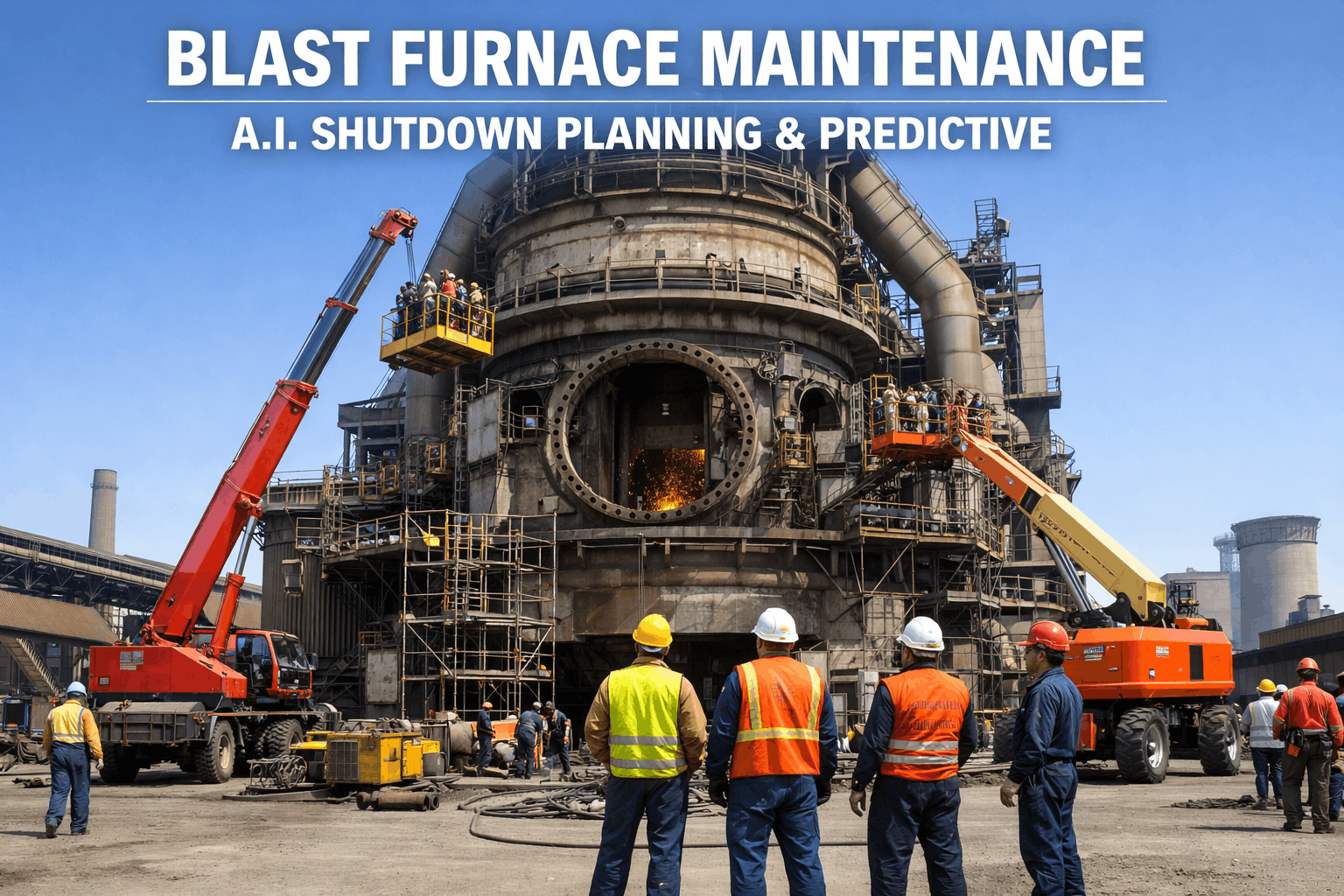
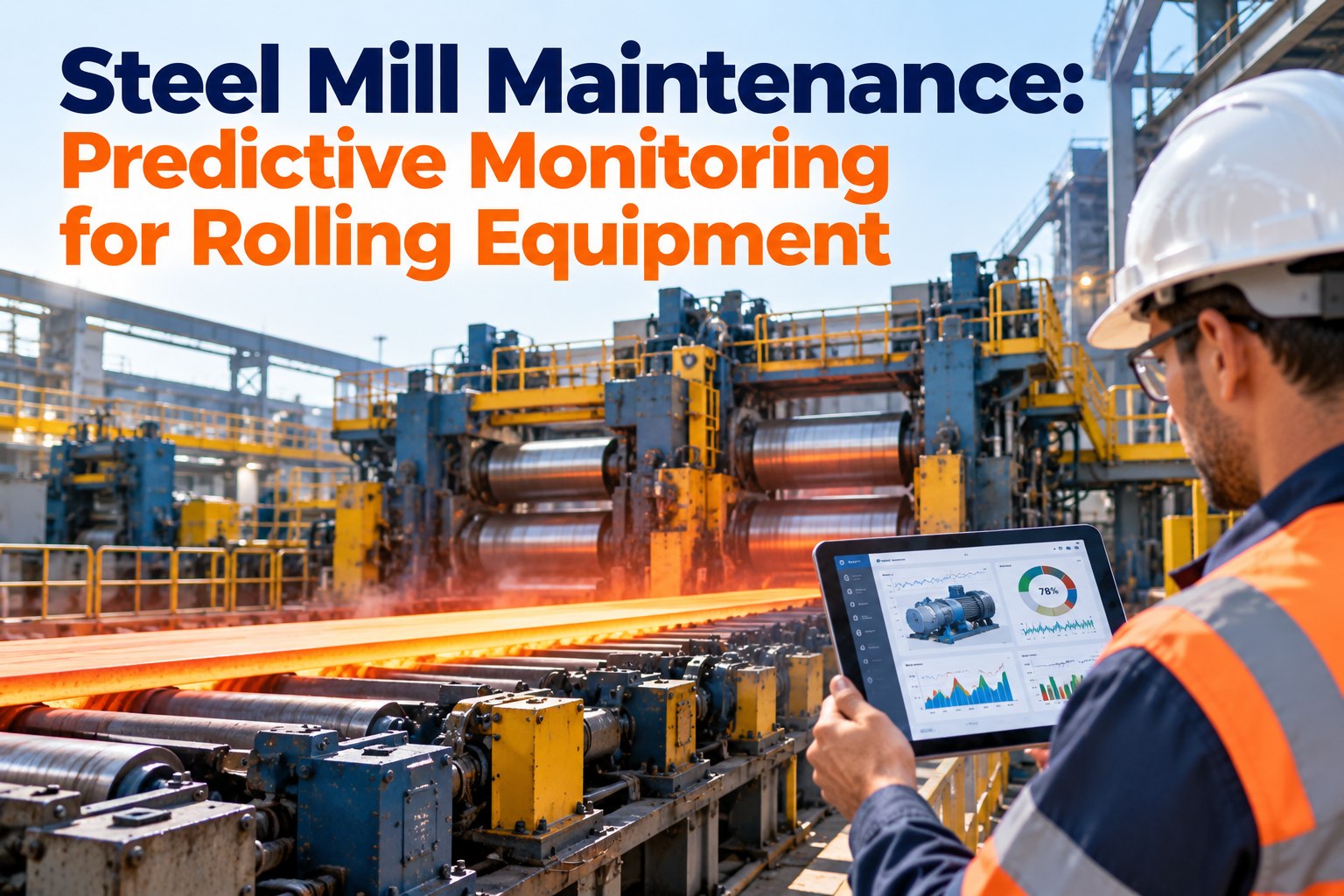
Blast furnaces operate on campaigns lasting 15–20 years with zero planned shutdowns between major relines — making them the most maintenance-critical assets in the entire steel production chain. A single unplanned blowdown costs $4–$12 million in direct repair expenses and $1.2–$3.5 million per day in lost hot metal production for every day the furnace remains offline. Yet the maintenance challenge is not simply preventing failures — it is detecting degradation across 200+ thermal zones, 30+ cooling circuits, 20+ tuyeres, and thousands of refractory measurement points while the furnace operates continuously at 2,700°F+ internal temperatures where direct inspection is physically impossible. AI-powered predictive monitoring changes this equation by analyzing the continuous data streams that blast furnaces already generate — cooling water differentials, shell temperature arrays, gas composition trends, burden descent patterns — and identifying degradation signatures 2–8 weeks before they reach critical thresholds. The result: planned interventions during scheduled production adjustments at 5–10% of emergency repair cost, extended campaign life by 2–4 years beyond historical averages, and shutdown planning driven by equipment condition data rather than calendar assumptions. The barrier to achieving these outcomes is not sensor technology — most blast furnaces already collect 4,000+ data points continuously. The barrier is the absence of a maintenance intelligence platform that connects this data to work order management, spare parts logistics, shutdown planning, and capital decision-making in a unified system. Sign up for Oxmaint and start building the AI-powered blast furnace maintenance program that converts raw monitoring data into prioritized maintenance actions, optimized shutdown plans, and extended campaign life.
Unplanned Blowdown Cost
$4–$12M
Direct repair cost per unplanned shutdown event — plus $1.2M–$3.5M/day in lost hot metal production
AI Detection Lead Time
2–8 wk
How far in advance AI identifies cooling, refractory, and mechanical degradation before critical failure
Campaign Life Extension
2–4 yr
Additional campaign years achievable through AI-optimized maintenance vs. calendar-based PM programs
Six Critical Failure Domains in Blast Furnace Operations
Blast furnace failures are not random events — they originate from six distinct equipment domains, each with characteristic degradation patterns that AI detects weeks before operators notice symptoms on the control room screen. Understanding these domains and their specific monitoring requirements is the foundation for building a predictive maintenance program that protects campaign integrity while minimizing unplanned production losses.
1
Cooling System — Staves, Plates & Circuits
$1.5M–$4.8M per stave failure event
AI-Detectable Degradation Patterns:
• Cooling water flow differential trending — AI detects 3–5% flow reduction indicating blockage or leak initiation 4–8 weeks before critical
• Stave temperature array anomalies — localized hotspots indicating refractory loss exposing copper stave to direct thermal load
• Heat flux calculation drift — rising heat extraction per stave zone correlating with refractory erosion rate acceleration
• Cooling circuit pressure oscillation — water hammer signatures indicating partial blockage or gas breakthrough into cooling channels
CMMS Action: Oxmaint monitors all cooling circuits continuously, generates condition-based work orders when any parameter crosses threshold, and tracks cooling system integrity across the entire campaign with historical trending per stave zone.
2
Refractory Lining — Hearth, Bosh & Stack
$15M–$40M full reline cost
AI-Detectable Degradation Patterns:
• Hearth thermocouple array trending — AI models residual lining thickness from multi-point temperature inversion calculations updated daily
• Bosh and belly wear rate acceleration — correlated with slag chemistry changes, casting rate variations, and thermal cycling frequency
• Shell temperature mapping — infrared scanning at 4–8 hour intervals detecting hot bands indicating localized refractory loss
• Salamander growth prediction — hearth bottom temperature trends indicating iron buildup that threatens tap hole accessibility
CMMS Action: Oxmaint tracks residual refractory life per zone across the entire campaign, generates alerts when wear rate exceeds projected campaign plan, and documents every refractory measurement for reline planning and insurance documentation.
3
Tuyere & Raceway Zone
$80K–$350K per tuyere failure + lost production
AI-Detectable Degradation Patterns:
• Individual tuyere cooling water differential trending — AI detects copper erosion or nose damage 2–4 weeks before burnthrough
• Tuyere peep-sight thermal imaging — automated raceway condition scoring detecting coke quality degradation and hanging burden conditions
• Blowpipe vibration and pressure pulsation — detecting loose connections, refractory erosion in the hot blast main, and valve degradation
• Individual tuyere flow distribution imbalance — AI correlates circumferential blast distribution with furnace wall heat load patterns
CMMS Action: Oxmaint tracks each tuyere individually with cooling performance history, schedules inspection during planned production holds, maintains spare tuyere inventory linked to predicted replacement timing, and documents every change for campaign records.
4
Hot Blast Stoves & Combustion System
15–25% blast temperature loss per degraded stove
AI-Detectable Degradation Patterns:
• Dome temperature cycling analysis — AI detects checker degradation from reduced thermal storage capacity over multi-month trending
• Stove gas efficiency monitoring — combustion air/fuel ratio optimization and detection of checker channeling from pressure drop analysis
• Mixing chamber refractory condition — thermal profile analysis detecting erosion patterns that reduce hot blast uniformity
• Stove changeover valve timing and seat condition — cycle time drift and leakage detection from pressure equalization analysis
CMMS Action: Oxmaint schedules stove-specific PM during each stove's "off-blast" cycle, tracks checker condition scoring per stove over the full campaign, and maintains changeover valve maintenance history with predicted service intervals.
5
Casthouse Equipment
$200K–$800K per unplanned cast delay
AI-Detectable Degradation Patterns:
• Taphole drill and mud gun cycle count tracking — AI predicts replacement timing based on operating hours, refractory condition, and cast frequency
• Runner and trough refractory life — condition scoring per cast with projected remaining life based on iron/slag chemistry and casting temperature
• Tilting runner hydraulic system health — pressure trending, cylinder response time, and proportional valve condition monitoring
• Casthouse fume extraction system — fan vibration, ductwork temperature, baghouse differential pressure, and damper position verification
CMMS Action: Oxmaint tracks every casthouse component by cycle count and condition score, generates replacement work orders before scheduled casts, and documents refractory life for cost-per-cast analysis and vendor performance benchmarking.
6
Gas Cleaning & Top Equipment
Production curtailment + environmental compliance risk
AI-Detectable Degradation Patterns:
• Top gas pressure and composition trending — AI detects burden distribution irregularities, channeling, and hanging conditions from gas analysis deviations
• Bell/bellless top charging equipment — hydraulic pressure, valve seat wear, distribution chute position accuracy, and rotation mechanism health
• Gas cleaning plant efficiency — scrubber pressure drop trending, venturi throat wear, water treatment system performance, dust loading measurement
• Bleeder valve and pressure relief — response time testing, seat condition verification, and explosion vent integrity checks per regulatory schedule
CMMS Action: Oxmaint schedules top equipment PM during charging pauses, tracks gas cleaning performance metrics for environmental compliance documentation, and manages bleeder valve testing on regulatory-mandated intervals with automated audit-ready reporting.
200+ Thermal Zones. 30+ Cooling Circuits. 20+ Tuyeres. One Platform That Tracks Everything.
Oxmaint integrates blast furnace monitoring data — cooling differentials, shell temperatures, refractory measurements, tuyere condition, stove performance — into a unified CMMS that generates condition-based work orders, manages shutdown planning, tracks spare parts, and documents the entire campaign from blowing-in through end-of-campaign reline decision.
The Shutdown Planning Challenge: Why Calendar-Based Turnarounds Fail
Blast furnace shutdown planning is the highest-stakes maintenance scheduling problem in steel manufacturing. A typical intermediate shutdown (no reline) involves 500–2,000 individual work orders, 150–400 maintenance personnel, $2–$8 million in direct costs, and 7–21 days of lost production at $1.2–$3.5 million per day. Calendar-based turnaround planning — scheduling shutdowns at fixed intervals regardless of actual equipment condition — systematically fails in two directions: either shutting down too early (wasting production days when equipment has remaining life) or too late (after degradation has caused collateral damage that extends the shutdown scope and cost).
Calendar-Based vs. AI-Optimized Shutdown Planning
Integrated blast furnace complex • 3,500 m³ working volume • 15-year campaign
Calendar-based intermediate shutdowns per campaign
6–8
Fixed 2–3 year intervals regardless of condition
AI-optimized intermediate shutdowns per campaign
3–5
Condition-based timing + scope optimization
Average shutdown duration (calendar-based)
14–21 days
Scope creep from discovered defects adds 40–60%
Average shutdown duration (AI-planned with known scope)
7–12 days
Pre-identified scope eliminates discovery delays
Total production days saved per campaign (AI vs. calendar)
42–85 days
At $1.2M–$3.5M/day = $50M–$298M campaign value
AI-Powered Shutdown Planning: The Four-Phase Framework
AI-optimized shutdown planning replaces the calendar-based approach with a condition-driven framework that determines when to shut down, what scope to execute, how to sequence the work, and when it is safe to restart — all based on documented equipment condition data rather than assumptions or historical precedent. Every phase is managed through the CMMS, creating an auditable record from initial condition assessment through post-shutdown verification.
Phase 1: Continuous Condition Assessment (Ongoing — 12–24 Months Pre-Shutdown)
AI monitors all six failure domains simultaneously and projects remaining equipment life per zone
✓ Refractory remaining life model updated daily — hearth, bosh, belly, and stack zones each tracked independently with wear rate trending
✓ Cooling system integrity scoring — per-circuit performance index tracking efficiency degradation, leak rates, and blockage indicators over months
✓ Tuyere fleet health dashboard — individual tuyere condition scores with projected replacement windows ranked by failure probability
✓ Hot blast stove capacity trending — checker condition, dome temperature cycling, and combustion efficiency scores per stove declining toward intervention threshold
Deliverable: AI-generated "Equipment Convergence Report" showing when multiple systems will simultaneously require intervention — the optimal shutdown window
Phase 2: Scope Definition & Work Package Assembly (6–12 Months Pre-Shutdown)
Convert condition data into a defined work scope with every task, part, and resource requirement documented before shutdown begins
✓ Work breakdown structure generated from AI condition assessments — each repair task linked to the specific degradation data that justified inclusion
✓ Critical path analysis: tasks sequenced by dependency, safety isolation requirements, cool-down and heat-up constraints, and concurrent work limitations
✓ Spare parts procurement triggered 6–12 months ahead — refractory materials (8–16 week lead), cooling staves (12–20 week lead), specialty alloy tuyeres (10–14 week lead)
✓ Contractor and specialty labor pre-qualified and reserved — refractory crews, crane operators, NDE technicians, scaffolding teams booked against defined work windows
Deliverable: Complete shutdown work package in CMMS — 500–2,000 individual work orders with estimated duration, resource assignment, parts allocation, and safety permits pre-staged
Phase 3: Shutdown Execution & Real-Time Management (During Shutdown)
Execute the defined scope with real-time progress tracking, scope change management, and critical path monitoring
✓ Daily progress dashboard: completed vs. planned work orders, critical path status, resource utilization, and projected completion date updated every shift
✓ Scope change control: any discovered defects requiring additional work are logged, estimated, and approved through CMMS workflow before execution — eliminating unauthorized scope creep
✓ Safety permit management: hot work, confined space, LOTO, and fall protection permits tracked per work order with automated expiration and renewal triggers
✓ Quality verification: photo-documented inspection holdpoints for refractory installation, cooling system pressure tests, and tuyere alignment confirmation before close-out
Deliverable: Real-time shutdown execution with documented progress, controlled scope changes, safety compliance verification, and quality holdpoint sign-offs — all in CMMS
Phase 4: Post-Shutdown Verification & Campaign Reset (Restart + 90 Days)
Verify all work completed to specification, reset monitoring baselines, and document campaign condition for next planning cycle
✓ Post-shutdown system pressure tests: cooling circuits hydrostatically tested at 150% operating pressure with CMMS-documented results per circuit
✓ Refractory cure and heat-up monitoring: AI tracks temperature ramp rates against refractory manufacturer specifications, generating alerts for deviation
✓ Monitoring baseline reset: AI establishes new "as-maintained" baselines for all cooling, thermal, and mechanical parameters — the reference for next degradation cycle
✓ Campaign record update: total shutdown cost, actual vs. planned duration, work scope variance, and lessons learned documented in CMMS for next shutdown planning cycle
Deliverable: Verified restart with documented baselines, updated campaign records, and AI models recalibrated for next degradation detection cycle
Predictive Monitoring: AI Detection Capabilities by Furnace Zone
Each zone of the blast furnace presents distinct monitoring challenges due to temperature extremes, physical inaccessibility, and the need to detect degradation through indirect measurement. AI overcomes these challenges by correlating multiple independent data streams — thermal, hydraulic, chemical, and mechanical — to identify degradation patterns that no single measurement reveals. The monitoring architecture below maps specific AI capabilities to each furnace zone, creating a comprehensive predictive intelligence layer that covers the entire vessel from hearth bottom to top gas outlet.
Hearth Zone — Campaign-Limiting Asset
The hearth determines maximum campaign life — its condition dictates the reline decision
✓ 80–120 thermocouples embedded in hearth wall and bottom — AI calculates residual lining thickness using inverse heat transfer models updated every 4 hours
✓ Hearth erosion rate tracking correlated with tap-to-tap cycle, iron temperature, slag basicity, and alkali loading — identifying which operating conditions accelerate wear
✓ Salamander buildup modeling from hearth bottom temperature patterns — AI predicts iron accumulation trajectory and recommends hearth maintenance tapping schedule
✓ Taphole clay performance tracking — consumption rate, drill time, and mud gun pressure per cast correlated with taphole condition scoring
Campaign impact: Hearth monitoring accuracy determines whether reline is needed at Year 12 or Year 16 — each additional year of campaign life is worth $400M+ in avoided reline cost and lost production
Bosh & Belly Zone — Highest Thermal Stress
Maximum heat load zone where refractory erosion and cooling system stress are most severe
✓ Stave cooling differential monitoring — per-stave water flow, inlet/outlet temperature, and calculated heat flux trending with AI anomaly detection at 5% deviation
✓ Shell temperature infrared mapping at 4–8 hour intervals — automated hot-spot detection with area calculation and growth rate projection
✓ Refractory-to-accretion transition detection — AI identifies when protective scaffold replaces eroded refractory, a critical indicator of bosh condition stability
✓ Tuyere zone interaction — bosh refractory wear correlated with individual tuyere blast parameters to identify circumferential wear pattern drivers
Early detection value: Bosh cooling stave failure costs $1.5M–$4.8M in emergency repair. AI detection at 5% deviation enables $80K–$250K planned intervention during production adjustment
Stack Zone — Burden Distribution & Gas Flow
Upper furnace where burden distribution and gas flow uniformity determine furnace efficiency and lower-zone loading
✓ Above-burden gas temperature and composition probes — AI analyzes radial and circumferential gas distribution to detect channeling, wall flow, and center flow deviations
✓ Stock line monitoring — burden descent rate trending per circumferential zone detecting hanging, slipping, and scaffolding conditions before they cascade to lower zones
✓ Stack refractory condition — shell temperature mapping at 8-hour intervals, thermal imaging of stack walls during wind-rate adjustments
✓ Charging equipment wear — distribution chute angle accuracy, skip/conveyor belt condition, and bell/hopper seat integrity from position sensor and pressure analysis
Operational impact: Stack condition directly affects furnace productivity (coke rate, hot metal quality). AI-optimized burden distribution improves fuel rate 2–5% — worth $3M–$8M/year at current coke prices
Ancillary Systems — The Hidden Failure Cascade Triggers
Supporting systems whose failure forces unplanned blowdown despite healthy furnace internals
✓ Hot blast main and bustle pipe — refractory condition monitoring via external shell temperature, expansion joint integrity, and compensator movement tracking
✓ Gas cleaning plant — scrubber pressure drop trending, venturi throat erosion rate, water recirculation system health, and dust loading measurement
✓ Cooling water pumps and heat exchangers — vibration monitoring, differential pressure trending, and N+1 redundancy verification before any maintenance window
✓ Electrical and instrumentation — UPS battery condition, PLC I/O health, safety interlock testing, and level/temperature/pressure transmitter calibration tracking
Hidden risk: 35% of unplanned blast furnace shutdowns originate from ancillary system failures — not furnace internals. AI monitors these systems with the same rigor as the furnace itself
35% of Unplanned Blowdowns Start Outside the Furnace. AI Monitors Everything.
Oxmaint tracks every blast furnace zone — hearth thermocouples, bosh cooling circuits, stack gas distribution, tuyere condition, stove performance, casthouse equipment, gas cleaning, and ancillary utilities — in a single predictive maintenance platform that generates condition-based work orders, optimizes shutdown timing, and documents the entire campaign lifecycle.
The Financial Model: ROI of AI-Powered Blast Furnace Maintenance
The ROI of AI-powered blast furnace maintenance operates at a scale unique in industrial maintenance — because the cost asymmetry between planned and unplanned work is 10–30× in this operating environment, and the production value protected per prevented failure event is measured in millions. For a single large blast furnace (3,500 m³ working volume, 10,000+ tonnes/day hot metal capacity), the following model projects annual value creation from predictive maintenance deployment.
Annual ROI: AI-Powered Blast Furnace Predictive Maintenance
Single large blast furnace • 3,500 m³ • 10,000+ t/day • 15-year campaign
Unplanned blowdown prevention (1–2 events avoided/year)
$8–$24M
Repair + lost production at $1.2M–$3.5M/day × 3–7 day avg shutdown
Shutdown scope optimization (reduced discovery during turnaround)
$3–$6M
Pre-identified scope eliminates 40–60% of schedule overrun
Campaign life extension (2–4 additional years)
$50–$200M
Annualized: $3.3–$13.3M/yr avoided reline amortization
Spare parts optimization (planned procurement vs. expediting)
$1.2–$2.8M
Eliminate 40–120% rush markup on refractory, staves, tuyeres
Total annual value per blast furnace
$15.5–$46M
Platform + integration: $150K–$400K/yr. ROI: 39–307×
Implementation Roadmap: From Manual Logging to AI-Predictive in 12 Months
Deploying AI-powered predictive maintenance on a blast furnace does not require new sensors in most cases — large blast furnaces already collect 4,000+ data points continuously through existing process control and monitoring systems. The missing layer is the analytical connection between this data and maintenance action. The phased roadmap below delivers measurable value at each stage while building the data foundation for full AI-predictive capability.
Phase 1: Digital Foundation (Month 1–3)
Replace paper logs with digital work orders and register every maintainable blast furnace component
✓ Register all blast furnace assets in CMMS: cooling circuits (individual staves + circuits), tuyeres (each numbered), stoves (individual), casthouse equipment, gas cleaning, and ancillary systems
✓ Activate automated PM schedules: daily operator rounds (digital checklists), weekly inspections, monthly condition assessments, and regulatory compliance tasks
✓ Deploy mobile inspection app to operators and maintenance technicians — structured data capture every shift replacing handwritten log sheets
✓ Establish baseline metrics: current unplanned shutdown frequency, mean time to repair, reactive-to-planned maintenance ratio, spare parts expediting costs
Phase 1 value: Immediate elimination of missed PM tasks. First emergency reduction (15–25%) from systematic scheduled maintenance alone. Self-funding within 90 days.
Phase 2: Condition Monitoring Integration (Month 4–6)
Connect existing furnace monitoring data to CMMS asset records for condition-based maintenance triggers
✓ Integrate process historian data: cooling water flows, stave temperatures, hearth thermocouples, gas compositions — linked to individual asset records in CMMS
✓ Connect existing vibration monitoring on rotating equipment (pumps, fans, compressors) — every alert generates a prioritized work order, not just a dashboard alarm
✓ Establish threshold-based alerts: cooling flow deviations >3%, temperature anomalies >5%, pressure differentials exceeding historical range — auto-generating condition-based work orders
✓ Deploy IoT sensors to fill monitoring gaps: ancillary system pumps, cooling tower fans, electrical transformer temperatures, and gas cleaning equipment not currently instrumented
Phase 2 value: First condition-based detections preventing unplanned events. Typically 2–4 significant failures prevented in first 90 days — each worth $200K–$4.8M in avoided cost.
Phase 3: AI Predictive Analytics (Month 7–9)
Machine learning models trained on 6+ months of furnace-specific data begin generating failure predictions and shutdown timing recommendations
✓ Activate refractory remaining life models: AI calculates residual lining thickness per zone from thermocouple array data, updating predictions daily
✓ Enable cooling system predictive models: AI identifies stave degradation trajectories 4–8 weeks before critical threshold, projecting optimal repair windows
✓ Deploy shutdown timing optimizer: AI identifies when multiple systems converge toward intervention thresholds — recommending the date that minimizes total campaign cost
✓ Generate first AI-driven campaign health report for management: zone-by-zone condition scores, projected remaining life per system, and recommended maintenance plan
Phase 3 value: AI predictions preventing 1–2 major failures per quarter. First condition-based shutdown plan generated with scope defined 6+ months before execution date.
Phase 4: Full AI-Optimized Campaign Management (Month 10–12+)
Continuous AI optimization of maintenance timing, shutdown planning, and campaign life extension decisions
✓ AI model maturation: prediction accuracy improves from 75–80% to 88–93% as models accumulate 12+ months of furnace-specific degradation and maintenance outcome data
✓ Integrated shutdown work package assembly: AI condition data feeds directly into shutdown scope definition with auto-generated work breakdown structure and resource requirements
✓ Campaign life projection: AI provides rolling 3-year forecast of remaining campaign life per zone, enabling reline capital planning decisions 3–5 years before the event
✓ Cross-furnace learning (multi-furnace operations): failure patterns detected on one furnace applied to enhanced monitoring on all furnaces in the fleet
Phase 4 value: World-class blast furnace reliability. Unplanned blowdowns reduced to <0.5 per year. Shutdown durations reduced 35–50%. Campaign life extended 2–4 years vs. industry average.
Every Unplanned Blowdown You Prevent Is Worth $4–$12 Million. Every Campaign Year You Extend Is Worth $400 Million+.
Oxmaint deploys in Week 1 with digital work orders replacing paper logs. Condition monitoring integrates in Month 4. AI predictive models begin generating failure predictions and shutdown optimization in Month 7. By Month 12, your blast furnace operates with documented condition intelligence that drives every maintenance decision, every shutdown plan, and every campaign life extension. The platform costs less than one hour of unplanned downtime.
Frequently Asked Questions
How does AI predict blast furnace refractory remaining life without direct physical inspection?
Blast furnaces are equipped with 80–200+ thermocouples embedded at known depths in the hearth walls, bottom, bosh, and stack refractory. AI applies inverse heat transfer models to these temperature readings — calculating the distance from the hot face to the thermocouple position based on the temperature gradient, thermal conductivity of the refractory material, and the known cooling conditions on the cold face. By updating this calculation every 4–8 hours and trending the residual thickness over weeks and months, the AI generates a wear rate trajectory per zone that projects when each area will reach minimum safe thickness. The model also correlates wear rate with operating parameters — iron temperature, slag basicity, alkali loading, casting frequency — identifying which conditions accelerate or decelerate erosion. This enables both predictive scheduling of repairs and operational adjustments that extend refractory life.
Sign up free to start tracking refractory condition data in a system designed for campaign-length monitoring.
What is the difference between an intermediate shutdown and a major reline, and how does AI affect the timing of each?
An intermediate shutdown (also called a repair shutdown or blow-down for maintenance) is a planned stoppage of 7–21 days to repair or replace specific components — cooling staves, tuyeres, casthouse equipment, gas cleaning elements — without replacing the hearth refractory. Cost: $2–$8 million direct plus production loss. A major reline is a complete rebuild of the furnace interior refractory, typically requiring 3–6 months and $15–$40 million, triggered when hearth remaining life reaches minimum safe thickness. AI affects both: for intermediate shutdowns, AI condition monitoring reduces the number needed per campaign (from 6–8 to 3–5) by replacing calendar-based scheduling with condition-based timing, and reduces duration (from 14–21 days to 7–12 days) by pre-identifying the full scope before shutdown begins. For the major reline, AI extends the interval by 2–4 years through optimized maintenance that slows hearth erosion rate and through more accurate remaining life prediction that avoids premature reline decisions based on conservative calendar assumptions.
What spare parts management capabilities does the platform provide for blast furnace maintenance?
Blast furnace spare parts management is uniquely challenging because critical components have 8–20 week lead times — custom refractory shapes (8–16 weeks), copper cooling staves (12–20 weeks), specialty alloy tuyeres (10–14 weeks), and large hydraulic cylinders (8–12 weeks). Oxmaint addresses this through four capabilities: first, AI predictive models generate spare parts demand forecasts 3–6 months ahead based on equipment condition trending — if the AI projects a cooling stave will need replacement at the next shutdown, the procurement work order generates immediately at standard pricing. Second, the CMMS tracks actual consumption per shutdown event, building the historical data that reveals true usage patterns versus theoretical estimates. Third, minimum/maximum inventory levels are set per critical spare based on lead time and failure consequence — ensuring availability without over-investment. Fourth, every maintenance event documents the actual parts consumed, vendor performance, and component service life — data that supports warranty claims and vendor qualification decisions.
Schedule a consultation to map spare parts strategy for your blast furnace operation.
How does the platform manage safety compliance during blast furnace shutdowns?
Blast furnace shutdowns involve the highest-risk maintenance activities in any steel plant — confined space entry, hot work adjacent to residual molten material, working at heights on scaffolding inside the furnace shell, and LOTO of high-energy systems (blast, gas, hydraulic, electrical). Oxmaint manages safety compliance through four mechanisms: every shutdown work order includes mandatory safety permit requirements (confined space, hot work, LOTO, fall protection) that must be completed before the work order can proceed. Safety permits are tracked with expiration times and automatic renewal triggers — preventing expired permits from authorizing continued work. Safety inspection holdpoints are embedded at critical stages — gas testing verification before confined space entry, atmosphere monitoring during refractory demolition, scaffolding inspection certification before each work level opens. All safety documentation is retained in the CMMS campaign record, creating the auditable compliance trail that OSHA and insurance auditors require.
Can the platform integrate with existing blast furnace Level 1 and Level 2 process control systems?
Yes. Oxmaint connects with blast furnace process control infrastructure via standard integration points — OPC-UA for direct PLC/DCS connections, process historian APIs (OSIsoft PI Web API, Honeywell PHD ODBC), and MQTT/REST protocols for IoT sensor platforms. This means the 4,000+ data points already collected by your Level 1 (direct control) and Level 2 (process optimization) systems — cooling water flows, stave temperatures, hearth thermocouples, gas compositions, burden distribution, and blast parameters — can feed directly into CMMS asset records without deploying new instrumentation. The AI analytics layer then correlates these process parameters with maintenance history on each specific asset to build equipment-specific degradation models. Most blast furnaces already have 80–90% of the monitoring data needed — the gap is not data collection, it is the connection between process data and maintenance decision-making.
Sign up free to start building the connection layer between your furnace data and your maintenance program.