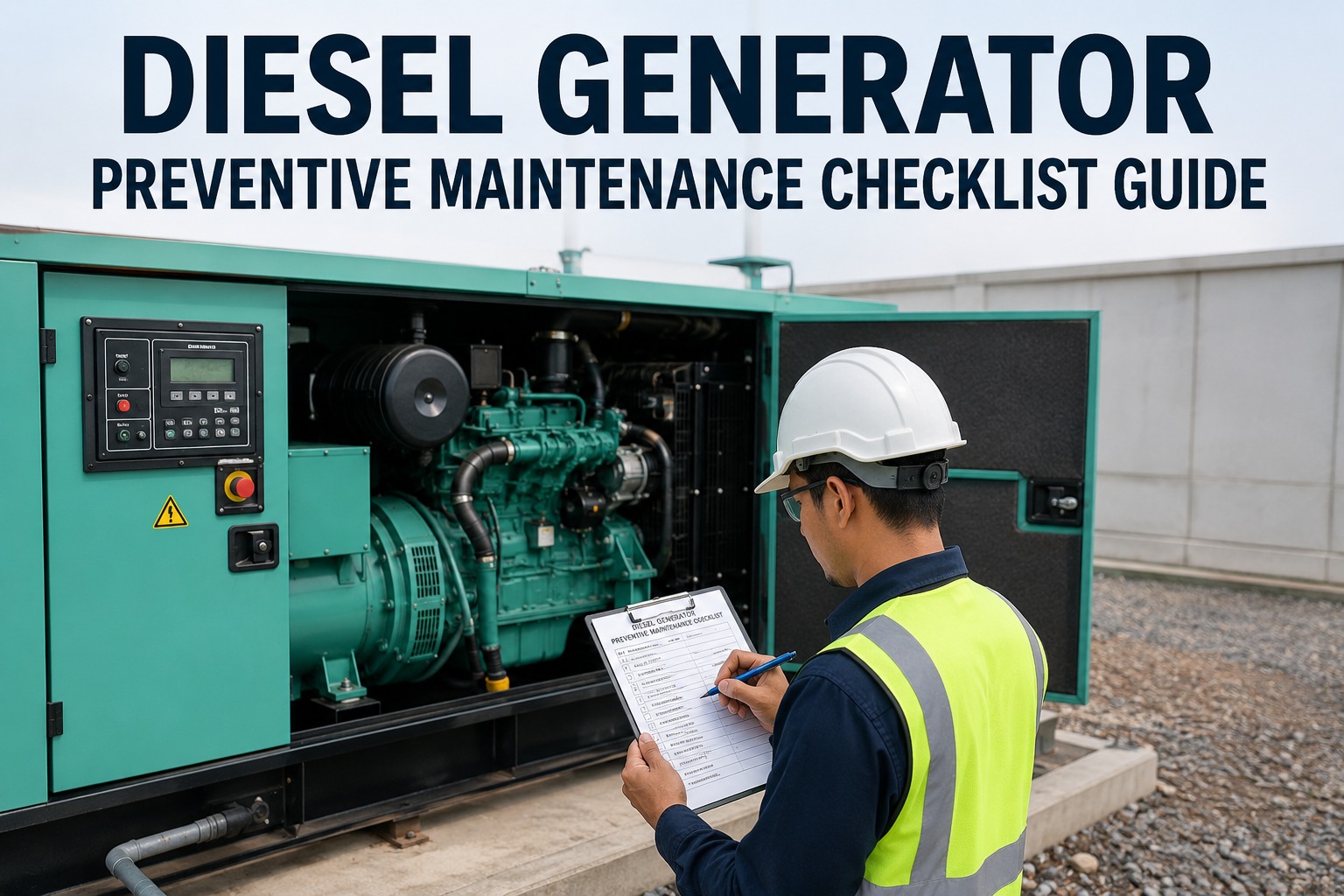
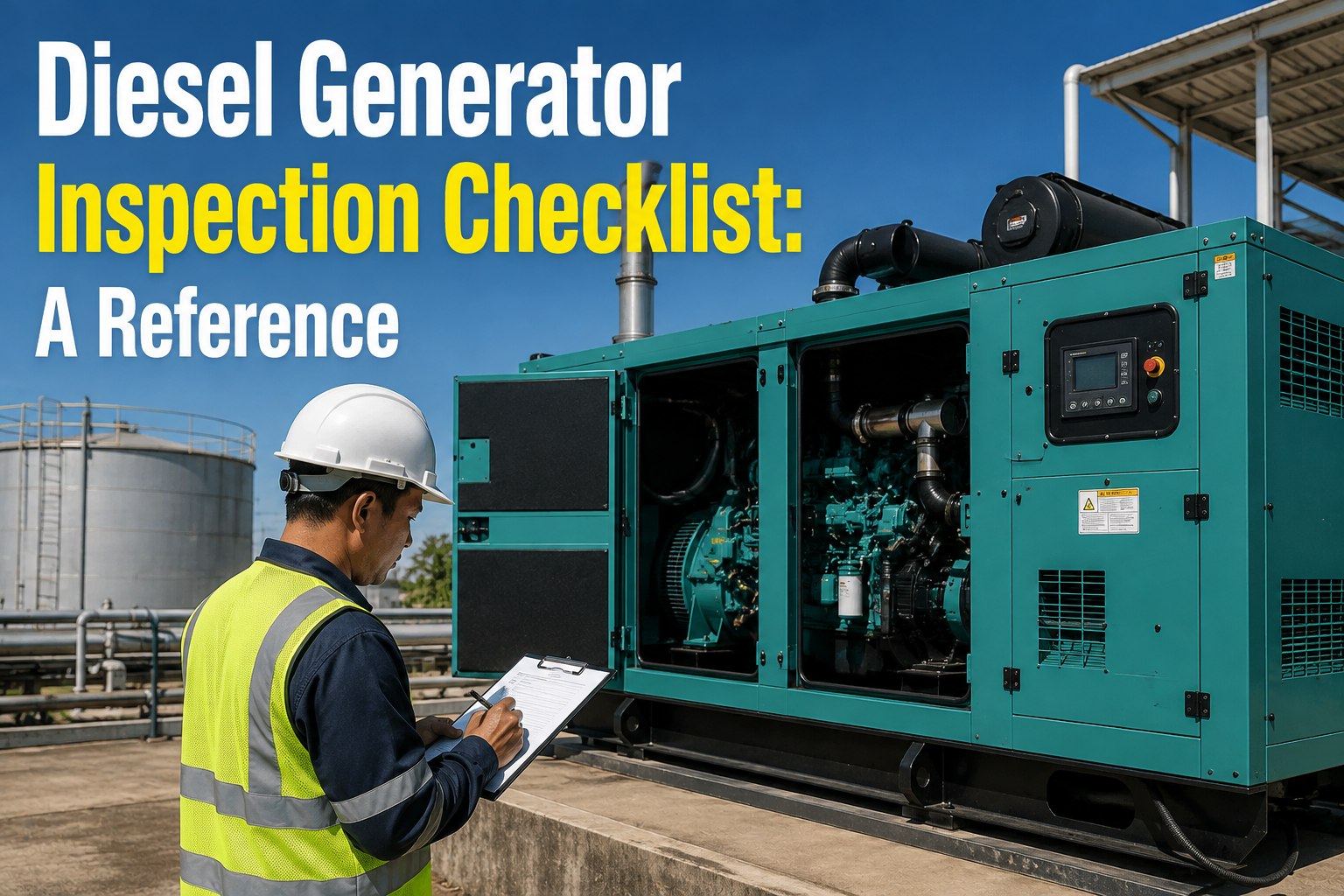
A diesel generator earns its keep on the day the utility drops — and that is the wors possible day to find out the ATS didn't transfer, the fuel had grown a microbial film, or the block heater tripped a breaker six months ago and nobody logged it. This preventive maintenance checklist covers every point a technician touches on a gen-set across the standard interval ladder — daily/weekly/monthly through to the NFPA 110 §8.4.9 annual load-bank test and the 36-month four-hour full-duration test. It also lays out the wet-stacking threshold, ATS quarterly PM, and the fluids-and-filters cadence that keeps a unit inside its 20,000–30,000-hour service life. Start free on OxMaint to load the whole ladder as auto-scheduled work orders per gen-set, or book a demo to see the NFPA 110 documentation package generate on demand.
Standby Power That Actually Starts — Every Time
The service ladder, the load-bank spec, and the compliance records — one program.
6 tiers
Daily → Weekly → Monthly → 250 hr / 6-mo → Annual → 36-mo / Major
30%
Minimum monthly exercise load per NFPA 110 — below this, wet-stacking begins
36 mo
NFPA 110 Level 1 EPSS four-hour full-duration operational test
30 k hr
Design service life — reached only with a real PM program
The Interval Ladder · Six Tiers From Daily to Major Overhaul
Diesel gen-set PM runs on whichever trigger comes first — calendar or run hours. The six-tier ladder below is the field-standard rhythm for a commercial or industrial standby unit; verify each interval against your OEM manual, since Caterpillar, Cummins, Kohler, and Detroit Diesel publish model-specific overrides. Every check at every tier gets a mobile record, a photo where visual evidence matters, and an e-signature on completion.
Visual Walk-Around
Panel indicator lights & alarm banner
No visible leaks — oil, coolant, fuel
Battery voltage on charger display
Enclosure clear; louvres unobstructed
Fuel tank level ≥ threshold
WEEKLY
NFPA 110 inspection
Static Inspection · No Start
Coolant level and freeze protection
Oil level cold; look for coolant contamination
Battery specific gravity or SoC; terminal corrosion
Block heater output ≥ 100 °F jacket temp
Day tank level, transfer pump function
Exhaust joints — no soot streaks or discoloration
MONTHLY
≥30 min loaded exercise
Loaded Exercise + ATS Function
Run under load ≥ 30% nameplate for ≥ 30 min (NFPA 110)
Log oil pressure, coolant temp, RPM, voltage, frequency
ATS operational transfer test at least quarterly
Exhaust color check under load — no white/blue smoke
Vibration and audible signature vs baseline
Confirm all safety shutdowns armed after run
250 HR / 6 MO
Whichever comes first
Fluids & Filters Service
Change engine oil and oil filter
Change fuel filter (primary and secondary)
Sample oil for lab analysis — wear metals, viscosity, TBN
Inspect and clean air cleaner; check restriction gauge
Belt tension & condition; hose integrity check
Torque exhaust manifold and turbo mounting bolts
ANNUAL
Compliance + comprehensive
Load-Bank Test + Deep Inspection
Load-bank test per NFPA 110 §8.4.9 (see protocol below)
Fuel sampling & polishing — water, microbial, particulate
NFPA 70B electrical inspection — thermographic scan, torque
Calibrate and function-test all safety shutdowns
Coolant analysis & conditioner strength check
Replace air filter if not restriction-based
36 MO / MAJOR
Full-duration + overhaul
Level 1 EPSS 4-Hr Test + Overhaul Prep
NFPA 110 Level 1 four-hour full-duration operational test
Coolant flush and full replacement every 2–3 years
Battery replacement per OEM (typically 3–5 years)
Injector inspection or replacement per hours accumulated
Compression check; blow-by measurement
Update remaining useful life estimate against the asset
NFPA 110 §8.4.9 · The Annual Load-Bank Test Protocol
Section 8.4.9 is where the compliance teeth live. If a gen-set doesn't reach 30% of nameplate during its monthly loaded exercise, the annual test has to make up the difference using a supplemental load bank — stepped through 50%, 75%, and 100% of nameplate for defined durations. This is a hard requirement for Level 1 emergency power supply systems in healthcare, life-safety, and code-required installations.
Load-Bank Sequence · Supplemental Test When Monthly < 30%
Total elapsed test time: 3.5 hours
50%
Warm-Up Stage
30 min at 50% of nameplate rating
Engine reaches operating temperature; verify cooling response
→
75%
Mid Load
60 min at 75% of nameplate rating
Sustained load stability check; log every 10 minutes
→
100%
Full Rated Load
120 min at 100% of nameplate rating
Certifies the unit can carry its rated capacity — burns off wet-stack deposits
Wet Stacking · The 30% Threshold Isn't Arbitrary
Any diesel that runs consistently below 30% of rated load builds unburned fuel and carbon in the exhaust system, turbocharger, and cylinder walls. Over months this glazes the liners, fouls injectors, and cuts output capacity — right when you need it most. The monthly ≥30% exercise and the annual 100% load-bank stage exist to burn that residue off. A gen-set that has never seen real load is a gen-set waiting to fail.
Six Subsystems · What Actually Gets Inspected
Every check on the ladder maps to one of these six subsystems. Grouping by subsystem — engine, fuel, lube, cooling, electrical, ATS — is what makes the mobile checklist scan cleanly and what makes a failure record trace to a specific root cause instead of a generic "generator won't start" ticket.
01 · ENGINE
Block, Turbo, Exhaust
Compression, blow-by, exhaust color and back-pressure, turbo shaft play, valve lash on schedule. Vibration signature vs baseline.
02 · FUEL
Tank, Polishing, Filters
Annual fuel sampling for water/microbial/particulate per NFPA 110. Fuel polishing on stored inventory. Filter changes every 250 hr or 6 months.
03 · LUBE
Oil System & Sampling
Oil and filter change every 250 hr or 6 months. Lab sampling for wear metals, viscosity, and TBN — flagging bearing, ring, and injector issues before they become downtime.
04 · COOLING
Radiator, Coolant, Block Heater
Coolant level, conditioner strength, and analysis. Full flush every 2–3 years. Block heater maintains jacket ≥100 °F for rapid-start reliability.
05 · ELECTRICAL
Batteries, Charger, Alternator
Battery specific gravity or SoC weekly, terminal corrosion, charger output. Annual thermographic scan on panels per NFPA 70B.
06 · ATS
Automatic Transfer Switch
Quarterly operational transfer test — the ATS is where most "generator failed to come on" incidents actually trace to. Annual contact inspection and torque check.
Load the Full 6-Tier Ladder as PM Work Orders — Free Forever
Sign up on OxMaint's free forever plan and load the daily/weekly/monthly/250-hr/annual/36-month ladder against every gen-set in your registry — with the NFPA 110 §8.4.9 load-bank protocol built in as a scheduled annual task. No card, no time limit. Or book a working session and we'll set it up with you.
Fluids & Filters Cadence · The Numbers on One Card
The single biggest source of PM drift on gen-sets is fluids and filters — items that "look fine" get pushed for a shift, then a month, then a year. These are the field-standard intervals for a commercial standby unit. Whichever comes first — calendar or run hours — is the trigger.
Item
Interval
Trigger Condition
Sampling / Test
Engine oil + filter
250 hr / 6 months
Whichever first
Lab sample every change
Fuel filters (primary + secondary)
250–500 hr / annual
Or dP alarm
Fuel sample annual min
Air filter
1,000 hr / annual
Or restriction gauge red
Visual + restriction reading
Coolant (flush & replace)
2–3 years
Or SCA/inhibitor depletion
Annual conditioner strength
Stored diesel — polishing
Annual
6–12 months if humid site
Water / microbial / particulate
Starting batteries
3–5 years
Or load-test failure
Monthly SoC, annual load test
These are field-standard starting values for a commercial standby unit — always align to your OEM manual. Prime and continuous-duty units run tighter intervals (every 200–400 hr on lube service depending on duty class).
Warning Signs That Trigger an Off-Cycle Inspection
Between scheduled PMs, these are the observations that mean a technician goes out today, not next month. Every one of them should auto-generate a work order the moment it's flagged — either by an operator, a controller alarm, or an OxMaint threshold rule. Sign up free to auto-trigger work orders from these signals.
Failed monthly exercise start — battery, glow plug, or fuel-air issue; do not wait for the next scheduled PM
White or blue exhaust smoke under load — coolant leak into cylinder or oil consumption; investigate immediately
Oily residue at exhaust stack — classic wet-stacking indicator, schedule a load-bank test
Coolant, oil, or fuel pooling under the skid — trace to source before the next scheduled exercise
Battery voltage below charger float or corrosion at terminals — the leading cause of "won't start" events
ATS failed transfer during test or nuisance re-transfer — panel inspection required, ATS is the single-point failure on most standby installs
How OxMaint Runs the Full Gen-Set PM Program
The six-tier ladder above becomes a running program in OxMaint — daily and weekly on the operator's phone, monthly through annual on the maintenance team's schedule, and the 36-month full-duration test on the asset's long-cycle calendar. Every check produces a signed record; every fail becomes a tracked repair; every NFPA 110 test generates the exact document an authority-having-jurisdiction inspection expects.
Schedule
Six-Tier PM Auto-Generation
Daily/weekly/monthly/250-hr/annual/36-month work orders per gen-set — run-hour trigger fires whichever comes first vs calendar.
Execute
Mobile Checklist + Live Readings
Six-subsystem checklist runs on the technician's phone with mandatory readings, photo capture on filter changes and load-bank test results.
Validate
Threshold Rules Per Subsystem
Oil pressure below spec, coolant temp above ceiling, monthly load below 30%, ATS transfer over time budget — all flag automatically.
Escalate
Fail → Tracked Repair Work Order
Any fail on the ladder spawns a repair work order tagged with the failure mode, deadline, and required parts from the asset BOM.
Prove
NFPA 110 Documentation Package
Monthly exercise logs, quarterly ATS tests, annual load-bank reports, and 36-month full-duration test — one export for the AHJ inspection.
Track
Run Hours & Reliability Metrics
Cumulative run hours, MTBF, cost per intervention rolled up per gen-set — the defensible answer for capital planning and asset-life decisions.
Turn Your Generator Log Into an Audit-Ready Reliability Program
Free forever plan — no card, no time limit. Load the ladder, assign it to your gen-set registry, and the next monthly exercise generates as a scheduled work order with mandatory readings, photo capture, and e-sign. Or book 30 minutes and we'll get you live on your critical units in one session.
Frequently Asked Questions
What are the NFPA 110 exercise and testing requirements for a standby diesel generator?
NFPA 110 requires weekly inspection, monthly loaded exercise for at least 30 minutes at 30% or more of nameplate rating, an annual load-bank test per §8.4.9 if monthly testing does not reach 30% loading, and — for Level 1 EPSS installations — a 36-month four-hour full-duration operational test. Each exercise and test must be documented with date, duration, loading level, and any abnormalities observed.
Book a demo to see the NFPA 110 documentation package auto-build.
How does the annual load-bank test actually work?
When monthly exercises don't reach 30% load, the supplemental annual test steps the gen-set through 50% of nameplate for 30 minutes, 75% for 60 minutes, and 100% for 120 minutes — 3.5 hours total. It verifies the engine can deliver rated capacity, burns off wet-stacking deposits, and produces the signed report that becomes primary audit evidence. Even units that meet 30% monthly benefit from an annual full-load run for the same wet-stacking reasons.
What is wet stacking, and why does the 30% load rule matter?
Wet stacking is the buildup of unburned fuel and carbon in the exhaust, turbocharger, and cylinder walls when a diesel runs consistently below about 30% of its rated load. Over time it glazes cylinder liners, fouls injectors, and cuts output — so a gen-set that has only ever seen light exercise loads is a gen-set that can't deliver rated capacity when the utility drops. The 30% threshold is the minimum needed to sustain proper combustion temperatures and prevent that residue from forming.
How often do oil, fuel, coolant, and other consumables need attention?
Standard field intervals for a commercial standby unit: engine oil and oil filter every 250 hours or 6 months whichever first, fuel filters every 250–500 hours or annually, air filter every 1,000 hours or by restriction gauge, coolant full flush every 2–3 years, stored diesel polished annually (more often in humid sites), and starting batteries replaced every 3–5 years. Prime and continuous-duty units run tighter cycles.
Sign up free to auto-schedule each item by whichever trigger fires first.
Can OxMaint manage a multi-site standby generator fleet?
Yes. OxMaint auto-generates the six-tier PM ladder per gen-set with run-hour and calendar triggers, enforces mandatory readings and photo capture on mobile, escalates failed items into tracked repair work orders, records ATS quarterly tests, produces the NFPA 110 documentation package per unit for AHJ inspections, and rolls run hours and MTBF per site and across the fleet. The free forever plan lets you trial the full workflow on your first gen-sets before scaling — no card, no time limit.