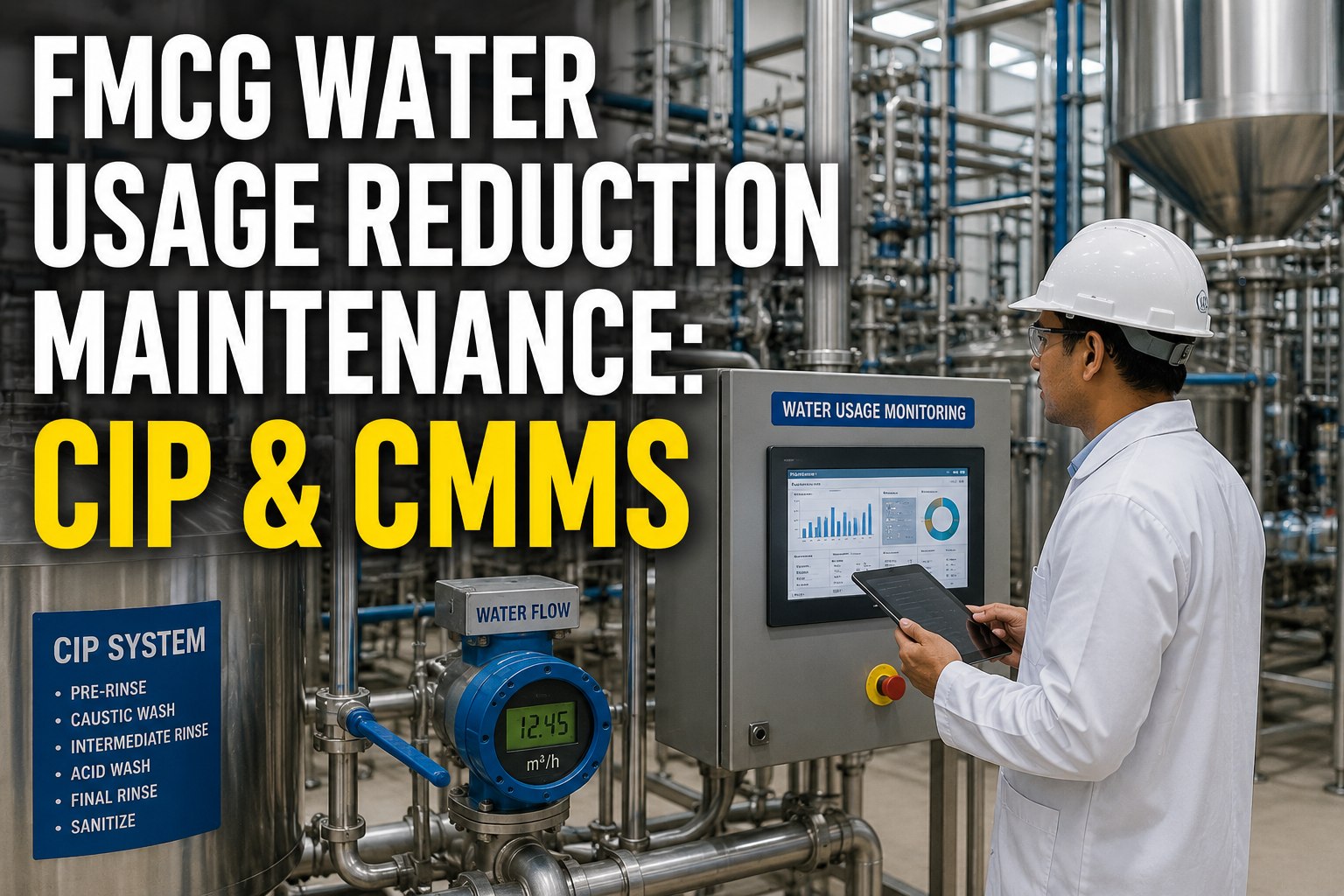
The water bill at an FMCG plant is, to a surprising degree, a maintenance report in disguise. A worn spray ball, a leaking CIP return valve, a drifted conductivity sensor — none of them trips an alarm, none stops production, and every one of them quietly pours water down the drain shift after shift. That's the insight most water-reduction efforts miss while chasing expensive capital projects: on the wet side of an FMCG plant, water consumption is largely a maintenance-controllable variable, and the biggest lever is the Clean-in-Place system, which alone accounts for 35 to 40% of total plant water use. One documented beverage plant cut its water use from 6.8 down to 3.2 litres per litre of product — and saved $138,000 a year — not by building anything, but by fixing three maintenance faults. This guide covers FMCG water usage reduction through maintenance: why CIP is the water hog, the maintenance faults that waste it, the recovery and reuse levers, and how a CMMS turns water into a tracked, managed program. Book a free water-reduction review.
The Water Bill Is a Maintenance Report in Disguise
A worn spray ball and a leaking valve waste water silently — no alarm, no downtime. Water is a maintenance variable.
35–40%
Of total plant water consumed by the CIP system alone
30–45%
CIP water cut by a well-maintained system with rinse recovery
6.8 to 3.2
Litres water per litre product in a documented turnaround
$138K
Annual water saving from fixing three maintenance faults
The Three Maintenance Faults That Waste CIP Water
CIP is the largest water user in the plant, and its waste traces to a short list of degraded components. Each looks like it's working — the cycle completes — while quietly consuming far more water than the validated minimum.
Worn & Blocked Spray Balls
A single blocked nozzle drops coverage 10–15%, leaving a shadow zone that forces extended or repeat rinse cycles to compensate — burning extra water every clean. Weekly inspection and a UV-dye coverage test catch it.
Leaking CIP Return Valves
A leaking return valve dumps recoverable rinse water straight to drain instead of returning it for reuse. In the documented case this alone wasted 14,000 litres a day — invisible until someone traced the loss.
Uncalibrated Chemical Sensors
A drifted conductivity sensor misreads chemical concentration and triggers unnecessary extra rinse stages "to be safe" — extra water per cycle. Weekly NIST-traceable calibration keeps rinses to the validated minimum.
A Documented Turnaround · Maintenance, Not Capital
The most compelling case for maintenance-first water reduction is a real one. A mid-size beverage plant running at nearly double the industry water benchmark fixed three maintenance faults — and transformed its water profile in ten months without a capital project.
Root Cause Found
The Maintenance Fault
The Fix
Leaking CIP return valves
14,000 litres wasted to drain daily
Valve repair & rinse recovery
Cooling tower blowdown
8 cycles instead of achievable 12
Conductivity sensor calibration
RO membrane recovery
62% recovery vs 85% design spec
Missed membrane replacement
Result: water use fell from 6.8 to 3.2 litres per litre of product, annual water cost dropped $138,000, and discharge compliance hit 100% — inside ten months, with maintenance work rather than new equipment. Every root cause was a degraded component a PM program would have caught.
Find Your Water-Waste Faults in 30 Minutes
Working session with our FMCG team — bring your water and CIP data. We'll map where maintenance faults are wasting water against the validated minimum, and show how OxMaint turns spray-ball, valve, and sensor PM into a tracked water program.
The Water Reduction Levers
A maintenance-first water program runs on four disciplines. Each targets a different source of loss, and together they hold consumption near the validated minimum year after year.
01
Keep Spray Devices at Full Coverage
Weekly spray-ball inspection, quarterly pattern testing, and annual replacement — plus UV-dye coverage checks — so cleaning is achieved in one validated cycle, not repeated rinses.
02
Calibrate Sensors to the Minimum
Weekly NIST-traceable calibration of conductivity and concentration sensors keeps CIP rinse stages at the validated minimum — no defensive extra rinses from drifted readings.
03
Fix Leaks Within 48 Hours
A scheduled leak-detection program on valves, seals, hoses, and headers, with a 48-hour fix standard — closing the silent losses that never show on a process alarm.
04
PM the Recovery Systems
Rinse-recovery, RO, and blowdown systems only save water if maintained — membrane replacement on schedule, recovery tanks and return pumps kept to design spec.
The Reuse Cascade · Water Used More Than Once
Beyond stopping waste, a mature program reuses water — but every stage of reuse depends on maintained equipment holding its design performance. Cascade water from cleaner uses to dirtier ones before it ever reaches drain.
FRESH
Final Rinse & Product Contact
Fresh, treated water for the final rinse and product-contact cleaning — the highest-quality demand, protected first.
RECOVER
Rinse Recovery to Pre-Rinse
Captured final-rinse water — clean enough to reuse — returned via recovery tanks to serve the next cycle's pre-rinse, the single biggest CIP saving.
CASCADE
Condensate, Blowdown & RO Reject
Condensate, cooling-tower blowdown, and RO reject cascaded to lower-grade uses — floor wash, initial flush — before final discharge.
How OxMaint Runs a Water-Reduction Program
OxMaint turns water consumption into a managed maintenance program — PM scheduling, calibration tracking, leak-detection routes, inspection checklists, and compliance reporting that ties every water-using asset to the tasks that keep it efficient, from one dashboard on desktop or mobile.
Schedule
Spray & Valve PM
Auto-generate weekly spray-ball inspection, pattern testing, and valve PM with coverage verification — keeping CIP to one validated cycle instead of repeat rinses.
Calibrate
Sensor Calibration Records
Track NIST-traceable conductivity and concentration calibration with as-found/as-left readings — FSMA-ready and keeping rinse stages at the validated minimum.
Detect
Leak-Detection Routes
Scheduled inspection routes on valves, seals, hoses, and headers with a 48-hour fix standard — turning silent losses into tracked, closed work orders.
Recover
Reuse System PM
Preventive maintenance on rinse-recovery, RO membranes, and blowdown control — keeping recovery systems at design spec so the reuse cascade actually saves.
Monitor
IoT Water & Flow Data
Track flow and consumption against the validated baseline, flagging a rising trend as a work order before it becomes a quarter of wasted water.
Report
Water & Compliance KPIs
Litres-per-litre, CIP water, and discharge-compliance dashboards — audit-ready for food-safety and environmental standards across one plant or a group.
Turn Your Water Bill Into a Maintenance Win
Cut water consumption without a capital project — by catching the worn spray balls, leaking valves, and drifted sensors that waste it. See how OxMaint runs water as a tracked maintenance program. Free forever plan available.
Frequently Asked Questions
Why is CIP the biggest water target in an FMCG plant?
Because Clean-in-Place systems are consistently the largest single water user in wet-side FMCG manufacturing, accounting for 35 to 40% of total plant consumption. They repeatedly rinse product-contact surfaces, so any inefficiency — a worn spray ball forcing repeat rinses, a leaking return valve, or a sensor triggering extra stages — multiplies across every cycle, every day. A well-maintained CIP system with multi-stage rinse recovery can cut CIP water use by 30 to 45%.
Book a review.
How does maintenance actually reduce water use?
By eliminating the degraded components that waste water invisibly. Worn spray balls lose coverage and force extended rinses; leaking return valves dump recoverable water to drain; drifted conductivity sensors trigger unnecessary rinse stages; and unmaintained recovery systems stop reclaiming water. Fixing and preventing these through scheduled PM keeps every cycle at its validated minimum — which is why maintenance-first programs often beat capital projects on water savings per dollar spent.
How much water can a maintenance-first program save?
In one documented case, a beverage plant cut consumption from 6.8 to 3.2 litres of water per litre of product in ten months, saving $138,000 a year and reaching 100% discharge compliance — purely by fixing leaking CIP valves, calibrating cooling-tower sensors, and replacing an underperforming RO membrane. Well-maintained CIP with rinse recovery alone delivers 30 to 45% CIP water reduction.
Start free.
How often should CIP spray balls be maintained?
Static spray balls should be visually inspected weekly for blocked orifices and mineral buildup, spray-pattern tested quarterly, and replaced annually or whenever a coverage test shows gaps. Rotary spray heads also need monthly mechanical inspection of the bearing and rotation mechanism. A single blocked nozzle cuts coverage 10 to 15%, so a worn or blocked device should be replaced before the next cycle, not deferred.
How does OxMaint support water reduction?
It auto-schedules spray-ball, valve, and recovery-system PM with coverage verification; tracks NIST-traceable sensor calibration with as-found/as-left records for FSMA; runs leak-detection routes with a 48-hour fix standard; maintains RO, rinse-recovery, and blowdown systems at design spec; and monitors flow against the validated baseline, flagging rising trends as work orders. Water KPIs and discharge-compliance dashboards keep it audit-ready. A free forever plan is available.