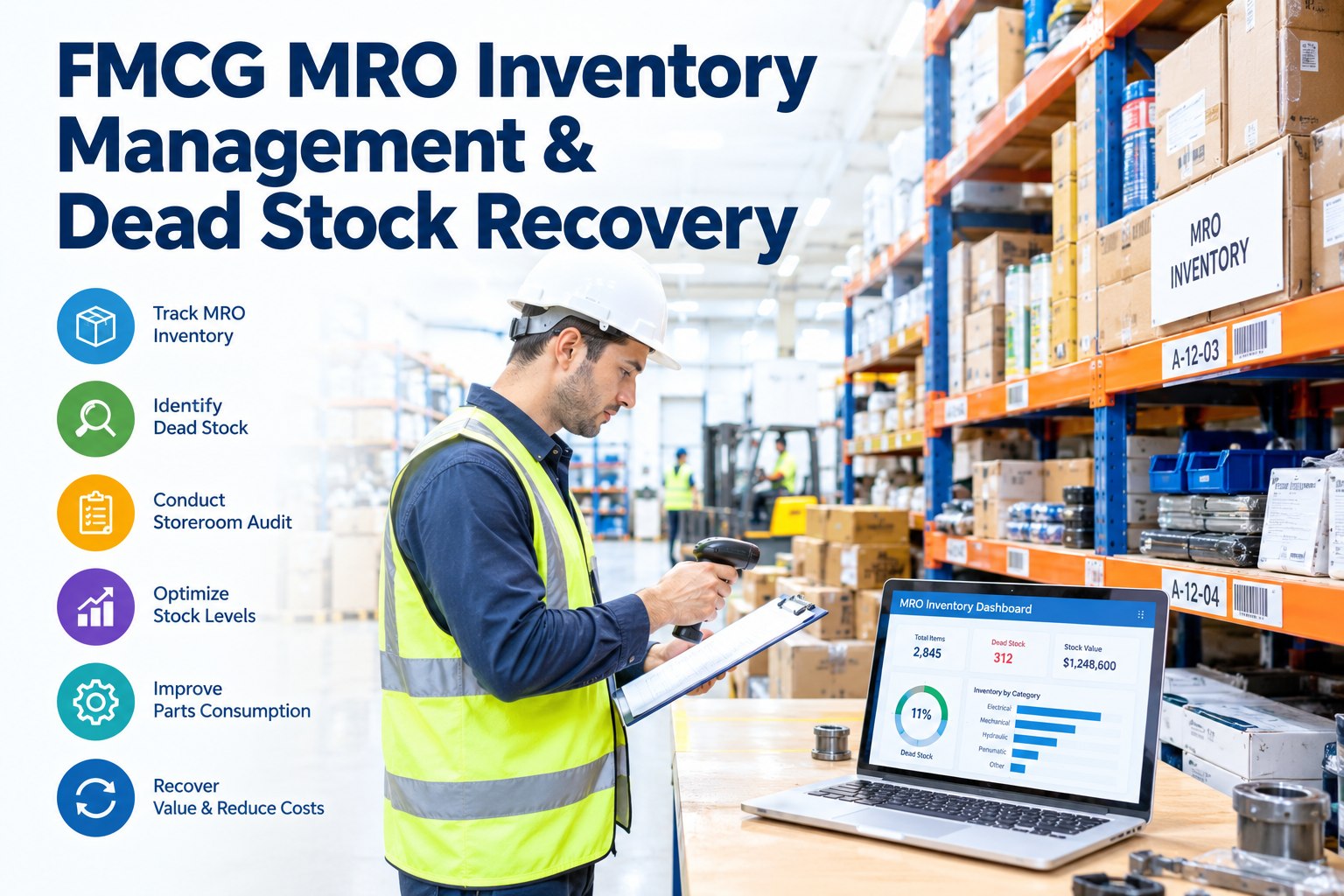
FMCG MRO Inventory Management & Dead Stock Recovery

Connect with Industry Experts, Share Solutions, and Grow Together!

Join Discussion Forum
fmcg-mro-inventory-management-dead-stock-recovery

Every FMCG storeroom holds a paradox: it's overflowing with parts nobody needs while running out of the ones that stop a line. MRO inventory eats 40–50% of the total maintenance budget, yet 15–25% of it sits obsolete on the shelf — tied to equipment that was retired years ago — while critical bearings and motors stockout during the breakdown that halts production. The root cause isn't too little inventory; it's too little intelligence. Nobody has classified what's on the shelf by criticality, sized stock against real consumption, or scanned for the dead stock quietly draining working capital. This guide covers FMCG MRO inventory management and dead stock recovery — the storeroom audit, a real $280K recovery, ABC and criticality classification, and the CMMS program that keeps critical spares available without carrying obsolete stock. Start free or book a demo.

FMCG Manufacturing · Maintenance & Storeroom · MRO Inventory · Dead Stock Recovery · 2026

FMCG MRO Inventory: Recover the Cash on Your Shelves Without Risking the Line

The first storeroom audit at a typical FMCG plant finds a quarter of the inventory hasn't moved in two years — hundreds of thousands in locked capital. The discipline is knowing which parts are dead weight and which are insurance you can't touch. Here's how to tell them apart and recover the difference.

$280K
locked capital recovered in one FMCG plant's first storeroom audit

18–30%
annual carrying cost on every dollar of idle inventory — the silent tax on the maintenance budget

The Two-Sided Cost of Getting MRO Wrong

Getting spare parts wrong cuts both ways, and most plants bleed from both at once. On one side, dead stock: 15–25% of the storeroom obsolete or surplus, each idle dollar carrying 18–30¢ a year in storage, handling, and obsolescence cost. On the other, stockouts: the critical motor that isn't there when a line goes down, turning a planned repair into an emergency purchase at a premium. The fix is never "buy more" — it's classify what you own and size it against real demand. Sign up free — no credit card and run your first dead-stock scan and ABC re-classification in under an hour.

40–50%
of the total maintenance budget is tied up in MRO inventory
15–25%
of that inventory is obsolete or surplus — dead stock on the shelf
25–30%
of SKUs a first audit typically finds unused for 2+ years
98%
service level achievable while holding 23% less inventory, with criticality-driven stocking

The Storeroom Audit: Where Recovery Starts

You can't recover what you can't see. The audit is the first move — and it's usually the one that pays for the entire program before ongoing savings even begin. Here's the sequence that took one plant to a $280K recovery. Schedule a 30-minute demo to see the audit workflow on a live catalog.

1
Consolidate & Inventory Everything
Pull scattered parts into one controlled storeroom and count it all. You will find items you didn't know you had — which cuts emergency purchases immediately.
2
Benchmark the Dead-Stock Ratio
Import every SKU and measure the dollars tied up per category and the share unused for 2+ years — the baseline that makes recovery measurable.
3
Run the Dead-Stock Filter
Flag every SKU with zero issues in the trailing 24 months and no open work order referencing it — scanned automatically across the full catalog, nightly.
4
Protect the Insurance Stock
Criticality overrides the no-issue rule: a part serving a Tier-1 asset with no substitution stays, however slow-moving. Never scrap the spare that prevents a catastrophic stop.

$280,000 Was Sitting on the Shelves. Nobody Had Looked in Years.

Parts for two decommissioned lines, duplicate bearings ordered because no one could see existing stock, consumables stacked ten years deep. The plant carried it all — and still stocked out on critical motors. OxMaint's first scan flagged every SKU with zero issues in 24 months and no open work order, cross-checked each against active assets and criticality, then routed the rest to redeploy, return, scrap, or sell. The recovery covered the platform's annual cost many times over before a single ongoing saving was counted.

Classify Before You Cut: ABC × Criticality

Dead-stock recovery without classification is dangerous — scrap the wrong "slow mover" and you've turned saved cash into a line-down emergency. The safeguard is a two-axis view: ABC ranks parts by spend, criticality (VED — Vital, Essential, Desirable) ranks them by what happens if they're missing. A part can be a C-item on cost and a V-item on consequence — and that's exactly the one you protect. Create your free account and classify your catalog on both axes at once.

A-Items
~20% of SKUs, ~80% of spend. Tight control, close reorder management, and framework pricing negotiated with vendors.
B-Items
Moderate spend and volume. Standard min/max reorder points sized from consumption history and lead time.
C-Items
High-volume, low-value consumables. Best handled with vendor-managed or consignment stock to remove admin overhead.
Criticality Overlay
VED status crosses every ABC tier — a low-cost, low-velocity Vital spare for a Tier-1 asset is insurance stock, protected regardless of usage.

The CMMS Program That Keeps It Optimized

An audit is a one-time win; a CMMS makes it permanent. By linking every part to equipment criticality, consumption, and PM schedules, the system reorders on data instead of a technician's gut — holding the 98% service level without the dead stock creeping back. Schedule a live walkthrough to see the full MRO loop.

Automatic Dead-Stock Scanning
A nightly four-rule scan flags idle SKUs across the full catalog and routes each candidate to redeploy, return, scrap, or sell — so recovery is continuous, not a once-a-year project.
ABC-VED Criticality Matrix
Every SKU classified by spend and by consequence, so cost-cutting never strips out a vital spare — the safeguard that makes recovery safe.
Consumption-Based Min/Max
Reorder points calculated from real issue history and supplier lead time, not guesswork — right-sizing every spare to actual demand.
Parts Linked to Work Orders
Every issue tied to the asset and work order that consumed it, building the consumption data that drives forecasting and exposes the machines eating spares.
Automatic Reorder Triggers
The system raises a purchase request when stock hits minimum — no manual chasing, no stockout discovered only when a line stops.
Demand Forecasting from PM
Upcoming PM schedules forecast parts demand ahead of the work, so critical spares are on the shelf before the planned job needs them.

Audit the storeroom, classify on both axes, recover the dead stock the criticality rule clears, and let the CMMS reorder on real consumption — and the storeroom turns from a silent tax on the budget into a reliability advantage that funds itself. Sign up free or schedule a demo to see it on your catalog.

"

I always suspected our storeroom was a money pit, but I couldn't prove it or safely cut it — every time I looked at scrapping a slow mover, someone would say 'we might need that.' The audit settled it with data: the scan flagged everything unused for two years, the criticality overlay protected the spares that actually mattered, and we recovered about $280K in parts tied to lines we'd decommissioned. What sold me long-term wasn't the one-time cash, though — it's that the reorder points now size themselves from consumption, so the dead stock doesn't come back and we stopped stocking out on the motors that matter.

Maintenance & Reliability Manager · Multi-Line FMCG Food Plant

Frequently Asked Questions

How much dead stock does a typical FMCG storeroom hold?
Industry benchmarks put 15–25% of MRO inventory as obsolete or surplus, and a first storeroom audit typically finds 25–30% of SKUs unused for two or more years — often recovering $200K–$600K in locked capital.
How is dead stock identified without risking a stockout?
By combining a usage rule with a criticality check: flag any SKU with zero issues in the trailing 24 months and no open work order — but protect any part serving a Tier-1 asset with no substitution, regardless of velocity. Criticality overrides the no-issue rule.
What's the difference between ABC and VED classification?
ABC ranks parts by spend (A-items are ~20% of SKUs and ~80% of spend); VED ranks by criticality — Vital, Essential, Desirable — based on the consequence of not having the part. Using both together is what makes cutting dead stock safe.
What happens to the dead stock once identified?
Each candidate is routed to one of four dispositions: redeploy to another line or site, return to the vendor for credit, sell as surplus, or scrap true obsolete stock — turning idle inventory back into recovered capital.
How does a CMMS stop dead stock from coming back?
By setting min/max reorder points from actual consumption and lead time, linking every part issue to a work order, and reordering automatically at minimum — so stock is sized to real demand instead of accumulating from over-ordering.
How fast does the first recovery show up?
The initial dead-stock scan runs in under an hour, and the recovery from the first audit typically covers the platform's full annual cost before ongoing savings are counted — making the program self-funding. Sign up free to run your first scan.

Turn Your Storeroom From a Cost Center Into Recovered Cash.

OxMaint scans for dead stock automatically, classifies every part by ABC and criticality, sizes reorder points from real consumption, and links spares to work-order demand. Start free — no credit card. Or book a demo.

By William Jerry

✨

Experience
Oxmaint's
Power

Take a personalized tour with our product expert to see how OXmaint can help you streamline your maintenance operations and minimize downtime.

Book a Tour

Share This Story, Choose Your Platform!

Connect all your field staff and maintenance teams in real time.

Report, track and coordinate repairs. Awesome for asset, equipment & asset repair management.

Schedule a demo or start your free trial right away.

iphone

Get Oxmaint App
Most Affordable Maintenance Management Software

Download Our App