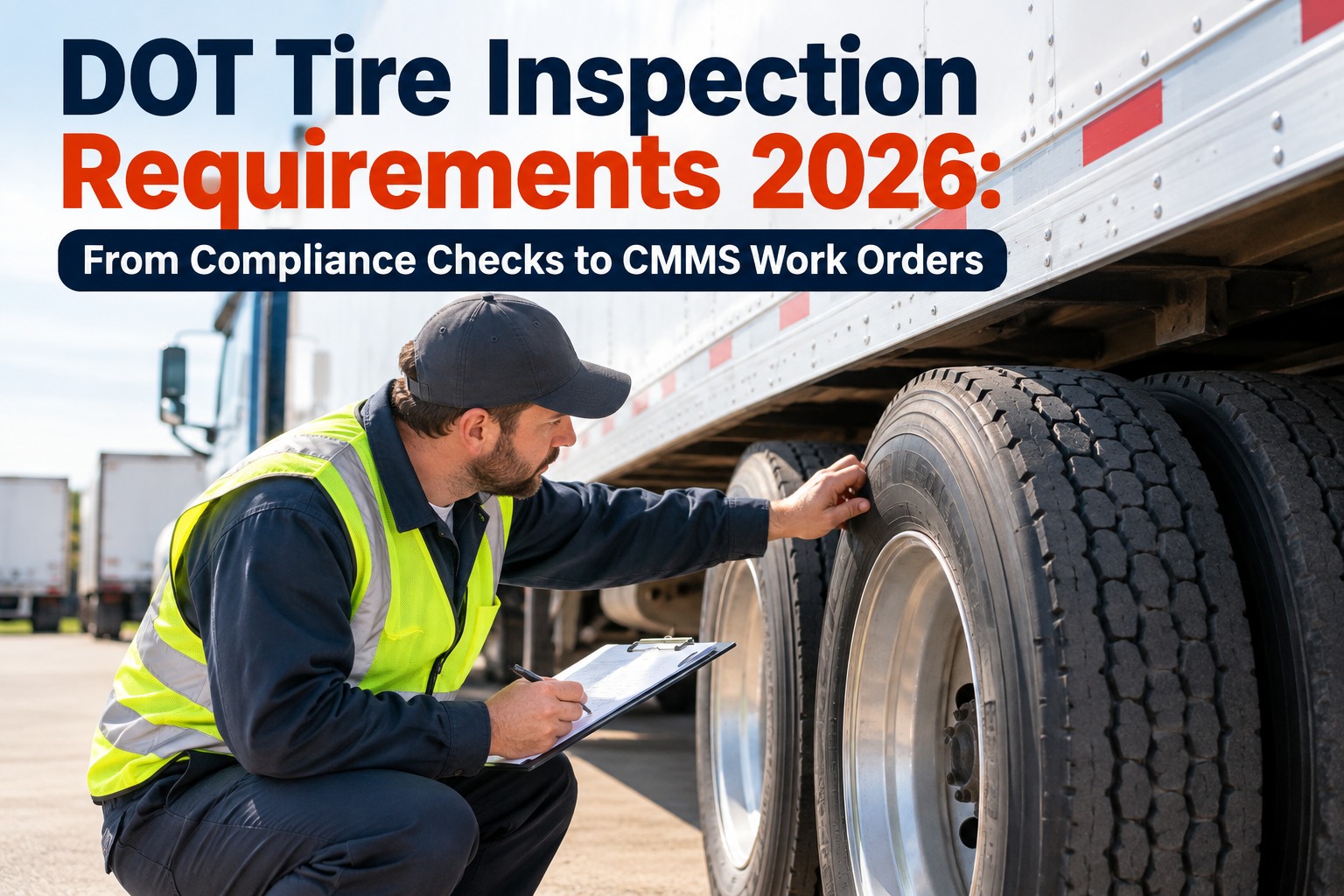
A tire is the single most-cited category at a roadside inspection — and the rules behind it are exact, not approximate. FMCSA sets a hard 4/32" tread minimum on steering tires, 2/32" everywhere else, and four defect conditions that put a truck out of service on the spot. The problem for most fleets isn't knowing the numbers; it's proving every tire was checked and every defect was fixed when an inspector or auditor asks. This guide lays out the 2026 DOT tire inspection requirements exactly, then shows how OXMAINT AI turns every inspection finding into a tracked, prioritized work order. See it on your fleet with a live demo.
Fleet Compliance · DOT Tires · Inspection → CMMS · 2026
DOT Tire Inspection Requirements 2026: From Compliance Checks to CMMS Work Orders
The tread minimums are exact and a defect is an instant out-of-service — but the audit is won on proof, not knowledge. OXMAINT AI links every DVIR and tread reading to a work order, so a flagged tire becomes a certified, searchable fix before it becomes a violation.
Inspect the tire
→
Flag the defect
→
Work order
→
Certified & audit-ready
Inspection to work order
Tread depth trended per tire
Defects auto-become work orders
DVIR → repair → certification chain
Audit-ready record on demand
4/32"
min tread on steering tires
2/32"
min tread on all other tires
4 defects
that trigger out-of-service
8 pts
CSA severity per tire violation
The Tread Depth Minimums — Exactly
This is the number inspectors carry a gauge to check, and it's not one number — steering tires are held to a higher standard than the rest, because a steer-tire failure is a loss-of-control event. Here's what 49 CFR 393.75 actually requires. Start free and trend tread depth per tire in OXMAINT.
Steering / Front Tires
4/32"
Measured at any point on a major tread groove. Higher bar because a steer-tire failure means lost steering control.
§393.75(b)
All Other Tires
2/32"
Measured in a major tread groove. Applies to drive and trailer positions across the vehicle.
§393.75(c)
Fleets that wait until the legal minimum are already too late — by the time a steer tire reads 4/32", it's due, not "getting close." Trending toward the minimum is what keeps a tire off the roadside violation list.
The 4 Defects That Put a Truck Out of Service
Tread depth is only half the rule. A tire at legal depth can still be an instant out-of-service if it shows any of these conditions — no measurement needed, the inspector sees it and the truck stops. These are the prohibited conditions under §393.75(a). Book a demo to see defect capture on a live DVIR.
Exposed Ply or Belt
Body ply or belt material showing through the tread or sidewall — the tire's structure is compromised.
Tread or Sidewall Separation
Any separation of the tread or sidewall from the tire body — a blowout waiting to happen.
Flat or Audible Leak
A flat tire, or one with an audible air leak — the tire can't safely carry its load.
Cut Exposing Ply / Belt
A cut deep enough to expose the ply or belt material underneath — structural integrity is gone.
There are also position rules: buses can't run regrooved, recapped or retreaded tires on the front wheels, and regrooved tires above a set load rating are barred from truck steering axles (§393.75(d)–(e)). Load must never exceed the tire's marked weight rating (§393.75(g)).
You Know the Rules. Can You Prove You Followed Them?
Fleet managers know the 4/32" and 2/32" tire limits, but missed repairs and incomplete DVIR records create audit risks. Tire violations can carry 8 CSA severity points for 24 months. OXMAINT AI turns inspection findings into work orders, tracks certified repairs, and keeps records audit-ready.
The Four Inspection Layers That Keep Tires Compliant
DOT tire compliance isn't one inspection — it's four, each at a different cadence and depth. Miss a layer and a tire drifts toward violation between the checks that would have caught it. This is the cadence OXMAINT AI schedules and records. Sign up free and put all four layers on schedule.
Daily
Pre- & Post-Trip DVIR
Driver visual check — tread, sidewall, inflation, valve stems, lug torque out; wear patterns, heat, punctures in. Records retained 3 months (§396.11).
Quarterly
90-Day PM
Calibrated tread-depth readings in 32nds, wear-pattern analysis, rotation, DOT TIN recording, wheel-torque verification.
Annual
DOT Inspection
Certified inspector: full tread documentation, physical condition, load-rating verification, tire-age tracking. 14-month record retention.
Continuous
Trend & Alert
Tread-depth trend tracking across the fleet's tire history, with automated alerts before a tire reaches the CVSA danger zone.
From Roadside Rule to CMMS Work Order
The rule only protects you if the finding turns into a fix on the record. This is the chain from a driver spotting a worn steer tire to a certified, audit-proof repair — the pipeline OXMAINT AI runs automatically. Book a demo to walk this chain on your own DVIRs.
1
Digital DVIR
Driver logs a timestamped, GPS-tagged tire check with an electronic signature — no paper to lose.
→
2
Defect Flagged
A worn or damaged tire is captured against the specific wheel position — not a vague "tire issue."
→
3
Work Order Created
The defect auto-generates a prioritized work order — steer-tire issues outrank a cosmetic finding.
→
4
Repair Certified
The mechanic closes the work order with a signed correction — the defect-to-fix chain is complete.
→
5
Audit-Ready Record
The full chain stays searchable — the proof a DOT audit or roadside review asks for, in seconds.
What a Tire Violation Actually Costs
The fine is the smallest part. A tire OOS ripples into downtime, roadside-repair premiums, CSA points and — for the fleets that let it compound — lost shipper contracts. This is the true cost the compliance program is protecting against. Sign up free and keep tires out of the OOS column.
FMCSA Penalty
$1K–$16K
Per violation, before anything downstream is counted.
CSA Score Hit
8 pts
Severity-weighted, per tire violation, held on the record for 24 months.
Roadside Repair
4×
A roadside tire fix runs roughly four times a scheduled replacement.
Planned Replacement
$300–$800
Per tire, planned — versus a full OOS incident that can run far higher.
The math is stark: a planned tire replacement is a few hundred dollars; a single out-of-service incident, once downtime and CSA impact are counted, runs into five figures — and a carrier dropped from a shipper's approved list over a bad CSA score can lose a quarter's revenue.
Where OXMAINT AI Fits: Compliance You Can Prove
Knowing the tread minimums is table stakes. OXMAINT AI is the CMMS layer that makes the compliance provable — every inspection, tread reading and repair on one searchable record, and every defect routed to a work order before it becomes a violation. Here's what your team gets. Sign up free and get your fleet's tires on record.
Digital DVIR Capture
Timestamped, GPS-tagged, e-signed pre- and post-trip tire checks — retained to the 3-month rule, no paper to lose.
Tread-Depth Trending
Readings in 32nds tracked per tire over time, with alerts before a tire reaches the legal minimum or CVSA danger zone.
Defect-to-Work-Order
Every flagged tire auto-generates a prioritized work order against its wheel position — steer issues ranked first.
Certification Chain
Driver report → work order → signed repair, kept as one searchable defect-correction record for audits.
90-Day PM Scheduling
Quarterly tread, rotation, TIN and torque checks scheduled automatically — the layer between DVIRs and the annual.
Audit-Ready Export
Pull the full tire-compliance history per vehicle on demand — the evidence a DOT audit or CSA review needs.
"
We failed a compliance review not because our tires were bad, but because we couldn't prove they were good — the driver had noted a worn steer tire on a paper DVIR, we'd replaced it, but nobody could find the paperwork that tied the finding to the fix. We moved DVIRs into OXMAINT, and now every tire defect becomes a work order that closes with a signed repair. The next review, the auditor asked for a tire's history and we pulled the whole chain on screen in under a minute.
Director of Maintenance · Regional Trucking Fleet
Frequently Asked Questions
What is the DOT minimum tire tread depth for commercial trucks?
Under 49 CFR 393.75, steering (front) tires must have at least 4/32" of tread measured at any point on a major groove, and all other tires must have at least 2/32". The higher steer-tire standard reflects that a front-tire failure is a loss-of-steering-control event.
What tire defects put a truck out of service?
Four conditions under §393.75(a): body ply or belt material exposed through the tread or sidewall; any tread or sidewall separation; a flat tire or audible air leak; and a cut deep enough to expose ply or belt material. Any one of these is an instant out-of-service, regardless of tread depth.
How often do commercial tires need to be inspected?
Daily via pre- and post-trip DVIRs (records kept 3 months under §396.11), on a roughly 90-day preventive-maintenance cycle for calibrated tread and rotation, and at the annual DOT inspection by a qualified inspector (records kept 14 months). Trend tracking between these catches wear before it becomes a violation.
Can I run retreaded or regrooved tires on the steer axle?
No for buses — regrooved, recapped or retreaded tires are prohibited on the front wheels (§393.75(d)). For trucks and truck tractors, regrooved tires above a set load rating are barred from the front wheels (§393.75(e)). Load must also never exceed the tire's marked weight rating.
How does OXMAINT help with DOT tire compliance?
It captures digital DVIRs and calibrated tread readings, trends them per tire with alerts before the legal minimum, and turns every defect into a prioritized work order that closes with a certified repair. The full defect-to-correction chain stays searchable, so a DOT audit or roadside review is answered in seconds, not hours.
Prove Every Tire Was Checked — and Fixed.
Know the 4/32" and 2/32" minimums, then make the compliance provable. OXMAINT AI links every DVIR, tread reading and repair into one audit-ready chain — and turns a flagged tire into a work order before it becomes a violation. Start free — no credit card, unlimited users.